Ailurus fulgensred panda

Geographic Range
Red pandas are found throughout the Himalayan mountains between 2,200 and 4,800 meters in elevation in northern Burma, Nepal, Sikkim region of India, and the districts of western Sichuan and Yunnan in China. Their geographic range is bounded in the north by the Namlung Valley in the Mugo District and the Lake Rara region of northern Nepal, in the south by the Liakiang Range of western Yunnan, and the northern and eastern boundary is the upper Min Valley of western Sichuan. (Roberts and Gittleman 1984)
Habitat
Red pandas live in temperate climates in deciduous and coniferous forests. There is usually an understory of bamboo and hollow trees. The average temperature is 10 to 25 degrees Celsius, and the average annual rainfall is 350 centimeters. (Glatston 1994, Roberts and Gittleman 1984)
- Habitat Regions
- temperate
- terrestrial
Physical Description
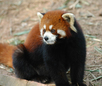
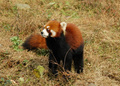
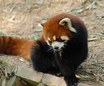
Red pandas are approximately 560 to 625 mm long, with relatively long, furry tails, from 370 to 472 mm long. The tails are marked with about 12 alternating red and buff rings, and are not prehensile. The head is round; the rostrum is shortened; and the ears are large, erect, and pointed. Long, coarse guard hairs cover the body, and the undercoat is soft, dense, and woolly. The body is darker in eastern specimens. The face is predominantly white with reddish-brown "tear" marks under the eyes. The fur on the upper side of its body is reddish-brown, while ventrally it is glossy black. The legs are black and the soles of its feet are covered with dense, white hair. There is no sexual dimorphism in color or size between males and females. Front legs are angled inward, leading to its waddling walk. The feet are plantigrade.
The red panda has a robust skull with a poorly developed zygomatic arch, sagittal crest, and postorbital process. The palatines extend beyond the level of the most posterior molar, the mesopterygoid fossa is constricted anteriorly, and the auditory bullae are small. The post glenoid process is large and anteriorly recurved, and an alisphenoid canal is present.
The mandible is robust but relatively short, and the mandibular symphysis is constricted. The coronoid process is strongly hooked posteriorly, and the mandibular condyles are large.
Premolar one and molar one and two are wider than they are long and have accessory cusplets. Each upper premolar has more than one cusp, and premolar three has a well developed paracone and hypocone.
(Morris 1965, Vaughan 1972, Roberts and Gittleman 1984)
- Other Physical Features
- endothermic
- homoiothermic
- bilateral symmetry
- Sexual Dimorphism
- sexes alike
-
- Range mass
- 3.7 to 6.2 kg
- 8.15 to 13.66 lb
-
- Range length
- 560 to 625 mm
- 22.05 to 24.61 in
-
- Average basal metabolic rate
- 4.898 W
- AnAge
Reproduction
Adult red pandas rarely interact with each other outside of the mating season. During the mating season, scent-markings increase, and the female invites the male to mount her on the ground. Males leave their scent by urinating or rubbing their anogenital area on trees. Both males and females may mate with more than one partner in a season.
- Mating System
- polygynandrous (promiscuous)
Mating season is early winter. Births occur in the spring and summer, with most newborns arriving in June. Litters range from one to four young. The gestation period of the red panda is approximately 134 days. Females become noticeably heavy and lethargic around six weeks before parturition. Several days before parturition, the female begins to carry nest materials (sticks, grass, leaves) to a suitable nest site. In the wild, a nest may be a hollow tree or a rock crevice. In captivity, a box, hollow logs, or other artificial dens can serve as a nest. All births take place between 4 PM and 9 AM, which is the period of highest activity.
The young attain adult size at around 12 months, and are sexually mature at around 18 months.
(Roberts and Gittleman 1984)
- Key Reproductive Features
- iteroparous
- seasonal breeding
- gonochoric/gonochoristic/dioecious (sexes separate)
- sexual
- viviparous
-
- Breeding interval
- Red pandas breed once yearly.
-
- Breeding season
- Mating occurs in early winter.
-
- Range number of offspring
- 1 to 4
-
- Average number of offspring
- 2
- AnAge
-
- Average gestation period
- 134 days
-
- Average gestation period
- 116 days
- AnAge
-
- Average time to independence
- 18 months
-
- Average age at sexual or reproductive maturity (female)
- 18 months
-
- Average age at sexual or reproductive maturity (female)
Sex: female - 550 days
- AnAge
- Average age at sexual or reproductive maturity (female)
-
- Average age at sexual or reproductive maturity (male)
- 18 months
-
- Average age at sexual or reproductive maturity (male)
Sex: male - 550 days
- AnAge
- Average age at sexual or reproductive maturity (male)
After birth, females quickly clean their young and remain with them for 60 to 90 % of the time for the first few days. Mothers recognize their young by olfactory cues established shortly after birth. After one week, females spend more time away from the nest, returning every few hours to nurse and groom their young, and to keep the nest clean. The young remain nest-bound for around 90 days. They make their first excursion from the nest at night. The young and mother share a close relationship until the young becomes aggressive at the onset of the next breeding season. Males have a small or nonexistent role in raising and caring for the young.
- Parental Investment
- altricial
-
pre-fertilization
- provisioning
-
protecting
- female
-
pre-hatching/birth
-
provisioning
- female
-
protecting
- female
-
provisioning
-
pre-weaning/fledging
-
provisioning
- female
-
protecting
- female
-
provisioning
-
pre-independence
-
provisioning
- female
-
protecting
- female
-
provisioning
Lifespan/Longevity
The maximum lifespan of the red panda is 14 years, but the average is eight to ten.
-
- Range lifespan
Status: wild - 14 (high) years
- Range lifespan
-
- Typical lifespan
Status: wild - 8 to 10 years
- Typical lifespan
-
- Average lifespan
Status: captivity - 13.4 years
- Max Planck Institute for Demographic Research
- Average lifespan
Behavior
Red panda's activity changes throughout the year based on the temperature, feeding regimes, and the presence of young. The normally solitary A. fulgens are most active at dusk, dawn, and during the night. Movement on the ground is done by a slow, cross-extension gait, and faster bounding or trotting. Ailurus fulgens is arboreal, sleeping in nests in evergreens. They descend trees headfirst and display their flexibility as they move from branch to branch. The tail is used for balance when in trees, while on the ground it is carried straight and horizontally. Red pandas engage in several leisure behaviors after awakening or eating. They lick the whole body and limbs, wash their face with a paw, and stretch or rub their back and abdomen against a stationary object such as a tree or rock.
(Roberts and Gittleman 1984, Morris 1965, Kowalski 1976, Glatston 1994)
- Key Behaviors
- arboreal
- nocturnal
- crepuscular
- motile
- solitary
Communication and Perception
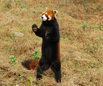
Red pandas exhibit several visual displays during intraspecific interactions, including arching the tail and back, the slow raising and lowering of the head while emitting a low intensity puffing, turning the head while jaw-clapping, shaking the head from side to side, a bipedal posture with forelegs extended above the head, and staring.
- Other Communication Modes
- scent marks
Food Habits
Red pandas eat berries, blossoms, bird eggs, bamboo leaves, and the small leaves of other plants. Bamboo (the leaves of which are the red panda's primary food source) is bent down to bring the leaves within reach of the mouth. Food is grasped in a forepaw and brought to the mouth while sitting, standing, or lying on the back. Food grasped in this manner is inserted in the side of the mouth, sheared, then chewed extensively before it is swallowed. (Glatston 1994, Roberts and Gittleman 1984)
- Animal Foods
- eggs
- Plant Foods
- leaves
- seeds, grains, and nuts
- fruit
- flowers
Predation
If threatened, red pandas climb a tree or strike out with their semi-retractile claws. One of their primary predators is the snow leopard (Uncia uncia).
-
- Known Predators
-
- snow leopards (Uncia uncia)
Economic Importance for Humans: Positive
Red pandas are important socially, scientifically and economically. They are the national animal of Sikkim and the mascot of the International Tea Festival in Darjeeling. Red panda skins are used to used for hats and their tails as dusters. Furthermore, red panda skin may still be worn by the bridegroom in a local Chinese wedding. Red pandas have been pivotal in research on the taxonomy of the families Ursidae and Procyonidae. Ailurus fulgens is illegally hunted and sold to zoos or killed for their skin. Very few zoos purchase these illegal specimens, making this a fairly unproductive business, but skins can be found in local villages and are used in cultural ceremonies.
(Glatston 1994)
- Positive Impacts
- body parts are source of valuable material
- ecotourism
- research and education
Economic Importance for Humans: Negative
Red pandas have no negative impact on humans. (Glatston 1994)
Conservation Status
Red pandas are threatened by deforestation and other human activities. Deforestation eliminates nesting sites and sources of food, and isolates populations into small fragments separated by inhospitable habitats. Ailurus fulgens is the occasional target of game hunting, and it is often found in traps set for musk deer. Red pandas are also outcompeted by local livestock for food. Expanding human populations in Asia and the increasing need for land and lumber are significant threats to the survival of this species. Red pandas are protected and listed in Appendix II of the Convention on the International Trade in Threatened and Endangered Species, and were declared endangered in March 1988. (Glatston 1994, Roberts and Gittleman 1984)
-
- IUCN Red List
-
Vulnerable
More information
-
- IUCN Red List
-
Vulnerable
More information
-
- US Federal List
- No special status
-
- CITES
- Appendix II
Other Comments
Red pandas have been a taxonomic enigma, their placement in a carnivoran family has been enormously controversial. They were originally placed in the family Procyonidae because of similarities in teeth, skull, ringed tail, and other morphological characteristics. They were then placed in the family Ursidae because of similarities in DNA. However, unlike other members of these two families, Ailurus fulgens has an Asiatic origin and has never migrated to the new world. Red pandas are considered members of their own family, Ailuridae, based on new molecular systematics research. (Morris 1965, Glatston 1994, Wilson and Reeder 1993) (Flynn, et al., 2005)
Contributors
Tanya Dewey (editor), Animal Diversity Web.
Terrell Heath (author), University of Michigan-Ann Arbor, Josh Platnick (author), University of Michigan-Ann Arbor.
Glossary
- acoustic
-
uses sound to communicate
- altricial
-
young are born in a relatively underdeveloped state; they are unable to feed or care for themselves or locomote independently for a period of time after birth/hatching. In birds, naked and helpless after hatching.
- arboreal
-
Referring to an animal that lives in trees; tree-climbing.
- bilateral symmetry
-
having body symmetry such that the animal can be divided in one plane into two mirror-image halves. Animals with bilateral symmetry have dorsal and ventral sides, as well as anterior and posterior ends. Synapomorphy of the Bilateria.
- chemical
-
uses smells or other chemicals to communicate
- crepuscular
-
active at dawn and dusk
- ecotourism
-
humans benefit economically by promoting tourism that focuses on the appreciation of natural areas or animals. Ecotourism implies that there are existing programs that profit from the appreciation of natural areas or animals.
- endothermic
-
animals that use metabolically generated heat to regulate body temperature independently of ambient temperature. Endothermy is a synapomorphy of the Mammalia, although it may have arisen in a (now extinct) synapsid ancestor; the fossil record does not distinguish these possibilities. Convergent in birds.
- folivore
-
an animal that mainly eats leaves.
- forest
-
forest biomes are dominated by trees, otherwise forest biomes can vary widely in amount of precipitation and seasonality.
- herbivore
-
An animal that eats mainly plants or parts of plants.
- iteroparous
-
offspring are produced in more than one group (litters, clutches, etc.) and across multiple seasons (or other periods hospitable to reproduction). Iteroparous animals must, by definition, survive over multiple seasons (or periodic condition changes).
- motile
-
having the capacity to move from one place to another.
- mountains
-
This terrestrial biome includes summits of high mountains, either without vegetation or covered by low, tundra-like vegetation.
- native range
-
the area in which the animal is naturally found, the region in which it is endemic.
- nocturnal
-
active during the night
- oriental
-
found in the oriental region of the world. In other words, India and southeast Asia.

- polygynandrous
-
the kind of polygamy in which a female pairs with several males, each of which also pairs with several different females.
- scent marks
-
communicates by producing scents from special gland(s) and placing them on a surface whether others can smell or taste them
- seasonal breeding
-
breeding is confined to a particular season
- sexual
-
reproduction that includes combining the genetic contribution of two individuals, a male and a female
- solitary
-
lives alone
- tactile
-
uses touch to communicate
- temperate
-
that region of the Earth between 23.5 degrees North and 60 degrees North (between the Tropic of Cancer and the Arctic Circle) and between 23.5 degrees South and 60 degrees South (between the Tropic of Capricorn and the Antarctic Circle).
- terrestrial
-
Living on the ground.
- visual
-
uses sight to communicate
- viviparous
-
reproduction in which fertilization and development take place within the female body and the developing embryo derives nourishment from the female.
References
Gittleman, J. 1993. Carnivore Behavior, Ecology and Evolution. Cornell University Press.
Gladston, A. R. 1994. The Red Panda, Olingos, Coatis, Raccoons, and Their Relatives. International Union for Conservation of Nature and Natural Resources.
Kowalski, K. 1976. Mammals: An Outline of Theriology. Polish Scientific Publishers: Warszawa.
Morris, D. 1965. The Mammals: A Guide to the Living Species. Harper and Row Publishers: New York and Evanston.
Roberts, M. S., J. L. Gittleman. 1984. Mammalian Species. Number 201-306. The American Society of Mammalogists.
Schaller, G. B. 1993. The Last Panda. The University of Chicago Press.
Vaughan, T. A. 1972. Mammology. W. B. Saunders Company: Philadelphia, London and Toronto.
Wilson, D. E., D. M. Reeder. 1993. Mammalian Species of the World: A Taxonomic and Geographic Reference. Second Edition. Smithsonian Institution Press: Washington and London.
Flynn, J., J. Finarelli, S. Zehr, J. Hsu, M. Nedbal. 2005. Molecular phylogeny of the Carnivora (Mammalia): Assessing the impact of increased sampling on resolving enigmatic relationships. Systematic Biology, 54: 317-337.