Agelaius tricolortricolored blackbird(Also: tricoloured blackbird)
Geographic Range
Tricolored blackbirds (Agelaius tricolor) are found in western coastal North America. They are native to California and parts of Oregon, Washington, and Nevada. Highest concentrations are found in the Central and San Joaquin Valleys of California, as well as coastal areas. ("Tricolored Blackbird status update and management guidelines", 1997; Hamilton, 1998)
Habitat
Tricolored blackbirds are found in areas near water, such as marshes, grasslands, and wetlands. They require some sort of substrate nearby to build nests. This substrate is often in the form of aquatic vegetation. They also need foraging areas, which can consist of grassland or agricultural pastures such as rice, grain, or alfalfa. (Beedy and Hamilton, 1999; Orians, 1960)
- Habitat Regions
- temperate
- terrestrial
- freshwater
- Terrestrial Biomes
- savanna or grassland
- Wetlands
- marsh
- Other Habitat Features
- agricultural
Physical Description
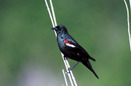
Tricolored blackbirds exhibit sexual dimorphism. Males are larger than females and possess dark red shoulder patches with white median coverts on the wings, giving the species its name. Males have brown plumage in the fall. Females are shades of gray with a lighter gray throat. One way to distinguish them from female red-winged blackbirds is that they tend to be darker, have more pointed wingtips, and have more slender bills. They are about 22 cm long with a 35.5 cm wingspan. They weigh approximately 59.5 grams. (Beedy and Hamilton, 1999; Orians, 1960; Sibley, 2007)
- Other Physical Features
- endothermic
- homoiothermic
- bilateral symmetry
- Sexual Dimorphism
- male larger
- male more colorful
-
- Average mass
- 59.5 g
- 2.10 oz
-
- Average length
- 22.2 cm
- 8.74 in
-
- Average wingspan
- 35.5 cm
- 13.98 in
Reproduction
Males attract females by singing and displaying courtship behaviors. The species exhibits polygyny, one male may breed with 1 to 4 females. ("Tricolored Blackbird status update and management guidelines", 1997; Beedy and Hamilton, 1999; Hamilton, 1998; Orians, 1960)
- Mating System
- polygynous
Tricolored blackbirds breed in both the spring and fall. Tricolored blackbirds exhibit itinerant breeding, meaning that they breed twice a year in two separate locations. Spring breeding takes place in mid-March through late April. Breeding colonies consisting of up to 200,000 nests. Clutch sizes in both breeding seasons ranged between one and four. The most common clutch size is three. Incubation lasts between 11 and 14 days. Females build nests and lay their eggs in approximately one week. Females also take part in incubating the young. Fledging occurs approximately 9 days after the chicks are born. An additional 15 days or so are required for the young to live away from their parents. Males begin to breed when they are two years of age. Females are able to breed when they are one year of age. ("Tricolored Blackbird status update and management guidelines", 1997; Orians, 1960)
- Key Reproductive Features
- iteroparous
- seasonal breeding
- gonochoric/gonochoristic/dioecious (sexes separate)
- sexual
- oviparous
-
- Breeding interval
- Breeding intervals are not reported.
-
- Breeding season
- Breeding can occur in spring and in fall.
-
- Range eggs per season
- 1 to 4
-
- Average eggs per season
- 3
-
- Range time to hatching
- 11 to 14 days
-
- Average fledging age
- 9 days
-
- Average time to independence
- 14 days
-
- Average age at sexual or reproductive maturity (female)
- 1 years
-
- Average age at sexual or reproductive maturity (male)
- 2 years
Males and females care for the young. Females remain at nests during the daytime to incubate the eggs. Males care for the young after they hatch. They range up to 6.5 km to acquire food for nestlings. (Hamilton, 1998; Orians, 1960)
- Parental Investment
- altricial
- male parental care
- female parental care
-
pre-fertilization
- provisioning
-
protecting
- female
-
pre-hatching/birth
-
provisioning
- female
-
protecting
- female
-
provisioning
-
pre-weaning/fledging
-
provisioning
- male
-
protecting
- male
- female
-
provisioning
Lifespan/Longevity
Not much is known about the lifespan of tricolored blackbirds due to few banded recoveries. They can live up to 13 years. Predation and harsh weather conditions account for the majority of mortality. Further studies on survivorship need to be conducted. ("Tricolored Blackbird status update and management guidelines", 1997)
-
- Range lifespan
Status: wild - 13 (high) years
- Range lifespan
Behavior
Tricolored blackbirds are the most colonial species of all North American passerines. They gather in large flocks outside of the breeding season and seasonally migrate among different areas. (Hamilton, 1998; Orians, 1960)
-
- Average territory size
- 10.7 m^2
Home Range
Males display territoriality. Generally, each territory is about 10.7 square meters, containing several nests. Foraging takes place far from their nests. (Hamilton, 1998; Orians, 1960)
Communication and Perception
Tricolored blackbirds have a nasal “oo-grreee” call that begins loud and gradually gets softer. They also emit a “drdodrp” call. Their calls have a lower pitch than those of red-winged blackbirds (Agelaius phoeniceus). Females tend to be silent during incubation. ("Tricolored Blackbird status update and management guidelines", 1997; Sibley, 2007)
Food Habits
Tricolored blackbirds are omnivorous, feeding on both animal and plant matter. Their diet depends on the region they live in and what crops or insects are most abundant. Insect prey includes grasshoppers, beetles, moths, and fly larvae. Their diet also includes grains, seeds, rice, and other crops. Nestlings are fed primarily insects. (Orians, 1960; Skorupa, et al., 1980)
- Primary Diet
- omnivore
- Animal Foods
- insects
- Plant Foods
- seeds, grains, and nuts
- fruit
Predation
Tricolored blackbirds are preyed on by a variety of species. Predators include mammals such as gray foxes (Urocyon cinereoargentus) and skunks (Mephitis mephitis). Larger birds, such as common ravens (Corvus corax), black-crowned night herons (Nycticorax nycticorax), northern harriers (Circus cyaneus) and Cooper’s hawks (Accipiter cooperii) also prey on tricolored blackbirds. In more urban areas, feral cats (Felis catus) prey on nests. Tricolored blackbirds do not fight back against predators and tend to be less aggressive than red-winged blackbirds. ("Tricolored Blackbird status update and management guidelines", 1997)
-
- Known Predators
-
- gray foxes (Urocyon cinereoargentus)
- skunks (Mephitis mephitis)
- common ravens (Corvus corax)
- black-crowned night herons (Nycticorax nycticorax)
- northern harriers (Circus cyaneus)
- Cooper’s hawks (Accipiter cooperii)
- feral cats (Felis catus)
Ecosystem Roles
Many tricolored blackbirds are dependent on rice-growing fields and duck-hunting areas of central California. Their populations change in response to insect abundances. They are ecologically dependent on insect outbreaks for food. Thus, they help to keep rampant insect populations under control. (Beedy and Hamilton, 1999)
Economic Importance for Humans: Positive
Tricolored blackbirds help manage insect populations that harm crops. They are especially significant during insect outbreak years where insects such as grasshoppers are in high abundance. By feeding on agriculturally harmful insects, higher crop yields can be obtained. (Skorupa, et al., 1980)
- Positive Impacts
- controls pest population
Economic Importance for Humans: Negative
Tricolored blackbirds are also considered agricultural pests because they often forage in nearby croplands. They can feed on young rice grains, oats, and barley. (Skorupa, et al., 1980)
- Negative Impacts
- crop pest
Conservation Status
Tricolored blackbirds are federally protected under the Migratory Bird Treaty Act of 1918. They are listed as endangered bu the International Union for Conservation of Nature and Natural Resources (IUCN) Red List. The California Department of Fish and Game lists tricolored blackbirds as Species of Special Concern. Population declines are due to loss of wetland habitat, urban sprawl, and agricultural needs. This has resulted in greatly reduced foraging and breeding areas. Several conservation efforts are underway to preserve this species. Tricolored blackbird habitat development on public land and colony preservation can help stimulate populations. Education and outreach is important for educating landowners on proper ways to coexist with the tricolored blackbirds. Continued tracking is helping researchers understand breeding and migrating behaviors of this species so that more precise conservation plans can be made. ("Tricolored Blackbird status update and management guidelines", 1997; Hamilton, 1998)
-
- IUCN Red List
-
Endangered
More information
-
- IUCN Red List
-
Endangered
More information
-
- US Migratory Bird Act
- Protected
-
- US Federal List
- No special status
-
- CITES
- No special status
-
- State of Michigan List
- No special status
Contributors
Carolina Fernandez (author), Florida State University, Emily DuVal (editor), Florida State University, Tanya Dewey (editor), University of Michigan-Ann Arbor.
Glossary
- Nearctic
-
living in the Nearctic biogeographic province, the northern part of the New World. This includes Greenland, the Canadian Arctic islands, and all of the North American as far south as the highlands of central Mexico.

- acoustic
-
uses sound to communicate
- agricultural
-
living in landscapes dominated by human agriculture.
- altricial
-
young are born in a relatively underdeveloped state; they are unable to feed or care for themselves or locomote independently for a period of time after birth/hatching. In birds, naked and helpless after hatching.
- bilateral symmetry
-
having body symmetry such that the animal can be divided in one plane into two mirror-image halves. Animals with bilateral symmetry have dorsal and ventral sides, as well as anterior and posterior ends. Synapomorphy of the Bilateria.
- chemical
-
uses smells or other chemicals to communicate
- colonial
-
used loosely to describe any group of organisms living together or in close proximity to each other - for example nesting shorebirds that live in large colonies. More specifically refers to a group of organisms in which members act as specialized subunits (a continuous, modular society) - as in clonal organisms.
- diurnal
-
- active during the day, 2. lasting for one day.
- endothermic
-
animals that use metabolically generated heat to regulate body temperature independently of ambient temperature. Endothermy is a synapomorphy of the Mammalia, although it may have arisen in a (now extinct) synapsid ancestor; the fossil record does not distinguish these possibilities. Convergent in birds.
- female parental care
-
parental care is carried out by females
- freshwater
-
mainly lives in water that is not salty.
- iteroparous
-
offspring are produced in more than one group (litters, clutches, etc.) and across multiple seasons (or other periods hospitable to reproduction). Iteroparous animals must, by definition, survive over multiple seasons (or periodic condition changes).
- male parental care
-
parental care is carried out by males
- marsh
-
marshes are wetland areas often dominated by grasses and reeds.
- migratory
-
makes seasonal movements between breeding and wintering grounds
- motile
-
having the capacity to move from one place to another.
- native range
-
the area in which the animal is naturally found, the region in which it is endemic.
- omnivore
-
an animal that mainly eats all kinds of things, including plants and animals
- oviparous
-
reproduction in which eggs are released by the female; development of offspring occurs outside the mother's body.
- polygynous
-
having more than one female as a mate at one time
- seasonal breeding
-
breeding is confined to a particular season
- sexual
-
reproduction that includes combining the genetic contribution of two individuals, a male and a female
- social
-
associates with others of its species; forms social groups.
- tactile
-
uses touch to communicate
- temperate
-
that region of the Earth between 23.5 degrees North and 60 degrees North (between the Tropic of Cancer and the Arctic Circle) and between 23.5 degrees South and 60 degrees South (between the Tropic of Capricorn and the Antarctic Circle).
- terrestrial
-
Living on the ground.
- tropical savanna and grassland
-
A terrestrial biome. Savannas are grasslands with scattered individual trees that do not form a closed canopy. Extensive savannas are found in parts of subtropical and tropical Africa and South America, and in Australia.
- savanna
-
A grassland with scattered trees or scattered clumps of trees, a type of community intermediate between grassland and forest. See also Tropical savanna and grassland biome.
- temperate grassland
-
A terrestrial biome found in temperate latitudes (>23.5° N or S latitude). Vegetation is made up mostly of grasses, the height and species diversity of which depend largely on the amount of moisture available. Fire and grazing are important in the long-term maintenance of grasslands.
- visual
-
uses sight to communicate
References
U.S. Fish and Wildlife Service and California Department of Fish and Game. Tricolored Blackbird status update and management guidelines. 97-099. Sacramento, CA.: E.C. Beedy and W.J. Hamilton III. 1997.
Beedy, E., W. Hamilton. 1999. The Birds of North America. Philadelphia, PA: The Birds of North America, Inc..
Hamilton, W. 1998. Tricolored Blackbird itinerant breeding in California. Condor, 100: 218-226.
Orians, G. 1960. Autumnal breeding in the Tricolored Blackbird. Auk, 77: 379-398.
Sibley, D. 2007. The Sibley Guide to Birds. New York: Alfred A. Knopf, Inc..
Skorupa, J., R. Hothem, R. DeHaven. 1980. Foods of breeding Tricolored Blackbirds in agricultural areas of Merced County. Condor, 82: 465-467.