Agelaius phoeniceusred-winged blackbird


Geographic Range
The range of red-winged blackbirds extends from southern Alaska at its northern most point, to the Yucatan peninsula in the south and covers the greater part of the continent reaching from the Pacific coast of California and Canada to the eastern seaboard. Winter ranges for red-winged blackbirds vary by geographic location. Northern populations migrate south to the southern United States and Central America beginning in September or October (or occasionally as early as August). Most western and middle American populations are non-migratory. (Kirschenbaum, 1996; Yasukawa and Searcy, 1995)
- Biogeographic Regions
- nearctic
- neotropical
Habitat
Red-winged blackbirds roost and breed in a variety of habitats, but tend to prefer wetlands. They have been known to live in fresh and saltwater marshes. On drier ground, red-winged blackbirds gravitate towards open fields (often in agricultural areas) and lightly wooded deciduous forests. In winter red-winged blackbirds are most often found in open fields and croplands. (Kirschenbaum, 1996; "Red-winged Blackbird", 1996; Yasukawa and Searcy, 1995)
- Habitat Regions
- temperate
- tropical
- terrestrial
- Terrestrial Biomes
- savanna or grassland
- Aquatic Biomes
- brackish water
- Other Habitat Features
- suburban
- agricultural
- riparian
- estuarine
Physical Description
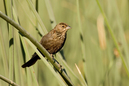
Easily distinguished by their glossy black feathers and red and yellow epaulets at the shoulder, males are the more brightly colored of the two sexes. Females tend to be dusty or brownish in color with dark stripes on their undersides. Females resemble large sparrows and are often recognized by their off-white eyebrow markings. Both males and females have dark legs and claws. The beak of male red-winged blackbirds tends to be totally black, whereas the beak of female red-winged blackbirds is dark brown on top with lighter brown on the underside. Both males and females have sharply pointed beaks. (Cleary, 2002; Jennings, 2000; Kirschenbaum, 1996; "Red-winged Blackbird", 1996; Neff, 1997; Yasukawa and Searcy, 1995)
Both male and female adult red-winged blackbirds are approximately 22 cm long, weigh 41.6 to 70.5 g and have a wingspan of 30 to 37 cm. Young males and females resemble adult females in coloration. Males undergo a transitional stage in which red epaulets appear orange in color before reaching their adult coloration. Olson (1994) showed that the average basal metabolic rate for adults in his experiments was 656 cm cubed/oxygen per minute and that the rate for three-day-old birds was 296 cm cubed/oxygen per minute. (Jennings, 2000; Kirschenbaum, 1996; "Red-winged Blackbird", 1996; Olson, 1994; Olson, 2001; Yasukawa and Searcy, 1995)
- Other Physical Features
- endothermic
- homoiothermic
- bilateral symmetry
- Sexual Dimorphism
- male larger
- sexes colored or patterned differently
- male more colorful
-
- Range mass
- 41.6 to 70.5 g
- 1.47 to 2.48 oz
-
- Range length
- 18 to 24 cm
- 7.09 to 9.45 in
-
- Average length
- 22 cm
- 8.66 in
-
- Range wingspan
- 30 to 37 cm
- 11.81 to 14.57 in
Reproduction
Red-winged blackbirds are extremely polygynous with as many as 15 females nesting in the territory of a single male. On average, a single male has roughly 5 females. Although copulation occurs mostly between the sovereign male and those females that inhabit his territory, roaming males are known to mate with the females on other territories. These behaviors seem to increase the chances of successful reproduction within a given mating season, compensating for broods and individuals lost to nest-predation and nest parasitism. (Yasukawa and Searcy, 1995)
Mating rituals begin with the song of the male. Females often do not return songs until they have established themselves in the territory of a male. Male pre-coital displays include vocalization in a crouched position with rapid and highly conspicuous fluttering of the wings. The female responds with a similar crouch and vocalization. Mating occurs in the egg-laying period or just prior and is characterized by a brief contact between the cloacal vents of the male and the female. (Yasukawa and Searcy, 1995)
- Mating System
- polygynous
- polygynandrous (promiscuous)
Breeding begins in the early spring and continues until mid-summer. Females may raise as many as three broods in a single season, although the average is 1.7 broods per season. Females choose nesting sites most often in wetland or agricultural areas (although a wide variety of nesting habitats are know to be exploited) and males perform a nesting display, which constitutes his main involvement in the nest building process. Nest building begins between March and May. Usually, the further south you go, the earlier the nest is built. After a female accepts the male and his site, the nest is built in or near marshland or moist, grassy areas. Plant materials, such as cattail stalks, are woven together to form a basket above water level, and soft materials are used to line the nest. Three to five pale greenish-blue, black or purple streaked eggs are laid per clutch. Each egg is approximately 2.5 by 1.8 cm. Nests can be completed in as little as a single day, especially if no mud-lining is constructed.
Clutch size is from 3 to 7 eggs and the eggs are incubated for 3 to 11 days. Chicks fledge in 10 to 14 days and are independent in 2 to 3 weeks. Juveniles usually reach sexual maturity in 2 to 3 years. (Yasukawa and Searcy, 1995)
- Key Reproductive Features
- iteroparous
- seasonal breeding
- gonochoric/gonochoristic/dioecious (sexes separate)
- sexual
- fertilization
- oviparous
-
- Breeding interval
- Females may raise as many as three broods in a single season, although the average is 1.7 broods per season.
-
- Breeding season
- Breeding begins in the early spring and continues until mid-summer.
-
- Range eggs per season
- 3 to 7
-
- Average eggs per season
- 4
-
- Average eggs per season
- 4
- AnAge
-
- Range time to hatching
- 11 to 13 days
-
- Average time to hatching
- 11 days
-
- Range fledging age
- 14 to 10 days
-
- Average fledging age
- 14 days
-
- Range time to independence
- 2 to 3 weeks
-
- Average time to independence
- 2 weeks
-
- Range age at sexual or reproductive maturity (female)
- 2 to 2 years
-
- Range age at sexual or reproductive maturity (male)
- 2 to 4 years
Incubation is the sole responsibility of females. Red-winged blackbird eggs tend to hatch at different times and the mother will continue to incubate until the last egg has hatched. Nestlings are fed almost immediately after hatching. Parents often begin with smaller portions and increase food amounts progressively. Young red-winged blackbirds are fed small arthropods, especially Odonata (dragonflies and damselflies), Lepidoptera (moths and butterflies), and Diptera (true flies). The nestlings are fed primarily by the female although the male will, at times, take part in the feeding process. In cases in which the mother is absent, males are known to take over feeding responsibilities for the brood. Fledglings leave the nest after 14 days and are fed by the female and, to a lesser degree, the male for two to three weeks before joining a flock of females. Within a year most red-winged blackbirds have joined mixed flocks. (Yasukawa and Searcy, 1995)
- Parental Investment
- no parental involvement
- altricial
-
pre-fertilization
-
protecting
- female
-
protecting
-
pre-hatching/birth
-
protecting
- female
-
protecting
-
pre-weaning/fledging
-
provisioning
- male
- female
-
protecting
- male
- female
-
provisioning
-
pre-independence
-
provisioning
- male
- female
-
protecting
- male
- female
-
provisioning
Lifespan/Longevity
In the wild, red-winged blackbirds live 2.14 years, on average. The olded recorded red-winged blackbird in the wild lived 15 years and 9 months. (Yasukawa and Searcy, 1995)
-
- Range lifespan
Status: wild - 20 (high) years
- Range lifespan
-
- Average lifespan
Status: wild - 2.14 years
- Average lifespan
-
- Average lifespan
Status: wild - 189 months
- Bird Banding Laboratory
- Average lifespan
Behavior
As migratory birds, red-winged blackbirds share many characteristics with related species. They are strong fliers that will often migrate in flocks of a thousand or more. Roosting is often communal, resulting in large, centralized populations. Red-winged blackbirds are largely diurnal, spending most of their day foraging. Males defend territories during the mating season. As the mating season progresses, both males and females will spend more time within their territory or the territory of their mate. Although fighting among red-winged blackbirds is not all that common, even among males, it is known to occur. Males chase females at top speed during breeding seasion. Because of their broad range and tendency to colonize large roosting areas, red-winged blackbirds are extremely common, and are easy to find in the mating season when singing and sexual displays make them more visible. ("Perching Birds: Red-winged Blackbird, Agelaius phoeniceus", 2000; Kirschenbaum, 1996; "Red-winged Blackbird", 1996; Yasukawa and Searcy, 1995)
- Key Behaviors
- flies
- diurnal
- motile
- migratory
- territorial
- social
-
- Range territory size
- 153 to 29235 m^2
-
- Average territory size
- 2000 m^2
Home Range
Home range and territory size vary greatly among red-winged blackbirds given their broad geographic range and extensive use of varying habits. Males tend to control territories of approximately 2,000 square meters, but some territories in marshes may be as small as 153 m^2, and some territories in upland habitat may be as large as 29,235 m^2. Females will occupy the territory of a single male, along with many other females. Males will defend their territory against other male red-winged blackbirds and also against other species of bird, including tricolored blackbirds and yellow-headed blackbirds, usually yielding to larger bird species. Birds in Costa Rica defend territories that are two to four times the size of temperate birds to the north. (Yasukawa and Searcy, 1995)
Communication and Perception
Males learn songs from other males. Both males and females have a variety of calls, some of which are the same. Only the males produce flight calls, which signal their exit from the territory. Both males and females employ distress and alarm calls which differ with the nature of the threat. Specific calls seem to communicate the presence of specific predators, such as raccoons or American crows. Short contact calls are also quite common, especially between a territorial male and the females in his territory. Threat calls are used to ward off predators, other birds and other red-winged blackbirds. Courtship calls vary little between males and females and are used only in the breeding season. Male songs are used to announce territorial boundaries and to attract mates. Female songs occur in the early breeding season and are most common before the incubation period.
Male red-winged blackbirds utter their familiar territorial and mate attraction song of "oak-a-lee" or "konkeree" in the spring. The last syllable is given more emphasis as a scratchy or buzzy trill. The common call used by both males and females is a "check" call. Males may utter a whistled "cheer" or "peet" call if alarmed. Other calls made by the male include a "seet," a "chuck," or a "cut." Females may utter a short chatter or sharp scream. A pre-mating call, "ti-ti-ti," may be uttered by both sexes. (Yasukawa and Searcy, 1995)
Visual displays are also a key form of communication, especial before and during mating. Males often use visual displays in order to attract females to their territories and to defend their territories and mates. An example is the "song spread" display. Males fluff their plumage, raise their shoulders, and spread their tail as they sing. As the display becomes more intense, the wings are more arched with the shoulders showing more prominently. Females will also engage in a "song spread" display directed at each other early in the breeding season. One possibility is that a female will defend a sub-territory within the male's territory. Females will engage in a "wing flip" display when a disturbance prevents them from returning to the nest. (Yasukawa and Searcy, 1995)
Food Habits
Red-winged blackbirds tend to be generalized feeders, consuming a greater amount of plant tissue in the non-breeding season and a greater amount of animal material in the breeding season. Red-winged blackbirds will feed on almost any plant material they can consume, preferring seeds and agricultural products, such as corn and rice. Adult red-winged blackbirds will consume a wide variety of foods including snails, frogs, fledgling birds, eggs, carrion, worms and a wide array of arthropods. Insects, especially Odonata (dragonflies and damselflies), Lepidoptera (butterflies and moths), and Diptera (true flies) are preferred, although arachnids and other insect and non-insect arthropods are consumed. For the most part, red-winged blackbirds feed on whatever they can find, picking insects out of plants and feeding on seeds and plant material. At times, red-winged blackbirds will hunt using their beaks for gaping (opening up of crevices in plant material with the beak). Red-winged blackbirds will also catch insects in flight. (Kirschenbaum, 1996; Yasukawa and Searcy, 1995)
- Primary Diet
- omnivore
- Animal Foods
- birds
- amphibians
- reptiles
- eggs
- carrion
- insects
- terrestrial non-insect arthropods
- terrestrial worms
- Plant Foods
- roots and tubers
- wood, bark, or stems
- seeds, grains, and nuts
Predation
As a result of high predation rates, especially of eggs and young, red-winged blackbirds have developed a number of anti-predator adaptations. Group nesting is one such trait which reduces the risk of individual predation by increasing the number of alert parents. Nesting over water reduces the likelihood of predation as do alarm calls. Nests, in particular, offer a strategic advantage over predators in that they are often well concealed in thick, waterside reeds and positioned at a height of one to two meters. Males often act as sentinels, employing a variety of calls to denote the kind and severity of danger. Mobbing, especially by males, is also used to scare off unwanted predators, although mobbing often targets large animals and man-made devices by mistake. The brownish coloration of the female may also serve as an anti-predator trait in that it may provide camouflage for her and her nest (while she is incubating).
Known predators include: racoons, American mink, black-billed magpies, marsh wrens, owls (family Strigidae) and hawks (order Falconiformes). ("Perching Birds: Red-winged Blackbird, Agelaius phoeniceus", 2000; Jennings, 2000; "Red-winged Blackbird", 1996; Neff, 1997; Yasukawa and Searcy, 1995)
- Anti-predator Adaptations
- aposematic
- cryptic
-
- Known Predators
-
- raccoons (Procyon lotor)
- American mink (Neovison vison)
- black-billed magpies Pica pica
- marsh wrens Cistothorus palustris
- owls (Strigiformes)
- diurnal raptors (Falconiformes)
Ecosystem Roles
As highly generalized foragers and predators, red-winged blackbirds can have a great and lasting impact on their environment. By controlling insect populations through predation and weed populations through the consumption of seeds, red-winged blackbirds allow larger plants and crops to flourish. Paradoxically, red-winged blackbirds can also devastate plant growth and crop yields by feeding on the very plants their predation protects. As one of the most numerous species of birds on the continent, red-winged blackbirds also play key roles in the dispersal of other species. Because red-winged blackbirds tend to flock and roost in such large numbers the survival of other species of birds that encroach upon their territory must surely be affected by their presence. Large roosting habitats can also greatly affect the physical terrain. In short, red-winged blackbirds are so numerous and active that their presence and natural behavior alone is enough to impact an ecosystem in a very visible way. (Jennings, 2000; Kirschenbaum, 1996; "Red-winged Blackbird", 1996; Yasukawa and Searcy, 1995)
- Ecosystem Impact
- disperses seeds
Economic Importance for Humans: Positive
Red-winged blackbirds have been known to feed on the seeds of numerous weeds that are detrimental to agricultural production. They also control insect populations, which can devastate agricultural yields. (Yasukawa and Searcy, 1995)
- Positive Impacts
- controls pest population
Economic Importance for Humans: Negative
Despite their consumption of the seeds of unwanted weed pests, red-wing blackbirds have been known to cause great agricultural damage due to their colonial roosting habits and taste for agricultural products. Red-winged blackbirds often open the husks of developing corn stalks to feed on corn kernels. They are also known to feed on rice paddies and sunflower seeds. This consumption of ripening crops has lead many agriculturalists to employ extremely effective and often inhumane tactics in battling red-winged blackbird populations. These tactics include the frequent use of traps, poisons, and Avitol, a chemical agent that causes birds to behave in abnormal ways. Surfactants, or wetting agents, have also caused considerable damage to red-winged blackbirds. These detergents break down the waterproofing properties of the blackbird's feathers making them extremely vulnerable to low temperatures. Because of the long history of human-blackbird conflict and their continued threat to agricultural initiatives many of these techniques are used to this day. Less harmful methods of red-winged blackbird control include the use of noisemakers and the reduction of post-harvest crop waste, which attracts hungry red-winged blackbirds to farmland. (Yasukawa and Searcy, 1995)
- Negative Impacts
- crop pest
Conservation Status
As one of the most common, widespread, and numerous birds in North America, little is done to protect red-winged blackbirds from the effects of habitat loss and urbanization. Because they can survive in a wide array of habitats, many populations can overcome losses of natural terrain. Nonetheless, red-winged blackbirds thrive in wetland areas and with the loss of natural wetlands it is likely that this species will suffer. This species is a migratory bird, and is protected under the U.S. Migratory Bird Treaty Act. (Jennings, 2000; Kirschenbaum, 1996; "Red-winged Blackbird", 1996; Yasukawa and Searcy, 1995)
-
- IUCN Red List
-
Least Concern
More information
-
- IUCN Red List
-
Least Concern
More information
-
- US Migratory Bird Act
- Protected
-
- US Federal List
- No special status
-
- CITES
- No special status
-
- State of Michigan List
- No special status
Contributors
Alaine Camfield (editor), Animal Diversity Web.
Anthony Rosenthal (author), University of Michigan-Ann Arbor, Phil Myers (editor), Museum of Zoology, University of Michigan-Ann Arbor.
Glossary
- Nearctic
-
living in the Nearctic biogeographic province, the northern part of the New World. This includes Greenland, the Canadian Arctic islands, and all of the North American as far south as the highlands of central Mexico.

- Neotropical
-
living in the southern part of the New World. In other words, Central and South America.
- acoustic
-
uses sound to communicate
- agricultural
-
living in landscapes dominated by human agriculture.
- altricial
-
young are born in a relatively underdeveloped state; they are unable to feed or care for themselves or locomote independently for a period of time after birth/hatching. In birds, naked and helpless after hatching.
- aposematic
-
having coloration that serves a protective function for the animal, usually used to refer to animals with colors that warn predators of their toxicity. For example: animals with bright red or yellow coloration are often toxic or distasteful.
- bilateral symmetry
-
having body symmetry such that the animal can be divided in one plane into two mirror-image halves. Animals with bilateral symmetry have dorsal and ventral sides, as well as anterior and posterior ends. Synapomorphy of the Bilateria.
- brackish water
-
areas with salty water, usually in coastal marshes and estuaries.
- carrion
-
flesh of dead animals.
- chemical
-
uses smells or other chemicals to communicate
- cryptic
-
having markings, coloration, shapes, or other features that cause an animal to be camouflaged in its natural environment; being difficult to see or otherwise detect.
- diurnal
-
- active during the day, 2. lasting for one day.
- endothermic
-
animals that use metabolically generated heat to regulate body temperature independently of ambient temperature. Endothermy is a synapomorphy of the Mammalia, although it may have arisen in a (now extinct) synapsid ancestor; the fossil record does not distinguish these possibilities. Convergent in birds.
- estuarine
-
an area where a freshwater river meets the ocean and tidal influences result in fluctuations in salinity.
- fertilization
-
union of egg and spermatozoan
- iteroparous
-
offspring are produced in more than one group (litters, clutches, etc.) and across multiple seasons (or other periods hospitable to reproduction). Iteroparous animals must, by definition, survive over multiple seasons (or periodic condition changes).
- marsh
-
marshes are wetland areas often dominated by grasses and reeds.
- migratory
-
makes seasonal movements between breeding and wintering grounds
- motile
-
having the capacity to move from one place to another.
- native range
-
the area in which the animal is naturally found, the region in which it is endemic.
- omnivore
-
an animal that mainly eats all kinds of things, including plants and animals
- oviparous
-
reproduction in which eggs are released by the female; development of offspring occurs outside the mother's body.
- polygynandrous
-
the kind of polygamy in which a female pairs with several males, each of which also pairs with several different females.
- polygynous
-
having more than one female as a mate at one time
- riparian
-
Referring to something living or located adjacent to a waterbody (usually, but not always, a river or stream).
- seasonal breeding
-
breeding is confined to a particular season
- sexual
-
reproduction that includes combining the genetic contribution of two individuals, a male and a female
- social
-
associates with others of its species; forms social groups.
- suburban
-
living in residential areas on the outskirts of large cities or towns.
- swamp
-
a wetland area that may be permanently or intermittently covered in water, often dominated by woody vegetation.
- tactile
-
uses touch to communicate
- temperate
-
that region of the Earth between 23.5 degrees North and 60 degrees North (between the Tropic of Cancer and the Arctic Circle) and between 23.5 degrees South and 60 degrees South (between the Tropic of Capricorn and the Antarctic Circle).
- terrestrial
-
Living on the ground.
- territorial
-
defends an area within the home range, occupied by a single animals or group of animals of the same species and held through overt defense, display, or advertisement
- tropical
-
the region of the earth that surrounds the equator, from 23.5 degrees north to 23.5 degrees south.
- tropical savanna and grassland
-
A terrestrial biome. Savannas are grasslands with scattered individual trees that do not form a closed canopy. Extensive savannas are found in parts of subtropical and tropical Africa and South America, and in Australia.
- savanna
-
A grassland with scattered trees or scattered clumps of trees, a type of community intermediate between grassland and forest. See also Tropical savanna and grassland biome.
- temperate grassland
-
A terrestrial biome found in temperate latitudes (>23.5° N or S latitude). Vegetation is made up mostly of grasses, the height and species diversity of which depend largely on the amount of moisture available. Fire and grazing are important in the long-term maintenance of grasslands.
- visual
-
uses sight to communicate
References
Georgia Museum of Natural History and Georgia Department of Natural Resorces. 2000. "Perching Birds: Red-winged Blackbird, Agelaius phoeniceus" (On-line). Georgia Wildlife Web. Accessed March 31, 2004 at http://museum.nhm.uga.edu/gawildlife/birds/passeriformes/aphoeniceus.html.
National Wildlife Federation. 1996. "Red-winged Blackbird" (On-line). Accessed March 31, 2004 at http://www.enature.com/partners/nwf/showSpeciesLG_nwf.asp?showType=4&rgnID=1599&curGroupID=1&curPageNum=284&recnum=BD0326.
Cleary, K. 2002. "Typical Birds that Host the West Nile Virus" (On-line). Accessed March 31, 2004 at http://www.nwhc.usgs.gov/research/west_nile/wnv_bird_id.html.
Jennings, H. 2000. "Red-winged Blackbird, Agelaius phoeniceus" (On-line). Accessed March 31, 2004 at http://www.elwas.org/highlights/data/20021013_211842454.
Kirschenbaum, M. 1996. "Red-winged Blackbird, Agelaius phoeniceus" (On-line). Accessed March 31, 2004 at http://nasa.utep.edu/chih/theland/animals/birds/aphoeni.htm.
Neff, J. 1997. "Red-winged Blackbird (Agelaius phoeniceus)" (On-line). Accessed March 31, 2004 at http://lupus.northern.edu:90/natsource/BIRDS/Redwin1.htm.
Olson, J. 2001. Ontogeny of catabolic and morphological properties of skeletal muscle of the red-winged blackbird (Agelaius phoeniceus). Journal of Comparitive Physiology, 171(7): 527-542.
Olson, J. 1994. The Ontogeny of Shivering Thermogenesis in the Red-winged Blackbird (Agelaius phoeniceus). Journal of Experimental Biology, 191(1): 59-88.
Yasukawa, K., W. Searcy. 1995. Red-winged Blackbird (Agelaius phoeniceus). A Poole, F Gill, eds. The Birds of North America, Vol. 184. The Academy of Natural Sciences, Philadelphia, and The American Ornithologist's Union, Washington, D.C.