More Information
See Also
Additional Information
Dreissena
Identification
Caption
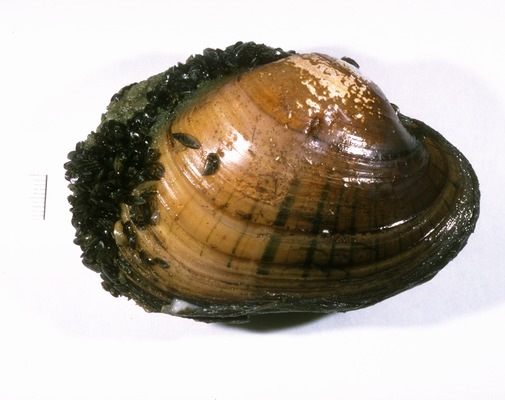
Lampsilis siliquoidea with attached zebra mussels (Dreissena polymorpha), Lake St. Clair, Michigan. The introduction of zebra mussels to North America is one of the great ecological disasters of our time. Their initial entry was from ship ballast emptied into Lake St. Clair, Michigan. They rapidly spread throughout much of the Great Lakes, then into smaller inland lakes, and most recently into the Mississippi River system. The native mussels in Lake St. Clair are not reported to be completely eliminated. The part of the Lampsilis covered in the picture is that part of the animal exposed above the substrate. Like most of our freshwater mussels, Lampsilis stays buried with only enough of the posterior shell exposed to allow the incurrent and excurrent siphons to operate. The Lampsilis shown here is a female, as shown by the posterior bulge in its shell.
- Subject
- Live Animal
- Type
- Photo
- Life Stages And Gender
- Adult/Sexually Mature
Contributors
John B. Burch (photographer; copyright holder), Mollusk Division, Museum of Zoology, University of Michigan-Ann Arbor
Conditions of Use
This resource may not be downloaded and used without permission of the copyright holder except for educational fair use.
The Animal Diversity Web team is excited to announce ADW Pocket Guides!
Search
Navigation Links
Classification
- Kingdom Animalia animals
- Class Bivalvia
- Order Veneroida
- Family Dreissenidae
- Genus Dreissena
To cite this page: Burch, J.2008. "26.rjb2.jpg" (On-line), Animal Diversity Web. Accessed May 06, 2024 at https://animaldiversity.org/collections/contributors/jack_burch/26.rjb2/
Disclaimer: The Animal Diversity Web is an educational resource written largely by and for college students. ADW doesn't cover all species in the world, nor does it include all the latest scientific information about organisms we describe. Though we edit our accounts for accuracy, we cannot guarantee all information in those accounts. While ADW staff and contributors provide references to books and websites that we believe are reputable, we cannot necessarily endorse the contents of references beyond our control.
- U-M Gateway | U-M Museum of Zoology
- U-M Ecology and Evolutionary Biology
- © 2020 Regents of the University of Michigan
- Report Error / Comment
This material is based upon work supported by the National Science Foundation Grants DRL 0089283, DRL 0628151, DUE 0633095, DRL 0918590, and DUE 1122742. Additional support has come from the Marisla Foundation, UM College of Literature, Science, and the Arts, Museum of Zoology, and Information and Technology Services.
The ADW Team gratefully acknowledges their support.