Zenkerella insignisCameroon scaly-tail
Geographic Range
Cameroon, or flightless, scaly-tailed squirrels (Zenkerella insignis) inhabit the high forests of Western central Africa, from the Cameroons to the Congo. (Dorst and Dandelot, 1972)
Habitat
The principle habitat of Cameroon Scaly-tails is tropical forests. The species has only been found from Cameroon to Gabon, and is thought to occupy the canopy. (Dorst and Dandelot, 1972; Dorst and Dandelot, 1972; Dorst and Dandelot, 1972; Dorst and Dandelot, 1972; Kingdon, 1997)
- Habitat Regions
- tropical
- terrestrial
- Terrestrial Biomes
- forest
-
- Range elevation
- 40 (high) m
- 131.23 (high) ft
Physical Description
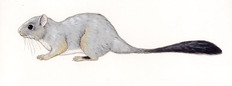
Z. insignis is small, weighing 180 to 220 g. The head and body length is between 18 and 23 cm. This species has a dense, soft, slate grey fur, with ochre tints on the forearms, lower shins, and cheeks. It has a lighter underside, and a darker, bushy tail that measures 15 to 17 cm in length. The ankles also have a tuft of darker ‘spoon-hairs’, which cover a glandular area. The function of this glandular area is still not known. (Dorst and Dandelot, 1972; Kingdon, 1997; Nowak, 1997)
Z. insignis resembles the other members of its family (Anomaluridae), possessing two rows of pointed scales on the underside of the tail near the base. These scales are thought to prevent slipping when at rest while climbing. Cameroon scaly-tails differ from their closest relatives in that this species is the only member of the family which does not possess a gliding membrane. Members of the species are therefore sometimes referred to as flightless scaly-tailed squirrels. Members of Anomaluridae are noted to have very well-adapted 'bat-like' claws, and very large eyes. (Dorst and Dandelot, 1972; Kingdon, 1997; Nowak, 1997)
- Other Physical Features
- endothermic
- bilateral symmetry
-
- Range mass
- 180 to 220 g
- 6.34 to 7.75 oz
-
- Range length
- 18 to 23 cm
- 7.09 to 9.06 in
-
- Average length
- 22 cm
- 8.66 in
Reproduction
Little is known about the reproductive behavior of Zenkerella. However members of the family Anomaluridae are believed to live singly or in mated pairs. (Dorst and Dandelot, 1972; Nowak, 1997)
Details on the reproductive behaviors of this species are lacking. Members of the family Anomaluridae most likely have one or two offspring at a time, but have been noted to have up to three precocious young. The timing of sexual maturity, age to independence, age at weaning, gestation period, size at birth, and breeding season are not known. (Dorst and Dandelot, 1972; Kingdon, 1997)
- Key Reproductive Features
- iteroparous
- gonochoric/gonochoristic/dioecious (sexes separate)
- sexual
- fertilization
- viviparous
-
- Breeding interval
- The breeding interval of Z. insignis is unknown.
-
- Breeding season
- The breeding season of this species has not been reported.
-
- Range number of offspring
- 1 to 3
-
- Average number of offspring
- 1-2
Anomalures are born precocious, with their eyes open and with a thick coat of fur. Their mothers provide milk, and the young grow quickly. They are weaned on pre-chewed food from the cheek pouches of both parents. It is reasonalbe to think that Z. insignis bears similarity to other members of its family in these areas. (Kingdon, 1997)
- Parental Investment
- no parental involvement
- precocial
- male parental care
- female parental care
-
pre-fertilization
-
protecting
- female
-
protecting
-
pre-hatching/birth
-
provisioning
- female
-
protecting
- female
-
provisioning
-
pre-weaning/fledging
-
provisioning
- female
-
provisioning
-
pre-independence
-
provisioning
- male
- female
-
provisioning
Lifespan/Longevity
Little is known about the lifespan of this species.
Behavior
Very little is known about the habits of this anomalurid. All other members of this family are nocturnal, but Cameroon scaly-tails are thought to be diurnal due to their inability to glide.
The is specialized for an arboreal life; its distinctive scales aid in grasping trees to prevent it from slipping. (Kingdon, 1997; Nowak, 1997)
Home Range
The home range size for these animals has not been reported.
Communication and Perception
Members or this family have very well developed bi-focal vision, an excellent sense of smell, and acute, possibly ultrasonic, hearing. They are believed to depend on scents, as well as sounds for communication. Twittering calls have been noted. (Kingdon, 1997; Nowak, 1997)
- Perception Channels
- visual
- tactile
- acoustic
- ultrasound
- chemical
Food Habits
The diet of Z. insignis has not been reported. However, they are probably like other members of their family with respect to diet. Members of the family Anomaluridae have been successful due to the specificity of their diet. Their primary food source is the bark which they gnaw from a small group (about a dozen specific species) of trees. The location of these trees is indicative of the locations of anomalures. Anomalurids have also been known to eat fruits, leaves, and flowers. They also probably eat small invertebrates: insects, larvae, and grubs. (Dorst and Dandelot, 1972; Kingdon, 1997)
- Primary Diet
-
herbivore
- lignivore
- Animal Foods
- insects
- Plant Foods
- leaves
- wood, bark, or stems
- fruit
- flowers
Predation
Little is known about predation on Z. insignis. It is likely that they might be prey to diurnal predators capable of gleaning them from the canopy of the forest.
Ecosystem Roles
The role of Z. insignis in the ecosystem has not been commented on in the literature. However, it is likely that they have a role similar to that of other members of their family. Members of this family are believed to greatly impact their ecosystem via a mutually beneficial relationship they have co-evolved with their food trees. Anomalures can use their incisors not only to eat, but also to cut small branches off trees. They use this ability to cut the tops off of young trees, a behavior called pruning, which kills young competitors near the base of their food trees. This pruning may provided their food trees with a competitive advantage. It has been observed that these specific trees are often dominant or are common in the areas where members of this family, Anomaluridae, are known to live. (Kingdon, 1997)
Economic Importance for Humans: Positive
These animals have no documented economic importance to humans.
Economic Importance for Humans: Negative
These animals are not reported to have any negative impact on humans.
Conservation Status
Z. insignis is extremely rare with an unknown status. It is listed, by the International Union for Conservation of Nature and Natural Resources, as lower risk in the near threatened category. (Kingdon, 1997)
-
- IUCN Red List
-
Least Concern
More information
-
- IUCN Red List
-
Least Concern
More information
-
- US Federal List
- No special status
-
- CITES
- No special status
Contributors
Nancy Shefferly (editor), Animal Diversity Web.
Michelle Harvey (author), Michigan State University, Barbara Lundrigan (editor, instructor), Michigan State University.
Glossary
- Ethiopian
-
living in sub-Saharan Africa (south of 30 degrees north) and Madagascar.

- acoustic
-
uses sound to communicate
- arboreal
-
Referring to an animal that lives in trees; tree-climbing.
- bilateral symmetry
-
having body symmetry such that the animal can be divided in one plane into two mirror-image halves. Animals with bilateral symmetry have dorsal and ventral sides, as well as anterior and posterior ends. Synapomorphy of the Bilateria.
- chemical
-
uses smells or other chemicals to communicate
- diurnal
-
- active during the day, 2. lasting for one day.
- endothermic
-
animals that use metabolically generated heat to regulate body temperature independently of ambient temperature. Endothermy is a synapomorphy of the Mammalia, although it may have arisen in a (now extinct) synapsid ancestor; the fossil record does not distinguish these possibilities. Convergent in birds.
- female parental care
-
parental care is carried out by females
- fertilization
-
union of egg and spermatozoan
- forest
-
forest biomes are dominated by trees, otherwise forest biomes can vary widely in amount of precipitation and seasonality.
- herbivore
-
An animal that eats mainly plants or parts of plants.
- iteroparous
-
offspring are produced in more than one group (litters, clutches, etc.) and across multiple seasons (or other periods hospitable to reproduction). Iteroparous animals must, by definition, survive over multiple seasons (or periodic condition changes).
- male parental care
-
parental care is carried out by males
- motile
-
having the capacity to move from one place to another.
- native range
-
the area in which the animal is naturally found, the region in which it is endemic.
- sexual
-
reproduction that includes combining the genetic contribution of two individuals, a male and a female
- tactile
-
uses touch to communicate
- terrestrial
-
Living on the ground.
- tropical
-
the region of the earth that surrounds the equator, from 23.5 degrees north to 23.5 degrees south.
- ultrasound
-
uses sound above the range of human hearing for either navigation or communication or both
- visual
-
uses sight to communicate
- viviparous
-
reproduction in which fertilization and development take place within the female body and the developing embryo derives nourishment from the female.
- young precocial
-
young are relatively well-developed when born
References
Bigalke, R. 1968. The Contemporary Mammal Fauna of Africa (in Evolution of Mammals on Southern Continents). The Quarterly Review of Biology, 43: 265-300. Accessed March 16, 2004 at www.jstor.org.
Booth, A. 1958. The Niger, The Volta and the Dahomey Gap as Geographic Barriers. Evolution, 12: 48-62. Accessed March 16, 2004 at www.jstor.org.
Dorst, J., P. Dandelot. 1972. A Field Guide to the Larger Mammals of Africa. St. James Place, London: Collin.
Kingdon, J. 1997. The Kingdon Field Guide to African Mammals. San Diego, California: Academic Press.
Nowak, R. 1997. "Walker's Mammals of the World" (On-line). Accessed March 16, 2004 at http://www.press.jhu.edu/books/walkers_mammals_of_the_world/rodentia/rodentia.anomaluridae.zenkerella.html.