Zebrasoma veliferumEastern sailfin tang(Also: Ringed tang)
Geographic Range
Zebrasoma veliferum is found in the Pacific Ocean from Indonesia and Christmas Island to the Hawaiian and Tuamotu Islands, north to southern Japan, and south to the southern Great Barrier Reef, New Caledonia, and Rapa. This species is also found throughout Micronesia. In the Indian Ocean, Z. veliferum is replaced by a similar species, Z. desjardinii. (Lieske and Myers, 1996; Myers, 1999)
- Biogeographic Regions
- oriental
- australian
- oceanic islands
- pacific ocean
Habitat
This species can be found inhabiting lagoons and seaward reefs from the lower surge zone to a depth of 30 m or more. Solitary juveniles can be found among rocks or corals of shallow and protected reefs, which may be turbid. While feeding, this species can be found in benthic environments. (Myers, 1999; Randall, 2005)
- Habitat Regions
- tropical
- saltwater or marine
-
- Range depth
- 0 to >30 m
- 0.00 to ft
Physical Description
Adult Z. veliferum are irregularly ovoid shaped and typically have a body depth that is 1.8 to 2.0 times shorter than the standard length (the length of the fish from the tip of the snout to the base of the caudal fin). The largest specimen recorded of this species was 39.5 cm long. Like other species in the family Acanthuridae, Z. veliferum has a deep compressed body. The front of the snout protrudes giving a concave dorsal and ventral profile of the head. (Randall, 2005; Sadovy and Cornish, 2000)
Zebrasoma veliferum has continuous, unnotched dorsal and anal fins. There are 29 to 33 (rarely 29) rays and 4 to 9 spines in the dorsal fin, 23 to 26 rays and 2 or 3 spines in the anal fin, and 15 to 17 rays in the pectoral fins. The pelvic fins have 3 to 5 rays as well as a spine. The dorsal and anal fins are extremely elevated and rounded, with the longest dorsal ray 2.1 to 2.5 times shorter than the standard length. Unlike other species in the genus Zebrasoma, the caudal spine of Z. veliferum is singular and not broadly joined to the body posteriorly (it folds into a narrow groove). The caudal fin is truncate. Other physical characteristics of Z. veliferum include a complete lateral line, small ctenoid scales, and 22 to 23 vertebrae. They also have up to 16 upper and 18 lower teeth, which are spatulate with denticulate edges. (Myers, 1999; Randall, 2005; Myers, 1999; Randall, 2005; Myers, 1999; Randall, 2005; Myers, 1999; Randall, 2005; Myers, 1999; Randall, 2005; Myers, 1999; Randall, 2005; Myers, 1999; Randall, 2005; Myers, 1999; Randall, 2005; Myers, 1999; National Marine Fisheries Service, 1984; Randall, 2005)
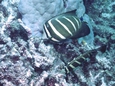
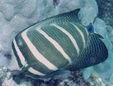
This species tends to show great variation in color but the overall body pattern is consistent. Posterior to the eye, the body and head of adult Z. veliferum is dark brown to grayish-black with vertical yellow lines and six narrow bands which incline diagonally forward. The anterior bands are white and the posterior are pale gray. Within the bands, the yellow lines are brighter than in the darker spaces between. Anterior to the eye, the head is light gray with many small white spots. The dorsal and anal fins of this species are dark brown with pale blue or green borders. The caudal fin is yellow with a white bar at the base, blue posterior margin, and a black submarginal line. (Field and Field, 1998; Marshall, 1966; Myers, 1999; Randall, 2005)
Juveniles of this species may be mistakenly identified as small angelfish because of their appearance. They have the same oversized dorsal and anal fins as the adults, but their coloration tends to be different. Juveniles have brightly colored yellow bodies with narrow black or gray bars. Their heads have two black bars. With age, the bright yellow color of the body fades. (Field and Field, 1998; Myers, 1999; Randall, 2005)
- Other Physical Features
- ectothermic
- bilateral symmetry
- Sexual Dimorphism
- sexes alike
-
- Range length
- 39.5 (high) cm
- 15.55 (high) in
Development
As with other species in the family Acanthuridae, this species has a specialized pelagic, dispersing larval stage before the juvenile stage. This is referred to as the acronurus larval stage. This particular larval stage is responsible for the broad geographical distribution found within this species. (National Marine Fisheries Service, 1984; Bonhomme and Planes, 2000; Myers, 1999; Rocha, et al., 2002)
This species has small (less than 1 mm) pelagic eggs with a single oil droplet. When the poorly-developed larvae hatch (after about 1 day), they soon develop serrate ridges on the head. The pelvic and second dorsal spines form next followed by the second anal spine. Next, the head and trunk become deepened. The body becomes kite-shaped, accentuated by the long pelvic, dorsal, and anal spines. Small, triangular scales form in vertical rows. Late in the larval stage, the juvenile coloration becomes evident and the caudal peduncle spine develops. (National Marine Fisheries Service, 1984; Thresher, 1984)
- Development - Life Cycle
- metamorphosis
Reproduction
Both paired and group spawning have been documented among this species. As with other acanthurids, group spawning is the most common. Color changes can be seen during this time. Just prior to spawning, individuals of this species form large groups. This usually occurs in winter or early spring, but it can occur throughout the year. Reproduction is usually polygynandrous: both males and females have multiple mating partners. (Lieske and Myers, 1996; Randall, 2005; Thresher, 1984)
- Mating System
- polygynandrous (promiscuous)
Reproduction among Z. veliferum typically occurs on a lunar cycle with peak activity during the winter or early spring. Occasionally, there is reproductive activity throughout the year. Spawning usually occurs at dusk and involves groups, but pair-spawning has also been observed. The eggs are pelagic and hatch after one day. Zebrasoma veliferum becomes sexually mature between one and two years of age. (Myers, 1999; Randall, 2005)
- Key Reproductive Features
- iteroparous
- seasonal breeding
- year-round breeding
- gonochoric/gonochoristic/dioecious (sexes separate)
- sexual
- fertilization
- broadcast (group) spawning
- oviparous
-
- Breeding season
- Typically this species reproduces during the winter or early spring but there is also some activity throughout the year
-
- Average time to hatching
- 1 days
-
- Range age at sexual or reproductive maturity (female)
- 1 to 2 years
-
- Range age at sexual or reproductive maturity (male)
- 1 to 2 years
Zebrasoma veliferum invests its energy producing gametes and spawning, but no parental care has been reported within this species. (Thresher, 1984)
- Parental Investment
- no parental involvement
Lifespan/Longevity
This species is relatively long-lived, living up to about 25 years. The oldest recorded individual in the wild was 27 years old. There is not sufficient information available on the longest-lived individual in captivity. (Sale, 2002; Thresher, 1984)
-
- Range lifespan
Status: wild - 27 (high) years
- Range lifespan
-
- Typical lifespan
Status: wild - 25 (high) years
- Typical lifespan
Behavior
Zebrasoma veliferum is a diurnal reef fish. It is usually found alone but occasionally it occurs in pairs. Large groups of these fish have also been reported and they mix freely with other surgeonfish species. These fish tend to live within dominance hierarchies among themselves and other reef fishes. They use their spines to exert their dominance over other individuals. (Field and Field, 1998; Randall, 2005)
- Key Behaviors
- natatorial
- diurnal
- motile
- solitary
- social
- dominance hierarchies
Home Range
The home range size of Z. veliferum has not been reported.
Communication and Perception
Members of this species communicate with each other and with other species of fishes in a number of ways. Like most other ray-finned fishes, this species uses visual displays as a means of communication. Color changes are observed in males during arousal, either during intraspecific competition or spawning. Also during intraspecific competition, the caudal peduncle spine may be brightly colored and positioned at an angle toward the competitor. Like many other species of fish, Z. veliferum also uses pheromones to communicate. These chemical signals can be detected by conspecifics or by closely related species. (Moyle and Cech, 2004; Thresher, 1984)
- Other Communication Modes
- pheromones
Food Habits
Zebrasoma veliferum is primarily a diurnal herbivore and feeds on benthic algae. Zebrasoma veliferum also feeds on zooplankton when it is abundant. (Lieske and Myers, 1996; Randall, 2005; Lieske and Myers, 1996; Randall, 2005)
- Primary Diet
-
herbivore
- algivore
- Animal Foods
- zooplankton
- Plant Foods
- algae
Predation
This species is prey for anything near the reef that is large enough to consume it. An example of such a predator is the whitetip reef shark, Triaenodon obesus. To avoid predation, Z. veliferum typically feeds during the day and hides among the reef at night. This species also has a sharp caudal spine that may act to deter predators. To advertise this protection, the tail fin is aposematic: the bright yellow coloration most likely serves as warning to predators. (Randall, 2005)
- Anti-predator Adaptations
- aposematic
-
- Known Predators
-
- whitetip reef sharks (Triaenodon obesus)
- cartilaginous fishes (Chondrichthyes)
- larger bony fishes (Actinopterygii)
Ecosystem Roles
These fish live among coral reefs, constantly interacting with each other and with individuals of other species. They are prey for cartilaginous fishes and other bony fishes. They consume benthic algae and occasionally zooplankton. Zebrasoma veliferum is known to be associated with symbiotic microorganisms that reside in its digestive tract. These microorganisms, named Epulopiscium fishelsoni, were thought to be eukaryotic protists at first, but later they were determined to be unusually large bacteria. The size of the bacteria appears to be correlated to the host feeding ecology. (Clements, et al., 1989; Lieske and Myers, 1996; Randall, 2005)
Mycobacterioses, or tuberculosis, are bacterial diseases that affect both freshwater and marine species of fishes. Mycobacterioses are caused by highly resistant bacteria which are difficult to control. These bacteria can be found in both wild and captive Z. veliferum. The most commonly isolated species of these bacteria in Acanthuridae are Mycobacterium fortuitum, M. marinum, and M. chelonae. (Prearo, et al., 2004)
- Epulopiscium fishelsoni
- Mycobacterium fortuitum
- Mycobacterium marinum
- Mycobacterium chelonae
Economic Importance for Humans: Positive
This species is quite common in the aquarium trade, probably because it is relatively large, showy, and one of the easiest species of Acanthuridae to keep in captivity if bought when young. (Lawrence and Harniess, 1991)
- Positive Impacts
- pet trade
Economic Importance for Humans: Negative
The sharp spine on the caudal peduncle of Z. veliferum has the capability of inflicting deep, painful wounds to a person trying to grasp one of these fish live. Also, in the larval stage, fish of this species have venomous second dorsal, second anal, and pelvic spines. This venom is lost during transformation to the juvenile stage. Furthermore, this species is ciguatoxic and can be poisonous to humans if eaten. Finally, the mycobacterioses carried by Z. veliferum are potential zoonoses that can cause skin infections and lesions in humans. (Halstead, 1978; Prearo, et al., 2004; Randall, 2005)
Conservation Status
Zebrasoma veliferum is not currently on the IUCN Red List, CITES appendices, or the United States Endangered Species Act list.
-
- IUCN Red List
- No special status
-
- US Federal List
- No special status
-
- CITES
- No special status
Contributors
Allison Poor (editor), University of Michigan-Ann Arbor.
Kristen Cater (author), University of Michigan-Ann Arbor, Kevin Wehrly (editor, instructor), University of Michigan-Ann Arbor.
Glossary
- Australian
-
Living in Australia, New Zealand, Tasmania, New Guinea and associated islands.

- Pacific Ocean
-
body of water between the southern ocean (above 60 degrees south latitude), Australia, Asia, and the western hemisphere. This is the world's largest ocean, covering about 28% of the world's surface.
- aposematic
-
having coloration that serves a protective function for the animal, usually used to refer to animals with colors that warn predators of their toxicity. For example: animals with bright red or yellow coloration are often toxic or distasteful.
- benthic
-
Referring to an animal that lives on or near the bottom of a body of water. Also an aquatic biome consisting of the ocean bottom below the pelagic and coastal zones. Bottom habitats in the very deepest oceans (below 9000 m) are sometimes referred to as the abyssal zone. see also oceanic vent.
- bilateral symmetry
-
having body symmetry such that the animal can be divided in one plane into two mirror-image halves. Animals with bilateral symmetry have dorsal and ventral sides, as well as anterior and posterior ends. Synapomorphy of the Bilateria.
- chemical
-
uses smells or other chemicals to communicate
- diurnal
-
- active during the day, 2. lasting for one day.
- dominance hierarchies
-
ranking system or pecking order among members of a long-term social group, where dominance status affects access to resources or mates
- ectothermic
-
animals which must use heat acquired from the environment and behavioral adaptations to regulate body temperature
- external fertilization
-
fertilization takes place outside the female's body
- fertilization
-
union of egg and spermatozoan
- herbivore
-
An animal that eats mainly plants or parts of plants.
- iteroparous
-
offspring are produced in more than one group (litters, clutches, etc.) and across multiple seasons (or other periods hospitable to reproduction). Iteroparous animals must, by definition, survive over multiple seasons (or periodic condition changes).
- metamorphosis
-
A large change in the shape or structure of an animal that happens as the animal grows. In insects, "incomplete metamorphosis" is when young animals are similar to adults and change gradually into the adult form, and "complete metamorphosis" is when there is a profound change between larval and adult forms. Butterflies have complete metamorphosis, grasshoppers have incomplete metamorphosis.
- motile
-
having the capacity to move from one place to another.
- natatorial
-
specialized for swimming
- oceanic islands
-
islands that are not part of continental shelf areas, they are not, and have never been, connected to a continental land mass, most typically these are volcanic islands.
- oriental
-
found in the oriental region of the world. In other words, India and southeast Asia.
- oviparous
-
reproduction in which eggs are released by the female; development of offspring occurs outside the mother's body.
- pet trade
-
the business of buying and selling animals for people to keep in their homes as pets.
- pheromones
-
chemicals released into air or water that are detected by and responded to by other animals of the same species
- poisonous
-
an animal which has a substance capable of killing, injuring, or impairing other animals through its chemical action (for example, the skin of poison dart frogs).
- polygynandrous
-
the kind of polygamy in which a female pairs with several males, each of which also pairs with several different females.
- reef
-
structure produced by the calcium carbonate skeletons of coral polyps (Class Anthozoa). Coral reefs are found in warm, shallow oceans with low nutrient availability. They form the basis for rich communities of other invertebrates, plants, fish, and protists. The polyps live only on the reef surface. Because they depend on symbiotic photosynthetic algae, zooxanthellae, they cannot live where light does not penetrate.
- saltwater or marine
-
mainly lives in oceans, seas, or other bodies of salt water.
- seasonal breeding
-
breeding is confined to a particular season
- sexual
-
reproduction that includes combining the genetic contribution of two individuals, a male and a female
- social
-
associates with others of its species; forms social groups.
- solitary
-
lives alone
- tactile
-
uses touch to communicate
- tropical
-
the region of the earth that surrounds the equator, from 23.5 degrees north to 23.5 degrees south.
- venomous
-
an animal which has an organ capable of injecting a poisonous substance into a wound (for example, scorpions, jellyfish, and rattlesnakes).
- visual
-
uses sight to communicate
- year-round breeding
-
breeding takes place throughout the year
- zooplankton
-
animal constituent of plankton; mainly small crustaceans and fish larvae. (Compare to phytoplankton.)
References
Bonhomme, F., S. Planes. 2000. Some Evolutionary Arguments About What Maintains the Pelagic Interval in Reef Fishes. Environmental Biology of Fishes, 59: 365-383.
Clements, K., S. Bullivant. 1991. An unusual symbiont from the gut of surgeonfishes may be the largest known prokaryote. Journal of Bacteriology, 173(17): 5359-5362.
Clements, K., D. Sutton, J. Choat. 1989. Occurrence and Characteristics of Unusual Protistan Symbionts from Surgeonfishes (Acanthuridae) of the Great Barrier Reef, Australia. Marine Biology, 102(3): 403-412.
Field, R., M. Field. 1998. Reef Fishes of the Red Sea:A Guide to Identification. New York, New York: Columbia University Press.
Halstead, B. 1978. Poisonous and Venomous Marine Animals of the World. Princeton, New Jersey: The Darwin Press, Inc..
Lawrence, E., S. Harniess. 1991. An Instant Guide to Aquarium Fish. New York: Gramercy Books.
Lieske, E., R. Myers. 1996. Coral Reef Fishes: Caribbean, Indian Ocean, and the Pacific Ocean. Princeton, New Jersey: Princeton University Press.
Marshall, T. 1966. Tropical Fishes of the Great Barrier Reef. Sydney, Australia: Angus and Robertson.
Moyle, P., J. Cech. 2004. Fishes: An Introduction to Ichthyology. Upper Saddle River, New Jersey: Prentice-Hall, Inc..
Myers, R. 1999. Micronesian Reef Fishes:A Field Guide for Divers and Aquarists. Barrigada, Territory of Guam, U.S.A.: Coral Graphics.
National Marine Fisheries Service, 1984. Ontogeny and Systematics of Fishes. Washington D.C.: American Society of Ichthyologists and Herpetologists.
Prearo, M., R. Zanoni, B. Dall'Orto, E. Pavoletti, D. Florio, V. Penati, C. Ghittino. 2004. Mycobacterioses: Emerging Pathologies in Aquarium Fish. Veterinary Research Communications, Volume 28, Supplement 1: 315-317.
Randall, J. 2005. Reef and Shore Fishes of the South Pacific:New Caledonia to Tahiti and the Pitcairn Islands. Honolulu: University of Hawai'i Press.
Rocha, L., A. Bass, R. Robertson, B. Bowen. 2002. Adult Habitat Preferences, Larval Dispersal, and the Comparative Phylogeny of Three Atlantic Surgeonfishes (Teleostei: Acanthuridae). Molecular Ecology, Volume 11, Issue 2: 243.
Sadovy, Y., A. Cornish. 2000. Reef Fishes of Hong Kong. Hong Kong: Hong Kong University Press.
Sale, P. 2002. Coral Reef Fishes:Dynamics and Diversity in a Complex Ecosystem. San Diego, California: Academic Press.
Thresher, R. 1984. Reproduction in Reef Fishes. Neptune City, New Jersey: T.F.H. Publications.