Xanthocephalus xanthocephalusyellow-headed blackbird


Geographic Range
During the summer, the yellow-headed blackbird migrates north to the west-central portions of Canada and the United States. Its range extends as far west as central-interior British Columbia, moving directly south through the central-interior west coast to northeastern Baja California. The eastern edge of the Yellow-headed Blackbird's range extends from western Ontario to northern Missouri.
During the winter, it can be found from California to Texas as well as in Mexico and casually in Costa Rica. (Ditital Atlas of Idaho version 1.3, 2000; Stokes and Stokes, 1996)
- Biogeographic Regions
- nearctic
- neotropical
Habitat
Yellow-headed blackbirds are found in freshwater marshes during the summer. They particularly like to live amongst cattails, tule, and bulrush. During migration and over the winter months, the Yellow-headed Blackbird is found in open, cultivated lands, in fields, and in pastures. (Ditital Atlas of Idaho version 1.3, 2000)
- Terrestrial Biomes
- savanna or grassland
- forest
- Aquatic Biomes
- lakes and ponds
- rivers and streams
Physical Description
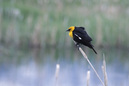
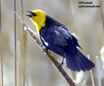
His bright yellow hood and black body best identify the male Yellow-headed Blackbird. A white patch on his wing can be seen both while perched or flying. The female's coloring is more subdued. She can be best identified by her duller-yellow supercilium, throat, and breast. The rest of her body is grayish-brown, and she has white streaks extending down her breast. Juveniles are similar in appearance to the females.
Both male and female Yellow-headed Blackbirds are 9.5 inches (24 cm) long and have sharply pointed black bills. (Gough et al. 1988; Stokes and Stokes 1996)
- Other Physical Features
- endothermic
- bilateral symmetry
-
- Average mass
- 65 g
- 2.29 oz
Reproduction
A polygynous breeder, the male Yellow-headed Blackbird stakes out his claim in a habitat of reeds over permanent open water. Females arrive to the area a few days later and are pursued by the males who sit on elevated vegetation with a spread tail and half-open wings and "sing." Sadly for human listeners, his song is composed of short, choked notes that sound more like a saw grating metal than a Romeo in love. The male Yellow-headed Blackbird may be able to secure up to as many as six mates depending on the quality of his territory. Male Yellow-headed Blackbirds who acquire new territory do not destroy broods sired by the previous territorial male. This tolerance for unrelated young may help them attract new mates as the females may mate and lay a second clutch with the new male.
The female builds a bulky, woven nest of wet vegetation in the reeds over water. As the nest materials dry, it shrinks, tightening its support on the emergent vegetation upon which it is attached. Nest building takes two to four days, and the nest is suspended ½ foot to three feet above the water.
The female Yellow-headed blackbird lays 3-5 greenish-white eggs with dark marks. Incubation lasts 11-13 days, and the chicks are altricial. They fledge within 9-12 days of hatching, and during their time in the nest, both parents feed them. For the first four days after birth, the chicks are fed at least partly by regurgitation. The amount of begging for food by Yellow-headed Blackbird chicks is related to the amount of food the parents bring to the nest. As nestlings, male Yellow-headed Blackbirds are significantly larger than their female counterparts. Yellow-headed Blackbirds only raise one (possibly two) broods each summer while their neighbors, the Red-winged Blackbirds, raises two to three broods (Elrich et al. 1988; Ortega and Cruz 1992; Gori et al. 1996; Stokes and Stokes 1996; Price 1998)
- Key Reproductive Features
- iteroparous
- gonochoric/gonochoristic/dioecious (sexes separate)
- sexual
- oviparous
Lifespan/Longevity
-
- Average lifespan
Status: wild - 150 months
- Bird Banding Laboratory
- Average lifespan
Behavior
Yellow-headed Blackbirds feed by gleaning insects and seeds from plants and from the ground, and by hawking insects in the air. Their main method of foraging is to push their bill into the ground or a food item and then force their bill, as well as the substrate, open.
Yellow-headed Blackbirds are strongly territorial during the breeding season. They prefer nesting in marshes above water two to four feet deep. Their nests are usually clumped in a different part of the marsh from the Red-Winged Blackbird who prefer nesting over shallower water. Marsh Wrens (Cistothorus palustris) occasionally destroy Yellow-headed Blackbird nests, so the territorial male excludes Marsh Wrens from their nesting areas.
During fall migration, males often form flocks that are separate from the females and young. Over the winter, the Yellow-headed Blackbird forms enormous flocks with other species of birds. (Elrich et al. 1988; University of Guelph. 1998)
- Key Behaviors
- flies
- motile
Communication and Perception
Food Habits
Insects are the favorite food of the Yellow-headed Blackbird. It also forages on the ground to eat seeds, spiders, grass, and forb seeds. This blackbird can be seen foraging in fields, meadows, ranches, agricultural areas, and farms. (Ehrich, et al., 1988; Stokes and Stokes, 1996)
- Primary Diet
- omnivore
- Animal Foods
- insects
- Plant Foods
- seeds, grains, and nuts
Economic Importance for Humans: Positive
As an insect eater, the Yellow-headed Blackbird may benefit humans by eating potentially harmful (or painful) insects such as crop-eating grasshoppers.
Economic Importance for Humans: Negative
In the spring, several species of blackbirds including the Yellow-headed Blackbird feed on newly planted seed in agricultural fields. They are therefore somewhat responsible for losses farmers absorb in missing crops. (Atkinson 1969)
Conservation Status
Yellow-headed Blackbirds are widespread, abundant, and secure throughout most of their range. The Eastern and Central Breeding Bird Surveys have shown increases in Yellow-headed Blackbird populations of around 2% per year from 1966-1993 while the Christmas Bird Counts have recorded decreases in populations of more than 2% per year. (Stokes and Stokes 1996; Digital Atlas of Idaho 2000). This is a species of special concern in Michigan and in California.
-
- IUCN Red List
-
Least Concern
More information
-
- IUCN Red List
-
Least Concern
More information
-
- US Migratory Bird Act
- Protected
-
- US Federal List
- No special status
-
- CITES
- No special status
-
- State of Michigan List
- Special Concern
Contributors
Stephanie Seto (editor), University of Michigan-Ann Arbor.
Althea Dotzour (author), University of Michigan-Ann Arbor, Terry Root (editor), University of Michigan-Ann Arbor.
Glossary
- Nearctic
-
living in the Nearctic biogeographic province, the northern part of the New World. This includes Greenland, the Canadian Arctic islands, and all of the North American as far south as the highlands of central Mexico.

- Neotropical
-
living in the southern part of the New World. In other words, Central and South America.
- acoustic
-
uses sound to communicate
- bilateral symmetry
-
having body symmetry such that the animal can be divided in one plane into two mirror-image halves. Animals with bilateral symmetry have dorsal and ventral sides, as well as anterior and posterior ends. Synapomorphy of the Bilateria.
- chemical
-
uses smells or other chemicals to communicate
- endothermic
-
animals that use metabolically generated heat to regulate body temperature independently of ambient temperature. Endothermy is a synapomorphy of the Mammalia, although it may have arisen in a (now extinct) synapsid ancestor; the fossil record does not distinguish these possibilities. Convergent in birds.
- forest
-
forest biomes are dominated by trees, otherwise forest biomes can vary widely in amount of precipitation and seasonality.
- iteroparous
-
offspring are produced in more than one group (litters, clutches, etc.) and across multiple seasons (or other periods hospitable to reproduction). Iteroparous animals must, by definition, survive over multiple seasons (or periodic condition changes).
- motile
-
having the capacity to move from one place to another.
- native range
-
the area in which the animal is naturally found, the region in which it is endemic.
- omnivore
-
an animal that mainly eats all kinds of things, including plants and animals
- oviparous
-
reproduction in which eggs are released by the female; development of offspring occurs outside the mother's body.
- sexual
-
reproduction that includes combining the genetic contribution of two individuals, a male and a female
- tactile
-
uses touch to communicate
- tropical savanna and grassland
-
A terrestrial biome. Savannas are grasslands with scattered individual trees that do not form a closed canopy. Extensive savannas are found in parts of subtropical and tropical Africa and South America, and in Australia.
- savanna
-
A grassland with scattered trees or scattered clumps of trees, a type of community intermediate between grassland and forest. See also Tropical savanna and grassland biome.
- temperate grassland
-
A terrestrial biome found in temperate latitudes (>23.5° N or S latitude). Vegetation is made up mostly of grasses, the height and species diversity of which depend largely on the amount of moisture available. Fire and grazing are important in the long-term maintenance of grasslands.
- visual
-
uses sight to communicate
References
Atkinson, M. 1969. "Yellow-headed Blackbird" (On-line). Accessed September 30, 2000 at http://www.softcom.net/users/naturenotes/ylwhdbbd.htm.
Ditital Atlas of Idaho version 1.3, 2000. "Digital Atlas of Idaho: Yellow-headed Blackbird" (On-line). Accessed September 30, 2000 at http://imnh.isu.edu/digitalatlas.
Ehrich, P., D. Dobkin, D. Wheye. 1988. The Birder's Handbook. New York: Simon & Schuster Inc..
Gori, D., S. Rohwer, J. Casselle. July 1996. Accepting unrelated broods helps replacement male yellow-headed blackbirds attract mates. Behavior Ecology, 7(1): 49-54.
Gough, G., J. Saur, M. Iliff. 1988 Version 97.1. "Patuxent Bird Identification Infocenter: Yellow-headed Blackbird Xaanthocephalus xanthocephalus" (On-line). Accessed September 30, 2000 at http://www.mbr-pwrc.usgs.gov/id/framlst/Idtips/h4970id.html.
National Geographic, 1999. Field Guide to the Birds of North America. Washington D.C.: National Geographic.
Ortega, C., A. Cruz. April 1992. Differential Growth Patterns of Nestling Brown-Headed Cowbirds and Yellow-Headed Blackbirds. The Auk, 109; 2: 368.
Price, K. September 1998. Benefits of begging for Yellow-headed Blackbird nestlings. Animal Behavior, 56(3): 571-577.
Stokes, D., L. Stokes. 1996. Stokes Field Guide to Birds. New York: Little, Brown, and Co..
University of Guelph, 1998. "Canada's Aquatic Environments: Yellow-headed Blackbird" (On-line). Accessed October 14, 2000 at http://www.aquatic.uoguelph.ca/birds/speciesacc/accounts/warblers/xanthoce/account.htm.