Wilsonia canadensisCanada warbler
Geographic Range
Wilsonia canadensis (Canada warblers) has a diverse range that includes both North and South America at various times during the year. They breed in the southern boreal forest and in a large portion of southeastern Canada in the Nearctic region and migrate during the spring and fall to their South American winter range in the Neotropical region. Canada warblers breed in the southern part of the boreal region in North America, from the southeastern Yukon territory, northeastern portion of British Columbia, and parts of northern Alberta across southern Canada as far east as Nova Scotia down to central Minnesota, New York and New England. Canada warblers also breed in the Great Lakes region. The range of Canada warblers extends south in areas of higher elevation through the Appalachian Mountains. To date, it has been determined that Canada warblers only winter in the northern region of South America in the Andes Mountains and in the region to the east of the Andes. “Accidental” occurrences of Wilsonia canadensis have been recorded in Greenland and Iceland. ("Life Histories of North American Wood Warblers - Order Passeriformes", 1953; "Wood Warblers' World", 1984; "Comprehensive Guide to selected species of: Birds of the Boreal Forest - Canada Warbler (Wilsonia canadensis)", 2007; "BFL Species Account: Canada Warbler", 2009; Savignac, 2008)
- Biogeographic Regions
- nearctic
- neotropical
Habitat
Canada warblers utilize a mixed woodland habitat. They are found nesting in areas that contain nearly-mature tree stands and an abundance of wet forest floor-cover and understory. Canada warblers will often inhabit areas at higher elevations, near open water. The eastern slopes of mountains where the forest composition is significantly deciduous are preferred. They are found at elevations ranging from 457 to 2500 m. In areas of lower elevation, they reside in bogs, clearings, woodland edges, and open areas created by human disturbance. This species has been found to show preference to mossy areas and it nests near wet habitats. Moss-covered stumps within a foot of water have been noted as extremely favorable nesting spots for Canada warblers. ("Life Histories of North American Wood Warblers - Order Passeriformes", 1953; "Wood Warblers' World", 1984; "Comprehensive Guide to selected species of: Birds of the Boreal Forest - Canada Warbler (Wilsonia canadensis)", 2007; "BFL Species Account: Canada Warbler", 2009; Hallworth, et al., 2008; Savignac, 2008)
Canada warblers also occur in riparian shrub forest on slopes, in deep ravines rich with hemlocks, moss-covered boulders and rhododendron thickets. They have also been recorded nesting in more exposed situations, such as in and around birch roots covered with moss and dead leaves, or under bank overhangs of streams. This species chooses very fine, delicate materials with which to construct its nest, so moss is often a key habitat component. In their wintering range, Canada warblers are found in mature cloud rainforests as well as some coffee plantations and agricultural areas. ("Life Histories of North American Wood Warblers - Order Passeriformes", 1953; "Wood Warblers' World", 1984; "Comprehensive Guide to selected species of: Birds of the Boreal Forest - Canada Warbler (Wilsonia canadensis)", 2007; "BFL Species Account: Canada Warbler", 2009; Hallworth, et al., 2008; Savignac, 2008)
- Habitat Regions
- temperate
- tropical
- terrestrial
- Terrestrial Biomes
- taiga
- forest
- rainforest
- scrub forest
- mountains
- Aquatic Biomes
- lakes and ponds
- rivers and streams
- Other Habitat Features
- agricultural
- riparian
-
- Range elevation
- 457 to 2500 m
- 1499.34 to 8202.10 ft
-
- Average elevation
- 1800-2000 m
- ft
Physical Description
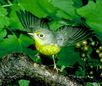
Canada warblers are bright, vividly colored birds. The species is nicknamed “the necklaced warbler” because of the unique ring of bluish-black markings around an otherwise yellow breast and throat. Canada warblers have no wing bars and have white under-tail coverts. They feature a yellowish-white ring of color around the eye that creates a spectacle-like marking that is very distinguishable. Canada warblers are remarked to always have a surprised look because of these spectacle markings. They have gray backs and matching wings that fade to black around the crown. They are a small warbler, weighing 9.5 to 12.5 g and measuring 12 to 15 cm in length. Their wingspans measure 20 to 22 cm. ("American Warblers : An Ecological and Behavioral Perspective", 1989; "Life Histories of North American Wood Warblers - Order Passeriformes", 1953; "Warblers of the Great Lakes Region & Eastern North America", 2003; "Wood Warblers' World", 1984; "BFL Species Account: Canada Warbler", 2009; Savignac, 2008)
Though females are always observed as having significantly less vivid coloring than males, females generally still exhibit at least a faint necklace marking. This color difference between sexes is typical of warblers, as they usually exhibit sexual dimorphism. There is also a wide variation of the necklace pattern that is independent of age differences. This distinct pattern may be considered a unique marking of individuals. Seasonal variation of a male's markings is typical, with the black markings being much less distinct in the fall than in the spring. In winter, the black coloring turns to more of an inky, bluish-dark gray color. Juveniles are usually a brownish color on their head and upper body parts, with lighter brown coloring on their under-parts. Any markings on juveniles are far less distinct than adults. ("American Warblers : An Ecological and Behavioral Perspective", 1989; "Life Histories of North American Wood Warblers - Order Passeriformes", 1953; "Warblers of the Great Lakes Region & Eastern North America", 2003; "Wood Warblers' World", 1984; "BFL Species Account: Canada Warbler", 2009; Savignac, 2008)
Canada warblers are often confused with other wood warbler species. They look similar to Kentucky warblers, which have a similar body color pattern but no “necklace” markings. Kentucky warblers also have a yellow breast and black cheeks similar to Canada warblers. Magnolia warblers are also similar in appearance to Canada warblers. They are also yellow-breasted with black stripes, but have a gray head and are more mottled with less distinct coloration than Canada warblers. ("American Warblers : An Ecological and Behavioral Perspective", 1989; "Life Histories of North American Wood Warblers - Order Passeriformes", 1953; "Warblers of the Great Lakes Region & Eastern North America", 2003; "Wood Warblers' World", 1984; "BFL Species Account: Canada Warbler", 2009; Savignac, 2008)
- Other Physical Features
- endothermic
- homoiothermic
- bilateral symmetry
- Sexual Dimorphism
- sexes colored or patterned differently
- male more colorful
-
- Range mass
- 9.5 to 12.5 g
- 0.33 to 0.44 oz
-
- Range length
- 12 to 15 cm
- 4.72 to 5.91 in
-
- Range wingspan
- 20 to 22 cm
- 7.87 to 8.66 in
Reproduction
Canada warblers are considered to be socially monogamous, but sometimes extra-pair copulations may occur during breeding season. Individuals will either arrive at the breeding grounds already in a breeding pair or will form breeding pairs quickly upon arrival. It was previously thought that Canada warblers maintained pair bonds year-round, however there has been research in the winter ranges that showed solitary birds as well as pair-bonded birds. Individuals of this species often return to the same site to nest, and often remain with the same mate year after year. ("BFL Species Account: Canada Warbler", 2009; Savignac, 2008)
- Mating System
- monogamous
Canada warblers have 2 broods a year on average. Canada warblers construct nests in the shape of a loosely built cup, and they are composed of a huge variety of material including grass, bark, leaf matter, moss, pine needles, twigs and animal hair. Canada warblers can make nests in 3 to 5 days using dried leaves and grass, close to the ground and often at the base of tree stumps or in clumps of ferns. Nest size is approximately 2 inches wide (4.5 inches outside diameter, 2.5 inches inside diameter), and 1.5 inches in depth. In the rare event that they re-use a nest, it will only take the birds about a day to make the nest, as they will likely just add more lining using the previously mentioned nest-construction materials. Optimal nesting areas contain dense shrubbery with abundant cover and protection. ("Life Histories of North American Wood Warblers - Order Passeriformes", 1953; "Comprehensive Guide to selected species of: Birds of the Boreal Forest - Canada Warbler (Wilsonia canadensis)", 2007; "BFL Species Account: Canada Warbler", 2009; "Development of a Baby Bird - Quick Reference", 1997; Savignac, 2008)
Females usually lay 4 to 5 eggs and incubation lasts approximately 12 days. The eggs are creamy white in color with a slightly glossy finish. They are also speckled with brownish dots in a wreath formation. Average fresh-laid egg mass is 1.56 grams and they are 17.33 mm long. All eggs usually hatch within 24 hours once hatching begins, and if not, then the remaining eggs are likely infertile. ("Life Histories of North American Wood Warblers - Order Passeriformes", 1953; "Comprehensive Guide to selected species of: Birds of the Boreal Forest - Canada Warbler (Wilsonia canadensis)", 2007; "BFL Species Account: Canada Warbler", 2009; "Development of a Baby Bird - Quick Reference", 1997; Savignac, 2008)
Canada warbler young are very dependent on their parents until they leave the nest. When the chicks are born, they have no feathers and their eyes are closed; they have very poor motor skills but are able to lift their heads for food. By day five, the feather sheaths are visibly prominent, and the chicks may start to stand and stretch their legs. It is estimated that the fledglings leave the nest at ten days old, and Canada warbler parents have been observed feeding their young after their departure from the nest. This species uses direct feeding methods and may regurgitate food for the young. Nestling period lasts an average of 8.1 days. Asymmetry is not uncommon in Canada warbler nests as one chick may be up to 2 times the size of another. The chicks remain dependent on their parents for two to three weeks after leaving the nest. ("Life Histories of North American Wood Warblers - Order Passeriformes", 1953; "Comprehensive Guide to selected species of: Birds of the Boreal Forest - Canada Warbler (Wilsonia canadensis)", 2007; "BFL Species Account: Canada Warbler", 2009; "Development of a Baby Bird - Quick Reference", 1997; Savignac, 2008)
- Key Reproductive Features
- iteroparous
- seasonal breeding
- gonochoric/gonochoristic/dioecious (sexes separate)
- sexual
- oviparous
-
- Breeding interval
- Canada warblers produce one clutch of eggs per year.
-
- Breeding season
- Canada warblers breed from May through August.
-
- Average eggs per season
- 4 to 5
-
- Average time to hatching
- 12 days
-
- Average fledging age
- 10 days
-
- Average time to independence
- 2 to 3 weeks
For Canada warblers, both parents are very invested in rearing their young. When a nesting site has been chosen, they both work on the construction of the nest. Female Canada warblers are known as “close-sitters” and will remain on the nest for a large majority of the incubation period unless intruders are immediately present. Males have been observed exhibiting anticipatory feeding where they bring food to eggs that have not yet hatched. This behavior may increase during the incubation period. ("Life Histories of North American Wood Warblers - Order Passeriformes", 1953; "Wood Warblers' World", 1984; "BFL Species Account: Canada Warbler", 2009; Savignac, 2008)
The male is a frequent presence during the entirety of nesting, and both parents clean out the nest once the chicks have hatched, ridding it of any eggshell or embryonic sac waste. Females remove unwanted pest insects from the nest, which tend to accumulate under the young if the nest is left for a relatively extended period of time. Males will often protect the nesting mother and chicks from a close range and feed the chicks often, sometimes 2 times more frequently than females do. The young are fed very frequently, anywhere from once per minute to every 20 minutes. ("Life Histories of North American Wood Warblers - Order Passeriformes", 1953; "Wood Warblers' World", 1984; "BFL Species Account: Canada Warbler", 2009; Savignac, 2008)
- Parental Investment
- altricial
- male parental care
- female parental care
-
pre-fertilization
- provisioning
-
protecting
- female
-
pre-hatching/birth
-
provisioning
- female
-
protecting
- male
- female
-
provisioning
-
pre-weaning/fledging
-
provisioning
- male
- female
-
protecting
- male
- female
-
provisioning
-
pre-independence
-
provisioning
- male
- female
-
provisioning
Lifespan/Longevity
The maximum recorded age for a Canada warbler is 7 years and 11 months old. Their estimated lifespan is 8 years. (Savignac, 2008)
-
- Range lifespan
Status: wild - 7.92 (high) years
- Range lifespan
-
- Typical lifespan
Status: wild - 8 (high) years
- Typical lifespan
Behavior
Canada warblers are very active and alert birds. Most often, Canada warblers hop along low branches, employing various methods of gleaning as foraging techniques. It flies with great agility and capability, even in thick vegetation. Canada warblers' behavior has been referred to as a "cross between American redstarts and true flycatchers" which is a reference to another of their common names, Canada flycatchers. ("Life Histories of North American Wood Warblers - Order Passeriformes", 1953; "Warblers of the Great Lakes Region & Eastern North America", 2003; "Wood Warblers' World", 1984; "BFL Species Account: Canada Warbler", 2009; Savignac, 2008)
Canada warblers are considered to be one of the more timid wood warbler species, however these birds have been observed at very close range with their young. They are extremely vocally territorial and hostile in the breeding season. These birds space their nests at about 30 m from each other to establish territory. They are also very protective of their nests from humans, and males have been known to chip up to 96 times per minute in protest of human intruders. ("Life Histories of North American Wood Warblers - Order Passeriformes", 1953; "Warblers of the Great Lakes Region & Eastern North America", 2003; "Wood Warblers' World", 1984; "BFL Species Account: Canada Warbler", 2009; Savignac, 2008)
Canada warblers have a rapid migration in late spring and early fall. Canada warblers are nocturnal and efficient travelers. They have been known to migrate in pairs, and travel an average of 30 miles a day during migration. Canada warblers are nocturnal and efficient travelers. They have been known to migrate in pairs, and travel an average of 30 miles a day during migration. These migrations can be dangerous as they travel along bodies of water, frequent collisions with lighthouses have been historically reported. During spring migration, Canada warblers travel through wet, swampy wooded areas; similar to Wilson's warblers. In the state of Ohio, they have been observed in spice bushes during spring migration. ("Life Histories of North American Wood Warblers - Order Passeriformes", 1953; "Warblers of the Great Lakes Region & Eastern North America", 2003; "Wood Warblers' World", 1984; "BFL Species Account: Canada Warbler", 2009; Savignac, 2008)
They are different than other warblers in migratory habits, as Canada warblers are the last to arrive at the breeding area and usually the last to leave. It usually takes this species about 3 weeks to reach its wintering grounds. It stays mostly in the Appalachians during its route. They leave their winter range by March in Peru, Ecuador by early April and they leave Columbia by mid-April. ("Life Histories of North American Wood Warblers - Order Passeriformes", 1953; "Warblers of the Great Lakes Region & Eastern North America", 2003; "Wood Warblers' World", 1984; "BFL Species Account: Canada Warbler", 2009; Savignac, 2008)
This species has been recorded migrating in flocks with other species like tufted titmice, American redstarts, and other warblers such as magnolia warblers, black-throated green warblers, blackburnian warblers, black-and-white warbler, bay-breasted warblers, and chestnut-sided warblers. In Panama, they are seen alone or in pairs with other species in small flocks. ("Life Histories of North American Wood Warblers - Order Passeriformes", 1953; "Warblers of the Great Lakes Region & Eastern North America", 2003; "Wood Warblers' World", 1984; "BFL Species Account: Canada Warbler", 2009; Savignac, 2008)
-
- Average territory size
- 0.02 km^2
Home Range
The average home range of the Canada warbler is 2 hectares. (Savignac, 2008)
Communication and Perception
Canada warblers have a very distinct song, though it follows no rules and is characteristically irregular and variant in pitch. It has been described as a rapid, sputtering warble. A common dictation is “chip-chupety swee-ditchety”, or another is “te-widdle-te-widdle-te-widdle-te-wip”. Canada warblers' songs are notoriously difficult to define, thus the variation in interpretations. The song of this species is different from other warblers; it does not have the same buzzing elements of other warblers’ songs, or the same husky notes. Some say it is a similar, longer version of the song of magnolia warblers. The call by both sexes is a “chyup” sound, while their alarm call is “check” or “chip” in a loud, sharp tone. They have a flight song in addition to a regular song that sounds the same but is generally longer. Canada warblers sing more after they have completed molting than any other wood warbler species. ("Life Histories of North American Wood Warblers - Order Passeriformes", 1953; "Wood Warblers' World", 1984; "Comprehensive Guide to selected species of: Birds of the Boreal Forest - Canada Warbler (Wilsonia canadensis)", 2007; "BFL Species Account: Canada Warbler", 2009)
Like all birds, they perceive their environments through visual, auditory, tactile and chemical stimuli. Their plumage differences serve to visually communicate gender, age, and breeding status to other individuals. ("Life Histories of North American Wood Warblers - Order Passeriformes", 1953; "Wood Warblers' World", 1984; "Comprehensive Guide to selected species of: Birds of the Boreal Forest - Canada Warbler (Wilsonia canadensis)", 2007; "BFL Species Account: Canada Warbler", 2009)
Food Habits
Canada warblers are excellent foragers and are well-adapted for catching flying insects. They can be found foraging in lower vegetation like shrubs and tree branches, and occasionally on the ground. Canada warblers use red-osier dogwood and young birch when it forages, as well as shrubs, saplings and the inner, entangled branches of trees. This enforces its niche requirements for substantial understory vegetation. It uses flight during foraging and gleaning in foliage while it hops along branches. In foraging, Canada warblers are similar to magnolia warblers in that they use deciduous and coniferous mixed-wood habitat equally. Others, like black-throated green warblers, may specialize and differ in habitat use throughout their range. ("American Warblers : An Ecological and Behavioral Perspective", 1989; "Life Histories of North American Wood Warblers - Order Passeriformes", 1953; "Comprehensive Guide to selected species of: Birds of the Boreal Forest - Canada Warbler (Wilsonia canadensis)", 2007; "BFL Species Account: Canada Warbler", 2009; Savignac, 2008; Sleep, et al., 2009)
The diet of Canada warblers consists primarily of flying insects which may include mosquitoes, flies, moths and beetles. At one time, 5 locusts and 29 other insects were found in a Canada warbler's stomach in Nebraska. Canada warblers may also eat small (hairless) caterpillars and spiders as well as insect larvae. They feed heavily on spruce budworm during outbreaks, though it is not considered to be a spruce budworm specialist. ("American Warblers : An Ecological and Behavioral Perspective", 1989; "Life Histories of North American Wood Warblers - Order Passeriformes", 1953; "Comprehensive Guide to selected species of: Birds of the Boreal Forest - Canada Warbler (Wilsonia canadensis)", 2007; "BFL Species Account: Canada Warbler", 2009; Savignac, 2008; Sleep, et al., 2009)
Canada warblers have some specialized physical structures and techniques for catching and eating flying insects. They have sensitive bristles surrounding the beak to aid in sensing and catching flying insects. Once a bird has caught its prey, the flying insects are sometimes held in the warbler’s beak and tossed against a tree branch before being eaten. ("American Warblers : An Ecological and Behavioral Perspective", 1989; "Life Histories of North American Wood Warblers - Order Passeriformes", 1953; "Comprehensive Guide to selected species of: Birds of the Boreal Forest - Canada Warbler (Wilsonia canadensis)", 2007; "BFL Species Account: Canada Warbler", 2009; Savignac, 2008; Sleep, et al., 2009)
- Primary Diet
- carnivore
- Animal Foods
- insects
- terrestrial non-insect arthropods
Predation
Canada warblers are subject at some stage of maturity to predation by blue jays and milk snakes. Blue jays have been reported as successful predators on Canada warbler nests, while milk snakes are reported predators of fledglings. ("Wood Warblers' World", 1984; "BFL Species Account: Canada Warbler", 2009)
Females stay on the nest until a predator is within very close range in order to camouflage and protect the eggs. If a predator descends on a Canada warbler nest, the female will launch into a dramatic display and feign an injury on the ground, away from the nest. She does this with her wings cocked out and dragging, fluttering around and with feathers fanned and ruffled. Males will also conduct this display. Purple martins will also imitate a fledgling on the ground if the eggs are already hatched to distract predators from the actual fledglings in the nest. ("Wood Warblers' World", 1984; "BFL Species Account: Canada Warbler", 2009)
-
- Known Predators
-
- blue jays (Cyanocitta cristata)
- milk snakes (Lampropeltis triangulum)
Ecosystem Roles
Canada warblers are considered to be territorial during the breeding season; however they can occur in small mixed-species flocks and with other warbler groups during migration and wintering season. In winter habitats these birds utilize such sites as coffee plantations and may positively impact the crops by consuming pest insects. ("BFL Species Account: Canada Warbler", 2009; Savignac, 2008)
Canada warbler nests are frequently parasitized by brown-headed cowbirds in areas of habitat overlaps like Saskatchewan, Ontario, New Brunswick, New York, Indiana, Michigan, and Minnesota. It has been reported that some female Canada warblers will accept these parasitic cowbird eggs and later hatch them successfully. Cowbirds will sometimes remove Canada warbler eggs from the nest so that the parasitic eggs receive priority incubation. ("BFL Species Account: Canada Warbler", 2009; Savignac, 2008)
- Brown-headed cowbirds (Lampropeltis triangulum)
Economic Importance for Humans: Positive
There are no known positive effects of Canada warblers on humans.
Economic Importance for Humans: Negative
There are no known adverse effects of Canada warblers on humans.
Conservation Status
The conservation status of Canada warblers was designated as “threatened” in Canada as of April 1998. This means, under the Committee on the Status of Endangered Wildlife In Canada (OSEWIC) definition, that the species may become endangered if limiting factors are not reduced. Canada warblers have low population densities across their range and deforestation has affected their wintering grounds. As they are migratory birds, Canada warblers are protected under the Migratory Birds Convention Act 1994. Canada warblers have been designated a Highest Priority Landbird under the North American Bird Conservation Initiative, and Partners in Flight has listed Canada warblers as being continentally important. ("American Warblers : An Ecological and Behavioral Perspective", 1989; "Life Histories of North American Wood Warblers - Order Passeriformes", 1953; "BFL Species Account: Canada Warbler", 2009; Savignac, 2008; Sleep, et al., 2009)
Historically, Canada warblers, black-and-white warblers, and American redstarts have shared one of the highest yearly survival rates at 71%, however Canada warblers have experienced a 40% decline overall since 1966. While this species appears to be mildly resilient to disturbances like forestry practices, Canada warblers are threatened by increasing habitat fragmentation. ("American Warblers : An Ecological and Behavioral Perspective", 1989; "Life Histories of North American Wood Warblers - Order Passeriformes", 1953; "BFL Species Account: Canada Warbler", 2009; Savignac, 2008; Sleep, et al., 2009)
-
- IUCN Red List
-
Least Concern
More information
-
- IUCN Red List
-
Least Concern
More information
-
- US Migratory Bird Act
- Protected
-
- US Federal List
- No special status
-
- CITES
- No special status
-
- State of Michigan List
- No special status
Other Comments
Canada warblers got their name because one was first seen in Canada by French ornithologist Brisson. In French, they are called Paruline du Canada. Canada warblers have also been called Canada flycatchers because of their inherent insect-grabbing abilities. ("Life Histories of North American Wood Warblers - Order Passeriformes", 1953; "Warblers of the Great Lakes Region & Eastern North America", 2003; "BFL Species Account: Canada Warbler", 2009; Savignac, 2008)
Canada warblers share the genus Wilsonia with only two other species: hooded warblers, to which they are most closely related, and Wilson's warblers. It has reportedly hybridized with hooded warblers, mourning warblers and Connecticut warblers. ("Life Histories of North American Wood Warblers - Order Passeriformes", 1953; "Warblers of the Great Lakes Region & Eastern North America", 2003; "BFL Species Account: Canada Warbler", 2009; Savignac, 2008)
Contributors
Shelby Sherwick (author), University of Alberta, Augustana Campus, Doris Audet (editor), University of Alberta, Augustana Campus, Rachelle Sterling (editor), Special Projects.
Glossary
- Nearctic
-
living in the Nearctic biogeographic province, the northern part of the New World. This includes Greenland, the Canadian Arctic islands, and all of the North American as far south as the highlands of central Mexico.

- Neotropical
-
living in the southern part of the New World. In other words, Central and South America.
- acoustic
-
uses sound to communicate
- agricultural
-
living in landscapes dominated by human agriculture.
- altricial
-
young are born in a relatively underdeveloped state; they are unable to feed or care for themselves or locomote independently for a period of time after birth/hatching. In birds, naked and helpless after hatching.
- arboreal
-
Referring to an animal that lives in trees; tree-climbing.
- bilateral symmetry
-
having body symmetry such that the animal can be divided in one plane into two mirror-image halves. Animals with bilateral symmetry have dorsal and ventral sides, as well as anterior and posterior ends. Synapomorphy of the Bilateria.
- bog
-
a wetland area rich in accumulated plant material and with acidic soils surrounding a body of open water. Bogs have a flora dominated by sedges, heaths, and sphagnum.
- carnivore
-
an animal that mainly eats meat
- chemical
-
uses smells or other chemicals to communicate
- diurnal
-
- active during the day, 2. lasting for one day.
- endothermic
-
animals that use metabolically generated heat to regulate body temperature independently of ambient temperature. Endothermy is a synapomorphy of the Mammalia, although it may have arisen in a (now extinct) synapsid ancestor; the fossil record does not distinguish these possibilities. Convergent in birds.
- female parental care
-
parental care is carried out by females
- forest
-
forest biomes are dominated by trees, otherwise forest biomes can vary widely in amount of precipitation and seasonality.
- insectivore
-
An animal that eats mainly insects or spiders.
- iteroparous
-
offspring are produced in more than one group (litters, clutches, etc.) and across multiple seasons (or other periods hospitable to reproduction). Iteroparous animals must, by definition, survive over multiple seasons (or periodic condition changes).
- male parental care
-
parental care is carried out by males
- migratory
-
makes seasonal movements between breeding and wintering grounds
- monogamous
-
Having one mate at a time.
- motile
-
having the capacity to move from one place to another.
- mountains
-
This terrestrial biome includes summits of high mountains, either without vegetation or covered by low, tundra-like vegetation.
- native range
-
the area in which the animal is naturally found, the region in which it is endemic.
- oviparous
-
reproduction in which eggs are released by the female; development of offspring occurs outside the mother's body.
- rainforest
-
rainforests, both temperate and tropical, are dominated by trees often forming a closed canopy with little light reaching the ground. Epiphytes and climbing plants are also abundant. Precipitation is typically not limiting, but may be somewhat seasonal.
- riparian
-
Referring to something living or located adjacent to a waterbody (usually, but not always, a river or stream).
- scrub forest
-
scrub forests develop in areas that experience dry seasons.
- seasonal breeding
-
breeding is confined to a particular season
- sexual
-
reproduction that includes combining the genetic contribution of two individuals, a male and a female
- social
-
associates with others of its species; forms social groups.
- solitary
-
lives alone
- swamp
-
a wetland area that may be permanently or intermittently covered in water, often dominated by woody vegetation.
- tactile
-
uses touch to communicate
- taiga
-
Coniferous or boreal forest, located in a band across northern North America, Europe, and Asia. This terrestrial biome also occurs at high elevations. Long, cold winters and short, wet summers. Few species of trees are present; these are primarily conifers that grow in dense stands with little undergrowth. Some deciduous trees also may be present.
- temperate
-
that region of the Earth between 23.5 degrees North and 60 degrees North (between the Tropic of Cancer and the Arctic Circle) and between 23.5 degrees South and 60 degrees South (between the Tropic of Capricorn and the Antarctic Circle).
- terrestrial
-
Living on the ground.
- territorial
-
defends an area within the home range, occupied by a single animals or group of animals of the same species and held through overt defense, display, or advertisement
- tropical
-
the region of the earth that surrounds the equator, from 23.5 degrees north to 23.5 degrees south.
- visual
-
uses sight to communicate
References
1989. American Warblers : An Ecological and Behavioral Perspective. Cambridge, Massachusetts and London, England: Harvard University Press.
1953. Life Histories of North American Wood Warblers - Order Passeriformes. Washington, US: US Government Printing Office.
2003. Warblers of the Great Lakes Region & Eastern North America. Buffalo, NY: Firefly Books Ltd..
1984. Wood Warblers' World. New York, New York: Simon and Schuster.
Cornell Lab of Ornithology. 2009. "BFL Species Account: Canada Warbler" (On-line). Birds in Forested Landscapes Cornell Lab of Ornithology. Accessed October 10, 2010 at http://www.birds.cornell.edu/bfl/speciesaccts/canwar.html.
Boreal Songbird Initiative. 2007. "Comprehensive Guide to selected species of: Birds of the Boreal Forest - Canada Warbler (Wilsonia canadensis)" (On-line). Boreal Songbird Initiative. Accessed November 10, 2011 at http://www.borealbirds.org/guide/guide_detail.php?curr_rec=1&view=imagelist&guideid=1&groupid=1&familyid=&term=Canada%20Warbler&process=1&sort=&from=0.
Messinger Woods Wildlife Care & Education Center, Inc. 1997. "Development of a Baby Bird - Quick Reference" (On-line). Messinger Woods Wildlife Care & Education Center, Inc.. Accessed October 11, 2010 at http://www.messingerwoods.org/quickreference.htm.
Hallworth, M., A. Ueland, E. Anderson, J. Lambert, L. Reitsma. 2008. Habitat Selection and Site Fidelity of Canada Warblers (Wilsonia Canadensis) in Central New Hampshire. The Auk, 125(4): 880-888. Accessed September 21, 2010 at http://www.bioone.org.login.ezproxy.library.ualberta.ca/doi/full/10.1525/auk.2008.07115.
Savignac, C. 2008. "COSEWIC assessment and status report on the Canada warbler, Wilsonia canadensis, in Canada" (On-line). Library and Archives Canada Electronic Collection. Accessed September 21, 2010 at http://epe.lac-bac.gc.ca/100/200/301/environment_can/cws-scf/cosewic-cosepac/canada_warbler-e/CW69-14-548-2008E.pdf.
Sleep, D., M. Drever, K. Szuba. 2009. Potential Role of Spruce Budworm in Range-Wide Decline. The Journal of wildlife management, Volume 73 no.4: 546-555.