Vanellus coronatuscrowned lapwing(Also: crowned plover)

Geographic Range
Resident in eastern and southern Africa, crowned plovers are found from Ethiopia in the north to South Africa in the south and east to Kenya. Recorded as high as 3000 m above sea level, this bird is absent from coastal lowlands south of Malindi and from much of the Lake Victoria basin.
Habitat
Crowned plovers are widespread over Africa. They are found where the grass is short or has been burned, such as on dry grassland, open savanna, and cultivated lands. Habitats with low rainfall are acceptable as long as the lacking of precipitation does not affect food availability.
- Terrestrial Biomes
- desert or dune
- savanna or grassland
- chaparral
Physical Description
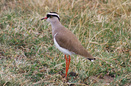
Female crowned plovers are identical to males. Adults are uniformly brown on the back and chest. The white belly is separated from the breast by a narrow black line. The tail is white with a broad black band while underneath the tail and wing are also white. The crowned plover has a broad, diagonal white wing-stripe. Its black crown is encircled by a white ring. The eyes are yellow during the breeding season and brownish orange when not breeding. The bill is red with a brownish tip, and the long legs are also red. This large plover has a length of 30-31 cm. Juveniles have a duller head pattern.
- Other Physical Features
- endothermic
- bilateral symmetry
Reproduction
Breeding occurs in the spring months from July to October. The nest is in a shallow depression in the soil with a lining of vegetation and other debris. The nests are on flat ground near a shade tree and mammal droppings that are the same color as the eggs. There are normally 3 eggs, sometimes 2 or 4. Incubation requires 28 to 32 days and is done by both sexes. Immediately after hatching the young leave the nest while both parents look after them.
- Key Reproductive Features
- iteroparous
- gonochoric/gonochoristic/dioecious (sexes separate)
- sexual
- oviparous
Behavior
Crowned plovers are gregarious, sometimes appearing in flocks of as many as 36 outside of the breeding season. Most often they occur in small groups that are casual aggregations. Territorial behavior is almost nonexistent even during the breeding season. When an alarm call is heard from another plover species, it responds by aerially swarming the intruder. But once the attack is over, the rescuing bird is often chased off by the bird that was in danger in the first place. Because crowned plovers live in open grassland where there is no vegetation to conceal them, they have a highly-developed ability to detect potential predators. Often nesting occurs in close vicinity to other plovers. As soon as hatching occurs the adults change from being quiet and restrained to being exceedingly noisy and aggressive at the approach of a human. The crowned plover is highly conspicuous, it moves by alternating short runs with its body held horizontally with a motionless vertical stance. The crowned plover is highly vocal with a rasping erEEK, an excited kree-kree-kreeip-kreeip or WEEK-EEK-EEK, or a chattering tri-tri-tri-tri.
- Key Behaviors
- flies
- motile
Communication and Perception
Food Habits
The crowned plover opportunistically forages on a wide variety of insects, but mostly ants and termites. These insects are often extracted from the dung of large mammals. They feed mainly by surface pecking as opposed to digging. One curious feeding habit of all plovers, which has not fully been analyzed, has been called foot paddling or foot trembling. The plover stamps the ground with its foot. Worms mistake the noise for the pattering of rain and burrow up to the surface where they are eaten by the plover.
Conservation Status
This species is widespread throughout its range and in no need of conservation attention. To make sure the species population remains at a safe size, open African habitats must be maintained.
-
- IUCN Red List
-
Least Concern
More information
-
- IUCN Red List
-
Least Concern
More information
-
- US Federal List
- No special status
-
- CITES
- No special status
Other Comments
Plover evolution began late in the Cretaceous period. The plover family Charadriidae is one of the nine families of waders. Of 190 wader species, 63 of them belong to the plover family.
Contributors
Kirsten McDonnell (author), University of Michigan-Ann Arbor, Dea Armstrong (editor), University of Michigan-Ann Arbor.
Glossary
- Ethiopian
-
living in sub-Saharan Africa (south of 30 degrees north) and Madagascar.

- acoustic
-
uses sound to communicate
- bilateral symmetry
-
having body symmetry such that the animal can be divided in one plane into two mirror-image halves. Animals with bilateral symmetry have dorsal and ventral sides, as well as anterior and posterior ends. Synapomorphy of the Bilateria.
- chaparral
-
Found in coastal areas between 30 and 40 degrees latitude, in areas with a Mediterranean climate. Vegetation is dominated by stands of dense, spiny shrubs with tough (hard or waxy) evergreen leaves. May be maintained by periodic fire. In South America it includes the scrub ecotone between forest and paramo.
- chemical
-
uses smells or other chemicals to communicate
- desert or dunes
-
in deserts low (less than 30 cm per year) and unpredictable rainfall results in landscapes dominated by plants and animals adapted to aridity. Vegetation is typically sparse, though spectacular blooms may occur following rain. Deserts can be cold or warm and daily temperates typically fluctuate. In dune areas vegetation is also sparse and conditions are dry. This is because sand does not hold water well so little is available to plants. In dunes near seas and oceans this is compounded by the influence of salt in the air and soil. Salt limits the ability of plants to take up water through their roots.
- endothermic
-
animals that use metabolically generated heat to regulate body temperature independently of ambient temperature. Endothermy is a synapomorphy of the Mammalia, although it may have arisen in a (now extinct) synapsid ancestor; the fossil record does not distinguish these possibilities. Convergent in birds.
- iteroparous
-
offspring are produced in more than one group (litters, clutches, etc.) and across multiple seasons (or other periods hospitable to reproduction). Iteroparous animals must, by definition, survive over multiple seasons (or periodic condition changes).
- motile
-
having the capacity to move from one place to another.
- native range
-
the area in which the animal is naturally found, the region in which it is endemic.
- oviparous
-
reproduction in which eggs are released by the female; development of offspring occurs outside the mother's body.
- sexual
-
reproduction that includes combining the genetic contribution of two individuals, a male and a female
- tactile
-
uses touch to communicate
- tropical savanna and grassland
-
A terrestrial biome. Savannas are grasslands with scattered individual trees that do not form a closed canopy. Extensive savannas are found in parts of subtropical and tropical Africa and South America, and in Australia.
- savanna
-
A grassland with scattered trees or scattered clumps of trees, a type of community intermediate between grassland and forest. See also Tropical savanna and grassland biome.
- temperate grassland
-
A terrestrial biome found in temperate latitudes (>23.5° N or S latitude). Vegetation is made up mostly of grasses, the height and species diversity of which depend largely on the amount of moisture available. Fire and grazing are important in the long-term maintenance of grasslands.
- visual
-
uses sight to communicate
References
Johnsgard, P. 1981. The Plovers, Sandpipers, and Snipes of the World. Lincoln: University of Nebraska Press.
Vaughan, R. 1980. Plovers. Lavenham: Terance Dalton Limited.
Ward, D. 1989. Behaviour associated with breeding of Crowned, Blackwinged and Lesser Blackwinged Plovers. Ostrich, 60(4): 141-150.
Ward, D. What Do Plovers Know About Competition?. Bokmakierie, 39(2): 62-64.
Ward, D., G. Maclean. 1989. Habitat Selection by Crowned, Blackwinged and Lesser Blackwinged Plovers. Ostrich, 60(2): 49-54.
Zimmerman, D., D. Turner, D. Pearson. 1996. Birds of Kenya and Northern Tanzania. London: Cristopher Helm.