Uroderma bilobatumtent-making bat

Geographic Range
Southern Mexico to Peru and SE Brazil
- Biogeographic Regions
- neotropical
Habitat
A lowland forest species.
- Terrestrial Biomes
- forest
- rainforest
- scrub forest
Physical Description
A small phyllostomid, forearm around 42 mm long. Dark grayish brown with a narrow white line down the middle of the upper back, and a distinct white line above and below each eye. No external tail, and the tail membrane is narrow and lacks a fringe. The external ears are rimmed with yellow. The upper middle incisors are distinctively bilobed. Dental formula 2/2, 1/1, 2/2, 3/3.
- Other Physical Features
- endothermic
- bilateral symmetry
Reproduction
The timing of the reproductive cycle varies seasonally. In Panama, Uroderma breed twice yearly, and birth to correlate with the fruiting and flowering cycle of plants. A single young is born after a gestation of 4 or 5 months.
- Key Reproductive Features
- gonochoric/gonochoristic/dioecious (sexes separate)
- sexual
Behavior
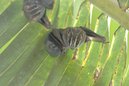
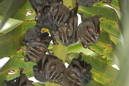
Uroderma roost in groups ranging in size from 2 to 59. They often build "tents" by cutting the structural veins of leaves by chewing parallel to the midrib. The leaves fold down along the midrib, and the bats roost under the resulting "tent."
- Key Behaviors
- motile
Communication and Perception
Food Habits
Uroderma feed predominately on fruit, but they may take some pollen, nectar, and insects associated with flowers and fruit.
Economic Importance for Humans: Positive
Important dispersers of seeds and pollinators of many species of tropical plants.
Economic Importance for Humans: Negative
May occasionally damage fruit crops.
Conservation Status
These bats are common in lowland forests.
-
- IUCN Red List
-
Least Concern
More information
Contributors
Phil Myers (author), Museum of Zoology, University of Michigan-Ann Arbor.
Glossary
- Neotropical
-
living in the southern part of the New World. In other words, Central and South America.

- bilateral symmetry
-
having body symmetry such that the animal can be divided in one plane into two mirror-image halves. Animals with bilateral symmetry have dorsal and ventral sides, as well as anterior and posterior ends. Synapomorphy of the Bilateria.
- chemical
-
uses smells or other chemicals to communicate
- endothermic
-
animals that use metabolically generated heat to regulate body temperature independently of ambient temperature. Endothermy is a synapomorphy of the Mammalia, although it may have arisen in a (now extinct) synapsid ancestor; the fossil record does not distinguish these possibilities. Convergent in birds.
- forest
-
forest biomes are dominated by trees, otherwise forest biomes can vary widely in amount of precipitation and seasonality.
- motile
-
having the capacity to move from one place to another.
- native range
-
the area in which the animal is naturally found, the region in which it is endemic.
- rainforest
-
rainforests, both temperate and tropical, are dominated by trees often forming a closed canopy with little light reaching the ground. Epiphytes and climbing plants are also abundant. Precipitation is typically not limiting, but may be somewhat seasonal.
- scrub forest
-
scrub forests develop in areas that experience dry seasons.
- sexual
-
reproduction that includes combining the genetic contribution of two individuals, a male and a female
- tactile
-
uses touch to communicate
References
Baker, R. J. and C. L. Clark. 1987. Uroderma bilobatum. Mammalian Species, 279:1-4.