Tyrannus tyrannuseastern kingbird


Geographic Range
Eastern kingbirds are the most widespread species in the genus Tyrranus. They breed throughout most of eastern North America, from the Gulf of Mexico north throughout much of southern and central Canada, as far east at the Atlantic seaboard to the Canadian maritime provinces, and as far west as central Texas, Colorado, northeastern Utah, eastern Oregon and Washington, and eastern British Columbia to the Yukon territories. They winter in South America, where their distribution is poorly understood but seems to be mainly in the western Amazon basin. (Murphy, 1996)
- Biogeographic Regions
- nearctic
- neotropical
Habitat
Eastern kingbirds are found in open, savanna-like habitats, often near water. They occur in fields and grasslands with scattered tall trees for nesting and perching. Suitable habitats include parks, riparian forests, large burned areas or blowouts in forests, golf courses, and suburban and urban areas. Little is know about their migratory habits, but they are found in a wide variety of habitats while migrating. In winter they are found in forest-edge, riparian forest, and near wetlands. (Murphy, 1996)
- Habitat Regions
- temperate
- tropical
- terrestrial
- Terrestrial Biomes
- savanna or grassland
- Other Habitat Features
- urban
- suburban
- agricultural
- riparian
Physical Description
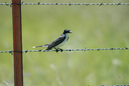
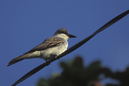
Eastern kingbirds are relatively small members of the genus Tyrannus, from 19.5 to 23 cm long. Males and females are similar, although males are slightly larger in all measurements. Males are distinguished from females by the notching of their 9th and 10th primaries, whereas only the 10th primary is notched in females. They are striking birds, with rich, black plumage dorsally and white plumage ventrally. They have an inconspicuous grey band across the chest. Kingbirds have an erectile crest of feathers on their head, although it isn't always observed. Males tend to erect their crown feathers more than females. Eastern kingbirds also have a small red or orange patch of feathers on the crown, which is rarely seen. They have a distinctive white trailing edge on the tail. The bill, claws, and legs are black. There are no recognized subspecies, but there is geographic variation in some measurements and in the width of the white tail tips. (Murphy, 1996)
- Other Physical Features
- endothermic
- homoiothermic
- bilateral symmetry
- Sexual Dimorphism
- male larger
-
- Range length
- 19.5 to 23 cm
- 7.68 to 9.06 in
Reproduction
Eastern kingbirds are monogamous, although they seem to have a skewed sex ratio, with fewer females than males. Male mates that are lost are quickly replaced by other males. There is some evidence of occasional extra pair copulations or quasiparasitism, where a second female mates with the resident male and lays eggs in the first female's nest. Males perform aerial displays to attract females, they fly in short, zig-zag patterns with their wings fluttering while vocalizing. (Murphy, 1996)
- Mating System
- monogamous
Eastern kingbirds breed from April to June, mostly in May. Females build nests of twigs, bark, and roots lined with softer material, like cattail down or willow catkins. Nests are constructed 2 to 8 m high in trees in open habitats. Females can lay 2nd or 3rd clutches if previous clutches are lost, but if a clutch is successful, there are no additional broods. Females lay 2 to 5, usually 3 cream colored eggs with reddish spots. Eggs are usually laid one per day until the clutch is complete. Incubation is for 14 to 17 days and young fledge 16 to 17 days after hatching. They can reproduce in their first year after hatching, although breeding may be delayed. (Murphy, 1996)
- Key Reproductive Features
- iteroparous
- seasonal breeding
- gonochoric/gonochoristic/dioecious (sexes separate)
- sexual
- oviparous
-
- Breeding interval
- Eastern kingbirds breed once each year.
-
- Breeding season
- Eastern kingbirds breed from April to June.
-
- Range eggs per season
- 2 to 5
-
- Average eggs per season
- 3
-
- Range time to hatching
- 14 to 17 days
-
- Range fledging age
- 16 to 17 days
-
- Average time to independence
- 30 days
-
- Range age at sexual or reproductive maturity (female)
- 1 (low) years
-
- Range age at sexual or reproductive maturity (male)
- 1 (low) years
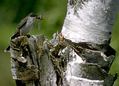
Young are naked at hatching. Only females incubate and brood the young. Males and females feed nestlings, but females feed more than males. Young are fed insects as much as possible, but parents will provide fruit as well. They remove stingers from bees and wasps before feeding them to the young. Parents continue to feed and protect their young up to 5 weeks after fledging, at 7 to 8 weeks old. Young begin to feed themselves at about 4 weeks old. (Murphy, 1996)
- Parental Investment
- altricial
-
pre-fertilization
- provisioning
-
protecting
- female
-
pre-hatching/birth
-
provisioning
- female
-
protecting
- male
- female
-
provisioning
-
pre-weaning/fledging
-
provisioning
- male
- female
-
protecting
- male
- female
-
provisioning
-
pre-independence
-
provisioning
- male
- female
-
protecting
- male
- female
-
provisioning
Lifespan/Longevity
Maximum lifespan is not reported for eastern kingbirds, but annual survival has been estimated at 54% for females and 69% for males. Most mortality in young is the result of predation. Causes of adult mortality are unclear, but may also be mainly predation. (Murphy, 1996)
Behavior
Eastern kingbirds do not typically walk or hop, instead they fly from place to place. They are agile and fast flyers and perform several interesting aerial displays. They are active during the day and aggressively defend territories during the breeding season. They are very intolerant of the presence of other birds and have to overcome aggressive tendencies to form the pair bond at the beginning of the breeding season. They will not tolerate other eastern kingbirds nearby and will also harass other perching birds. During migration and winter, however, they are very social, forming large flocks of up to several thousand birds to migrate and staying in smaller foraging flocks of 10 to 20 in winter. (Murphy, 1996)
Eastern kingbirds migrate during the day in small flocks of 10 to 60, or sometimes up to thousands, of birds. They migrate overland mostly, but will form large flocks and cross water boundaries together. Northbound migrants begin to arrive in the United States in March, fall migration begins in late July and continues through September. Migrating flocks may stop over for several days in areas with abundant food. (Murphy, 1996)
- Key Behaviors
- flies
- diurnal
- motile
- migratory
- territorial
- social
Home Range
There is no information on home range sizes in eastern kingbirds. They aggressively defend territories during the breeding season, but nests may be as close as 30 m apart in areas with dense populations. (Murphy, 1996)
Communication and Perception
Eastern kingbirds use a variety of vocalizations to communicate, especially during the breeding season. In their winter range eastern kingbirds vocalize very little. Males sing a complex song in the pre-dawn hours, especially males in more dense populations. Calls are harsh and buzzing, often repeated "zeers." Males vocalize extensively when patrolling their nesting territory. Females vocalize as well, but males use vocalizations more frequently. Adults and juveniles will snap their bills at threats as well and they make whirring sounds with their wings occasionally. Courtship involves aerial displays between mates. (Murphy, 1996)
Food Habits
Eastern kingbirds eat insects during the breeding season and both insects and fruit outside of the breeding season. Insects make up 85% of the diet from May to September, including bees and wasps (Hymenoptera), beetles (Coleoptera), grasshoppers (Orthoptera), bugs (Hemiptera), and flies (Diptera). Insect prey is mainly taken by hawking from a perch. They dart out from perches to capture flying prey in their air. They will also take insects from the water or ground by hovering or gleaning. Small prey are eaten immediately, larger prey are taken back to the perch and smashed until they are subdued before being eaten. Larger prey are preferred. Fruit is taken in flight while hovering or gleaning as well. Eastern kingbirds do not seem to drink water. (Murphy, 1996)
- Primary Diet
- omnivore
- Animal Foods
- amphibians
- insects
- Plant Foods
- fruit
Predation
Most predators target eggs and nestlings. Eastern kingbird adults are sometimes taken by aerial predators, such as American kestrels (Falco sparverius). Eastern kingbirds are aggressive and will energetically attack perceived threats, such as large hawks, crows, blue jays, squirrels, and snakes, whenever they are nearby. They will dive at a threat with their crest raised, exposing the red crown feathers, and with the mouth wide open, exposing their bright red gape. They will repeatedly attack the threat until they retreat. Eggs and nestlings are preyed on by crows (Corvus), blue jays (Cyanocitta cristata), squirrels (Sciurus and Tamiasciurus), and arboreal snakes. (Murphy, 1996)
-
- Known Predators
-
- American kestrels (Falco sparverius)
- crows (Corvus)
- blue jays (Cyanocitta cristata)
- tree squirrels (Sciurus)
- red squirrels (Tamiasciurus)
- arboreal snakes (Serpentes)
Ecosystem Roles
Eastern kingbirds are important predators of insects during the breeding season. They eat fruits and may disperse seeds as well. They forage with other Tyrannus species in their winter range in South America, including tropical kingbirds (Tyrannus melancholicus) and fork-tailed flycatchers (Tyrannus savanna). They may nest near Swainson's or ferruginous hawks (Buteo swainsoni, Buteo regalis), both of which prey on common nest predators, such as crows and blue jays. Hatchlings are parasitized by mites, otherwise there is little known about parasites. Eastern kingbird nests are parasitized by brown-headed cowbirds (Molothrus ater) and other eastern kingbirds. (Murphy, 1996)
- tropical kingbirds (Tyrannus melancholicus)
- fork-tailed flycatchers (Tyrannus savanna)
- Swainson's hawks (Buteo swainsoni)
- ferruginous hawks (Buteo regalis)
- blood-sucking mites (Acari)
- brown-headed cowbirds (Molothrus ater)
Economic Importance for Humans: Positive
Eastern kingbird may help to control insect pest populations in some areas.
- Positive Impacts
- controls pest population
Economic Importance for Humans: Negative
There are no adverse effects of eastern kingbirds on humans, although they may harass humans they perceive as threats near nests.
Conservation Status
Eastern kingbirds are widespread and populations are large, they are considered "least concern" by the IUCN. They are protected by the U.S. Migratory Bird Act. (Murphy, 1996)
-
- IUCN Red List
-
Least Concern
More information
-
- IUCN Red List
-
Least Concern
More information
-
- US Migratory Bird Act
- Protected
-
- US Federal List
- No special status
-
- CITES
- No special status
-
- State of Michigan List
- No special status
Contributors
Tanya Dewey (author), Animal Diversity Web.
Glossary
- Nearctic
-
living in the Nearctic biogeographic province, the northern part of the New World. This includes Greenland, the Canadian Arctic islands, and all of the North American as far south as the highlands of central Mexico.

- Neotropical
-
living in the southern part of the New World. In other words, Central and South America.
- acoustic
-
uses sound to communicate
- agricultural
-
living in landscapes dominated by human agriculture.
- altricial
-
young are born in a relatively underdeveloped state; they are unable to feed or care for themselves or locomote independently for a period of time after birth/hatching. In birds, naked and helpless after hatching.
- bilateral symmetry
-
having body symmetry such that the animal can be divided in one plane into two mirror-image halves. Animals with bilateral symmetry have dorsal and ventral sides, as well as anterior and posterior ends. Synapomorphy of the Bilateria.
- chemical
-
uses smells or other chemicals to communicate
- diurnal
-
- active during the day, 2. lasting for one day.
- endothermic
-
animals that use metabolically generated heat to regulate body temperature independently of ambient temperature. Endothermy is a synapomorphy of the Mammalia, although it may have arisen in a (now extinct) synapsid ancestor; the fossil record does not distinguish these possibilities. Convergent in birds.
- iteroparous
-
offspring are produced in more than one group (litters, clutches, etc.) and across multiple seasons (or other periods hospitable to reproduction). Iteroparous animals must, by definition, survive over multiple seasons (or periodic condition changes).
- migratory
-
makes seasonal movements between breeding and wintering grounds
- monogamous
-
Having one mate at a time.
- motile
-
having the capacity to move from one place to another.
- native range
-
the area in which the animal is naturally found, the region in which it is endemic.
- omnivore
-
an animal that mainly eats all kinds of things, including plants and animals
- oviparous
-
reproduction in which eggs are released by the female; development of offspring occurs outside the mother's body.
- riparian
-
Referring to something living or located adjacent to a waterbody (usually, but not always, a river or stream).
- seasonal breeding
-
breeding is confined to a particular season
- sexual
-
reproduction that includes combining the genetic contribution of two individuals, a male and a female
- social
-
associates with others of its species; forms social groups.
- suburban
-
living in residential areas on the outskirts of large cities or towns.
- tactile
-
uses touch to communicate
- temperate
-
that region of the Earth between 23.5 degrees North and 60 degrees North (between the Tropic of Cancer and the Arctic Circle) and between 23.5 degrees South and 60 degrees South (between the Tropic of Capricorn and the Antarctic Circle).
- terrestrial
-
Living on the ground.
- territorial
-
defends an area within the home range, occupied by a single animals or group of animals of the same species and held through overt defense, display, or advertisement
- tropical
-
the region of the earth that surrounds the equator, from 23.5 degrees north to 23.5 degrees south.
- tropical savanna and grassland
-
A terrestrial biome. Savannas are grasslands with scattered individual trees that do not form a closed canopy. Extensive savannas are found in parts of subtropical and tropical Africa and South America, and in Australia.
- savanna
-
A grassland with scattered trees or scattered clumps of trees, a type of community intermediate between grassland and forest. See also Tropical savanna and grassland biome.
- temperate grassland
-
A terrestrial biome found in temperate latitudes (>23.5° N or S latitude). Vegetation is made up mostly of grasses, the height and species diversity of which depend largely on the amount of moisture available. Fire and grazing are important in the long-term maintenance of grasslands.
- urban
-
living in cities and large towns, landscapes dominated by human structures and activity.
- visual
-
uses sight to communicate
References
Murphy, M. 1996. Eastern Kingbird (Tyrannus tyrannus). The Birds of North America Online, 253: 1-20. Accessed April 17, 2009 at http://bna.birds.cornell.edu.proxy.lib.umich.edu/bna/species/253.