Trachemys scriptaPond Slider, scripta


Geographic Range
Slider turtles, Trachemys scripta, are native to the southeastern and central United States and northern Mexico. Yellow-bellied sliders, Trachemys scripta scripta, range from the southern portion of Virginia south to the northern border of Florida. Cumberland sliders, Trachemys scripta troostii, range from southwestern Virginia to Alabama. Cumberland sliders are found west of the Appalachian Mountains. Red-eared sliders, Trachemys scripta elegans, range from Alabama south to northern Mexico.
Red-eared sliders have been introduced into other areas of the United States, including Hawaii, California, Arizona, Michigan, New Jersey, Pennsylvania, Maryland, the Blue Ridge Mountains of Virginia, and southern Florida. They have also been introduced into Canada, and central Mexico. Introduced populations can be found in parts of Africa and in Israel. They also can be found on the islands of Guadeloupe and throughout southern France. Populations are present in southern Portugal, Greece, Spain, Italy, the Italian border of Slovenia, Austria, Turkey, Netherlands, and Switzerland. Introduced populations are also present in the Asian countries of Cambodia, China, Japan, Indonesia, Taiwan, and Thailand. Sliders also can be found in Australia. (Buhlmann, et al., 2008; Cadi, et al., 2004; Ernst and Barbour, 1989; Green and Pauley, 1987; Mitchell and Conant, 1994; Perez-Santigosa, et al., 2008; Rödder, et al., 2009; Stafford and Meyer, 2000)
- Biogeographic Regions
- nearctic
- palearctic
- oriental
- ethiopian
- australian
Habitat
Slider turtles are semiaquatic animals that live in freshwater and brackish environments. They can be found in waterbodies that hold water year-round, like ponds, lakes, rivers, swamps, lagoons, and streams. They also can live in vernal/seasonal farm ponds. Slider turtles are found in shallow, slow-moving water that has diverse vegetation and nearby places to bask. Depths of 0.6 m to 0.9 m are most common for sliders. They can also be found in terrestrial habitats, such as semi-evergreen forests or savannas, that have water sources close to them. During seasonal dryness, turtles living in these areas will seek a new habitat with a water source. Moist sloughs and muddy areas are also common places for slider turtles to live. They do not inhabit marine environments. (Buhlmann, et al., 2008; Carr, 2008; Ernst and Barbour, 1989; Green and Pauley, 1987; Stafford and Meyer, 2000; Tran, et al., 2007)
- Habitat Regions
- temperate
- terrestrial
- freshwater
- Terrestrial Biomes
- savanna or grassland
- forest
- Aquatic Biomes
- lakes and ponds
- rivers and streams
- temporary pools
- brackish water
- Wetlands
- swamp
-
- Range depth
- 0.6 to 0.9 m
- 1.97 to 2.95 ft
Physical Description
Slider turtles range from 10-29 cm in length and exhibit sexual dimorphism; females tend to be larger than males. Females can reach a mass of up to 3,200 grams. Average female shell length in adulthood is 25.4 cm. Female slider turtles are considered adults when they are 15-20 cm in length and 5-8 years old. Average male shell length in adulthood is 17.78 cm. Male sliders are considered adults when they are 9-11 cm in length and 2-5 years old. Male masses are not reported in literature. Hatchlings are usually between 23 and 35 mm in shell length, but average masses are not available.
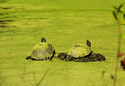
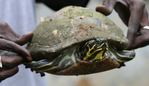
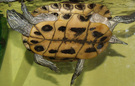
The upper portion of the shell, the carapace, tends to be oval-shaped with sharp edges. The carapace is rough with indentations that vary in direction. The bottom of the shell, the plastron, is flat and smooth. The overall roundness of the plastron is determined by the roundness of the egg from which the turtle hatched. The coloring of the carapace ranges from greenish yellow to gray, brown, and black. Large, yellow lines are often present on the carapace. The plastron tends to be lighter in color than the carapace, and it is usually yellow with black spots or streaks. The skin is dark green and brown. Older males exhibit melanism, which is the darkening of both the carapace and plastron in addition to the skin. These turtles are often completely black in color.
Slider turtles have oblong heads that end in snouts that point upward. They have webbed feet for swimming with five digits on each limb. Both males and females have foreclaws that are used in courtship. These claws may be longer in males than in females, although lengths have not been reported in the literature.
Skin and some plastron markings vary by subspecies. Cumberland sliders, Trachemys scripta troostii, have yellow and black lines on their legs and their posteriors as well as yellow markings on their necks and behind their eyes. Cumberland sliders usually have less yellow coloration than other subspecies. Yellow-bellied sliders, Trachemys scripta scripta, have yellow and black lines on their necks and limbs, but the lines tend to be vertical, thinner, and more frequent. The yellow areas near their eyes are rectangular and vertical. Two black spots are usually present on the plastrons of these turtles. Red-eared sliders, Trachemys scripta elegans, have similar lines on their hind limbs, but the streaks posterior to their eyes are horizontal and bright red.
Slider turtles are often mistaken for chicken turtles, Deirochelys reticularia, and painted turtles, Chrysemys picta. Slider turtles can be distinguished from chicken turtles by the carapace. Unlike slider turtles, chicken turtles have smooth shells. Differentiation for painted turtles is based on the markings behind the eyes. Painted turtles have two yellow patches behind each eye, and all slider turtles have only one yellow or red patch behind each eye. (Buhlmann, et al., 2008; Ernst and Barbour, 1989; Green and Pauley, 1987; Hays and McBee, 2010; Mitchell and Conant, 1994; Myers, et al., 2006; Packard, et al., 1997; Stafford and Meyer, 2000; Thomas and Altig, 2006; Thomas, 2002; van Dijk, et al., 2013)
- Other Physical Features
- ectothermic
- bilateral symmetry
- Sexual Dimorphism
- female larger
- female more colorful
-
- Range mass
- 3,200 (high) g
- oz
-
- Range length
- 10 to 29 cm
- 3.94 to 11.42 in
-
- Average basal metabolic rate
- 0.1157 W
- AnAge
Development
Slider turtles lay spherical eggs with flexible shells that allow for the absorption of water inside to the developing hatchling. Egg mass and dimensions are related to both water availability within the nest and the size of the laying female. Overly dry conditions can lead to very small hatchlings with decreased mobility and overall fitness. Eggs that have too much water intake can burst or be subject to infections from fungi.
Embryonic development of slider turtles takes place within fertilized eggs in 27 stages over a range of 60-95 days. Stages 0-11 are common to all turtles and consist of the preliminary development of a head, a tail, and two hind limbs. Stages 12-23 are common to all turtles in the family Emydidae. Completion of each of these stages is marked by a characteristic change in limb and foreclaw development. Stages 24-27 are unique to slider turtles. These stages are focused on the development of facial characteristics and skin coloration. Time spent in each stage averages 2-4 days but increases in more advanced stages. Stages 23 and above can as long as 6-7 days each.
Determination of the sex of hatchlings in a nest is temperature-dependent. Nests that are below 28.6 degrees Celsius develop as all males. Nests that are above 29.6 degrees Celsius develop as all females. Nests at temperatures within this range develop as a mix of males and females. Nests that are above 28.6 degrees Celsius but below 29.6 degrees Celsius will have a high proportion of females, but males will be present. Incubation periods range from 69-95 days. Yolk sacs serve as a nutrient source for developing sliders.
Development from juvenile to adult occurs in annual stages. Each year, a new layer of scutes develops beneath the old one. The turtles then undergo a molt that sheds the old layer of scutes. When this process occurs, a growth line is left in the scute. These lines can be used to determine slider turtle age until they are 4 years old. After this time, shell wear usually renders the growth lines too difficult to see. Growth rate declines markedly once the turtles have reached sexual maturity. (Bergeron, et al., 1999; Filoramo and Janzen, 1999; Greenbaum, 2002; Mitchell and Conant, 1994; Stone and Babb, 2005; Tucker, et al., 1998)
- Development - Life Cycle
- temperature sex determination
Reproduction
Slider turtles exhibit polygynandrous mating behavior. Courtship behavior involves biting, chasing, and foreclaw displays. This behavior can be initiated and reciprocated by either sex, but male initiation is most common. Males will frequently chase females and make attempts to bite their limbs and tails. Slider turtles also engage in a behavior known as titillation. This is a ritualistic display of the males' foreclaws. It involves using the foreclaws to make underwater vibrations near the eyes of females. It can also involve touching the faces of the females. After the display, females may reciprocate. Mating attempts usually follow titillation. Melanistic males more frequently engage in courtship behaviors than nonmelanistic males do. Melanistic males are generally older and larger than nonmelanistic males. Nonmelanistic males are more likely to attempt to mate without performing prior courtship rituals. (Aresco, 2004; Filoramo and Janzen, 1999; Marlen and Fischer, 1999; Mitchell and Conant, 1994; Thomas and Altig, 2006; Thomas, 2002; Tucker, 2001)
- Mating System
- polygynandrous (promiscuous)
The breeding season for slider turtles begins in April and usually last through late October. During ideal weather conditions, mating can occur through December. Males reach sexual maturity between 2 and 5 years of age, and females reach sexual maturity between 5 and 8 years of age. Females typically lay 1-2 clutches per year, but they can lay up to 4 clutches. Females lay an average of 6-11 (range 2-20) eggs per clutch. Nesting females have been known to voyage across land more than 1.6 km from their permanent aquatic habitats to find an opportune nesting site. Hatchling incubation periods range from 60-95 days.
Female sliders usually construct their nests between April and July. Nests are oval-shaped with a single hole that is usually about 10-14 cm deep. Soil type is not a good predictor of nest location. Sliders are commonly found building nests after dark or during periods of rain. Females will nest in the same area if they had success the previous year. Due to their basking needs, females often construct nests in places that receive large amounts of sunshine. While this can decrease the incubation period, it means that the nests are in the open, which makes them more subject to predation.
Some surviving hatchlings emerge from their nests almost immediately after hatching, but most engage in something known as overwintering. These hatchlings remain in their nests for up to 10 months. During this time, sliders internalize the yolks from their eggs for sustenance. Overwintering can increase hatchling fitness by increasing emerging hatchling size and energy reserves. Hatchlings are 23-35 mm in shell length. Birth mass is unknown. (Aresco, 2004; Buhlmann, et al., 2008; Hamilton, et al., 2002; Mitchell and Conant, 1994; Rose, 2011; Thomas, 2002; Tucker, et al., 1998; Tucker, 2001; van Dijk, et al., 2013)
- Key Reproductive Features
- seasonal breeding
- gonochoric/gonochoristic/dioecious (sexes separate)
- sexual
- oviparous
-
- Breeding interval
- Slider turtles can nest every 10-46 days and can have up to 4 laying events per breeding season.
-
- Breeding season
- The breeding season is April through late October, but it can last through December during ideal weather conditions.
-
- Range number of offspring
- 2 to 20
-
- Average number of offspring
- 6-11
-
- Average number of offspring
- 13
- AnAge
-
- Range gestation period
- 60 to 95 days
-
- Range time to independence
- 0 (low) days
-
- Range age at sexual or reproductive maturity (female)
- 5 to 8 years
-
- Range age at sexual or reproductive maturity (male)
- 2 to 5 years
Once eggs are deposited into nests, parental care does not take place. Hatchlings begin their independence from the day they emerge from their eggs. The only form of parental care given by mother sliders is classified as pre-ovulatory. Female sliders invest a large amount of energy in the creation of nutrient-rich yolks for their eggs. Yolks have to contain an adequate amount of stored lipids to sustain the hatchlings during their time in the nest. (Filoramo and Janzen, 1999; Marlen and Fischer, 1999)
- Parental Investment
- no parental involvement
Lifespan/Longevity
Slider turtles can live up to 30 years in the wild. Captive sliders can live up to 41.3 years. Data on average lifespans of both wild and captive sliders are insufficient and are not reported in literature. Survival studies of wild turtles present logistical challenges due to the fact that they have relatively long lifespans. Information about captive turtles is frequently found to be unreliable due to owner exaggeration about age. Owners also frequently release their sliders into the wild after a few years, preventing maximum lifespan ages from being collected. (Castanet, 1994; Gibbons, 1987)
-
- Range lifespan
Status: wild - 30 (high) years
- Range lifespan
-
- Range lifespan
Status: captivity - 41.3 (high) years
- Range lifespan
Behavior
Slider turtles spend their time walking, swimming, grazing, foraging, and basking. They are most active during warm months and on sunny days during cold months. Sliders are gregarious animals, and they are often found in large numbers. They have webbed toes that are adapted for swimming, and they can often be seen foraging for aquatic prey and floating with their heads just above the water. They are also efficient at walking on dry ground as well as shallow areas along the banks of water sources. Walking time is mostly spent grazing on various vegetation and foraging for terrestrial prey.
Sliders spend a substantial amount of time basking in the sun. They bask on rocks, logs, banks, floating vegetation/debris, and any other available surface in direct sunlight. Basking sliders sustain their body temperatures between 18.2 degrees Celsius and 33.6 degrees Celsius. An ideal body temperature within this range has not been identified. Increasing body temperature via basking stimulates metabolic rates and aids in digestion. Males bask most frequently in September and October. This is likely because increasing their body temperatures helps them to produce testosterone and sperm. Females bask most frequently during May and June, but the reason for this is unclear. Sliders exhibit a relatively high tolerance to cold temperatures. For example, hatchlings have the ability to supercool their body fluids, and they can withstand temperatures as low as -4 degrees Celsius without harm. Sliders do not bury themselves for warmth, so they rely solely on basking to maintain appropriate body temperatures. (Buhlmann, et al., 2008; Carr, 2008; Mitchell and Conant, 1994; Thomas, et al., 1999)
- Key Behaviors
- terricolous
- natatorial
- diurnal
- motile
- social
Home Range
Slider turtles are found in large numbers living in the same area. Sliders are not known to be territorial or aggressive, and they do not make efforts to defend a specific home range. (Packard, et al., 1997)
Communication and Perception
Slider turtles use their vision to forage and respond to their surroundings. Their eyes have receptors that are capable of seeing ultraviolet, violet, blue, green, and red light. They communicate by eye rolling, displays, vibrations, and touch. Slider turtles move their eyes quickly back and forth to create flashes of light and reflections that send messages to other turtles. Sliders communicate during courtship rituals by engaging in foreclaw posturing. For example, waving their claws underwater causes vibrations that stimulate the perception channels of other turtles. Slider turtles also use their foreclaws to touch the faces of conspecifics for mate choosing and general social communication. (Ernst and Barbour, 1989; Flamarique, et al., 2007; Grosse, et al., 2010; Simang, et al., 2010; Thomas and Altig, 2006)
- Other Communication Modes
- vibrations
- Perception Channels
- visual
- ultraviolet
- polarized light
- tactile
- vibrations
Food Habits
Juvenile slider turtles are mostly carnivorous. They feed on insects such as beetles and grasshoppers, larvae, spiders, crayfish, tadpoles, fish, clams, freshwater sponges, snails, slugs, small amphibians, and other reptiles. They occasionally consume the flesh of dead animals. Juvenile slider turtles need to eat other animals because they require more nutrients than they are able to digest from plants. This is potentially due to the time-consuming fermentation process in their guts during digestion. When animal prey are scare, eating a plant-based diet can result in stunted growth and poor survival.
As they mature, they experience an ontogenetic shift and become omnivores. Adult slider turtles develop a microflora in their digestive tracts that allow them to break down plants. They feed mostly on aquatic plants and terrestrial plant material like stems, leaves, flowers, and seeds. They also consume algae regularly. Adult slider turtles will consume other animals when they can, particularly freshwater invertebrates. Slider turtles are opportunistic, foraging both in the water and on land.
A study of wild-caught slider turtles in southern Illinois found subtle differences between the diets of males and females. Dreslik (1999), found that the stomachs of adult sliders contained more than 40% plant material. He found that males eat slightly more plant material than females. Females consume more mollusks and freshwater invertebrates than males. Females are particularly carnivorous while they are nesting, likely due to calcium demands. This same author found that proportions of plant and animal diets vary by geographic range for adult sliders. Turtles found in Neotropical areas consume roughly equivalent amounts of plants and animals. Stomachs of sliders found in Tennessee contained almost entirely plant material. Stomachs of sliders found in Florida contained 89% animal material. (Aresco, 2010; Bouchard and Bjorndal, 2005; Buhlmann, et al., 2008; Carr, 2008; Dreslik, 1999; Ernst and Barbour, 1989; Green and Pauley, 1987; Mitchell and Conant, 1994; Stafford and Meyer, 2000)
- Primary Diet
- omnivore
- Animal Foods
- amphibians
- reptiles
- fish
- eggs
- carrion
- insects
- terrestrial non-insect arthropods
- mollusks
- aquatic crustaceans
- Plant Foods
- leaves
- wood, bark, or stems
- seeds, grains, and nuts
- flowers
- algae
Predation
Adult and juvenile slider turtles are vulnerable to reptilian predators including many snakes and American alligators (Alligator mississippiensis). Bird predators include various wading birds and crows in the genus Corvus. Predatory fish include gar and catfish. Marsupials, such as opossums, regularly feed on slider turtles. Mammalian predators are many skunks, raccoons (Procyon lotor), American mink (Neovison vison), otters, coyotes (Canis latrans), grey foxes (Urocyon cinereoargenteus), red foxes (Vulpes vulpes), and armadillos. Humans (Homo sapiens) are also contributors to slider turtle mortality rates. Humans are known to shoot basking sliders, crush them with automobiles, and kill them with boat propellers. Striped skunks (Mephitis mephitis), white-tailed deer (Odocoileus virginianus), largemouth bass (Micropterus salmoides), and red foxes have been recorded feeding on slider turtle eggs.
The bright yellow and red markings on slider turtles have been shown to be aposematic. In Mississippi, Britson (1998) found that largemouth bass do not eat slider turtles once they have hatched. Britson concluded that largemouth bass, that rely almost solely on visual cues to hunt, avoid sliders because of bright warning colors found on their plastrons and skin.
Sliders also have the ability to retract their limbs and heads into their shells. Bite marks and embedded teeth found in the shells of live sliders suggest that shells can protect the turtles from a variety of predators, including alligators. (Britson, 1998; Buhlmann, et al., 2008; Hamilton, et al., 2002; Hays and McBee, 2010; Mitchell and Conant, 1994; Semlitsch and Gibbons, 1989)
- Anti-predator Adaptations
- aposematic
-
- Known Predators
-
- snakes (Serpentes)
- American alligators (Alligator mississippiensis)
- crows (Corvus species)
- gar (Atractosteus species)
- catfish (Siluriformes)
- raccoons (Procyon lotor)
- American mink (Neovison vison)
- otters (Lontra canadensis)
- coyotes (Canis latrans)
- armadillos (Dasypus novemcinctus)
- humans (Homo sapiens)
- white-tailed deer (Odocoileus virginianus)
- striped skunks (Mephitis mephitis)
- largemouth bass (Micropterus salmoides)
- red foxes (Vulpes vulpes)
- grey foxes (Urocyon cinereoargenteus)
- opossums (Didelphis virginiana)
Ecosystem Roles
Like many other reptiles, slider turtles are subject to parasitic infection. By examining the fecal material of multiple sliders, numerous parasitic species of leeches, spiny-headed worms, flukes, roundworms, and alveolates have been identified. Parasitic leeches include Helobdella papillata, Placobdella parasitica, Placpbdella multilineata, and some in the famiy Glossiphoniidae. Spiny-headed worms parasites are Neoechinorhynchus chrysemydis, Neoechinorhynchus emyditoides, Neoechinorhynchus pseudemydis, and Neoechinorhynchus stunkardi. Parasitic flukes identified are Dictyangium chelydrae, Heronimus mollis, Neopolystoma orbiculare, Telorchis corti, and Telorchis singularis. Roundworm parasites are Camallanus trispinosus, Spironoura contortus, Serpinema microcephalus, Falcaustra donanaensis, members in the genus Physaloptera, and members in the genus Aplectana. Alveolate parasites include Eimeria chrysemydis, Eimeria graptemydos, Eimeria lutotestudinis, Eimeria marginata, Eimeria mitraria, Eimeria pseudogeographica, Eimeria pseudemydis, Eimeria scriptae, Eimeria tetradacrutata, and Eimeria trachemydis. (Hildalgo-Vila, et al., 2009; McAllister and Upton, 1988; Readel, et al., 2008; Rosen and Marquardt, 1978)
- leeches Helobdella papillata
- leeches Placobdella parasitica
- leeches Placpbdella multilineata
- leeches in the family Glossiphoniidae
- spiny-headed worms Neoechinorhynchus chrysemydis
- spiny-headed worms Neoechinorhynchus emyditoides
- spiny-headed worms Neoechinorhynchus pseudemydis
- spiny-headed worms Neoechinorhynchus stunkardi
- flukes Dictyangium chelydrae
- flukes Heronimus mollis
- flukes Neopolystoma orbiculare
- flukes Telorchis corti
- flukes Telorchis singularis
- roundworms Camallanus trispinosus
- roundworms Spironoura contortus
- roundworms Serpinema microcephalus
- roundworms Falcaustra donanaensis
- roundworms in the genus Physaloptera
- roundworms in the genus Aplectana
- alveolates Eimeria chrysemydis
- alveolates Eimeria graptemydos
- alveolates Eimeria lutotestudinis
- alveolates Eimeria marginata
- alveolates Eimeria mitraria
- alveolates Eimeria pseudogeographica
- alveolates Eimeria pseudemydis
- alveolates Eimeria scriptae
- alveolates Eimeria tetradacrutata
- alveolates Eimeria trachemydis
Economic Importance for Humans: Positive
Slider turtles have historically been a large component of the pet trade in the United States, Europe, and Asia. They have been consistently sold in dime stores and pet shops in the United States and are exported frequently. An estimated 500,000 live pet turtles, including many sliders, are exported to Japan from the United States each year. Slider turtles are consumed as a delicacy in China. (Buhlmann, et al., 2008; Nagano, et al., 2006; van Dijk, et al., 2013)
Economic Importance for Humans: Negative
Slider turtles can be a source of Salmonella enterica, a bacterium that causes illness in humans. Salmonella enterica is found in the feces of slider turtles, and may cause abdominal pain, vomiting, diarrhea, and fever in humans. Most of these infections can be eliminated by the human immune system and require no treatment. Infections in children, elderly people, and immunocompromised individuals can be severe and have been known to cause septicemia and meningitis. In these cases, patients require hospitalization and treatment with intravenous antibiotics. Severe, untreated salmonella infections can be fatal. (Nagano, et al., 2006; Pendelbury, 2010)
- Negative Impacts
- injures humans
Conservation Status
Slider turtles are listed as a species of least concern on the IUCN Red List. They do not have any special statuses on US government lists. Slider turtles are a prolific invasive species, and there is more concern surrounding their presence in many locations rather than their threatened status. Sliders have been introduced through pet releases onto nearly every continent. They have been reproducing with closely-related species on these new continents, forming hybrids. These turtles have also been out-competing many native turtles in both Europe and Asia. The European Union declared the import of sliders illegal effective in 1997, and they are seeking to eliminate many European slider populations. Because the global introduction of sliders is a relatively recent occurrence, long-term ecosystem impacts have not yet been determined. (Buhlmann, et al., 2008; van Dijk, et al., 2013)
-
- IUCN Red List
-
Lower Risk - Near Threatened
More information
-
- IUCN Red List
-
Lower Risk - Near Threatened
More information
-
- US Federal List
- No special status
-
- CITES
- No special status
-
- State of Michigan List
- No special status
Contributors
Kelly Armentrout (author), Radford University - Fall 2015, Cari Mcgregor (author), Radford University, Karen Powers (editor), Radford University, April Tingle (editor), Radford University, Zeb Pike (editor), Radford University, Jacob Vaught (editor), Radford University, Tanya Dewey (editor), University of Michigan-Ann Arbor.
Glossary
- Australian
-
Living in Australia, New Zealand, Tasmania, New Guinea and associated islands.

- Ethiopian
-
living in sub-Saharan Africa (south of 30 degrees north) and Madagascar.
- Nearctic
-
living in the Nearctic biogeographic province, the northern part of the New World. This includes Greenland, the Canadian Arctic islands, and all of the North American as far south as the highlands of central Mexico.
- Palearctic
-
living in the northern part of the Old World. In otherwords, Europe and Asia and northern Africa.
- aposematic
-
having coloration that serves a protective function for the animal, usually used to refer to animals with colors that warn predators of their toxicity. For example: animals with bright red or yellow coloration are often toxic or distasteful.
- bilateral symmetry
-
having body symmetry such that the animal can be divided in one plane into two mirror-image halves. Animals with bilateral symmetry have dorsal and ventral sides, as well as anterior and posterior ends. Synapomorphy of the Bilateria.
- brackish water
-
areas with salty water, usually in coastal marshes and estuaries.
- carrion
-
flesh of dead animals.
- causes disease in humans
-
an animal which directly causes disease in humans. For example, diseases caused by infection of filarial nematodes (elephantiasis and river blindness).
- diurnal
-
- active during the day, 2. lasting for one day.
- ectothermic
-
animals which must use heat acquired from the environment and behavioral adaptations to regulate body temperature
- food
-
A substance that provides both nutrients and energy to a living thing.
- forest
-
forest biomes are dominated by trees, otherwise forest biomes can vary widely in amount of precipitation and seasonality.
- freshwater
-
mainly lives in water that is not salty.
- introduced
-
referring to animal species that have been transported to and established populations in regions outside of their natural range, usually through human action.
- motile
-
having the capacity to move from one place to another.
- natatorial
-
specialized for swimming
- native range
-
the area in which the animal is naturally found, the region in which it is endemic.
- omnivore
-
an animal that mainly eats all kinds of things, including plants and animals
- oriental
-
found in the oriental region of the world. In other words, India and southeast Asia.
- oviparous
-
reproduction in which eggs are released by the female; development of offspring occurs outside the mother's body.
- pet trade
-
the business of buying and selling animals for people to keep in their homes as pets.
- polarized light
-
light waves that are oriented in particular direction. For example, light reflected off of water has waves vibrating horizontally. Some animals, such as bees, can detect which way light is polarized and use that information. People cannot, unless they use special equipment.
- polygynandrous
-
the kind of polygamy in which a female pairs with several males, each of which also pairs with several different females.
- seasonal breeding
-
breeding is confined to a particular season
- sexual
-
reproduction that includes combining the genetic contribution of two individuals, a male and a female
- social
-
associates with others of its species; forms social groups.
- swamp
-
a wetland area that may be permanently or intermittently covered in water, often dominated by woody vegetation.
- tactile
-
uses touch to communicate
- temperate
-
that region of the Earth between 23.5 degrees North and 60 degrees North (between the Tropic of Cancer and the Arctic Circle) and between 23.5 degrees South and 60 degrees South (between the Tropic of Capricorn and the Antarctic Circle).
- terrestrial
-
Living on the ground.
- tropical savanna and grassland
-
A terrestrial biome. Savannas are grasslands with scattered individual trees that do not form a closed canopy. Extensive savannas are found in parts of subtropical and tropical Africa and South America, and in Australia.
- savanna
-
A grassland with scattered trees or scattered clumps of trees, a type of community intermediate between grassland and forest. See also Tropical savanna and grassland biome.
- temperate grassland
-
A terrestrial biome found in temperate latitudes (>23.5° N or S latitude). Vegetation is made up mostly of grasses, the height and species diversity of which depend largely on the amount of moisture available. Fire and grazing are important in the long-term maintenance of grasslands.
- vibrations
-
movements of a hard surface that are produced by animals as signals to others
- visual
-
uses sight to communicate
References
Aresco, M. 2010. Competitive interactions of two species of freshwater turtles, a generalist omnivore and an herbivore, under low resource conditions. Herpetologica, 66/3: 259-268.
Aresco, M. 2004. Reproductive ecology of Pseudemys floridana and Trachemys scripta (Testudines: Emydidae) in northwestern Florida. Journal of Herpetology, 38/2: 249-256.
Bergeron, J., E. Willingham, T. Osborn, T. Rhen, D. Crews. 1999. Developmental synergism of steroidal estrogens in sex determination. Environmental Health Perspectives, 107/2: 93-97.
Bouchard, S., K. Bjorndal. 2005. Ontogenetic diet shifts and digestive constraints in the omnivorous freshwater turtle Trachemys scripta. Physiological and Biochemical Zoology, 79/1: 150-158.
Britson, C. 1998. Predatory responses of largemouth bass (Micropterus salmoides) to conspicuous and cryptic hatchling turtles: A comparative experiment. Copeia, 1998/2: 383-390.
Buhlmann, K., T. Tuberville, W. Gibbons. 2008. Turtles of the Southeast. Athens, GA and London: University of Georgia Press.
Cadi, A., V. Delmas, A. Prévot-Julliard, P. Joly, C. Pieau, Girdondot. 2004. Successful reproduction of the introduced slider turtle (Trachemys scripta elegans) in the south of France. Aquatic Conservation: Marine and Freshwater Ecosystems, 14/3: 237-246.
Carr, J. 2008. Terrestrial foraging by two species of semiaquatic turtles (Testudines: Emydidae). Southeastern Naturalist, 7/4: 748-752.
Castanet, J. 1994. Age estimation and longevity in reptiles. Gerontology, 40/2-4: 174-192.
Dreslik, M. 1999. Dietary notes on the red-eared slider (Trachemys scripta) and river cooter (Pseudemys concinna) from southern Illinois. Transactions of the Illinois State Academy of Science, 92/3-4: 233-241.
Ernst, C., R. Barbour. 1989. Turtles of the World. Washington D.C. and London, England: Smithsonian Institution Press.
Filoramo, N., F. Janzen. 1999. Effects of hydric conditions during incubation on overwintering hatchlings of the red-eared slider turtle (Trachemys scripta elegans). Journal of Herpetology, 33/1: 29-35.
Flamarique, N., G. Mueller, C. Cheng, C. Figiel. 2007. Communication using eye roll reflective signaling. Proceedings: Biological Sciences, 274/1611: 877-882.
Gibbons, J. 1987. Why do turtles live so long?. BioScience, 37/4: 262-269.
Green, B., T. Pauley. 1987. Amphibians and Reptiles in West Virginia. Pittsburgh, PA: University of Pittsburgh Press.
Greenbaum, E. 2002. A standardized series of embryonic stages for the emydid turtle Trachemys scripta. Canadian Journal of Zoology, 80/8: 1350-1370.
Grosse, A., S. Sterrett, J. Maerz. 2010. Effects of turbidity on the foraging success of the eastern painted turtle. Copeia, 2010/3: 463-467.
Hamilton, A., A. Freedman, R. Franz. 2002. Effects of deer feeders, habitat and sensory cues on predation rates on artificial turtle nests. American Midland Naturalist, 147/1: 123-134.
Hays, K., K. McBee. 2010. Population demographics of red-eared slider turtles (Trachemys scripta) from Tar Creek superfund site. Journal of Herpetology, 44/3: 441-446.
Hildalgo-Vila, J., C. Díaz - Paniagua, A. Ribas, M. Florencio, N. Pérez - Santigosa, J. Casanova. 2009. Helminth communities of the exotic introduced turtle, Trachemys scripta elegans in southwestern Spain: Transmission from native turtles. Research in Veterinary Science, 86/3: 463-465.
Marlen, M., R. Fischer. 1999. Parental investment in the red-eared slider turtle, Trachemys scripta elegans. Journal of Herpetology, 33/2: 306-309.
McAllister, C., S. Upton. 1988. Eimeria trachemydis n. sp. (Apicomplexa: Eimeriidae) and other Eimerians from the red-eared slider, Trachemys scripta elegans (Reptilia: Testudines), in northcentral Texas. The Journal of Parasitology, 74/6: 1014-1017.
Mitchell, J., R. Conant. 1994. The Reptiles of Virginia. Washington D.C. and London, England: Smithsonian Institution Press.
Myers, E., F. Janzen, D. Adams, J. Tucker. 2006. Quantitative genetics of plastron shape in slider turtles (Trachemys scripta). Evolution, 60/3: 563-572.
Nagano, N., S. Oana, Y. Nagano, Y. Arakawa. 2006. A severe Salmonella enterica serotype Paratyphi B infection in a child related to a pet turtle, Trachemys scripta elegans. Japan Journal of Infectious Disease, 59/2: 132-134.
Packard, G., J. Tucker, D. Nicholson, M. Packard. 1997. Cold tolerance in hatchling slider turtles (Trachemys scripta). Copeia, 1997/2: 339-345.
Pendelbury, P. 2010. "Trachemys scripta elegans (reptile)" (On-line). Global Invasive Species Database. Accessed November 07, 2015 at http://www.issg.org/database/species/management_info.asp?si=71&fr=1&sts=&lang=EN.
Perez-Santigosa, N., C. Diaz-Paniagua, J. Hildago-Vila. 2008. The reproductive ecology of exotic Trachemys scripta elegans in an invaded area of southern Europe. Aquatic Conservation: Marine and Freshwater Ecosystems, 18/7: 1302-1310.
Readel, A., C. Phillips, M. Wetzel. 2008. Leech parasitism in a turtle assemblage: Effects of host and environmental characteristics. Copei, 2008/1: 227-233.
Rose, F. 2011. Annual frequency of clutches of Pseudemys texana and Trachemys scripta at the headwaters of the San Marcos river in Texas. The Southwestern Naturalist, 55/1: 61-66.
Rosen, R., W. Marquardt. 1978. Helminth parasites of the red-eared turtle (Pseudemys scripta elegans) in central Arkansas. The Journal of Parasitology, 64/6: 1148-1149.
Rödder, D., S. Schmidtlein, M. Veith, S. Lötters. 2009. Alien invasive slider turtles in unpredicted habitat: A matter of niche shift or of predictors studied?. PLoS ONE, 4/11: e7843. Accessed September 21, 2015 at http://journals.plos.org/plosone/article?id=10.1371/journal.pone.0007843.
Semlitsch, R., W. Gibbons. 1989. Lack of largemouth bass predation on hatchling turtles (Trachemys scripta). Copeia, 1989/4: 1030-1031.
Simang, A., P. Cunningham, B. Henen. 2010. Color selection by juvenile leopard tortoises (Stigmochelys pardalis) in Namibia. Journal of Herpetology, 44/2: 327-331.
Stafford, P., J. Meyer. 2000. Reptiles of Belize. San Diego, San Fransisco, New York, Boston, London, Sydney, Tokyo: Academic Press.
Stone, P., M. Babb. 2005. A test of the annual growth line hypothesis in Trachemys scripta elegans. Herpetologica, 61/4: 409-414.
Thomas, B., R. Altig. 2006. Characteristics of the foreclaw display behaviors of female Trachemys scripta (slider turtles). Southeastern Naturalist, 5/2: 227-234.
Thomas, B. 2002. Conditional mating strategy in a long-lived vertebrate: Ontogenetic shifts in the mating tactics of male slider turtles (Trachemys scripta). Copeia, 2002/2: 456-461.
Thomas, R., N. Vogrin, R. Altig. 1999. Sexual and seasonal differences in behavior of Trachemys scripta (Testudines: Emydidae). Journal of Herpetology, 33/3: 511-515.
Tran, S., D. Moorhead, K. McKenna. 2007. Habitat selection by native turtles in a Lake Erie wetland, USA. American Midland Naturalist, 158/1: 16-28.
Tucker, J. 2001. Nesting red-eared sliders (Trachemys scripta elegans) exhibit fidelity to their nesting areas. Journal of Herpetology, 35/4: 661-664.
Tucker, J., N. Filoramo, G. Paukstis, F. Janzen. 1998. Residual yolk in captive and wild-caught hatchlings of the red-eared slider turtle (Trachemys scripta elegans). Copeia, 1998/2: 488-492.
Tucker, J., G. Paukstis, F. Janzen. 1998. Annual and local variation in reproduction in the red-eared slider, Trachemys scripta elegans. Journal of Herpetology, 32/4: 515-526.
van Dijk, P., J. Harding, G. Hammerson. 2013. "The IUCN Red List of Threatened Species" (On-line). Accessed September 21, 2015 at http://www.iucnredlist.org/details/22028/0.