Toxostoma curvirostrecurve-billed thrasher



Geographic Range
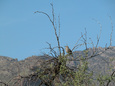
Toxostoma curvirostre is found in southeastern and central Arizona, southeastern parts of Colorado, northeastern New Mexico, through western and central Texas and south to Mexico.
Habitat
The curve-billed thrasher prefers dense aggregations of cholla cactus, mesquite, or palo verde. It will also choose dense urban areas as long as there are suitable nesting areas nearby.
- Terrestrial Biomes
- desert or dune
Physical Description
T. curvirostre is an overall brownish-gray bird that quite effectively blends in with its surroundings. The chest is mottled and the tail is dark gray. A very conspicuous characteristic of T. curvirostre is the golden-orange color of its eyes and of course the long curved bill that gives it its name. Both male and female are between 9.5"-11.5" in length; there is no sexual dimorphism evident in this species.
- Other Physical Features
- endothermic
- bilateral symmetry
Reproduction
It builds its nest most often in cholla cactus, usually under the upper protective arms. Twigs are used to construct the nest. Two to four light blue eggs are laid; and the altricial young hatch between 12 to 15 days.
- Key Reproductive Features
- iteroparous
- gonochoric/gonochoristic/dioecious (sexes separate)
- sexual
- oviparous
Lifespan/Longevity
-
- Average lifespan
Status: wild - 129 months
- Bird Banding Laboratory
- Average lifespan
Behavior
T. curvirostre has the most curious personality out of all the thrashers. Not of the shy sort, T. curvirostre broadcasts its call "whit-wheet" vigorously while flying from shrub to shrub.
- Key Behaviors
- flies
- motile
Communication and Perception
Food Habits
T. curvirostre is an omnivore that uses its curved bill to probe for insects under dead leaves and other debris. While insects are its main food source, other food items include cacti seeds, prickly pear fruit, and various berries.
Economic Importance for Humans: Positive
T. curvirostre may benefit humans by reducing the numbers of pest or damaging insects. As a seed eater, it may play a role in seed dispersal.
Also, T. curvirostre is an enjoyable species to observe in nature. Its antics will keep the observer amused for hours.
Conservation Status
-
- IUCN Red List
-
Least Concern
More information
-
- IUCN Red List
-
Least Concern
More information
-
- US Federal List
- No special status
-
- CITES
- No special status
Contributors
Lindsay Carney (author), Pima Community College.
Glossary
- Nearctic
-
living in the Nearctic biogeographic province, the northern part of the New World. This includes Greenland, the Canadian Arctic islands, and all of the North American as far south as the highlands of central Mexico.

- acoustic
-
uses sound to communicate
- bilateral symmetry
-
having body symmetry such that the animal can be divided in one plane into two mirror-image halves. Animals with bilateral symmetry have dorsal and ventral sides, as well as anterior and posterior ends. Synapomorphy of the Bilateria.
- chemical
-
uses smells or other chemicals to communicate
- desert or dunes
-
in deserts low (less than 30 cm per year) and unpredictable rainfall results in landscapes dominated by plants and animals adapted to aridity. Vegetation is typically sparse, though spectacular blooms may occur following rain. Deserts can be cold or warm and daily temperates typically fluctuate. In dune areas vegetation is also sparse and conditions are dry. This is because sand does not hold water well so little is available to plants. In dunes near seas and oceans this is compounded by the influence of salt in the air and soil. Salt limits the ability of plants to take up water through their roots.
- endothermic
-
animals that use metabolically generated heat to regulate body temperature independently of ambient temperature. Endothermy is a synapomorphy of the Mammalia, although it may have arisen in a (now extinct) synapsid ancestor; the fossil record does not distinguish these possibilities. Convergent in birds.
- iteroparous
-
offspring are produced in more than one group (litters, clutches, etc.) and across multiple seasons (or other periods hospitable to reproduction). Iteroparous animals must, by definition, survive over multiple seasons (or periodic condition changes).
- motile
-
having the capacity to move from one place to another.
- native range
-
the area in which the animal is naturally found, the region in which it is endemic.
- oviparous
-
reproduction in which eggs are released by the female; development of offspring occurs outside the mother's body.
- sexual
-
reproduction that includes combining the genetic contribution of two individuals, a male and a female
- tactile
-
uses touch to communicate
- visual
-
uses sight to communicate
References
Davis, B. 1986. Birds of the Southwest Volume I. Tucson, Arizona: Treasure Chest Publication, Inc..
Phillips, A., J. Marshall, G. Monson. 1964. The Birds of Arizona. Tucson, Arizona: The University of Arizona Press.
Phillips, S., P. Comus. 2000. A Natural History of the Sonoran Desert. Tucson, Arizona: Arizona-Sonora Desert Museum Press.