Tolypeutes matacussouthern three-banded armadillo

Geographic Range
South America: north central Argentina, east central Bolivia and sections of Brazil and Paraguay.
- Biogeographic Regions
- neotropical
Habitat
This species is found mainly in the grasslands or marshes near dry forests or savannah areas.
- Terrestrial Biomes
- savanna or grassland
- scrub forest
Physical Description
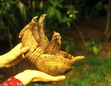
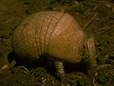
Total body length is around 300mm with a tail length of 64mm. They are dark brown and heavely armored with a thick, leathery shell that is usually segmented into 3 bands. This armor covers the tail, head, feet, and back of the animal. The tail is very stout and immobile. The middle three toes on the back feet are grown together and have a thick claw. The forefeet toes are seperated and have 4 claws.
- Other Physical Features
- endothermic
- bilateral symmetry
-
- Range mass
- 1.4 to 1.6 kg
- 3.08 to 3.52 lb
-
- Average basal metabolic rate
- 1.172 W
- AnAge
Reproduction
The southern three-banded armadillo reaches sexual maturity at 9-12 months of age. Most of the young are born from November-January but births have been reported throughout the year, indicating that there is no distinct breeding season. The single young are born blind but quickly develop the ability to close their shells and walk. They are no longer dependent on their mothers after 72 days.
- Key Reproductive Features
- gonochoric/gonochoristic/dioecious (sexes separate)
- sexual
Lifespan/Longevity
-
- Average lifespan
Status: captivity - 36 years
- AnAge
- Average lifespan
Behavior
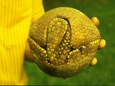
The southern three-banded armadillo is peculiar amoung armadillos for its rolling behavior. It can completely close its shell around its entire body. Usually it leaves a small space between a section of its armor, which it forcefully closes on the hand, finger, or paw of a would-be predator. This shell is also very efficient at trapping air, which is warmed by body heat, and thus conserves heat loss. Three-banded armadillos are usually solitary but occasionally group together during cold weather. They do not dig burrows of their own but use abandoned anteater burrows, or they make their dens under dense vegetation.
- Key Behaviors
- motile
Communication and Perception
Food Habits
This species of armadillo eats mainly ants and termites. They use their strong legs and large claws to dig through insect colonies or under bark to get to their food.
Economic Importance for Humans: Positive
This species is hunted throughout its range for its meat and is an important food source in some areas.
Economic Importance for Humans: Negative
No documented examples.
Conservation Status
They do not appear to be declining at a threatening rate.
-
- IUCN Red List
-
Near Threatened
More information
Other Comments
This species of armadillo is easily caught by hand. Its genetic makeup is very different from most armadillos.
Contributors
Eric J. Ellis (author), University of Michigan-Ann Arbor.
Glossary
- Neotropical
-
living in the southern part of the New World. In other words, Central and South America.

- bilateral symmetry
-
having body symmetry such that the animal can be divided in one plane into two mirror-image halves. Animals with bilateral symmetry have dorsal and ventral sides, as well as anterior and posterior ends. Synapomorphy of the Bilateria.
- chemical
-
uses smells or other chemicals to communicate
- endothermic
-
animals that use metabolically generated heat to regulate body temperature independently of ambient temperature. Endothermy is a synapomorphy of the Mammalia, although it may have arisen in a (now extinct) synapsid ancestor; the fossil record does not distinguish these possibilities. Convergent in birds.
- motile
-
having the capacity to move from one place to another.
- native range
-
the area in which the animal is naturally found, the region in which it is endemic.
- scrub forest
-
scrub forests develop in areas that experience dry seasons.
- sexual
-
reproduction that includes combining the genetic contribution of two individuals, a male and a female
- tactile
-
uses touch to communicate
- tropical savanna and grassland
-
A terrestrial biome. Savannas are grasslands with scattered individual trees that do not form a closed canopy. Extensive savannas are found in parts of subtropical and tropical Africa and South America, and in Australia.
- savanna
-
A grassland with scattered trees or scattered clumps of trees, a type of community intermediate between grassland and forest. See also Tropical savanna and grassland biome.
- temperate grassland
-
A terrestrial biome found in temperate latitudes (>23.5° N or S latitude). Vegetation is made up mostly of grasses, the height and species diversity of which depend largely on the amount of moisture available. Fire and grazing are important in the long-term maintenance of grasslands.
References
MacDonald, Dr. David [Editor]. The Encyclopedia of Mammals. Equinox Ltd, 1984. Pg 783.
Nowak, Ronald M. Walker's Mammals of the World, 5th Edition Volume 1. The Johns Hopkins University Press, 1991. Pgs 531-532,