Thylamys venustusbuff-bellied fat-tailed mouse opossum
Geographic Range
Thylamys venustus is distributed at low- to mid-elevations in the Andes from Central Bolivia southward into northern Argentina. (Giarla, et al., 2010)
- Biogeographic Regions
- neotropical
Habitat
Thylamys venustus primarily inhabits mid-level montane forests and seasonally dry forests between 350 and 4000 meters above sea level in the eastern Andes. This species overlaps in distribution with Thylamys sponsorius, Thylamys pallidior, and Thylamys pusillus. (Giarla, et al., 2010)
- Habitat Regions
- tropical
- terrestrial
-
- Range elevation
- 350 to 4000 m
- 1148.29 to 13123.36 ft
Physical Description
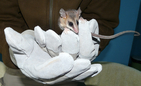
Like other members of its genus, Thylamys venustus is notable for its incrassate (fattened) tail. The size of the tail varies by season in accordance with food availability. Although this species is a marsupial, females do not have a pouch. This species is tricolored, with darker dorsal fur, paler lateral fur, and a grayish ventral region. This species is very similar in morphology to its sister species Thylamys sponsorius, though it tends to be slightly smaller. Like Thylamys sponsorius, this species has a relatively long tail that is considerably longer than its body. Giarla et al. (2010) report head and body lengths that range from 84 to 110 mm (average 96 mm) and tail lengths that range from 111 to 138 mm long (average 126 mm). (Giarla, et al., 2010)
- Other Physical Features
- endothermic
- bilateral symmetry
-
- Range length
- 195 to 248 mm
- 7.68 to 9.76 in
-
- Average length
- 222 mm
- 8.74 in
Reproduction
Little is known about the mating system in Thylamys venustus.
Little is known about the general reproductive behavior of Thylamys venustus.
- Key Reproductive Features
- gonochoric/gonochoristic/dioecious (sexes separate)
- sexual
- fertilization
- viviparous
Little is known about parental investment in Thylamys venustus. Like all marsupials, females nurse their highly altricial young. However, because members of the genus Thylamys lack a pouch (marsupium), the young must cling to their mother's venter. (Giarla, et al., 2010)
- Parental Investment
- altricial
- female parental care
-
pre-fertilization
- provisioning
-
protecting
- female
-
pre-hatching/birth
-
provisioning
- female
-
protecting
- female
-
provisioning
-
pre-weaning/fledging
-
provisioning
- female
-
protecting
- female
-
provisioning
Lifespan/Longevity
No records of lifespan in this species are available.
Behavior
Little is known about the behavior of Thylamys venustus. This species is likely solitary, as most small, insectivorous mammals are. As is the case for other members of this genus, Thylamys venustus is nocturnal and experiences daily torpor. Like other members of the genus Thylamys, individuals likely build nests out of grass, hair, feathers, and leaves in rocks, trees, and under shrubs (Braun et al., 2010). Thylamys species are primarily terrestrial but are also skilled at climbing bushes and small trees. (Braun, et al., 2010; Giarla, et al., 2010)
Home Range
No data on the home range of this species are available.
Communication and Perception
Because this species is small and nocturnal, communication between individuals is likely primarily olfactory in nature. Palma (1997) reports that the olfactory and visual regions of another Thylamys species' brain are especially well developed. (Palma, 1997)
- Perception Channels
- visual
- tactile
- acoustic
- vibrations
- chemical
Food Habits
Little is known about the food habits of this species. Like other Thylamys species, Thylamys venustus likely consumes insects and perhaps occasionally eats small vertebrates, leaves, fruit, seeds, and carrion (Palma 1997). (Palma, 1997)
- Primary Diet
- carnivore
Predation
Like other small mammals, Thylamys venustus is likely well adapted to avoiding predators by being nocturnal and inconspicuous. No records of known predators are available.
- Anti-predator Adaptations
- cryptic
Ecosystem Roles
Thylamys venustus likely acts as an important predator to many arthropod species and perhaps some small vertebrates. It is likely prey to both bird and medium-sized mammals, such as owls and foxes. It is also likely host to many ecto- and endoparasites. More specific information about the ecosystem role of Thylamys venustus is not presently available.
Economic Importance for Humans: Positive
There are no known positive effects of Thylamys venustus on humans.
Economic Importance for Humans: Negative
There are no known negative effects of Thylamys venustus on humans.
Conservation Status
This species is listed as "Data Deficient" by the IUCN.
-
- IUCN Red List
- Data Deficient
Contributors
Tom Giarla (author), University of Minnesota, Sharon Jansa (editor), American Museum of Natural History, Robert Voss (editor), American Museum of Natural History, Tanya Dewey (editor), University of Michigan-Ann Arbor.
Glossary
- Neotropical
-
living in the southern part of the New World. In other words, Central and South America.

- acoustic
-
uses sound to communicate
- altricial
-
young are born in a relatively underdeveloped state; they are unable to feed or care for themselves or locomote independently for a period of time after birth/hatching. In birds, naked and helpless after hatching.
- arboreal
-
Referring to an animal that lives in trees; tree-climbing.
- bilateral symmetry
-
having body symmetry such that the animal can be divided in one plane into two mirror-image halves. Animals with bilateral symmetry have dorsal and ventral sides, as well as anterior and posterior ends. Synapomorphy of the Bilateria.
- carnivore
-
an animal that mainly eats meat
- chemical
-
uses smells or other chemicals to communicate
- cryptic
-
having markings, coloration, shapes, or other features that cause an animal to be camouflaged in its natural environment; being difficult to see or otherwise detect.
- endothermic
-
animals that use metabolically generated heat to regulate body temperature independently of ambient temperature. Endothermy is a synapomorphy of the Mammalia, although it may have arisen in a (now extinct) synapsid ancestor; the fossil record does not distinguish these possibilities. Convergent in birds.
- female parental care
-
parental care is carried out by females
- fertilization
-
union of egg and spermatozoan
- forest
-
forest biomes are dominated by trees, otherwise forest biomes can vary widely in amount of precipitation and seasonality.
- insectivore
-
An animal that eats mainly insects or spiders.
- motile
-
having the capacity to move from one place to another.
- mountains
-
This terrestrial biome includes summits of high mountains, either without vegetation or covered by low, tundra-like vegetation.
- native range
-
the area in which the animal is naturally found, the region in which it is endemic.
- nocturnal
-
active during the night
- sedentary
-
remains in the same area
- sexual
-
reproduction that includes combining the genetic contribution of two individuals, a male and a female
- solitary
-
lives alone
- tactile
-
uses touch to communicate
- terrestrial
-
Living on the ground.
- tropical
-
the region of the earth that surrounds the equator, from 23.5 degrees north to 23.5 degrees south.
- vibrations
-
movements of a hard surface that are produced by animals as signals to others
- visual
-
uses sight to communicate
- viviparous
-
reproduction in which fertilization and development take place within the female body and the developing embryo derives nourishment from the female.
References
Braun, J., N. Pratt, M. Mares. 2010. Thylamys pallidior (Didelphimorphia: Didelphidae). Mammalian Species, 42(856): 90-98.
Giarla, T., R. Voss, S. Jansa. 2010. Species Limits and Phylogenetic Relationships in the Didelphid Marsupial Genus Thylamys Based on Mitochondrial DNA Sequences and Morphology. Bulletin of the American Museum of Natural History, 346: 1-67.
Palma, R. 1997. Thylamys elegans. Mammalian Species, 572: 1-4.