Thryonomyidaecane rats
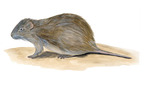
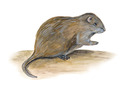
The Thryonomyidae contains 2 species placed in a single genus ( Thryonomys). At present, its members are distributed over Africa south of the Sahara. In the past, cane rats were much more broadly distributed; fossil thryonomyids have been found in Asia and Europe as well as Africa.
Cane rats are large, ranging up to around 9 kg in weight. They have stocky bodies, a large and blunt head, small eyes, and small rounded ears. The tail is considerably shorter than the body and sparsely haired. Limbs are short and powerful. The forefeet and hindfeet have 3 large digits; the pollex and hallux are reduced in size or absent and the fifth finger is very small. On both forefeet and hindfeet, the functional digits have thick, strong claws that are adapted for digging.
The pelage of cane rats is unusual, made up of coarse, flattened or grooved bristle-like hairs, and lacking underfur. Dorsally, cane rats tend to be brown or grayish brown, heavily speckled with yellow or buff; ventrally, they are usually gray or buffy.
Cane rats have a massive skull, heavily built and with conspicuous crests and ridges. The rostrum is broad, the frontal region is broad and flat, and the zygomatic arch is robust. Thryonomyids are hystricomorphous and hystricognathus; the infraorbital canal is large and includes a distinct groove for nerves passing to the rostrum. The jugal nearly contacts the lacrimal. On the ventral surface of the cranium, the bullae are small, and the paroccipital processes are long and straight.


Cane rats have broad, deeply orange incisors. Curiously, the anterior surface of each incisor has 3 grooves that run the length of the tooth. Cheekteeth are moderately hypsodont but rooted (not evergrowing). The upper molars have 2 labial folds and 1 lingual; the reverse is true of the lowers. Each appears to be made up of 3 transverse crests.
Cane rats are generally found in wet or swampy areas where grasses are plentiful. They do sometimes move into agricultural lands, where they can be serious pests in plantations of corn, cassava, sugar cane, pineapple, and other crops. Individuals sometimes associate in small groups, but they are not strongly gregarious. They communicate vocally and by foot-stamping. Cane rats make well-defined paths through dense grass; these usually go from feeding areas to water. These rodents are excellent swimmers, often retreating to water when threatened. Cane rats also are good diggers and excavate shallow burrows as shelters.
While cane rats cause considerable damage to crops, they are themselves prized for their meat.
References and literature cited:
Feldhamer, G. A., L. C. Drickamer, S. H. Vessey, and J. F. Merritt. 1999. Mammalogy. Adaptation, Diversity, and Ecology. WCB McGraw-Hill, Boston. xii+563pp.
Macdonald, David. 1984. The encyclopedia of mammals. Facts on File Publications, New York.
Nowak, R. M. and J. L. Paradiso. 1983. Walker's mammals of the world. The Johns Hopkins University Press, Baltimore and London, pp 803-810.
Vaughan, T. A. 1986. Mammalogy. Third Edition. Saunders College Publishing, Fort Worth. vii+576 pp.
Vaughan, T. A., J. M. Ryan, N. J. Czaplewski. 2000. Mammalogy. Fourth Edition. Saunders College Publishing, Philadelphia. vii+565pp.
Wilson, D. E. and D. M. Reeder (eds.). 1993. Mammal species of the world: A taxonomic and geographic reference, 2nd ed.. Smithsonian Institution Press, Washington and London.
Woods, C. A. 1984. Hystricognath rodents. Pp. 389-446 in Anderson, S. and J. K. Jones, Jr. (eds.). Orders and familes of mammals of the world. John Wiley and Sons, New York.
Contributors
Phil Myers (author), Museum of Zoology, University of Michigan-Ann Arbor.
Glossary
- bilateral symmetry
-
having body symmetry such that the animal can be divided in one plane into two mirror-image halves. Animals with bilateral symmetry have dorsal and ventral sides, as well as anterior and posterior ends. Synapomorphy of the Bilateria.
- chemical
-
uses smells or other chemicals to communicate
- endothermic
-
animals that use metabolically generated heat to regulate body temperature independently of ambient temperature. Endothermy is a synapomorphy of the Mammalia, although it may have arisen in a (now extinct) synapsid ancestor; the fossil record does not distinguish these possibilities. Convergent in birds.
- motile
-
having the capacity to move from one place to another.
- sexual
-
reproduction that includes combining the genetic contribution of two individuals, a male and a female
- tactile
-
uses touch to communicate