Testudinidae


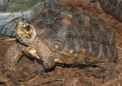
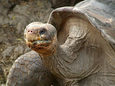
The species of the genus Geochelone are the largest living land turtles.
The family Testudinidae contains approximately 11 genera and 40-50 species, depending on the source. Tortoises are found in North and South America, Europe, Africa, Asia, and on the islands of Madagascar, the Galapagos, and the Aldabra Atoll. All are terrestrial and inhabit warm areas ranging from rain forests to deserts.
Tortoises range in size from a carapace of < 12 cm (Homopus) to carapace lengths of 130 cm (Geochelone). The carapace is domed, and the plastron is usually without a hinge. A plastral hinge is found in both Pyxis and Testudo, and the only carapacial hinge known in the Testudines is found in Kinixys. Adaptations for terrestrial life include thick, elephantine rear legs, short, web-less feet, and short digits. The forelegs usually have heavy scales on the anterior surface. Tortoises can be diagnosed by the lack of glands in the axillary and inguinal regions and the presence of only four digits on the rear feet.
Tortoises are essentially herbivores and feed on grasses, sedges, flowers, succulents, and fruits, although some species all also known to feed on carrion. Predators of eggs and hatchlings include small mammals, birds, and other reptiles. Species with smaller adults suffer occasional predation by canids and raccoons.
Courtship routines are varied, but often involve trailing of the female by the male, head gestures by the male, and biting of the female by the male. Females typically produce small clutches (less than 10 eggs), but may produce more than one clutch per season.
Conservation is necessary for many tortoises. Exploitation has come about through over-collection for pets and food. In the southeastern US, organized rattlesnake hunts destroy gopher tortoise (Gopherus polyphemus) burrows and lead to the deaths of tortoises.
The Testudinidae are most closely related to the pond turtles (Emydidae) and are included along with that family in the Testudinoidea. Shared features include a lack of inframarginal scutes, the shape and muscle attachment of the ilium, and the shape of the eighth cervical vertebra (biconvex). If, as some authors suggest, the Emydidae is split into two families- Emydidae and Bataguridae, then the Batagurids are placed in closer association with the Testudinidae in a group called the Testudinoidae which excludes the Emydidae. No subfamilies within Testudinidae are recognized.
Fossil tortoises are numerous, and the oldest (Geochelone majusculus) dates to the early Eocene. Manouria is considered the oldest extant genus.
Ernst, C.H., and Barbour, R.W. 1989. Turtles of the World. Smithsonian Inst. Press, Washington, D.C.
Ernst, C.H., Lovich, J.E., and Barbour, R.W. 1994. Turtles of the United States and Canada. Smithsonian Inst. Press, Washington, D.C.
Pough, F.H., Andrews, R.M., Cadle, J.E., Crump, M.L., Savitzky, A.H., and Wells, K.D. 2000. Herpetology, 2nd ed. Prentice Hall, Upper Saddle River, NJ.
Contributors
Keith Pecor (author).
Glossary
- bilateral symmetry
-
having body symmetry such that the animal can be divided in one plane into two mirror-image halves. Animals with bilateral symmetry have dorsal and ventral sides, as well as anterior and posterior ends. Synapomorphy of the Bilateria.
- ectothermic
-
animals which must use heat acquired from the environment and behavioral adaptations to regulate body temperature
- motile
-
having the capacity to move from one place to another.