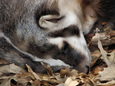
Taxidea taxusAmerican badger
Geographic Range
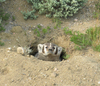
Badgers are found primarily in the Great Plains region of North America. Badgers occur north through the central western Canadian provinces, in appropriate habitat throughout the western United States, and south throughout the mountainous areas of Mexico. They have expanded their range since the turn of the 20th century and are now found as far east as Ontario, Canada. (Kurta, 1995; Long, 1999)
Habitat
Badgers prefer to live in dry, open grasslands, fields, and pastures. They are found from high alpine meadows to sea level (or below in Death Valley, California). (Long, 1999)
- Habitat Regions
- temperate
- terrestrial
- Terrestrial Biomes
- desert or dune
- savanna or grassland
- chaparral
- mountains
- Wetlands
- marsh
- Other Habitat Features
- agricultural
Physical Description
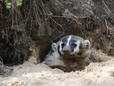
Badgers measure 520 to 875 mm from head to tail, with the tail making up only 100 to 155 mm of this length. Badgers weigh 4 to 12 kg. The body is flattened, and the legs are short and stocky. The fur on the back and flanks of the animal ranges from grayish to reddish. The ventrum is a buffy color. The face of the badger is distinct. The throat and chin are whitish, and the face has black patches. A white dorsal stripe extends back over the head from the nose. In northern populations, this stripe ends near the shoulders. In southern populations, however, it continues over the back to the rump. Males are significantly larger than females and animals from northern populations are larger than those from southern populations. (Kurta, 1995; Long, 1999)
- Other Physical Features
- endothermic
- heterothermic
- homoiothermic
- bilateral symmetry
- Sexual Dimorphism
- male larger
-
- Range mass
- 4 to 12 kg
- 8.81 to 26.43 lb
-
- Range length
- 520 to 875 mm
- 20.47 to 34.45 in
-
- Average basal metabolic rate
- 15.062 W
- AnAge
Reproduction
The home ranges of both male and female badgers expands during the breeding season, indicating that males and females travel more extensively to find mates. Males have larger home ranges that are likely to overlap with the home ranges of several females. (Long, 1999)
- Mating System
- polygynandrous (promiscuous)
Mating occurs in late summer or early autumn but embryos are arrested early in development. Implantation is delayed until December or as late as February. After this period embryos implant into the uterine wall and resume development. So, although a female is technically pregnant for 7 months, gestation is a mere 6 weeks. Litters of 1 to 5 offspring, with an average of 3, are born in early spring. Females are able to mate when they are 4 months old, but males do not mate until the autumn of their second year. Most females mate after their first year. (Long, 1999; Sullivan, 1996)
- Key Reproductive Features
- iteroparous
- seasonal breeding
- gonochoric/gonochoristic/dioecious (sexes separate)
- sexual
- viviparous
- delayed implantation
-
- Breeding interval
- Badgers breed once per year.
-
- Breeding season
- Badgers mate in late summer or early autumn.
-
- Range number of offspring
- 1 to 5
-
- Average number of offspring
- 3
- AnAge
-
- Average gestation period
- 6 weeks
-
- Average gestation period
- 41 days
- AnAge
-
- Range weaning age
- 2 to 3 months
-
- Range time to independence
- 5 to 6 months
-
- Range age at sexual or reproductive maturity (female)
- 4 (low) months
-
- Average age at sexual or reproductive maturity (female)
- 12 months
-
- Average age at sexual or reproductive maturity (male)
- 16 months
-
- Average age at sexual or reproductive maturity (male)
Sex: male - 441 days
- AnAge
- Average age at sexual or reproductive maturity (male)
Female badgers prepare a grass-lined den in which to give birth. Badgers are born blind and helpless with a thin coat of fur. The eyes of the youngsters open at 4 to 6 weeks old, and the young are nursed by their mother until they are 2 to 3 months old. Females give their young solid food before they are weaned and for a few weeks after they are weaned. Young may emerge from the den as early as 5 to 6 weeks old. Juveniles disperse at 5 to 6 months. (Kurta, 1995; Long, 1999; Sullivan, 1996)
- Parental Investment
- altricial
-
pre-fertilization
- provisioning
-
protecting
- female
-
pre-hatching/birth
-
provisioning
- female
-
protecting
- female
-
provisioning
-
pre-weaning/fledging
-
provisioning
- female
-
protecting
- female
-
provisioning
-
pre-independence
-
provisioning
- female
-
protecting
- female
-
provisioning
Lifespan/Longevity
Badgers have lived to be 26 years old in captivity. The average lifespan in the wild has been estimated by different researchers at 4 to 5 years and at 9 to 10 years. The oldest wild badger lived to 14 years. Yearly mortality was estimated at 35% by one study. Some populations are estimated to be up to 80% yearlings or young of the year, suggesting high mortality rates. (Kurta, 1995; Long, 1999; Sullivan, 1996)
-
- Range lifespan
Status: wild - 14 (high) years
- Range lifespan
-
- Range lifespan
Status: captivity - 26 (high) years
- Range lifespan
-
- Typical lifespan
Status: wild - 10 (high) years
- Typical lifespan
-
- Average lifespan
Status: captivity - 26.0 years
- Max Planck Institute for Demographic Research
- Average lifespan
-
- Average lifespan
Status: captivity - 16.0 years
- Max Planck Institute for Demographic Research
- Average lifespan
Behavior
Badgers are solitary animals. Typical population density is about 5 animals per square kilometer. Badgers are mainly active at night, and tend to be inactive during the winter months. They are not true hibernators, but spend much of the winter in cycles of torpor that usually last about 29 hours. During torpor body temperatures fall to about 9 degrees Celsius and the heart beats at about half the normal rate. They emerge from their dens on warm days in the winter.
Badgers are excellent digging machines. Their powerfully built forelimbs allow them to tunnel rapidly through the soil, and apparently through other harder substances as well. There are anecdotal accounts of badgers emerging from holes they have excavated through blacktopped pavement and two inch thick concrete.
Their burrows are constructed mainly in the pursuit of prey, but they are also used for sleeping. A typical badger den may be as far a 3 meters below the surface, contain about 10 meters of tunnels, and have an enlarged chamber for sleeping. Badgers use multiple burrows within their home range, and they may not use the same burrow more than once a month. In the summer months they may dig a new burrow each day. (Kurta, 1995; Long, 1999; Sullivan, 1996)
-
- Range territory size
- 1.6 to 2.4 km^2
Home Range
Males occupy larger home ranges than females (2.4 versus 1.6 square kilometers), but this species is not known to defend an exclusive territory. (Kurta, 1995; Long, 1999)
Communication and Perception
Badgers have keen vision, scent, and hearing. They have nerve endings in the foreclaws that may make them especially sensitive to touch in their forepaws, but this has not been investigated. Not much is known about communication in these normally solitary animals, but it is likely that home ranges are marked with scents that are used by conspecifics to determine reproductive readiness. (Long, 1999)
- Communication Channels
- chemical
Food Habits
Badgers are carnivorous. Their dominant prey are pocket gophers (Geomyidae), ground squirrels (Spermophilus), moles (Talpidae), marmots (Marmota), prairie dogs (Cynomys), woodrats (Neotoma), kangaroo rats (Dipodomys), deer mice (Peromyscus), and voles (Microtus). They also prey on ground nesting birds, such as bank swallows (Riparia riparia and burrowing owls Athene cunicularia), lizards, amphibians, carrion, fish, hibernating skunks (Mephitis and Spilogale), insects, including bees and honeycomb, and some plant foods, such as corn (Zea) and sunflower seeds (Helianthus). Unlike many carnivores that stalk their prey in open country, badgers catch most of their food by digging. They can tunnel after ground dwelling rodents with amazing speed. They have been known to cache food. (Long, 1999; Sullivan, 1996)
- Primary Diet
-
carnivore
- eats terrestrial vertebrates
- Animal Foods
- birds
- mammals
- amphibians
- reptiles
- insects
- terrestrial non-insect arthropods
- Foraging Behavior
- stores or caches food
Predation
Natural predation on badgers is rare, with young animals being most vulnerable. The primary predators of badgers are humans who are responsible for habitat destruction, trapping, hunting, automobile fatalities, and poisoning. Other reported predators of American badgers include golden eagles (Aquila chrysaetos), bobcats (Lynx rufus), cougars (Puma concolor), and coyotes (Canis latrans). Bears (Ursus) and gray wolves (Canis lupus) may also sometimes take badgers. (Long, 1999; Sullivan, 1996)
-
- Known Predators
-
- humans (Homo sapiens)
- golden eagles (Aquila chrysaetos)
- bobcats (Lynx rufus)
- cougars (Puma concolor)
- coyotes (Canis latrans)
Ecosystem Roles
Badgers are important consumers of many small prey items in their ecosystem. They help to control rodent populations, kill venomous snakes, and eat insects and carrion. Their burrows provide shelter for other species and their digging activity helps in soil development. (Long, 1999)
Badgers and coyotes are sometimes seen hunting at the same time in an apparently cooperative manner. Badgers can readily dig rodents out of burrows but cannot run them down readily. Coyotes, on the other hand, can readily run rodents down while above ground, but cannot effectively dig them out of burrows. When badgers and coyotes hunt in the same area at the same time, they may increase the number of rodents available to the other. Coyotes take advantage of rodents attempting to escape from badgers attacking their burrows and it has been demonstrated that coyotes benefit from the association. Badgers may be able to take advantage of rodents that are escaping coyotes by fleeing into burrows, but it is more difficult to assess whether badgers actually do benefit from this association. Badgers and coyotes tolerate each other's presence and may even engage in play behavior. (Sullivan, 1996)
- Ecosystem Impact
- creates habitat
- soil aeration
- coyotes (Canis latrans)
Economic Importance for Humans: Positive
Badgers eat many rodent pests, which may carry disease or damage crops. In addition, their burrows provide shelter for small game mammals, like cottontail rabbits. The fur is attractive, it has been used as a trim on Native American garments and historically it was used to make shaving and painting brushes. (Long, 1999)
- Positive Impacts
- body parts are source of valuable material
- controls pest population
Economic Importance for Humans: Negative
Badger burrows may present a hazard to cattle and horses. Such animals have been known to break legs by stepping into badger holes.
Conservation Status
American badgers are fairly common in appropriate habitats and are not generally considered threatened. In some areas they are uncommon or rare. In Michigan, Wisconsin, Illinois, and British Columbia they are protected from hunting by law. (Kurta, 1995; Long, 1999; Sullivan, 1996)
-
- IUCN Red List
-
Least Concern
More information
-
- IUCN Red List
-
Least Concern
More information
-
- US Federal List
- No special status
-
- CITES
- No special status
-
- State of Michigan List
- No special status
Contributors
Tanya Dewey (editor), Animal Diversity Web.
Allison Poor (editor), University of Michigan-Ann Arbor.
Nancy Shefferly (author), Animal Diversity Web.
Glossary
- Nearctic
-
living in the Nearctic biogeographic province, the northern part of the New World. This includes Greenland, the Canadian Arctic islands, and all of the North American as far south as the highlands of central Mexico.

- acoustic
-
uses sound to communicate
- agricultural
-
living in landscapes dominated by human agriculture.
- altricial
-
young are born in a relatively underdeveloped state; they are unable to feed or care for themselves or locomote independently for a period of time after birth/hatching. In birds, naked and helpless after hatching.
- bilateral symmetry
-
having body symmetry such that the animal can be divided in one plane into two mirror-image halves. Animals with bilateral symmetry have dorsal and ventral sides, as well as anterior and posterior ends. Synapomorphy of the Bilateria.
- carnivore
-
an animal that mainly eats meat
- chaparral
-
Found in coastal areas between 30 and 40 degrees latitude, in areas with a Mediterranean climate. Vegetation is dominated by stands of dense, spiny shrubs with tough (hard or waxy) evergreen leaves. May be maintained by periodic fire. In South America it includes the scrub ecotone between forest and paramo.
- chemical
-
uses smells or other chemicals to communicate
- delayed implantation
-
in mammals, a condition in which a fertilized egg reaches the uterus but delays its implantation in the uterine lining, sometimes for several months.
- desert or dunes
-
in deserts low (less than 30 cm per year) and unpredictable rainfall results in landscapes dominated by plants and animals adapted to aridity. Vegetation is typically sparse, though spectacular blooms may occur following rain. Deserts can be cold or warm and daily temperates typically fluctuate. In dune areas vegetation is also sparse and conditions are dry. This is because sand does not hold water well so little is available to plants. In dunes near seas and oceans this is compounded by the influence of salt in the air and soil. Salt limits the ability of plants to take up water through their roots.
- diurnal
-
- active during the day, 2. lasting for one day.
- endothermic
-
animals that use metabolically generated heat to regulate body temperature independently of ambient temperature. Endothermy is a synapomorphy of the Mammalia, although it may have arisen in a (now extinct) synapsid ancestor; the fossil record does not distinguish these possibilities. Convergent in birds.
- fossorial
-
Referring to a burrowing life-style or behavior, specialized for digging or burrowing.
- heterothermic
-
having a body temperature that fluctuates with that of the immediate environment; having no mechanism or a poorly developed mechanism for regulating internal body temperature.
- hibernation
-
the state that some animals enter during winter in which normal physiological processes are significantly reduced, thus lowering the animal's energy requirements. The act or condition of passing winter in a torpid or resting state, typically involving the abandonment of homoiothermy in mammals.
- iteroparous
-
offspring are produced in more than one group (litters, clutches, etc.) and across multiple seasons (or other periods hospitable to reproduction). Iteroparous animals must, by definition, survive over multiple seasons (or periodic condition changes).
- marsh
-
marshes are wetland areas often dominated by grasses and reeds.
- motile
-
having the capacity to move from one place to another.
- mountains
-
This terrestrial biome includes summits of high mountains, either without vegetation or covered by low, tundra-like vegetation.
- native range
-
the area in which the animal is naturally found, the region in which it is endemic.
- nocturnal
-
active during the night
- polygynandrous
-
the kind of polygamy in which a female pairs with several males, each of which also pairs with several different females.
- seasonal breeding
-
breeding is confined to a particular season
- sedentary
-
remains in the same area
- sexual
-
reproduction that includes combining the genetic contribution of two individuals, a male and a female
- soil aeration
-
digs and breaks up soil so air and water can get in
- solitary
-
lives alone
- stores or caches food
-
places a food item in a special place to be eaten later. Also called "hoarding"
- tactile
-
uses touch to communicate
- temperate
-
that region of the Earth between 23.5 degrees North and 60 degrees North (between the Tropic of Cancer and the Arctic Circle) and between 23.5 degrees South and 60 degrees South (between the Tropic of Capricorn and the Antarctic Circle).
- terrestrial
-
Living on the ground.
- tropical savanna and grassland
-
A terrestrial biome. Savannas are grasslands with scattered individual trees that do not form a closed canopy. Extensive savannas are found in parts of subtropical and tropical Africa and South America, and in Australia.
- savanna
-
A grassland with scattered trees or scattered clumps of trees, a type of community intermediate between grassland and forest. See also Tropical savanna and grassland biome.
- temperate grassland
-
A terrestrial biome found in temperate latitudes (>23.5° N or S latitude). Vegetation is made up mostly of grasses, the height and species diversity of which depend largely on the amount of moisture available. Fire and grazing are important in the long-term maintenance of grasslands.
- visual
-
uses sight to communicate
- viviparous
-
reproduction in which fertilization and development take place within the female body and the developing embryo derives nourishment from the female.
References
Hoffmeister, D.F. 1989. Mammals of Illinois. University of Illinois Press, Urbana and Chicago.
Nowak, Ronald. 1991. Walker's Mammals of the World. John Hopkins University Press, Baltimore and London.
Kurta, A. 1995. Mammals of the Great Lakes Region. Ann Arbor: University of Michigan Press.
Long, C. 1999. American badger: Taxidea taxus. Pp. 177-179 in D Wilson, S Ruff, eds. The Smithsonian Book of North American Mammals. Washington, D.C.: Smithsonian Institution Press.
Sullivan, J. 1996. "Taxidea taxus" (On-line). USDA Forest Service, Wildlife Species. Accessed September 08, 2006 at http://www.fs.fed.us/database/feis/wildlife/mammal/tata/all.html.