Tamiasciurus douglasiiDouglas's squirrel

Geographic Range
Douglas squirrels are found along the Pacific coast of North America. Their range is limited to northern California, west and central Oregon, western Washington and southwestern British Columbia, Canada. (""Douglas' Squirrel"", 2003; )
Habitat
Douglas squirrels mainly inhabit conifer forests; on occasion, they are found in other forests where conifer trees are present. Their elevation ranges from sea level to 3300 meters. (""Douglas' Squirrel"", 2003; Harvey, 2003; Maser and et. al, 1981)
Douglas squirrels make their homes in nests. In summer, they usually build their nest of twigs, mosses, lichens and shredded bark. Sometimes they will occupy empty bird nests. The nests can be found in the forks of trees or further out on the limbs. In winter, they often build their nest in tree crevices, in holes from deserted woodpecker nests, or underground, under their food cache. ("Chickaree", 1969; ""Douglas' Squirrel"", 2003; Maser and et. al, 1981)
- Habitat Regions
- temperate
- Terrestrial Biomes
- forest
-
- Range elevation
- 0 to 3300 m
- 0.00 to 10826.77 ft
Physical Description
There are no characteristic differences between the physical appearances of female and male Douglas squirrels. The adult body length ranges from 270 to 355 mm. The tail ranges from 100 to 160 mm. The hind feet range from 44-60 mm. Weight range is 141-312 g. (""Douglas' Squirrel"", 2003; Maser and et. al, 1981)
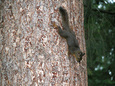
Douglas squirrels have distinct summer and winter coats. Their summer pelage ranges from reddish-brown to grayish-brown on the backside. Many of these hairs are orange or black at the ends. The underside ranges from light to dark orange, sometimes with white areas. It is this orange coloring on the chest and belly that sets Tamiasciurus douglasii apart from its nearest relative, the red squirrel. Douglas squirrels have a broad, bushy tail, the dorsal side of which is similarly colored to the back, with a black tip. The tail's underside is reddish-brown in the center, fading out to black, and then to light orange or white at the edges. Douglas squirrels have a black stripe that runs along their sides. This stripe is lacking in juveniles and faded or absent in winter. The winter pelage is more gray overall; thus, the orange of the underside becomes less visible. In the most northern part of its range, Tamiasciurus douglasii may also have ear tufts in winter. ("Chickaree", 1969; ""Douglas' Squirrel"", 2003; Maser and et. al, 1981)
- Other Physical Features
- endothermic
- bilateral symmetry
- Sexual Dimorphism
- sexes alike
-
- Range mass
- 141 to 312 g
- 4.97 to 11.00 oz
-
- Range length
- 270 to 355 mm
- 10.63 to 13.98 in
Reproduction
Like other squirrels, the courtship of Tamiasciurus douglasii consists of a mating chase in which the males and females call to and chase each other. This ultimately leads to coupling off and mating. Each Douglas squirrel has one mate per mating season. ("Chickaree", 1969)
- Mating System
- monogamous
Male Douglas squirrel testes become mature in spring. Reproduction occurs from January until mid-August with the greatest portion between March and May. Most females have only one litter per year, although occasionally a second litter is born in August or September. The gestation period ranges from 36 to 40 days. Females have eight mammae, and the litter size ranges from 1 to 8, with 4 to 6 on average. (Costello and Rosenberger, 2003; ""Douglas' Squirrel"", 2003; Harvey, 2003; Maser and et. al, 1981)
- Key Reproductive Features
- seasonal breeding
- gonochoric/gonochoristic/dioecious (sexes separate)
- sexual
- viviparous
-
- Breeding interval
- The majority of Douglas squirrels breed once a year.
-
- Breeding season
- Reproduction can occur from January through August, although it usually occurs from March to June.
-
- Range number of offspring
- 1 to 8
-
- Average number of offspring
- 4-6
-
- Range gestation period
- 36 to 40 days
-
- Range weaning age
- 6 to 9 weeks
-
- Range time to independence
- 4 to 7 months
-
- Range age at sexual or reproductive maturity (female)
- 8 to 9 months
-
- Range age at sexual or reproductive maturity (male)
- 8 to 9 months
Douglas squirrels are born blind and without hair, weighing between 13 and 18 g. Fur covers the body by 18 days, and the eyes open at around 26 to 36 days. The young stay in their mother’s nest until they are one-half to two-thirds the size of an adult, usually around mid-July to early August. Siblings and the mother remain in close contact when they first leave the nest. Weaning starts at 6 weeks and is finished by 9 weeks. After this, the young become more independent, but families remain together until December. A juvenile Douglas squirrel will reach adult body size after around 8 to 9 months. Most will reproduce the following summer. (; Harvey, 2003; Maser and et. al, 1981)
- Parental Investment
- altricial
-
pre-hatching/birth
-
provisioning
- female
-
protecting
- female
-
provisioning
-
pre-weaning/fledging
-
provisioning
- female
-
protecting
- female
-
provisioning
-
pre-independence
-
provisioning
- female
-
protecting
- female
-
provisioning
Lifespan/Longevity
No information could be found on the lifespan of Tamiasciurus douglasii.
Behavior
Douglas squirrels are diurnal and active during all seasons. However, during harsh winter weather and storms, they will retreat to their nests. They are solitary except when mating and when the mother cares for her young. Douglas squirrels spend much of their time foraging for food, climbing about the trees, and keeping watch. They are very noisy, especially when fighting over territory, and warning of danger. Tamiasciurus douglasii is scansorial. Adaptations for this include great jumping ability, strong claws that can grip bark, and the tail, which is used for balance. (Costello and Rosenberger, 2003; ""Douglas' Squirrel"", 2003; Harvey, 2003; Maser and et. al, 1981)
- Key Behaviors
- arboreal
- scansorial
- diurnal
- motile
- solitary
- territorial
-
- Average territory size
- 10,000-15,000 m^2
Home Range
Douglas squirrels' home range and territory are the same. The average territory ranges from 1 to 1.5 hectares (10,000 to 15,000 square meters), with no difference between males and females. They do not migrate. (Harvey, 2003)
Communication and Perception
Douglas squirrels are very vocal and have a wide variety of calls. Maser describes them as “ranging from a low ‘chir’ or ‘burr’ to an explosive ‘bauf, bauf bauf.’” (Maser et.al., 1981) The squirrels communicate with each other when disputing over territory, during courtship, and when warning of danger. They presumably also use chemical signals (i.e. scent), like other squirrels, to communicate with each other. ("Chickaree", 1969; Maser and et. al, 1981)
Douglas squirrels have whiskers above and below their eyes, as well as on their noses, and chins. These allow tactile perception of their environment. Additionally, Douglas squirrels have very good vision and hearing, and a good sense of smell.
Food Habits
Douglas squirrels feed on a wide array of foods. They are mainly granivorous; pine seeds make up large portion of their diet. Depending on the season, they also eat fungi, cambium of conifers, twigs, sap, leaves, buds, acorns and other nuts, mushrooms, fruits, and berries. From time to time, they also eat arthropods, birds eggs, and nestlings. In fall, Douglas squirrels cut green cones from the tops of trees and cache them in a damp place, so the seeds remain fresh to eat throughout the winter. They will also cut mushrooms and store them in the forks of trees to dry and eat during winter. Douglas squirrels often store more food than they will eat during the winter, which can be useful if food sources are poor in the spring. They are protective of their caches and will burrow through the snow to get to them. ("Chickaree", 1969; ""Douglas' Squirrel"", 2003; ; Harvey, 2003; Maser and et. al, 1981)
- Animal Foods
- birds
- eggs
- terrestrial non-insect arthropods
- Plant Foods
- leaves
- wood, bark, or stems
- seeds, grains, and nuts
- fruit
- sap or other plant fluids
- Other Foods
- fungus
- Foraging Behavior
- stores or caches food
Predation
Predators of Tamiasciurus douglasii include bobcats, martens, coyotes, larger owls, long-tailed weasels, domestic cats, foxes, and goshawks. Douglas squirrels are alert and fast, helping to evade predators. Typically, they will not eat on the ground, since this inhibits awareness of their surroundings. (""Douglas' Squirrel"", 2003; Harvey, 2003; Maser and et. al, 1981)
-
- Known Predators
-
- long-tailed weasels (Mustela frenata)
- American martens (Martes americana)
- coyotes (Canis latrans)
- bobcats (Lynx rufus)
- domestic cats (Felis silvestris)
- northern goshawks (Accipiter gentilis)
- foxes (Canidae)
- owls (Strigiformes)
Ecosystem Roles
In eating the fruiting bodies of fungi, Douglas squirrels may help to distribute the fungi's spores through their feces. These spores may then develop mycorrhizal relationships with conifer roots. They probably also help disperse conifer seeds in carrying cones to their caches. They also use plants from their environment to build their nests. (Pyare and Longland, 2001)
- Ecosystem Impact
- disperses seeds
- creates habitat
- none known
- none known
- none known
Economic Importance for Humans: Positive
People often steal Douglas squirrels's green cone caches and sell the cones, which contain fresh seeds, to tree nurseries. (""Douglas' Squirrel"", 2003; Maser and et. al, 1981)
Economic Importance for Humans: Negative
Douglas squirrels can cause damage to homes. They also sometimes gather nuts from filbert orchards before they are ready. (Maser and et. al, 1981)
- Negative Impacts
- crop pest
- household pest
Conservation Status
There are no known major threats to Douglas squirrel populations.
-
- IUCN Red List
-
Least Concern
More information
-
- IUCN Red List
-
Least Concern
More information
-
- US Federal List
- No special status
-
- CITES
- No special status
Contributors
Matthew Wund (editor), University of Michigan-Ann Arbor.
Jennifer Pfau (author), University of Michigan-Ann Arbor, Phil Myers (editor, instructor), Museum of Zoology, University of Michigan-Ann Arbor.
Glossary
- Nearctic
-
living in the Nearctic biogeographic province, the northern part of the New World. This includes Greenland, the Canadian Arctic islands, and all of the North American as far south as the highlands of central Mexico.

- acoustic
-
uses sound to communicate
- altricial
-
young are born in a relatively underdeveloped state; they are unable to feed or care for themselves or locomote independently for a period of time after birth/hatching. In birds, naked and helpless after hatching.
- arboreal
-
Referring to an animal that lives in trees; tree-climbing.
- bilateral symmetry
-
having body symmetry such that the animal can be divided in one plane into two mirror-image halves. Animals with bilateral symmetry have dorsal and ventral sides, as well as anterior and posterior ends. Synapomorphy of the Bilateria.
- chemical
-
uses smells or other chemicals to communicate
- diurnal
-
- active during the day, 2. lasting for one day.
- endothermic
-
animals that use metabolically generated heat to regulate body temperature independently of ambient temperature. Endothermy is a synapomorphy of the Mammalia, although it may have arisen in a (now extinct) synapsid ancestor; the fossil record does not distinguish these possibilities. Convergent in birds.
- forest
-
forest biomes are dominated by trees, otherwise forest biomes can vary widely in amount of precipitation and seasonality.
- granivore
-
an animal that mainly eats seeds
- herbivore
-
An animal that eats mainly plants or parts of plants.
- monogamous
-
Having one mate at a time.
- motile
-
having the capacity to move from one place to another.
- native range
-
the area in which the animal is naturally found, the region in which it is endemic.
- seasonal breeding
-
breeding is confined to a particular season
- sexual
-
reproduction that includes combining the genetic contribution of two individuals, a male and a female
- solitary
-
lives alone
- stores or caches food
-
places a food item in a special place to be eaten later. Also called "hoarding"
- tactile
-
uses touch to communicate
- temperate
-
that region of the Earth between 23.5 degrees North and 60 degrees North (between the Tropic of Cancer and the Arctic Circle) and between 23.5 degrees South and 60 degrees South (between the Tropic of Capricorn and the Antarctic Circle).
- territorial
-
defends an area within the home range, occupied by a single animals or group of animals of the same species and held through overt defense, display, or advertisement
- visual
-
uses sight to communicate
- viviparous
-
reproduction in which fertilization and development take place within the female body and the developing embryo derives nourishment from the female.
References
enature.com, Inc. 2003. ""Douglas' Squirrel"" (On-line). enature.com. Accessed February 07, 2004 at http://www.enature.com/fieldguide/showSpeciesSH.asp?curGroupID=5&shapeID=1041&curPageNum=46&recnum=MA0137.
B.P.C Publishing Unlimited. 1969. Chickaree. Pp. 421-422 in D Brown, R Burton, eds. The International Wildlife Encyclopedia, Vol. 4, 1 Edition. New York: Marshal Cavendish Corp..
Costello, R., A. Rosenberger. 2003. "Tamiasciurus douglasii" (On-line). North American Mammals. Accessed February 07, 2004 at http://web4.si.edu/mna/image_info.cfm?species_id=399.
Harvey, T. 2003. "California Department of Fish and Game" (On-line). California Wildlife Habitat Relaitonships System: M079 Douglas Squirrel. Accessed February 07, 2004 at http://www.dfg.ca.gov/whdab/html/M079.html.
Maser, C., et. al. 1981. Natural History of Oregon Coast Mammals. Portland, OR: Pacific Northwest Forest and Range Experiment Station, USDA, Forest Service.
Pyare, S., W. Longland. 2001. Patterns of ectomycorrhizal-fungi consumption by small mammals in renmant old-growth forests of the Sierra Nevada. Journal of Mammology, Vol. 82, Iss. 3: 681.
Ransome, D., T. Sullivan. 2002. Short-term population dynamics of Glaucomys sabrinus and Tamiasciurus douglasii in commercially thinned and unthinned stands of coastal coniferous forest. Canadian Journal of Forest Research, Vol. 32, Iss. 11: 2043. Accessed February 07, 2004 at http://proquest.umi.com/pqdweb?index=1&did=000000244076101&SrchMode=1&sid=1&Fmt=4&VInst=PROD&VType=PQD&RQT=309&VName=PQD&TS=1076200441&clientId=17822.
Thomas, J., ed. 1979. Wildlife Habitats in Managed Forests the Blue Mountains of Oregon and Washington. Washington D.C.: USDA, Forest Service, Agriculture Handbook No.553.