Tamias sibiricusSiberian chipmunk

Geographic Range
Tamias sibiricus is the only member of the genus Tamias found outside North America. It is found naturally in northern Asia from central Russia to China, Korea, and northern Japan. It is also found in eastern Europe as a result of individuals escaping from captivity. ("Siberian Chipmunk", 2009; Weathers, 2006)
- Biogeographic Regions
- palearctic
Habitat
Siberian chipmunks live primarily on the forest floor where there is plenty of cover and among rocky outcroppings and in human structures, such as house foundations. They are also excellent climbers. (Weathers, 2006)
- Habitat Regions
- temperate
- terrestrial
Physical Description
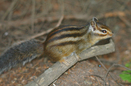
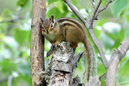
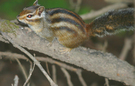
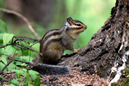
Siberian chipmunks are 18 to 25 cm in total length, including a tail that is approximately one third of that length. Body length is 12 to 17 cm. The fur on the back is yellow to brown, with white fur on the chest and belly. There are 5 dark and 4 light colored stripes that runs down the back. Body mass varies with season and availability of food. A typical Siberian chipmunk will weigh 50 to 150g. (; "Siberian Chipmunk", 2009)
- Other Physical Features
- endothermic
- homoiothermic
- bilateral symmetry
- Sexual Dimorphism
- sexes alike
-
- Range mass
- 50 to 150 g
- 1.76 to 5.29 oz
-
- Range length
- 12 to 17 cm
- 4.72 to 6.69 in
Reproduction
There is little known information on the mating systems of Siberian chipmunks. Most other chipmunks and squirrels have a promiscuous mating system. (Saddington, 2007)
The breeding season of Tamias sibericus begins in the second half of April. After a gestation period of 28 to 35 days a litter of 3 to 8 young is born. In Europe a second litter may be born over the summer months. Size at birth is 3.8 to 4g. ("Siberian Chipmunk", 2009; Saddington, 2007)
- Key Reproductive Features
- iteroparous
- seasonal breeding
- gonochoric/gonochoristic/dioecious (sexes separate)
- sexual
- viviparous
-
- Breeding interval
- Siberian chipmunks breed once to twice yearly, depending on location.
-
- Breeding season
- Breeding occurs from April to June.
-
- Range number of offspring
- 3 to 8
-
- Range gestation period
- 28 to 35 days
-
- Range weaning age
- 7 (high) weeks
-
- Range time to independence
- 8 (low) weeks
-
- Average age at sexual or reproductive maturity (female)
- 9 months
-
- Average age at sexual or reproductive maturity (male)
- 9 months
Females are solely responsible for care of the offspring. The eyes of the young typically open after 20 to 25 days. The mother will take the young out foraging at 6 weeks old, weaning will be complete by 7 weeks, and at 8 weeks the young will be old enough to look for territory of their own. (Saddington, 2007)
- Parental Investment
- altricial
-
pre-fertilization
- provisioning
-
protecting
- female
-
pre-hatching/birth
-
provisioning
- female
-
protecting
- female
-
provisioning
-
pre-weaning/fledging
-
provisioning
- female
-
protecting
- female
-
provisioning
Lifespan/Longevity
Siberian chipmunks live for a maximum 2 to 5 years in the wild, and 6 to 10 years in captivity. Several reports of Siberian chipmunks living past 10 years as personal pets have been reported. ("Siberian Chipmunk", 2009)
-
- Typical lifespan
Status: wild - 2 to 5 years
- Typical lifespan
-
- Typical lifespan
Status: captivity - 6 to 10 years
- Typical lifespan
Behavior
Siberian chipmunks are active during the day and sleep at night. During the winter months they will enter a period of torpor, waking every few weeks to eat food stored in their burrow. Like other squirrels, they will bury food up to 5 cm deep in soil. Siberian chipmunks are constantly cleaning themselves, starting with the back and ending with the tail. Sometimes one chipmunk will bathe another. (Weathers, 2006)
- Key Behaviors
- scansorial
- terricolous
- fossorial
- diurnal
- motile
- sedentary
- hibernation
Home Range
Little information on Tamias sibericus homne range size was readily available. Other Tamias species dig burrows throughout their lives. Towards the end of their lifespan burrows can encompass a 30 square m area with multiple chambers for bedding and food storage. There may even be a latrine that is used during the winter months. Chipmunks empty latrine chambers at the beginning of spring, depositing the waste far from the entrance so as to not attract predators. ("Eastern chipmunk (Tamias striatus)", 2009)
Communication and Perception
Siberian chipmunks have 2 vocalizations. The first is a fast "cheep" that sounds a lot like a bird call. This is used when frightened, and lasts only 1/5 of a second. It is often used 3 to 6 times in succession. The second sound is a deep croaking sound. It is unknown what this croak is used for, although it is believed to be related to mating. They may also use visual and scent cues in communication, although this has not been documented.
- Communication Channels
- acoustic
Food Habits
Siberian chipmunks are omnivores. In the wild their diet consists of seeds and grains, fungi, fruits, vegetables, grains, insects, small birds, and lizards.
- Primary Diet
- omnivore
- Animal Foods
- birds
- reptiles
- insects
- terrestrial non-insect arthropods
- Plant Foods
- seeds, grains, and nuts
- fruit
- Other Foods
- fungus
- Foraging Behavior
- stores or caches food
Predation
Natural predators for Siberian chipmunks include birds of prey, weasels, and cats, although specific predator species are not reported in the literature. These chipmunks are vigilant and agile, escaping to their burrows when threatened. They are also cryptically colored in their forest undergrowth habitats. ("Siberian Chipmunk", 2009)
- Anti-predator Adaptations
- cryptic
-
- Known Predators
-
- diurnal raptors (Falconiformes)
- weasels (Mustela)
- small cats (Felis)
Ecosystem Roles
Siberian chipmunks provide an important food source to their predators. Chipmunks are also important seed distributors due to their buried and forgotten caches. Like other chipmunks, they help to disperse fungal spores, dispersing important forest fungi. Parasite species are not reported for Siberian chipmunks. ("Siberian Chipmunk", 2009)
- Ecosystem Impact
- disperses seeds
Economic Importance for Humans: Positive
Siberian chipmunks disperse tree and plant seeds and fungal spores that aid in forest regeneration. Siberian chipmunks are occasionally kept as pets and their pelts are sometimes used. They may help to control pests, especially in outbreaks of forest tree pests. ("Eastern chipmunk (Tamias striatus)", 2009; Danell, et al., 1998; Weathers, 2006; "Eastern chipmunk (Tamias striatus)", 2009; Danell, et al., 1998; Weathers, 2006; "Eastern chipmunk (Tamias striatus)", 2009; Danell, et al., 1998; Weathers, 2006; "Eastern chipmunk (Tamias striatus)", 2009; Danell, et al., 1998; Weathers, 2006)
- Positive Impacts
- pet trade
- body parts are source of valuable material
- controls pest population
Economic Importance for Humans: Negative
Siberian chipmunks may occasionally eat crops and damage gardens. Like other mammals, they may carry diseases or host fleas infected with plague. ("Siberian Chipmunk", 2009; Weathers, 2006)
- Negative Impacts
-
injures humans
- carries human disease
- crop pest
Conservation Status
Siberian chipmunks are considered "least concern" by the IUCN because they are widespread and common throughout their range. There have been no recorded declines in populations.
-
- IUCN Red List
-
Least Concern
More information
-
- IUCN Red List
-
Least Concern
More information
-
- US Federal List
- No special status
-
- CITES
- No special status
Contributors
Kenneth Haberland (author), Northern Michigan University, Bruggink John (editor, instructor), Northern Michigan University, Tanya Dewey (editor), Animal Diversity Web.
Glossary
- Palearctic
-
living in the northern part of the Old World. In otherwords, Europe and Asia and northern Africa.

- acoustic
-
uses sound to communicate
- altricial
-
young are born in a relatively underdeveloped state; they are unable to feed or care for themselves or locomote independently for a period of time after birth/hatching. In birds, naked and helpless after hatching.
- bilateral symmetry
-
having body symmetry such that the animal can be divided in one plane into two mirror-image halves. Animals with bilateral symmetry have dorsal and ventral sides, as well as anterior and posterior ends. Synapomorphy of the Bilateria.
- chemical
-
uses smells or other chemicals to communicate
- cryptic
-
having markings, coloration, shapes, or other features that cause an animal to be camouflaged in its natural environment; being difficult to see or otherwise detect.
- diurnal
-
- active during the day, 2. lasting for one day.
- endothermic
-
animals that use metabolically generated heat to regulate body temperature independently of ambient temperature. Endothermy is a synapomorphy of the Mammalia, although it may have arisen in a (now extinct) synapsid ancestor; the fossil record does not distinguish these possibilities. Convergent in birds.
- forest
-
forest biomes are dominated by trees, otherwise forest biomes can vary widely in amount of precipitation and seasonality.
- fossorial
-
Referring to a burrowing life-style or behavior, specialized for digging or burrowing.
- hibernation
-
the state that some animals enter during winter in which normal physiological processes are significantly reduced, thus lowering the animal's energy requirements. The act or condition of passing winter in a torpid or resting state, typically involving the abandonment of homoiothermy in mammals.
- introduced
-
referring to animal species that have been transported to and established populations in regions outside of their natural range, usually through human action.
- iteroparous
-
offspring are produced in more than one group (litters, clutches, etc.) and across multiple seasons (or other periods hospitable to reproduction). Iteroparous animals must, by definition, survive over multiple seasons (or periodic condition changes).
- motile
-
having the capacity to move from one place to another.
- native range
-
the area in which the animal is naturally found, the region in which it is endemic.
- omnivore
-
an animal that mainly eats all kinds of things, including plants and animals
- pet trade
-
the business of buying and selling animals for people to keep in their homes as pets.
- seasonal breeding
-
breeding is confined to a particular season
- sedentary
-
remains in the same area
- sexual
-
reproduction that includes combining the genetic contribution of two individuals, a male and a female
- stores or caches food
-
places a food item in a special place to be eaten later. Also called "hoarding"
- tactile
-
uses touch to communicate
- taiga
-
Coniferous or boreal forest, located in a band across northern North America, Europe, and Asia. This terrestrial biome also occurs at high elevations. Long, cold winters and short, wet summers. Few species of trees are present; these are primarily conifers that grow in dense stands with little undergrowth. Some deciduous trees also may be present.
- temperate
-
that region of the Earth between 23.5 degrees North and 60 degrees North (between the Tropic of Cancer and the Arctic Circle) and between 23.5 degrees South and 60 degrees South (between the Tropic of Capricorn and the Antarctic Circle).
- terrestrial
-
Living on the ground.
- visual
-
uses sight to communicate
- viviparous
-
reproduction in which fertilization and development take place within the female body and the developing embryo derives nourishment from the female.
References
2009. "Eastern chipmunk (Tamias striatus)" (On-line). Accessed March 12, 2009 at http://www.wildernesshaven.net/chipmunks.htm.
2009. "Siberian Chipmunk" (On-line). Wikipedia. Accessed February 12, 2009 at http://en.wikipedia.org/wiki/Siberian_Chipmunk.
Danell, K., T. Willebrand, L. Baskin. 1998. Mammalian Herbivores in the Boreal Forests: Their Numerical Fluctuations and Use by Man. Ecology and Society, volume 2 issue 2: article 9. Accessed April 25, 2009 at http://www.consecol.org/vol2/iss2/art9/.
Muster, G. 2009. "Siberian Chipmunk rodent" (On-line). Encyclopedia Brittanica. Accessed February 12, 2009 at http://www.britannica.com/EBchecked/topic/852624/Siberian-chipmunk.
Saddington, G. 2007. NOTES ON THE BREEDING OF THE SIBERIAN CHIPMUNK Tamias sibircius IN CAPTIVITY. International Zoo Yearbook, volume 6 issue 1: 165-166. Accessed April 03, 2009 at http://www3.interscience.wiley.com/cgi-bin/vsample?PISSN=0074-9664&path_ok=/journal/117997665/home.
Weathers, K. 2006. "Tamias sibericus - Siberian Chipmunk" (On-line). Accessed February 12, 2009 at http://www.paw-talk.net/forums/printthread.php?t=7182.