Tamias amoenusyellow-pine chipmunk
Geographic Range
Yellow-pine chipmunks, Tamias amoenus, are found in the northwestern United States and southwestern Canada. They occur throughout Idaho, Washington, and Oregon (excluding coastal areas), as well as northern Nevada and northern Utah, western Wyoming and western Montana, and mountainous areas of California. In Canada, yellow-pine chipmunks occupy most of southern British Colombia and the mountainous regions of southwestern Alberta. ("National Wildlife Federation", 2003; Kays and Wilson, 2002; Sutton, 1992)
Habitat
Yellow-pine chipmunks are most common in brushy coniferous forests, but can be found in a broad range of habitat types including areas with rocky outcrops, chaparral, and meadows. They occupy areas that are dominated by shrubs such as service berry (Amelanchier), snowberry (Symphoricarpos), mountain mahogany (Cercocarpus), currant (Ribes), antelope brush (Purshia), and buckbrush (Ceanothus).
Yellow-pine chipmunks require logs, snags, rock crevices, or stumps for nesting, in addition to shrubs and ground litter for cover.
Yellow-pine chipmunks typically occur at altitudes ranging from 600 to 2,800 m, however in Washington they have been recorded at elevations of up to 4,300 m. (Banfield, 1974; Harvey and Polite, 2003; Sutton, 1992; Wilson and Ruff, 1999)
- Habitat Regions
- temperate
- terrestrial
- Other Habitat Features
- riparian
-
- Range elevation
- 600 to 4,300 m
- 1968.50 to ft
-
- Average elevation
- 2,800 m
- ft
Physical Description
Yellow-pine chipmunks are small compared to other members of the genus Tamias. They measure 181 to 245 mm in length, and can weigh between 30 and 70 g. Females tend to be larger than males.
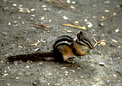
These animals have five black, evenly-spaced, longitudinal stripes down the back. The three dorsal stripes extend from shoulder to rump, whereas the two lateral strips extend only to mid-body. The pale stripes are usually white or grayish. Body color varies depending upon subspecies. Tamias amoenus affinis has a pinkish-cinnamon colored body, T. a. monoensis is a cinnamon buff, T. a. luteiventris is sayal-brown, T. a. felix is ochraceous tawny, and T. a. ludibundus is tawny. The underside of the tail ranges from pinkish-cinnamon to grayish-yellow to sayal-brown. The ears are whitish behind and black in front.
Yellow-pine chipmunks can be distinguished from similar species by the genital bones of both sexes. They can also be distinguished based upon size and color. Lodgepole chipmunks are larger than yellow-pine chipmunks, have bigger ears, and more sharply contrasting stripes. The outer stripes of lodgepole chipmunks are also wider than the inner stripes. Least chipmunks are smaller than yellow-pine chipmunks, and also paler in color. Yellow-pine chipmunks are smaller and redder than Unita chipmunks. Unita chipmunks also have grayer shoulders and heads. (Banfield, 1974; "National Wildlife Federation", 2003; Larrison, 1976; Sutton, 1992; Verts and Carraway, 1998; Wilson and Ruff, 1999; Zeveloff and Collett, 1988)
- Other Physical Features
- endothermic
- bilateral symmetry
- Sexual Dimorphism
- female larger
-
- Range mass
- 30 to 73 g
- 1.06 to 2.57 oz
-
- Range length
- 181 to 245 mm
- 7.13 to 9.65 in
-
- Average basal metabolic rate
- 0.5 W
- AnAge
Reproduction
Yellow-pine chipmunks are polygynandrous. Females are in estrous for one day each year. They use vocalizations to attract mates a few days before the onset of estrous. On the day of estrous, females are typically pursued by two to six males in what is called a “mating chase”. A female mates with multiple males during this mating chase. All sexually mature males and females mate during the mating season, which occurs in late April or early May. (Larrison, 1976; Schulte-Hostedde, et al., 2002; Sutton, 1992; Verts and Carraway, 1998; Wilson and Ruff, 1999; Zeveloff and Collett, 1988)
- Mating System
- polygynandrous (promiscuous)
Female yellow-pine chipmunks are in estrous for one day and breed only once per year during late April to early May. Average gestation period is 30 days, after which a female usually gives birth to a litter of 3 to 8 babies. Young are highly altricial at birth and remain in the burrow until they are weaned at six weeks of age. Young begin to disperse and find their own burrows at about 8 to 12 weeks of age. They reach sexual maturity at 12 to 23 months. (Harvey and Polite, 2003; Schulte-Hostedde, et al., 2002; Sutton, 1992; Verts and Carraway, 1998; Wilson and Ruff, 1999; Zeveloff and Collett, 1988)
- Key Reproductive Features
- iteroparous
- seasonal breeding
- gonochoric/gonochoristic/dioecious (sexes separate)
- sexual
- fertilization
- viviparous
-
- Breeding interval
- Yellow-pine chipmunks breed only once per year.
-
- Breeding season
- Breeding occurs in late April or early May.
-
- Range number of offspring
- 3 to 8
-
- Average number of offspring
- 4 to 5
-
- Average number of offspring
- 5.19
- AnAge
-
- Range gestation period
- 28 to 40 days
-
- Average gestation period
- 30 days
-
- Average weaning age
- 45 days
-
- Range time to independence
- 2 to 3 months
-
- Range age at sexual or reproductive maturity (female)
- 12 to 23 months
-
- Range age at sexual or reproductive maturity (male)
- 12 to 23 months
Pregnant females make nests of leaves, grass, lichen, and feathers in burrows that are about 1.5 m below ground or up to 18 m in trees. Babies are altricial and depend on the mother for food and protection until they emerge from the burrow at about 6 weeks of age. Males do not contribute to the care of the offspring. At about 8 weeks of age, young of both sexes disperse to find their own nests and burrows for winter. (Larrison, 1976; Verts and Carraway, 1998; Wilson and Ruff, 1999; Zeveloff and Collett, 1988)
- Parental Investment
- altricial
-
pre-fertilization
- provisioning
-
protecting
- female
-
pre-hatching/birth
-
provisioning
- female
-
protecting
- female
-
provisioning
-
pre-weaning/fledging
-
provisioning
- female
-
protecting
- female
-
provisioning
-
pre-independence
-
provisioning
- female
-
protecting
- female
-
provisioning
Lifespan/Longevity
Yellow-pine chipmunks have been known to live up to 5 years 2 months in the wild. Young have a 30% survival rate. Once they emerge from the den at about 6 weeks of age, they are easy prey for a variety of predators. Adults have a summer survival rate of 33% to 88% and a winter survival rate of 97%.
No information was available on the lifespan and survival rate of captive yellow-pine chipmunks. (Schulte-Hostedde, et al., 2002; Sutton, 1992; Verts and Carraway, 1998)
-
- Average lifespan
Status: wild - 5 years
- Average lifespan
-
- Average lifespan
Status: wild - 3 years
- Average lifespan
Behavior
Yellow-pine chipmunks are solitary except during the breeding season in late April and early May. They are active from just before sunrise until about a half hour after sunset. The chipmunks return to their burrows during the middle of the day and are rarely seen from 0900h to 1500h. On cloudy days, or days with light rain, they may be active all day.
Most of a yellow-pine chipmunk's day is spent foraging or grooming. These animals frequently brush their fur, take dust baths, and wash their faces. Like most chipmunks, yellow-pine chipmunks move with short jerky movements. The tail is held horizontally or erect during running, and swings from side to side as an individual sits. Foraging typically takes place in areas with shade and shrub cover.
Yellow-pine chipmunks enter a state of torpor for about four months during the winter. When in torpor, they emerge every 5 to 7 days to eat seeds stored in various caches. Caches have been recorded to contain up to 68,000 items. Yellow-pine chipmunks do not gain a heavy fat layer in winter like most other chipmunks. They enter torpor when temperatures drop below 23˚C and photoperiods begin to decrease.
Yellow-pine chipmunks are often found in association with golden-mantled ground squirrels and well as least chipmunks. When engaging in interspecific competition with least chipmunks, yellow-pine chipmunks are dominant. (Banfield, 1974; Sutton, 1992; Verts and Carraway, 1998)
- Key Behaviors
- terricolous
- diurnal
- crepuscular
- motile
- sedentary
- hibernation
- solitary
Home Range
Home ranges for males range from 0.4 to 2.8 ha and average 1.3 ha. Female home ranges are smaller, ranging from 0.1 to 1.1 ha and averaging about 0.6 ha.
Yellow-pine chipmunks are not territorial and may have overlapping home ranges, however they will defend areas that are in the immediate vicinity of the entrance to their burrows. (Harvey and Polite, 2003; Sutton, 1992; Verts and Carraway, 1998)
Communication and Perception
Yellow-pine chipmunks have 10 different recognizable vocalizations. Most of these calls are alarm calls to alert conspecifics of predators. When greeting conspecifics, they first touch noses, then smell the sides of the face and neck, and last they sniff the anus. Visual signals, such as body posture, are important in communication. (Verts and Carraway, 1998)
Food Habits
Yellow-pine chipmunks are mostly omnivorous. They consume at least 59 species of seeds, plants, fruits, fungi, corms, and insects. They are also known to eat small mammals, bird eggs, and roots. They use their cheek pouches to carry conifer seeds and other foods to their burrows.
These chipmunks forage both on the ground and in trees. Foraging is done during the day and from spring to fall. In the fall, they begin storing food in caches for winter. Winter caches of up to 68,000 items, ranging from seeds to bumble bees, have been recorded. ("National Wildlife Federation", 2003; Harvey and Polite, 2003; Sutton, 1992)
- Primary Diet
- omnivore
- Animal Foods
- mammals
- eggs
- insects
- terrestrial non-insect arthropods
- terrestrial worms
- Plant Foods
- leaves
- roots and tubers
- seeds, grains, and nuts
- fruit
- flowers
- Other Foods
- fungus
- Foraging Behavior
- stores or caches food
Predation
Yellow-pine chipmunks usually live in underground burrows, which help conceal them from predators. The black and white stripes on the back of these animals help to camouflage them in open forests where sharp shadows are cast by the sun. They also have, to some extent, a system of watch where one chipmunk looks out for predators and warns the others with alarm vocalizations. This is mostly observed in more open areas where chipmunks are more exposed to predators.
Predators include coyotes (Canis latrans), goshawks (Accipiter gentilis), long-tailed weasels (Mustela frenata), badgers (Taxidea taxus), bobcats (Lynx rufus), rattlesnakes (Crotalus viridis), and sparrow hawks (Falco sparverius). ("National Wildlife Federation", 2003; Harvey and Polite, 2003; Sutton, 1992)
- Anti-predator Adaptations
- cryptic
-
- Known Predators
-
- Coyotes (Canis latrans)
- goshawks (Accipiter gentilis)
- long-tailed weasels (Mustela frenata)
- badgers (Taxidea taxus)
- bobcats (Lynx rufus)
- rattlesnakes (Crotalus viridis)
- sparrow hawks (Falco sparverius)
Ecosystem Roles
Yellow-pine chipmunks are important dispersers of the seeds of various conifer species. They also contribute to the food base of many different carnivore species. (Banfield, 1974; Larrison, 1976)
- Ecosystem Impact
- disperses seeds
- none identified
- none identified
- Rickettsia rickettsii
- Rickettsia rhipicephali
- Cuterebra emasculator
- Acarus monopsyllus
- Yersinia pestis
- Borellia hermsii
Economic Importance for Humans: Positive
Like most chipmunks, yellow-pine chipmunks are favored among nature lovers. This species is less destructive of young conifers (often harvested by humans for timber) than other small mammals. (Banfield, 1974; Larrison, 1976)
- Positive Impacts
- research and education
Economic Importance for Humans: Negative
Yellow-pine chipmunks have been identified as hosts for the disease vectors responsible for Colorado tick fever, tick-borne relapsing fever, hantavirus pulmonary syndrome, and Rocky Mountain spotted fever richettsia. They also become heavily infested with bot fly warbles and fleas that are known to carry plague.
Destruction by yellow-pine chipmunks of young conifers intended for timber harvest has been documented, however the overall damange is insubstantial. (Sutton, 1992; Verts and Carraway, 1998)
- Negative Impacts
-
injures humans
- causes disease in humans
- carries human disease
- causes or carries domestic animal disease
Conservation Status
Yellow-pine chipmunks are common in the northwestern United States and southwestern Canada. The species has no special status. (Wilson and Ruff, 1999)
-
- IUCN Red List
-
Least Concern
More information
-
- IUCN Red List
-
Least Concern
More information
-
- US Federal List
- No special status
-
- CITES
- No special status
Contributors
Melissa Looney (author), Humboldt State University, Brian Arbogast (editor, instructor), Humboldt State University.
Nancy Shefferly (editor), Animal Diversity Web.
Glossary
- Nearctic
-
living in the Nearctic biogeographic province, the northern part of the New World. This includes Greenland, the Canadian Arctic islands, and all of the North American as far south as the highlands of central Mexico.

- acoustic
-
uses sound to communicate
- altricial
-
young are born in a relatively underdeveloped state; they are unable to feed or care for themselves or locomote independently for a period of time after birth/hatching. In birds, naked and helpless after hatching.
- bilateral symmetry
-
having body symmetry such that the animal can be divided in one plane into two mirror-image halves. Animals with bilateral symmetry have dorsal and ventral sides, as well as anterior and posterior ends. Synapomorphy of the Bilateria.
- causes disease in humans
-
an animal which directly causes disease in humans. For example, diseases caused by infection of filarial nematodes (elephantiasis and river blindness).
- causes or carries domestic animal disease
-
either directly causes, or indirectly transmits, a disease to a domestic animal
- chaparral
-
Found in coastal areas between 30 and 40 degrees latitude, in areas with a Mediterranean climate. Vegetation is dominated by stands of dense, spiny shrubs with tough (hard or waxy) evergreen leaves. May be maintained by periodic fire. In South America it includes the scrub ecotone between forest and paramo.
- chemical
-
uses smells or other chemicals to communicate
- crepuscular
-
active at dawn and dusk
- cryptic
-
having markings, coloration, shapes, or other features that cause an animal to be camouflaged in its natural environment; being difficult to see or otherwise detect.
- diurnal
-
- active during the day, 2. lasting for one day.
- endothermic
-
animals that use metabolically generated heat to regulate body temperature independently of ambient temperature. Endothermy is a synapomorphy of the Mammalia, although it may have arisen in a (now extinct) synapsid ancestor; the fossil record does not distinguish these possibilities. Convergent in birds.
- fertilization
-
union of egg and spermatozoan
- forest
-
forest biomes are dominated by trees, otherwise forest biomes can vary widely in amount of precipitation and seasonality.
- hibernation
-
the state that some animals enter during winter in which normal physiological processes are significantly reduced, thus lowering the animal's energy requirements. The act or condition of passing winter in a torpid or resting state, typically involving the abandonment of homoiothermy in mammals.
- iteroparous
-
offspring are produced in more than one group (litters, clutches, etc.) and across multiple seasons (or other periods hospitable to reproduction). Iteroparous animals must, by definition, survive over multiple seasons (or periodic condition changes).
- motile
-
having the capacity to move from one place to another.
- mountains
-
This terrestrial biome includes summits of high mountains, either without vegetation or covered by low, tundra-like vegetation.
- native range
-
the area in which the animal is naturally found, the region in which it is endemic.
- omnivore
-
an animal that mainly eats all kinds of things, including plants and animals
- polygynandrous
-
the kind of polygamy in which a female pairs with several males, each of which also pairs with several different females.
- riparian
-
Referring to something living or located adjacent to a waterbody (usually, but not always, a river or stream).
- seasonal breeding
-
breeding is confined to a particular season
- sedentary
-
remains in the same area
- sexual
-
reproduction that includes combining the genetic contribution of two individuals, a male and a female
- solitary
-
lives alone
- stores or caches food
-
places a food item in a special place to be eaten later. Also called "hoarding"
- tactile
-
uses touch to communicate
- temperate
-
that region of the Earth between 23.5 degrees North and 60 degrees North (between the Tropic of Cancer and the Arctic Circle) and between 23.5 degrees South and 60 degrees South (between the Tropic of Capricorn and the Antarctic Circle).
- terrestrial
-
Living on the ground.
- visual
-
uses sight to communicate
- viviparous
-
reproduction in which fertilization and development take place within the female body and the developing embryo derives nourishment from the female.
References
eNature.com, Inc. 2003. "National Wildlife Federation" (On-line). eNature.com. Accessed February 18, 2005 at http://www.enature.com/fieldguide/showSpeciesSH.asp?curGroupID=5&shapeID=1041&display=2&curPageNum=32&recnum=MA0129.
Banfield, A. 1974. The Mammals of Canada. Toronto: University of Toronto Press.
Harvey, T., C. Polite. 2003. "California Department of Fish and Game" (On-line). California Wildlife Habitat Relationships System. Accessed March 01, 2005 at http://www.dfg.ca.gov/whdab/html/M055.html.
Kays, R., D. Wilson. 2002. Mammals of North America. Oxfordshire: Princeton University Press.
Larrison, E. 1976. Mammals of the Northwest: Washington, Oregon, Idaho, and British Columbia. Seattle: Seattle Audubon Society.
Schulte-Hostedde, A., J. Millar, L. Gibbs. 2002. Female-biased sexual size dimorphism in the yellow-pine chipmunk (Tamias amoenus): sex-specific patterns of annual reproductive success and survival. Evolution, 56/12: 2519-2529.
Sutton, D. 1992. Tamias amoenus. Mammalian Species, 390: 1-8.
Verts, B., L. Carraway. 1998. Land Mammals of Oregon. Los Angeles: University of California Press.
Wilson, D., S. Ruff. 1999. The Smithsonian Book of North American Mammals. Washington: Smithsonian Institute Press.
Zeveloff, S., F. Collett. 1988. Mammals of the Intermountain West. Salt Lake City: University of Utah Press.