Sympetrum vicinum




Geographic Range
Sympetrum vicinum is widely distributed throughout much of North America. The species occurs throughout the most of the U.S. except the desert Southwest, the northern Rocky Mountains, peninsular Florida and the Gulf coasts of Louisiana and Texas. It's found in southeastern and extreme southwestern Canada. (Needham, et al., 2000)
Habitat
Sympetrum vicinum inhabits marshes, lakes, ponds and bogs in areas that are usually somewhat wooded. The ponds that this species inhabits must be permanent and have slow flowing water. (Needham, et al., 2000)
- Habitat Regions
- temperate
- freshwater
- Aquatic Biomes
- lakes and ponds
- rivers and streams
Physical Description
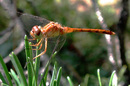
Sympetrum vicinum has a dull yellow face, which in males becomes reddish toward maturity. The pterothorax is red on the front while the sides are an olive color. This species has reduced venation with hyaline (clear, colorless) wings with a yellow base. The abdomen is slender and red, and is lighter than in other species of Sympetrum. (Emmitt, 2000)
- Other Physical Features
- ectothermic
- heterothermic
- bilateral symmetry
- Sexual Dimorphism
- sexes colored or patterned differently
-
- Average mass
- 5.5 g
- 0.19 oz
-
- Range length
- 26 to 35 mm
- 1.02 to 1.38 in
-
- Range wingspan
- 21 to 23 mm
- 0.83 to 0.91 in
Development
Eggs hatch in the early spring of the following year after overwintering. They emerge when the water temperature reaches about 10 degrees Celsius. At the beginning of the first free-living larval stadium (period between one molt and the next) ecdysis (shedding of the outer skin) occurs. This larval stage is restricted to the spring and summer seasons. After molting, the larva increases in size and changes in coloring can occur. This process takes place over about an hour.
After going through a series of molts S. vicinum begins showing signs of becoming an adult dragonfly. These signs include: setae on the dorsum of the head, contraction of the labium and microtrichia on the wings. It can take an individual anywhere from one to seven weeks to become ready to emerge as an adult. The first adults to emerge of this species are seen in late June. Once an individual has become an adult, it has two main goals: to eat and to mate. The pre-reproductive stage in S. vicinum can last anywhere from 30-87 days, depending on the latitude where they are found. Once they reach sexual maturity, individuals seek a mate, lay eggs and die soon afterward. (Corbet, 1999)
- Development - Life Cycle
- metamorphosis
Reproduction
Once sexual maturity has been reached males begin looking for mates. When a female is found and the male determines visually and physically that she is of the same species, copulation will take place. The male places sperm into the female's genital tract. The eggs are laid in summer and "complete katatrepsis" (embryo revolution) occurs in autumn. The insects then pass the winter as fully formed embryos. Once oviposition has taken place the sexes separate and stop flying in tandem. (Corbet, 1999)
- Key Reproductive Features
- seasonal breeding
- sexual
- fertilization
- oviparous
-
- Breeding season
- Late summer to early autumn
There is no parental investment beyond laying of eggs.
- Parental Investment
-
pre-fertilization
-
protecting
- female
-
protecting
Lifespan/Longevity
The life cycle of this dragonfly is approximately one year.
Behavior
Sympetrum vicinum is a nonterritorial species. After mating, the male will keep hold of the female and they fly as a pair during oviposition. Dominance hierarchies have also been observed in S. vicinum. Disputes between competing males lead to an orderly ranking of individuals. Behavior can be affected by temperature. If an individual begins the morning in the shade it sometimes takes six extra hours for the insect's first flight of the day. (McMillian, 2000)
- Key Behaviors
- flies
- diurnal
- motile
- hibernation
- dominance hierarchies
Communication and Perception
Odonates have highly developed sight. The large compound eyes are used to capture prey. (Merritt and Cummins, 1984)
- Communication Channels
- chemical
- Perception Channels
- visual
- infrared/heat
- tactile
- chemical
Food Habits
The larvae of this species are sprawlers. They lie on pond bottoms and attack prey as it comes into their immediate area. The family of dragonflies that includes S. vicinum, Libellulidae, are all perching adults. This means that they sit and wait for their prey (small flying insects) to fly by. Once they see it, they take off and pursue it, with an amazing success rate of 97%. The study recording these data was done through keen observations from binoculars and video recorders. Trays were set out within patches of Eleocharis to maximize the test results by limiting the potential landing site area within two artificial ponds.
Foods eaten by larval S. vicinum include medium-sized water fleas and relatives of Cladocera; Ostracoda; Oligochaeta; burrowing and climbing flies of the family Chironomidae and Ceratopogonidae. Sympetrum vicinum will also eat larva of smaller dragonfly species. (Corbet, 1999; Olberg, et al., 2000)
- Primary Diet
-
carnivore
- insectivore
- eats non-insect arthropods
- Animal Foods
- insects
- aquatic or marine worms
- aquatic crustaceans
- zooplankton
Predation
When spotted by predators the larvae form simply lies immobile. Large individuals, when attacked by the snake Regina alleni will actually bite the snake's mouth, which makes the snake bleed. Usually the snake will let go of the dragonfly larva. For some reason these snakes swallow dragonfly larvae head first. It has also been hypothesized, but not documented, that individuals may produce sounds to ward off predators. (Corbet, 1999; Olberg, et al., 2000)
-
- Known Predators
-
- spinycheek crayfish (Oronectes limosus)
- rainbow trout (Oncorhynchus mykiss )
- sunfish species (Lepomis)
- striped swamp snake (Regina alleni)
- fish that feed in shallow fresh waters (Actinopterygii)
- possibly also other dragonfly species (Odonata)
- mantises (Mantidae)
- crows, jays ,and magpies (Corvidae)
- green frogs (Lithobates clamitans clamitans)
- turtles (Testudines)
Ecosystem Roles
Dragonflies help keep insect populations at a stable level. Sympetrum vicinum has a commensal relationship with the species mentioned below and are also parasitized by certain species of mites. Parasitic chironomid fly larvae can be found on the back of the head, prothorax, wing sheaths and legs of S. vicinum. Spiroxys contortus uses S. vicinum as an intermediate host (turtles are the definitive host). (White, et al., 1980)
- Haematoloechus medioplexus
- Phyllodistomum spp.
- Spiroxys contortus
- Chironomidae
Economic Importance for Humans: Positive
Dragonflies can be used to protect humans from mosquitoes and blackflies. One experiment has show that larval species of Bradinopyga geminata were able to destroy an entire population of mosquitoes within a 194-liter drum in a matter of hours. Application of this method would allow pest control of mosquitoes without the use of chemicals. Several studies have show that Sympetrum species are apparently immune to pollutants. This could possibly help humans, in the long run, if we can develop ways to deal with pollutants if understood in detail. (Corbet, 1999)
- Positive Impacts
- research and education
- controls pest population
Economic Importance for Humans: Negative
Larva can sometimes deplete fish fry populations that fishermen want to culture. (Corbet, 1999)
Conservation Status
This species is secure and currently not of any conservation concern.
-
- IUCN Red List
- Not Evaluated
-
- US Federal List
- No special status
-
- CITES
- No special status
-
- State of Michigan List
- No special status
Contributors
Renee Sherman Mulcrone (editor).
Joshua Winchell (author), University of Michigan-Ann Arbor, Kerry Yurewicz (editor), University of Michigan-Ann Arbor.
Glossary
- Nearctic
-
living in the Nearctic biogeographic province, the northern part of the New World. This includes Greenland, the Canadian Arctic islands, and all of the North American as far south as the highlands of central Mexico.

- bilateral symmetry
-
having body symmetry such that the animal can be divided in one plane into two mirror-image halves. Animals with bilateral symmetry have dorsal and ventral sides, as well as anterior and posterior ends. Synapomorphy of the Bilateria.
- bog
-
a wetland area rich in accumulated plant material and with acidic soils surrounding a body of open water. Bogs have a flora dominated by sedges, heaths, and sphagnum.
- carnivore
-
an animal that mainly eats meat
- chemical
-
uses smells or other chemicals to communicate
- diurnal
-
- active during the day, 2. lasting for one day.
- dominance hierarchies
-
ranking system or pecking order among members of a long-term social group, where dominance status affects access to resources or mates
- ectothermic
-
animals which must use heat acquired from the environment and behavioral adaptations to regulate body temperature
- estuarine
-
an area where a freshwater river meets the ocean and tidal influences result in fluctuations in salinity.
- fertilization
-
union of egg and spermatozoan
- freshwater
-
mainly lives in water that is not salty.
- heterothermic
-
having a body temperature that fluctuates with that of the immediate environment; having no mechanism or a poorly developed mechanism for regulating internal body temperature.
- hibernation
-
the state that some animals enter during winter in which normal physiological processes are significantly reduced, thus lowering the animal's energy requirements. The act or condition of passing winter in a torpid or resting state, typically involving the abandonment of homoiothermy in mammals.
- infrared/heat
-
(as keyword in perception channel section) This animal has a special ability to detect heat from other organisms in its environment.
- insectivore
-
An animal that eats mainly insects or spiders.
- internal fertilization
-
fertilization takes place within the female's body
- marsh
-
marshes are wetland areas often dominated by grasses and reeds.
- metamorphosis
-
A large change in the shape or structure of an animal that happens as the animal grows. In insects, "incomplete metamorphosis" is when young animals are similar to adults and change gradually into the adult form, and "complete metamorphosis" is when there is a profound change between larval and adult forms. Butterflies have complete metamorphosis, grasshoppers have incomplete metamorphosis.
- motile
-
having the capacity to move from one place to another.
- native range
-
the area in which the animal is naturally found, the region in which it is endemic.
- oviparous
-
reproduction in which eggs are released by the female; development of offspring occurs outside the mother's body.
- seasonal breeding
-
breeding is confined to a particular season
- sexual
-
reproduction that includes combining the genetic contribution of two individuals, a male and a female
- suburban
-
living in residential areas on the outskirts of large cities or towns.
- swamp
-
a wetland area that may be permanently or intermittently covered in water, often dominated by woody vegetation.
- tactile
-
uses touch to communicate
- temperate
-
that region of the Earth between 23.5 degrees North and 60 degrees North (between the Tropic of Cancer and the Arctic Circle) and between 23.5 degrees South and 60 degrees South (between the Tropic of Capricorn and the Antarctic Circle).
- urban
-
living in cities and large towns, landscapes dominated by human structures and activity.
- visual
-
uses sight to communicate
- zooplankton
-
animal constituent of plankton; mainly small crustaceans and fish larvae. (Compare to phytoplankton.)
References
Corbet, P. 1999. Dragonflies:Behavior and Ecology of Odonata. Ithaca, New York: Cornell University Press.
Emmitt, R. 2000. "Yellow-legged Meadowhawk" (On-line). Accessed March 20, 2002 at http://www.rlephoto.com/odes/yellow_legged-meadowhawk01.htm.
McMillian, V. 2000. Aggregating Behavior During Oviposition in the Dragonfly *Sympetrum vicinum* (Hagen)(Odonata:Libellulidae). The American Midland Naturalist, 144 no. 1: 11-18.
Merritt, R., K. Cummins. 1984. An Introduction to the Aquatic Insects of North America. Dubuque, Iowa: Kendall/Hunt Publishing Company.
Needham, J., M. Westfall, M. May. 2000. Dragonflies of North America. Gainesville, FL: Scientific Publishers.
Olberg, R., A. Worthington, K. Venator. 2000. Prey pursuit and interception in dragonflies. Journal of Comp. Physiology, 186: 155-162.
White, T., J. Weaver, R. Fox. 1980. Phoretic relationships between Chironomidae(Diptera) and benthic macroinvertebrates. EnN, 91: 69-74.