Sus salvaniuspygmy hog
Geographic Range
The present range of Sus salvanius (commonly known as the pygmy hog) is found only in the reserve forest belts of the Manas Wildlife Sanctuary and the Barnadi Wildlife Sanctuary in northwestern Assam, India. However, they were once found in throughout northern India, Bhutan, and Nepal.
(Macdonald 1999; Massacot 2000)
Habitat
Pygmy hogs live in tall, dense grasslands that have a mixture of shrubs and trees. Within their home range of approximately 25 hectares (61 acres), family groups live in high dome-shaped nests made of grass and other vegetation.
This species once occupied parts of India, Bhutann and Nepal, however today they are restricted to northwest Assam in India. Their decline is believed to be caused by elimination of their habitat through human settlement, overgrazing of livestock, commercial forestry, flood control projects and agricultural encroachment. In addition, the grassland habitat is periodically burned during the dry season by Forest Deparment personnel or by herdsman and thatch collectors, leaving no cover and thus increasing vulnerability to hunters from neighboring villages.
(Sanyal 1994; Massicot 2000)
- Terrestrial Biomes
- savanna or grassland
Physical Description
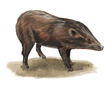
Sus salvanius is the smallest suid known. Adult males are on average 65 cm long (including the head), and 25 cm tall (to the shoulder). Females are only slighly smaller. Males average 8.5 kg in weight. Their coats have blackish-brown bristles over gray-brown skin and they have no facial warts. Both sexes have a tail that is approximatly 3 cm long and females have three pairs of mammae.
(WWF 1997; Macdonald 1999)
- Other Physical Features
- endothermic
- bilateral symmetry
-
- Range mass
- 0 to 0 kg
- 0.00 to 0.00 lb
-
- Average mass
- 8 kg
- 17.62 lb
Reproduction
Reproduction is strongly seasonal, and the birth peak coincides with the monsoon in late April and May. Gestation is approximately 100 days and litters range from 2 to 6 young, but are usually 3 to 4 young. Sus salvanius reaches sexual maturity at 13 to 33 months and may live 10 to 12 years in the wild.
(Huffman 1999; Massicot 2000)
- Key Reproductive Features
- gonochoric/gonochoristic/dioecious (sexes separate)
- sexual
Lifespan/Longevity
-
- Average lifespan
Status: wild - 7.5 years
- Max Planck Institute for Demographic Research
- Average lifespan
-
- Average lifespan
Status: wild - 12.0 years
- Max Planck Institute for Demographic Research
- Average lifespan
Behavior
This species is non-territorial and lives in small family groups of generally 4 to 5 members. However, larger groups have been found consisting of as many as 20 individuals. These family groups usually have one or two adult females and their associated juveniles. Adult males are usually solitary but often join estrus sows and maintain loose contact with the basic family group thoughout the year.
Both sexes create year-round vegetation nests by digging a trough with their snout and then lining the hole with grasses to create a comfortable bedding. This nest is especially important in cold weather to help their small bodies maintain heat.
(Huffman 1999; Massicot 2000)
- Key Behaviors
- motile
Communication and Perception
Food Habits
Pygmy hogs have well developed teeth, with upturned canines and molars with rounded cusps. This allows them to enjoy an omnivorous diet. They feed primarily on roots, tubers and other vegetative food as well as insects, eggs, young birds, and reptiles. Foraging occurs for approximately 6 to 10 hours a day, pausing midday to escape the heat.
(Chung 1997; WWF 1997; Huffman 1999; Massicot 2000)
Economic Importance for Humans: Positive
Sus salvanius has been over-hunted, so at one point it is likely that they provided a source of food for local hunters, and possibly income if the people sold the meat. There is no information available that speaks directly about Sus salvanius positively benefiting humans.
Economic Importance for Humans: Negative
There is no information available that indicates Sus salvanius adversely affects humans.
Conservation Status
Sus salvanius was placed in the Endangered category according to IUCN in 1960. The species remained Endangered until 1996 when it was placed in the Critically Endangered category. In 1970 it was estimated that there were less than 150 pygmy hogs living in the wild. Currently Sus salvanius is protected by Schedule 1 of the Indian Wildlife (Protection) Act. In addition, a "three-point" Action Plan was agreed upon by the Indian Central Government, and the IUCN/SSC Pigs and Peccaries Specialist Group in 1987. This plan includes conducting field surveys on the remaining wild populations and assessing areas for future reintroduction of captive bred animals.
Pygmy hogs are listed under CITES Appendix I.
(WWF 1997; Massicot 2000)
-
- IUCN Red List
-
Critically Endangered
More information
-
- IUCN Red List
-
Critically Endangered
More information
-
- CITES
- Appendix I
Other Comments
Sus salvanius is believed to be the only host of the pygmy hog sucking louse (Haematopinus oliver), and therefore this species has also been placed in the category of IUCN Red List of Threatened Animals.
(WWF 1997)
Contributors
Laura Stinson (author), University of Michigan-Ann Arbor, Phil Myers (editor), Museum of Zoology, University of Michigan-Ann Arbor.
Glossary
- bilateral symmetry
-
having body symmetry such that the animal can be divided in one plane into two mirror-image halves. Animals with bilateral symmetry have dorsal and ventral sides, as well as anterior and posterior ends. Synapomorphy of the Bilateria.
- chemical
-
uses smells or other chemicals to communicate
- endothermic
-
animals that use metabolically generated heat to regulate body temperature independently of ambient temperature. Endothermy is a synapomorphy of the Mammalia, although it may have arisen in a (now extinct) synapsid ancestor; the fossil record does not distinguish these possibilities. Convergent in birds.
- motile
-
having the capacity to move from one place to another.
- native range
-
the area in which the animal is naturally found, the region in which it is endemic.
- oriental
-
found in the oriental region of the world. In other words, India and southeast Asia.

- sexual
-
reproduction that includes combining the genetic contribution of two individuals, a male and a female
- tactile
-
uses touch to communicate
- tropical savanna and grassland
-
A terrestrial biome. Savannas are grasslands with scattered individual trees that do not form a closed canopy. Extensive savannas are found in parts of subtropical and tropical Africa and South America, and in Australia.
- savanna
-
A grassland with scattered trees or scattered clumps of trees, a type of community intermediate between grassland and forest. See also Tropical savanna and grassland biome.
- temperate grassland
-
A terrestrial biome found in temperate latitudes (>23.5° N or S latitude). Vegetation is made up mostly of grasses, the height and species diversity of which depend largely on the amount of moisture available. Fire and grazing are important in the long-term maintenance of grasslands.
References
January 5, 2001. "Protected Areas Programme" (On-line). Accessed March 10, 2001 at http://www.wcmc.org.uk/protected_areas/data/wh/manas.html.
Chung, R. December 1997. "Wild Pigs and Boars" (On-line). Accessed April 6, 2001 at http://members.home.net/r-chung/pigs/index.html#List_info.
Huffman, B. January 1, 1999. "Pygmy Hog" (On-line). Accessed April 6, 2001 at http://www.ultimateungulate.com/pygmyhog.html.
MacDonald, A. May 25, 1999. "Sus Salvanius-The Pigmy Hog" (On-line). Accessed March 10, 2001 at http://www.vet.ed.ac.uk/students/taxonomy/salvanius.htm.
Massicot, P. December 2, 2000. "Animal Info-Pygmy Hog" (On-line). Accessed March 18, 2001 at http://www.animalinfo.org/species/artiperi/sus_salv.htm.
Sanyal, P. 1995. A New Report on Pigmy Hog Sus salvanius (Hodgson) from West Bengal. Bombay Natural History Society, 92: 116.
World Wildlife Fund, 9/15/97. "Species Under Threat, Pygmy Hog" (On-line). Accessed 3/19/01 at http://www.panda.org/resources/publications/species/underthreat/pygmyhog.htm.