Stenorhynchus seticornisyellowline arrow crab

Geographic Range
Atlantic Ocean: Stenorhynchus seticornis, more commonly known as the yellowline arrow crab, is most commonly found along the coral reefs of the Caribbean, in the Atlantic Ocean. In North America, this area includes the coral reefs that run along Florida and Texas.
- Biogeographic Regions
- atlantic ocean
Habitat
The yellowline arrow crab lives on coral reefs between depths of 10 and 30 feet (Humann 1992).
- Aquatic Biomes
- reef
Physical Description
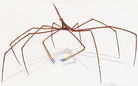
The yellowline arrow crab, on average, is 3 to 6 centimeters in length.
What makes the yellowline arrow crabs unusual is their long, spider-like legs, and and extremely pointed head. The eight legs are extremely long, more than three times the length of their body, and resemble the legs of a daddy long-legs spider. The entire body of the yellowline arrow crab is a medium golden brown in color. Along the dorsal side of the crab's body are stripes that are white, brown, or gold depending on the individual crab. The tips of their legs are a deep violet in color. As crabs grow, they occasionally shed their exoskeleton. The new skin hardens with calcium carbonate, obtained from sea water and by ingesting the old shell (Humann 1992, and Snyderman and Wiseman 1996).
- Other Physical Features
- ectothermic
- bilateral symmetry
Reproduction
During mating, a male yellowline arrow crab holds the female against his belly to deposit a sperm packet into the female crab. A female yellowline arrow crab then carries her eggs under her abdomen until they are ready to hatch. The young crabs that emerge are called zoea. They are called zoea only during the larval stage of growth. During this time the zoea are transparent, have a rounded body, and swim towards the surface of the sea They live in open water, feeding on small plankton. The zoea grows and molts the old skin by replacing it with the new skin. Eventually the larval crab emerges from the molt in a new stage, called a megalops. During this stage of growth the body and limbs finally start to look more crab-like in form, though the abdomen has still not folded up. The yellowline arrow crab will continue to shed, replacing their exoskeleton, and will eventually grow to look like any other adult yellowline arrow crab. The reproduction cycle can then begin again (Olhausen and Russo 1981, and Anonymous 2000).
Behavior
The best time to see a yellowline arrow crab is during the night. During the day, the crab tends to hide under ledges, sea fans, and on sponges. But at night, this crab comes alive. This is the time when yellowline arrow crabs do most of their scavenging. These crabs do not feel threatened by divers in the least. However, when it comes to other species of the sea, they tend to not be as friendly and can be extremely territorial.
Yellowline arrow crabs are rather interesting to watch. Their long legs are what make them such an interesting sight. The divers that have seen the yellowline arrow crab say that the crab walks with much grace but at the same time they look comical as they maneuver. Being such a unique species of crabs, the yellowline arrow crab is notorious for getting its picture taken (Ehrengruber 1999, Synderman and Wiseman 1996).
Food Habits
The yellowline arrow crab is mainly a nocturnal scavenger, but is also occasionally carnivorous, preying on small feather duster worms and other tiny animals of the coral reefs (Snyderman and Wiseman 1996, and Hauter 2000).
Economic Importance for Humans: Positive
None reported
Economic Importance for Humans: Negative
None reported
Other Comments
Sometimes kept as scavengers in salt water aquaria. The yellowline arrow crab eats many of the smaller particles that might be found in an aquarium. Territorial behavior usually prevents more than one crab from flourishing in a tank. They work well with other species, but not usually with their own.
Contributors
Melissa Block (author), Fresno City College, Shirley Porteous-Gafford (editor), Fresno City College.
Glossary
- Atlantic Ocean
-
the body of water between Africa, Europe, the southern ocean (above 60 degrees south latitude), and the western hemisphere. It is the second largest ocean in the world after the Pacific Ocean.

- bilateral symmetry
-
having body symmetry such that the animal can be divided in one plane into two mirror-image halves. Animals with bilateral symmetry have dorsal and ventral sides, as well as anterior and posterior ends. Synapomorphy of the Bilateria.
- ectothermic
-
animals which must use heat acquired from the environment and behavioral adaptations to regulate body temperature
- native range
-
the area in which the animal is naturally found, the region in which it is endemic.
- reef
-
structure produced by the calcium carbonate skeletons of coral polyps (Class Anthozoa). Coral reefs are found in warm, shallow oceans with low nutrient availability. They form the basis for rich communities of other invertebrates, plants, fish, and protists. The polyps live only on the reef surface. Because they depend on symbiotic photosynthetic algae, zooxanthellae, they cannot live where light does not penetrate.
References
Anonymous, 2000. "Crab" (On-line). Accessed November 3, 2000 at http://www.eblast.com/bcom/eb/article/idxref/6/0,5716,497566,00.html.
Hauter, D., S. Hauter. 2000. "About.com-Saltwater Aquariums" (On-line). Accessed 10/20/00 at http://saltaquarium.about.com/pets/saltaquarium/mbody.htm.
Humann, P. 1992. Reef Creature Indentification. New World Publications.
Olhausen, P., R. Russo. 1981. Pacific Intertidal Life. Nature Study Guide.
Snyderman, M., C. Wiseman. 1996. Guide to Marine Life. Aqua Quest Publication.