Stenella frontalisAtlantic spotted dolphin

Geographic Range
Atlantic spotted dolphins (Stenella frontalis) are found throughout the Atlantic Ocean at latitudes between 50 degrees North and 25 degrees South. They are most commonly observed in coastal waters, but also move into deeper waters.
Atlantic spotted dolphins are found in coastal regions of both the western and eastern Atlantic Ocean. Their distribution includes waters along the east coast of Canada and the United States, the Gulf of Mexico, the Caribbean Sea, and waters along the east coast of central and south America, as far south as Uruguay. Their distribution also includes the waters along the west coast of Africa, as far south as Angola, and waters around Oceanic islands, such as St. Helena, the Azores, and the Canary Islands. Atlantic spotted dolphins are absent in the Mediterranean Sea and western South Atlantic. (Jefferson, et al., 2008; Perrin, et al., 2009; Reeves, et al., 2002; Shirihai and Jarrett, 2006; Thewissen, et al., 2002)
- Biogeographic Regions
- atlantic ocean
Habitat
Atlantic spotted dolphins are found in tropical and warm, temperate waters of the Atlantic Ocean. Their distribution primarily includes shallow waters along the continental shelf and upper continental slope. However, some populations are found in deeper waters farther from land.
Atlantic spotted dolphins are most common at depths of 200 m, although populations farther from land may inhabit waters as deep as 1000 m. Some populations near the Bahamas are found in shallow sand flats only 6 to 12 m deep. Atlantic spotted dolphins spend most of their time at depths of less than 10 m, but may dive to depths of 40 to 60 m for up to 6 minutes when foraging for food. (Jefferson, et al., 2008; Perrin, et al., 2009; Reeves, et al., 2002; Shirihai and Jarrett, 2006; Thewissen, et al., 2002; Viricel and Rosel, 2014)
- Habitat Regions
- tropical
- saltwater or marine
-
- Range depth
- 6 to 1000 m
- 19.69 to 3280.84 ft
-
- Average depth
- 200 m
- 656.17 ft
Physical Description
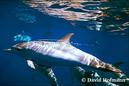
Atlantic spotted dolphins have a three-part body coloration and a two-part spotting pattern. They have dark gray dorsal coloration with white spots, light gray lateral coloration with white spots, and white ventral coloration with dark spots. Newborn calves and juveniles are not spotted, developing spots first on their ventral sides around weaning age, from 2 to 6 years old. As Atlantic spotted dolphins mature, they develop more spots on their lateral and dorsal sides. Atlantic spotted dolphins can be heavily spotted or sparsely spotted and the amount of spotting typically varies between populations depending on their location. For example, individuals located in offshore and/or temperate areas have little or no spotting and tend to be smaller in size, with skulls measuring 360 mm long on average. Conversely, individuals in coastal populations tend to have intense spotting and are larger in size, with skulls measuring 461 mm long on average. Atlantic spotted dolphins have white-tipped beaks measuring 90 to 140 mm in length and have a distinct crease, called a melon, between their beaks and the rest of their heads. Their dorsal fin is curved and 160 to 250 mm in length, and located near the middle of their backs. Atlantic spotted dolphins have 32 to 42 teeth in their upper jaws and 30 to 40 teeth in their lower jaws.
Adult males measure up to 2.6 m in length and weigh as much as 140 kg, whereas females measure up to 2.29 m in length and weigh as much as 130 kg. Newborns are about 0.9 to 1.1 m in length, but newborn weights have not been recorded. (Jefferson, et al., 2008; Perrin, et al., 2009; Reeves, et al., 2002; Shirihai and Jarrett, 2006; Thewissen, et al., 2002)
- Other Physical Features
- endothermic
- bilateral symmetry
-
- Range mass
- 110 to 143 kg
- 242.29 to 314.98 lb
-
- Range length
- 1.9 to 2.3 m
- 6.23 to 7.55 ft
-
- Average length
- 2.1 m
- 6.89 ft
Reproduction
Atlantic spotted dolphins are polygynandrous and usually breed between early spring and late fall. Mating events typically involve three or four males that pursue one female. Males escort the female they are following to the seafloor and fend off other male groups until the female is ready to mate. Small groups of males initially attract female dolphins with behaviors such as synchronized swimming, vocalizations, and specific postures. The duration of courtship behaviors is unknown. The mating strategies of Atlantic spotted dolphins play a key role in shaping social structure by influencing female-male associations. (Elliser and Herzing, 2014; Green, et al., 2015; Herzing, 1997; Melillo, et al., 2009)
- Mating System
- polygynandrous (promiscuous)
Atlantic spotted dolphins are iteroparous, viviparous, reproduce sexually, and exhibit internal fertilization. Females reach reproductive maturity after 8 to 11 years. The age at which males reach sexual maturity is currently unknown, but is estimated to be at around 10 years old. Atlantic spotted dolphins breed between early spring and late fall. The gestation period lasts 11 to 12 months and females have only 1 offspring per breeding season. There are no records of mass at birth, but newborn calves are around 1/3 of the mothers size. Calves are dependent on their mothers for several years. They are considered fully weaned at 3 to 5 years after birth, but they start catching and eating solid foods 6 to 10 months after birth. The calving interval for Atlantic spotted dolphins is 3 to 4 years, which means that females may be pregnant while still nursing an older calf. Calves usually stay with their mothers for around 3 years after birth. However, if their mother does not become pregnant in successive years, then calves may remain partially dependent for up to 9 years after birth. (Archer and Robertson, 2004; Green, et al., 2011; Herzing, 1997; Jefferson, et al., 2008; Miles and Herzing, 2003; Reeves, et al., 2002)
- Key Reproductive Features
- iteroparous
- seasonal breeding
- gonochoric/gonochoristic/dioecious (sexes separate)
- sexual
- fertilization
- viviparous
-
- Breeding interval
- Atlantic spotted dolphins breed once yearly.
-
- Breeding season
- Between early spring and late fall
-
- Range number of offspring
- 1 to 1
-
- Range gestation period
- 11 to 12 months
-
- Average gestation period
- 12 months
-
- Range weaning age
- 36 to 60 months
-
- Range time to independence
- 3 to 9 years
-
- Average time to independence
- 3 years
-
- Range age at sexual or reproductive maturity (female)
- 8 to 11 years
Atlantic spotted dolphins exhibit extended parental investment in their offspring. Although males do not specifically care for their own offspring, they will occasionally protect females who are pregnant or have a young calf. Females are responsible for feeding and protecting their young, and newborns rely on their mothers for learning and development. Calves spend are entirely dependent on their mothers for around 3 years, during which time mothers teach their calves how to hunt. To do so, mothers will catch prey and release it back into the sand. They then motion towards the prey with their jaws and allow the calf to participate in catching the prey. Calves become fully dependent from their mothers between 3 and 9 years after birth. (Bender, et al., 2009; Green, et al., 2011)
- Parental Investment
- precocial
- female parental care
-
pre-fertilization
- provisioning
-
protecting
- female
-
pre-hatching/birth
-
provisioning
- female
-
protecting
- male
-
provisioning
-
pre-weaning/fledging
-
provisioning
- female
-
protecting
- male
- female
-
provisioning
-
pre-independence
-
provisioning
- female
-
protecting
- female
-
provisioning
- extended period of juvenile learning
Lifespan/Longevity
Atlantic spotted dolphins have an average lifespan of 23 years in the wild. In captivity, they typically live 1 year or less because they often refuse to eat. (Perrin, et al., 2009)
-
- Average lifespan
Status: wild - 23 years
- Average lifespan
-
- Range lifespan
Status: captivity - 0 to 1 years
- Range lifespan
Behavior
Atlantic spotted dolphins are highly social and are presumed to be highly intelligent. They are fast swimmers and are often observed swimming frantically around conspecifics. Atlantic spotted dolphins are also acrobatic and tend to leap out of the water and ride the waves creates by the bows of ships.
Atlantic spotted dolphins are usually found in groups, called pods, containing 5 to 15 individuals in coastal areas and closer to 50 individuals in deeper waters. They are known to interact with bottlenose dolphins (Tursiops truncatus) both playfully and aggressively.
Atlantic spotted dolphins do not appear to be migratory. In the Bahamas, the same individuals have been sighted in multiple consecutive years. (Dudzinski and Frohoff, 2008; Jefferson, et al., 2008; Melillo, et al., 2009; Reeves, et al., 2002; Thewissen, et al., 2002)
- Key Behaviors
- natatorial
- motile
- sedentary
- social
Home Range
There is limited information regarding home ranges of Atlantic spotted dolphins. Research on bottlenose dolphins (Tursiops truncatus) has shown that they can travel 40 to 50 km in one day. It is possible that Atlantic spotted dolphins have similar movement behaviors. (Jefferson, et al., 2008; Mann, et al., 2000)
Communication and Perception
Atlantic spotted dolphins have complex methods of intraspecific communication, using both vocal and non-vocal signals that differ depending on context. Atlantic spotted dolphins have a highly developed sense of hearing and produce sounds at high frequencies, from 0.1 to 18 kHz. They often communicate using a series of clicks, which can range in number from 8 to 1,200 clicks in one continuous call.
Atlantic spotted dolphins do not produce sound using vocal cords, but rather using a mass of fatty tissue in their forehead, called a melon. They use three main types of vocal communication: whistles, clicks, and burst pulsed sounds. Whistles are a common form of communication in most dolphins, and are primarily used for social communication and excitement vocalizations. Dolphins use clicks to navigate and orient themselves in their environment. Dolphins produce whistles using the right side of their melons and produce clicks using the left side. Dolphins also use burst pulsed sounds for social communication. Other vocalizations, including squawks, synchronized squawks, screams, and barks are also associated with contextual and social behavior. Other sounds associated with foraging and feeding behaviors include razor buzzes, trills, and upswept whistles.
Atlantic spotted dolphins also use non-vocal communication. They do not use many visual signals, due to limited visibility underwater. However, they do emit bubbles from their blowholes to communicate visually. Atlantic spotted dolphins also communicate information using tactile stimuli. They use their dorsal fins, pectoral fins, tails, bellies, rostrums, and sometimes the entire bodies to communicate with each other. Physical contact can have different meanings depending on the specific relationship between two individuals. For example pectoral fin rubbing between a female and its calf is a method of calming the calf, but pectoral fin rubbing between unrelated dolphins could mean that one needs help.
Atlantic spotted dolphins also communicate using chemical stimuli. For example, reproductive females will emit specific pheromones to communicate their receptivity to mating. How exactly other dolphins detect these pheromones is unknown, since their olfactory and gustatory senses are not necessarily well developed. (Dudzinski and Frohoff, 2008; Herzing, 1996; Herzing, 2014; Mann, et al., 2000)
- Perception Channels
- visual
- tactile
- echolocation
- chemical
Food Habits
Atlantic spotted dolphins eat a variety of prey, and their diets vary depending on geographic location. Prey items include small, soft-bodied fish including flatfishes (order Pleuronectiformes), clupeoids (family Clupeidae), halfbeaks (family Hemiramphidae), and carangids (family Carangidae). They also eat squid and some other cephalopods (class Cephalopoda), as well as other invertebrates. Atlantic spotted dolphins typically hunt by trapping prey near islands or seamounts. However, they are also known to follow trawling ships and eat discarded organisms such as fish and shrimp. (Jefferson, et al., 2008; Mann, et al., 2000; Perrin, 2002; Perrin, et al., 2009; Reeves, et al., 2002; Thewissen, et al., 2002)
- Primary Diet
-
carnivore
- piscivore
- molluscivore
- eats other marine invertebrates
- Animal Foods
- fish
- mollusks
- aquatic or marine worms
- aquatic crustaceans
Predation
Predators of Atlantic spotted dolphins include sharks, orcas (Orcinus orca), and humans (Homo sapiens). The most common predators of Atlantic spotted dolphins are tiger sharks (Galeocerdo cuvier) and bull sharks (Carcharhinus leucas).
Humans kill Atlantic spotted dolphins both intentionally for food and unintentionally through fishing practices. Dolphins can get tangled in fishing equipment, which can cause them to drown or sustain serious injuries.
Atlantic spotted dolphins exhibit several anti-predator behaviors, which can vary depending on the type of predator and the condition of the individual dolphin. They have been observed hitting potential predators with their flippers or shaking their heads and emitting clouds of bubbles. Atlantic spotted dolphins may also face predators directly and flare their flippers in order to appear larger and more intimidating. To communicate the presence of predators to other members of their social group, Atlantic spotted dolphins repeatedly slap their tails against the surface of the water, which creates a low, loud sound. They are also able to hear the high frequencies that orcas emit when hunting and can thus avoid predation. (Dudzinski and Frohoff, 2008; Dunn and Claridge, 2014; Melillo-Sweeting, et al., 2014; Reeves, et al., 2002; Thewissen, et al., 2002)
-
- Known Predators
-
- Tiger sharks (Galeocerdo cuvier)
- Bull sharks (Carcharhinus leucas)
- Killer whales (Orcinus orca)
- Humans (Homo sapiens)
Ecosystem Roles
Atlantic spotted dolphins prey on small, soft-bodied fish, squids, and other invertebrates. They also serve as prey for bull sharks (Carcharhinus leucas), tiger shark (Galeocerdo cuvier), and orcas (Orcinus orca).
Atlantic spotted dolphins are known hosts of three parasites. Bolbosoma vasculosum is found in their intestines, Anisakis typica is found in their stomachs, and Phyllobothrium delphini is found in their blubber. (Colón-Llavina, et al., 2009; Dunn and Claridge, 2014; Melillo-Sweeting, et al., 2014; Mignucci-Giannoni, et al., 1998; Perrin, 2002)
- Spiny-headed worms (Bolbosoma vasculosum)
- Roundworms (Anisakis typica)
- Tapeworms (Phyllobothrium delphini)
Economic Importance for Humans: Positive
Atlantic spotted dolphins are a popular research species due to their large brain size and social behavior. They also serve as a source of ecotourism in the Bahamas, where they are tolerant of humans swimming nearby. (Dudzinski and Frohoff, 2008; Jefferson, et al., 2008)
- Positive Impacts
- ecotourism
Economic Importance for Humans: Negative
There are no known adverse economic effects of Atlantic spotted dolphins on humans.
Conservation Status
Atlantic spotted dolphins are listed as “data deficient” on the IUCN Red List, meaning that their conservation status cannot be categorized until more information is collected. They are listed under Appendix II of CITES, which strictly regulates importation or exportation of individuals and emphasizes humane treatment. Atlantic spotted dolphins are also protected by the Marine Mammal Protection Act. They are not listed on any other national or international conservation lists.
Atlantic spotted dolphin populations are most threatened by fishing and whaling practices. There are still whaling groups that target Atlantic spotted dolphins. Furthermore, Atlantic spotted dolphins often forage near the shore and sometimes follow boats to catch discarded fish. This close association with ships and fishing areas results in their accidental capture or entanglement in fishing equipment. As a result, they either drown in fishing equipment or are shot or speared by fishermen. The number of Atlantic spotted dolphins that die due to entanglements or captures is currently unknown. (Dudzinski and Frohoff, 2008; Hammond, et al., 2012; Jefferson, et al., 2008; Perrin, et al., 2009; Reeves, et al., 2002; Roman, et al., 2013)
-
- IUCN Red List
-
Data Deficient
More information
-
- IUCN Red List
-
Data Deficient
More information
-
- US Federal List
- No special status
-
- CITES
- Appendix II
-
- State of Michigan List
- No special status
Contributors
Kelsey Brimer (author), Radford University, Karen Powers (editor), Radford University, April Tingle (editor), Radford University, Emily Clark (editor), Radford University, Cari Mcgregor (editor), Radford University, Jacob Vaught (editor), Radford University, Galen Burrell (editor), Special Projects.
Glossary
- Atlantic Ocean
-
the body of water between Africa, Europe, the southern ocean (above 60 degrees south latitude), and the western hemisphere. It is the second largest ocean in the world after the Pacific Ocean.

- acoustic
-
uses sound to communicate
- bilateral symmetry
-
having body symmetry such that the animal can be divided in one plane into two mirror-image halves. Animals with bilateral symmetry have dorsal and ventral sides, as well as anterior and posterior ends. Synapomorphy of the Bilateria.
- carnivore
-
an animal that mainly eats meat
- chemical
-
uses smells or other chemicals to communicate
- coastal
-
the nearshore aquatic habitats near a coast, or shoreline.
- echolocation
-
The process by which an animal locates itself with respect to other animals and objects by emitting sound waves and sensing the pattern of the reflected sound waves.
- ecotourism
-
humans benefit economically by promoting tourism that focuses on the appreciation of natural areas or animals. Ecotourism implies that there are existing programs that profit from the appreciation of natural areas or animals.
- endothermic
-
animals that use metabolically generated heat to regulate body temperature independently of ambient temperature. Endothermy is a synapomorphy of the Mammalia, although it may have arisen in a (now extinct) synapsid ancestor; the fossil record does not distinguish these possibilities. Convergent in birds.
- female parental care
-
parental care is carried out by females
- fertilization
-
union of egg and spermatozoan
- iteroparous
-
offspring are produced in more than one group (litters, clutches, etc.) and across multiple seasons (or other periods hospitable to reproduction). Iteroparous animals must, by definition, survive over multiple seasons (or periodic condition changes).
- molluscivore
-
eats mollusks, members of Phylum Mollusca
- motile
-
having the capacity to move from one place to another.
- natatorial
-
specialized for swimming
- native range
-
the area in which the animal is naturally found, the region in which it is endemic.
- pelagic
-
An aquatic biome consisting of the open ocean, far from land, does not include sea bottom (benthic zone).
- piscivore
-
an animal that mainly eats fish
- polygynandrous
-
the kind of polygamy in which a female pairs with several males, each of which also pairs with several different females.
- saltwater or marine
-
mainly lives in oceans, seas, or other bodies of salt water.
- seasonal breeding
-
breeding is confined to a particular season
- sedentary
-
remains in the same area
- sexual
-
reproduction that includes combining the genetic contribution of two individuals, a male and a female
- social
-
associates with others of its species; forms social groups.
- tactile
-
uses touch to communicate
- tropical
-
the region of the earth that surrounds the equator, from 23.5 degrees north to 23.5 degrees south.
- visual
-
uses sight to communicate
- viviparous
-
reproduction in which fertilization and development take place within the female body and the developing embryo derives nourishment from the female.
- young precocial
-
young are relatively well-developed when born
References
Archer, F., K. Robertson. 2004. Age and length at weaning and development of diet of pantropical spotted dolphins, Stenella attenuata, from the Eastern Tropical Pacific. SOC Marine Mammalogy, 20/2: 232-245.
Bender, C., D. Herzing, D. Bjorklund. 2009. Evidence of teaching in Atlantic spotted dolphins by mother dolphins foraging in the presence of their calves. Animal Cognition, 12/1: 43-53.
Colón-Llavina, M., A. Mignucci-Giannoni, S. Mattiucci, M. Paoletti, G. Nascetti, E. Williams. 2009. Additional records of metazoan parasites from Caribbean marine mammals, including genetically identified anisakid nematodes. Parasitology Research, 105/5: 1239-1252.
Donoghue, M., A. Wheeler. 1990. Save the Dolphins. New York: Sheridan House Inc.
Dudzinski, K., T. Frohoff. 2008. Dolphin Mysteries. Connecticut: Yale University Press.
Dunn, C., D. Claridge. 2014. Killer whale (Orcinus orca) occurrence and predation in the Bahamas. Journal of the Marine Biological Association of the United Kingdom, 94/6: 1305-1309.
Elliser, C., D. Herzing. 2014. Long-term social structure of a resident community of Atlantic spotted dolphins, Stenella Frontalis, in the Bahamas 1991-2002. Marine Mammal Science, 30/1: 308-328.
Green, M., D. Herzing, J. Baldwin. 2015. Molecular assessment of mating strategies in a population of Atlantic spotted dolphins. PLoS ONE, 10/2: 1-17.
Green, M., D. Herzing, J. Baldwin. 2011. Reproductive success of male Atlantic spotted dolphins (Stenella frontalis) revealed by noninvasive genetic analysis of paternity. Canadian Journal of Zoology, 89/3: 239-253.
Hammond, P., G. Bearzi, A. Bjørge, K. Forney, L. Karkzmarski, T. Kasuya, W. Perrin, M. Scott, J. Wang, R. Wells, B. Wilson. 2012. "Stenella frontalis" (On-line). The IUCN Red List of Threatened Species. Accessed March 23, 2015 at www.iucnredlist.org.
Herzing, D. 2014. Clicks, whistles, and pulses: passive and active signal use in dolphin communication. Acta Astronautica, 105/2: 534-537.
Herzing, D. 1997. The life of free ranging Atlantic spotted dolphins: age, class, color phases, and female reproduction. Marine Mammal Science, 13/4: 576-595.
Herzing, D. 1996. Vocalizations and associated underwater behavior of free-ranging Atlantic spotted dolphins, Stenella frontalis and bottlenose dolphins, Tursiops truncatus. Aquatic Mammals, 22/2: 61-79.
Herzing, D., C. Elliser. 2012. Community structure and cluster definition of Atlantic spotted dolphins, Stenella frontalis, in the Bahamas. Marine Mammal Science, 28/4: 486-502.
Jefferson, T., M. Webber, R. Pitman, B. Jarrett. 2008. Marine Mammals of the World. Oxford, UK: Elsevier.
Mann, J., R. Connor, P. Tyack, H. Whitehead. 2000. Cetacean Societies. Chicago & London: The University of Chicago Press.
Melillo-Sweeting, K., S. Turnbull, T. Guttridge. 2014. Evidence of shark attacks on Atlantic spotted dolphins (Stenella frontalis) off Bimini, the Bahamas. Marine Mammal Science, 30/3: 1158-1164.
Melillo, K., K. Dudzinski, L. Cornick. 2009. Interactions between Atlantic spotted (Stenella frontalis) and bottlenose (Tursiops truncatus) dolphins off Bimini, the Bahamas, 2003-2007. Aquatic Mammals, 35/2: 281-291.
Mignucci-Giannoni, A., E. Hoberg, D. Siegel-Causey, E. Williams. 1998. Metazoan parasites and other symbionts of cetaceans in the Caribbean. The Journal of Parasitology, 84/5: 939-946.
Miles, J., D. Herzing. 2003. Underwater analysis of the behavioural development of free-ranging Atlantic spotted dolphin (Stenella frontalis) calves (brith to 4 years of age). Aquatic Mammals, 29/3: 363-377.
Perrin, W. 2002. Stenella frontalis. Mammalian Species, 43/1: 1-6.
Perrin, W., J. Thewissen, B. Wursig. 2009. Encyclopedia of Marine Mammals. London: Academic Press.
Reeves, R., B. Stewart, P. Clapham, J. Powell, P. Folkens. 2002. Guide to Marine Mammals of the World. New York: Random House.
Roman, J., I. Altman, M. Dunphy-Daly, C. Campbell, M. Jasny, A. Read. 2013. The Marine Mammal Protection Act at 40: Status, recovery, and future of U.S. marine mammals. Annals of the New York academy of sciences, 1286/1: 29-49.
Shirihai, H., B. Jarrett. 2006. Whales Dolphins and Other Marine Mammals of the World. New Jersey: Princeton University Press.
Thewissen, J., B. Würsig, W. Perrin. 2002. Encyclopedia of Marine Mammals. San Diego: Academic Press.
Viricel, A., P. Rosel. 2014. Hierarchical population structure and habitat differences in a highly mobile marine species: the Atlantic spotted dolphin. Molecular Ecology, 23/20: 5018-5035.