Stegostoma fasciatumLeopard shark(Also: Variegated shark; Zebra shark)
Geographic Range
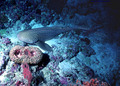
Zebra sharks (Stegostoma fasciatum) live in the central, western and Indian Pacific oceans. This species is abundant in Australian coastal waters. It lives mainly over continental and insular shelves and is very common around coral reefs and sandy bottoms. It generally resides around 62 m below the surface of the ocean, but it has occasionally been found in fresh water also. ("Zebra shark", 2005)
- Biogeographic Regions
- indian ocean
- pacific ocean
Habitat
Stegostoma fasciatum is commonly found around warm water reefs and sandy areas. It is common along the Australian coast. It usually resides at a depth of 62 m.
- Habitat Regions
- saltwater or marine
- freshwater
-
- Average depth
- 62 below sea level m
- ft
Physical Description
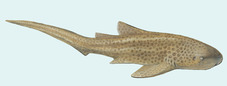
Zebra sharks range from about 2.5 m to 3.0 m in length. The largest zebra shark captured wasabout 3.5 m in length. The body is cylindrical with lateral ridges and a tail as long as the body. The head is broad with large eyes and a transverse mouth just below them. Five gill slits are present on the side of the head. The anterior dorsal fin is larger than the posterior and the gray body is covered in dark brown spots. (Kyne, et al., 2005; "Zebra shark", 2005)
- Other Physical Features
- ectothermic
- bilateral symmetry
- Sexual Dimorphism
- male larger
-
- Range length
- 2.0 to 3.5 m
- 6.56 to 11.48 ft
-
- Average length
- 2.5-3.0 m
- ft
Development
Newly fertilized eggs are laid on rocks at the bottom of reefs. From the time they hatch they are independent of their parents. Individuals less than 70 cm in length are rarely seen, indicating that they spend the first months of their lives at depths that recreational divers do not reach. The young sharks are darker in base color and have light stripes and spots than do adult sharks. As they age, the young lose their stripes and gain spots as their base color lightens. ("Zebra shark", 2005)
Reproduction
Details on the mating system of this species are not available.
Stegostoma fasciatum is oviparous. Females lay eggs, and are suspected to lay more than one egg at a time. The eggs are large, about 17 cm in diameter and are fertilized externally. The eggs hatch at about 20 to 36 cm.
Breeding in captivity has been achieved, but the eggs are hard to incubate. At the Henry Doorly Zoo in Omaha, Nebraska, 3 eggs hatched out of a group of 46 laid. Of the 46, 7 were infertile and 31 did not develop entirely. Only eight developed to a full embryo. The incubation of these eggs took about 6.5 months, which is estimated to be the same as in the wild. ("Henry Doorly Zoo, Omaha, Nebraska, U.S.A.", 1999; "Zebra shark", 2005)
- Key Reproductive Features
- iteroparous
- year-round breeding
- gonochoric/gonochoristic/dioecious (sexes separate)
- sexual
- fertilization
- oviparous
-
- Breeding interval
- The breeding frequency of this species is not known.
-
- Breeding season
- Breeding in this species occurs year- round.
-
- Range number of offspring
- 2 to 7
-
- Average number of offspring
- 4
-
- Average time to independence
- 0 minutes
-
- Average age at sexual or reproductive maturity (female)
- around 1.7 meters months
-
- Range age at sexual or reproductive maturity (male)
- 1.5 meters to 1.8 meters months
Females produce very large eggs, which can be considered a form of parental investment. In spite of this early investment, however, there is no pronounced parental care in either eggs or newly hatched offspring.
- Parental Investment
-
pre-fertilization
- provisioning
-
protecting
- female
Lifespan/Longevity
When S. fasciatum is kept in small tanks, the expected life span is about 9 years. When held captive in large aquariums, the average lifespan of S. fasciatum is about 25 years. In the wild, it is suspected that the lifespan is about the same, although it could be closer to 30 years. (Kyne, et al., 2005; "Zebra shark", 2005)
-
- Range lifespan
Status: wild - 33 (high) years
- Range lifespan
-
- Average lifespan
Status: wild - 25 years
- Average lifespan
-
- Range lifespan
Status: captivity - 5 to 27 years
- Range lifespan
-
- Average lifespan
Status: captivity - 25 years
- Average lifespan
-
- Average lifespan
Status: wild - 25 years
- Average lifespan
-
- Average lifespan
Status: captivity - 25 years
- Average lifespan
Behavior
Stegostoma fasciatum is mostly solitary. It is a nocturnal hunter, so most of its day is spent lazily swimming around the reef. Like other bottom dwelling sharks, it can pump water across its gills through its mouth, which allows the shark to respire while stationary. It is a powerful swimmer with a tail that is as long as, if not longer than, its body. (Cavanagh, et al., 2003; Kyne, et al., 2005; "Zebra shark", 2005; Stead, 1963)
- Key Behaviors
- natatorial
- nocturnal
- motile
- sedentary
- solitary
Home Range
These sharks do not usually swim in open water, so their territories are limited mainly to the reef at which they were hatched or reefs that are closely connected to their natal area. ("Zebra shark", 2005; Stead, 1963)
Communication and Perception
Communication in these animals has not been studied extensively. However, it is likely that some visual cues are important, especially during mating, and that tactile and accoustic cues are used.
- Other Communication Modes
- vibrations
- Perception Channels
- visual
- tactile
- acoustic
- vibrations
- chemical
Food Habits
Natural foods include gastropod and bivalve mollusks with smaller amounts of crabs, shrimp, and small fish. (Cavanagh, et al., 2003; Kyne, et al., 2005; "Zebra shark", 2005)
- Primary Diet
-
carnivore
- eats non-insect arthropods
- molluscivore
- Animal Foods
- fish
- mollusks
- aquatic or marine worms
- aquatic crustaceans
- other marine invertebrates
Predation
Predators of zebra sharks are other large sharks and humans. (Cavanagh, et al., 2003)
- Anti-predator Adaptations
- cryptic
-
- Known Predators
-
- Humans
- other large sharks
Ecosystem Roles
These sharks are predators on a number of invertebrate and vertebrate species. Because of this, they likely affect the popultion dynamics of those species that serve as their prey.
Economic Importance for Humans: Positive
Zebra sharks are seen in fish markets all around Indonesia, Thailand, Malaysia, the Philippines, and India. The liver of this species is used to make vitamins, and its fins are used in many soups. (Kyne, et al., 2005)
- Positive Impacts
- food
- source of medicine or drug
Economic Importance for Humans: Negative
Zebra sharks are not known to have a negative effect on human economies.
Conservation Status
The IUCN Red List considers S. fasciatum to be a vulnerable species. The population trend is on a decline, mostly because of human hunters.
-
- IUCN Red List
-
Vulnerable
More information
-
- IUCN Red List
-
Vulnerable
More information
-
- US Federal List
- No special status
-
- CITES
- No special status
Contributors
Nancy Shefferly (editor), Animal Diversity Web.
Pamela Rasmussen (editor, instructor), Michigan State University, Jessica Reum (author), Michigan State University.
Glossary
- Pacific Ocean
-
body of water between the southern ocean (above 60 degrees south latitude), Australia, Asia, and the western hemisphere. This is the world's largest ocean, covering about 28% of the world's surface.

- acoustic
-
uses sound to communicate
- bilateral symmetry
-
having body symmetry such that the animal can be divided in one plane into two mirror-image halves. Animals with bilateral symmetry have dorsal and ventral sides, as well as anterior and posterior ends. Synapomorphy of the Bilateria.
- carnivore
-
an animal that mainly eats meat
- chemical
-
uses smells or other chemicals to communicate
- coastal
-
the nearshore aquatic habitats near a coast, or shoreline.
- cryptic
-
having markings, coloration, shapes, or other features that cause an animal to be camouflaged in its natural environment; being difficult to see or otherwise detect.
- drug
-
a substance used for the diagnosis, cure, mitigation, treatment, or prevention of disease
- ectothermic
-
animals which must use heat acquired from the environment and behavioral adaptations to regulate body temperature
- external fertilization
-
fertilization takes place outside the female's body
- fertilization
-
union of egg and spermatozoan
- food
-
A substance that provides both nutrients and energy to a living thing.
- freshwater
-
mainly lives in water that is not salty.
- iteroparous
-
offspring are produced in more than one group (litters, clutches, etc.) and across multiple seasons (or other periods hospitable to reproduction). Iteroparous animals must, by definition, survive over multiple seasons (or periodic condition changes).
- molluscivore
-
eats mollusks, members of Phylum Mollusca
- motile
-
having the capacity to move from one place to another.
- natatorial
-
specialized for swimming
- native range
-
the area in which the animal is naturally found, the region in which it is endemic.
- nocturnal
-
active during the night
- oviparous
-
reproduction in which eggs are released by the female; development of offspring occurs outside the mother's body.
- reef
-
structure produced by the calcium carbonate skeletons of coral polyps (Class Anthozoa). Coral reefs are found in warm, shallow oceans with low nutrient availability. They form the basis for rich communities of other invertebrates, plants, fish, and protists. The polyps live only on the reef surface. Because they depend on symbiotic photosynthetic algae, zooxanthellae, they cannot live where light does not penetrate.
- saltwater or marine
-
mainly lives in oceans, seas, or other bodies of salt water.
- sedentary
-
remains in the same area
- sexual
-
reproduction that includes combining the genetic contribution of two individuals, a male and a female
- solitary
-
lives alone
- tactile
-
uses touch to communicate
- vibrations
-
movements of a hard surface that are produced by animals as signals to others
- visual
-
uses sight to communicate
- year-round breeding
-
breeding takes place throughout the year
References
1999. Henry Doorly Zoo, Omaha, Nebraska, U.S.A.. International Zoo News, Vol. 46/5. Accessed April 26, 2005 at http://www.zoonews.ws/IZN/294/IZN-294.html#news.
MarineBio.org. 2005. "Zebra shark" (On-line). Marine Biology. Accessed April 12, 2005 at http://www.marinebio.com/species.asp?id=56.
Cavanagh, R., P. Kyne, S. Fowler, M. Bennett. 2003. "The Conservation Status of Australasian Chondrichtyans" (On-line pdf). Accessed April 12, 2005 at http://www.flmnh.ufl.edu/fish/Organizations/SSG/regions/region8/Ausfinal.pdf.
Demski, L., J. Wourms. 1993. The Reproduction and Development of Sharks, Skates, Rays and ratfishes. Norwell, MA: Kluwer Acedemic Press.
Kyne, P., R. Cavanagh, S. Fowler, C. Pollick. 2005. "IUNC Shark Specialist Group Red List assesments, 2000-2004" (On-line pdf). Accessed April 12, 2005 at http://www.flmnh.ufl.edu/fish/organizations/ssg/redlistassessment2004.pdf.
Stead, D. 1963. Sharks and Rays of Australian Seas. Sydney, Australia: Halstead.