Spilocuscus maculatusshort-tailed spotted cuscus

Geographic Range
The main portion of the common spotted cuscus range occurs in New Guinea (comprised of Indonesia and Papua New Guinea) and the Cape York Peninsula of Australia, a tropical region in the northeastern portion of Australia. The common spotted cuscus is endemic to both New Guinea and Australia. The range of the common spotted cuscus overlaps with the range of southern common cuscus (Phalanger mimicus) in New Guinea and in a small portion of the Cape York Peninsula in Australia. The common spotted cuscus also has a small amount of range overlap with the common brushtail possum (Trichosurus vulpecula) in the Cape York Peninsula. Both the southern common cuscus and the common brushtail possum belong to the same family as the common spotted cuscus, family Phalangeridae. (Heinsohn, 2002; Helgen and Flannery, 2004; Strahan, 1995)
- Biogeographic Regions
- australian
- oceanic islands
Habitat
In New Guinea, common spotted cuscus are found in secondary forests, and tropical lowland forests, which are located from 500 m (sea level) to 1000 m. Within these forests, common spotted cuscus forage in the understory, subcanopy, and canopy layers. Common spotted cuscus can also live in close proximity to human civilizations, where they inhabit agricultural matrices and coconut plantations. In Australia, common spotted cuscus also inhabit freshwater and saline mangrove forests. (Heinsohn, 2002; Richards and Gamui, 2011; Strahan, 1995)
- Habitat Regions
- tropical
- terrestrial
- Terrestrial Biomes
- forest
- rainforest
- Other Habitat Features
- agricultural
- riparian
-
- Range elevation
- 500 to 1000 m
- 1640.42 to 3280.84 ft
Physical Description
The common spotted cuscus is a medium sized marsupial mammal with a body mass of 3 to 6 kg. Males (body mass 4.0 to 4.8 kg, body length 515 to 555 mm) are typically larger than females (body mass 3.0 to 4.1 kg, body length 485 to 525 mm). The average tail length of female and male common spotted cuscus is 310 to 435 mm. Tails are long, prehensile, and lack fur, but rough papillae are present on the ventral surface. The skull of the common spotted cuscus is wide and characterized by a short rostrum, thick zygomatic arches and large posterior vacuities on the palate. The common spotted cuscus has diprotodont dentition with long canines and low crowned lophodont molars. The dental formula of the family Phalangeridae is 3/2, 1/0, 2-3/2-3, 4/4.
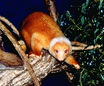
Compared to other mammals, the common spotted cuscus has a relatively low basal metabolic rate. The average basal metabolic rate of the common spotted cuscus is 6.27 W and their basal body temperature is 34.6°C. This species exhibits sexual dichromatism, where male pelage is white with red/brown spots and female pelage is all white without spots. Before reaching adult pelage coloration juveniles have grey downy pelage. Fur of the common spotted cuscus is thick and insulative. A ring of yellow-red skin is present around the blue-green eye of the common the spotted cuscus. The southern common cuscus, a species that has range overlap with the common spotted cuscus, has brown pelage with a dorsal stripe, a longer snout and larger ears than the common spotted cuscus. Another species that has range overlap with the spotted common cuscus, the common brushtail possum has grey pelage, a bushy tail and longer ears compared to the spotted common cuscus. (Clemens, et al., 1989; Dawson and Degabriele, 1973; Flannery, 1995; Heinsohn, 2002; Helgen and Flannery, 2004; Long, 2003; Menzies, 1972; Richards and Gamui, 2011; Saragih, et al., 2010; Savage, et al., 2004; Sinery, et al., 2012; Strahan, 1995; Ungar, 2010)
- Other Physical Features
- endothermic
- homoiothermic
- bilateral symmetry
- Sexual Dimorphism
- male larger
- sexes colored or patterned differently
- male more colorful
-
- Range mass
- 3 to 6 kg
- 6.61 to 13.22 lb
-
- Range length
- 348 to 580 mm
- 13.70 to 22.83 in
-
- Average basal metabolic rate
- 6.27 W
- AnAge
Reproduction
Little is known about reproduction in the common spotted cuscus, except that they are a polygamous species. (Sinery, et al., 2012)
Within Phalangeridae, the family to which the common spotted cuscus belongs, average litter size is typically 1.3 offspring. The number of offspring is limited by food availability which influences the reproductive capacity of individuals. The common spotted cuscus has a low reproductive rate, where it is typical for them to breed only once a year. The gestation period for the common spotted cuscus ranges from 20 to 42 days. Offspring exit the females pouch at five to seven months of age. Male testes descend at eight months and females have an estrous cycle of twenty-eight days. (Fisher, et al., 2001; Hayssen, et al., 1993; Sinery, et al., 2013)
- Key Reproductive Features
- semelparous
- iteroparous
- gonochoric/gonochoristic/dioecious (sexes separate)
- sexual
- viviparous
-
- Breeding interval
- Common spotted cuscuses typically breed once a year
-
- Range number of offspring
- 1 to 4
-
- Average number of offspring
- 1.3
-
- Average number of offspring
- 2
- AnAge
-
- Range gestation period
- 20 to 42 days
-
- Range time to independence
- 5 to 7 months
-
- Average age at sexual or reproductive maturity (male)
Sex: male - 243 days
- AnAge
- Average age at sexual or reproductive maturity (male)
Little is known about parental investment in the common spotted cuscus, but mothers have been observed carrying offspring on their back following offspring emergence from the mother's pouch. (Turner, 2004)
- Parental Investment
- female parental care
Lifespan/Longevity
In captivity the common spotted cuscus has been documented to live for seven to nine years. (Jackson, 2003)
-
- Typical lifespan
Status: captivity - 7 to 9 years
- Typical lifespan
-
- Average lifespan
Status: wild - 11.0 years
- Max Planck Institute for Demographic Research
- Average lifespan
Behavior
The common spotted cuscus is an arboreal species. Although they are skilled climbers they have also been documented walking between trees and are capable of galloping. This species is mainly crepuscular but can also be active at night. During the day the common spotted cuscus can be found sleeping in the forest canopy where they shield themselves with foliage to camouflage their bodies from predators. Common spotted cuscus have been observed using behavioral thermoregulation, panting and licking their feet, to stay cool. Common spotted cuscus are mainly solitary. Captive male common spotted cuscuses are aggressive and cannot be held in the same enclosure. (Chen, et al., 2005; Clemens, et al., 1989; Heinsohn, 2002; Long, 2003; Strahan, 1995; Woinarski, et al., 2014)
Home Range
The common spotted cuscus has an average home range size of one hectare. (Heinsohn, 2002)
Communication and Perception
There is little known about the communication and perception in the common spotted cuscus, but females are known to produce a bray call when in oestrous. Both sexes are known to make several types of calls, including hissing, screeches and buccal clicks. (Clemens, et al., 1989; Strahan, 1995)
- Communication Channels
- acoustic
Food Habits
The common spotted cuscus is a foliovore, as its diet mainly consists of leaves, such as, leaves of epiphytic ferns, climbers, Piper betle and Ficus species. The common spotted cuscus will often selectively consume young shoots and leaves. Less frequently, common spotted cuscus eat immature coconuts, fruits of Pometia pometia, insects, and small vertebrates. (Chen, et al., 2005; Heinsohn, 2002; Latinis, 1996; Saragih, et al., 2010; Sinery, et al., 2013)
- Animal Foods
- insects
- Plant Foods
- leaves
- fruit
Predation
The main predators of the common spotted cuscus are Kapul eagles (Harpyopsis novaeguineae), white-breasted sea eagles (Haliaeetus leucogaster) and humans (Homo sapiens). Common spotted cuscus exhibit predator avoidance by camouflaging themselves with surrounding foliage when they are resting in trees. (Heinsohn, 2002)
- Anti-predator Adaptations
- cryptic
-
- Known Predators
-
- Kapul eagles (Harpyopsis novaeguineae)
- white-breasted sea eagles (Haliaeetus leucogaster)
- humans (Homo sapiens)
Ecosystem Roles
There is little information on the ecosystem roles of the common spotted cuscus. The common spotted cuscus can be parasitized by nematodes and cestodes. The cestode species include Bertiella edulis and Bertiella Kapul. Bertiella kapul is a large cestode that is found in the small intestine of the common spotted cuscus. The nematode species include Breinlia sp. and Dipetalonema sp. Overall, parasite diversity in the Family Phalangeridae, to which the common spotted cuscus belongs, is much lower compared to other metatherian families. The decrease in parasite diversity is attributed to the arboreal lifestyle of Phalangerids. (Beveridge and Spratt, 2015; Beveridge, 1985; Clemens, et al., 1989; Ewers, 1973; Spratt, et al., 1991)
- trichostrongyloid nematodes
Economic Importance for Humans: Positive
Humans (Homo sapiens) hunt the common spotted cuscus as a food source or for clothing and accessories (bags and hats). In New Guinea, hunting is often done for rituals, such as, birthdays, birthing ceremonies, or male initiation ceremonies. Hunters are most commonly adult and/or adolescent males and hunting is carried out in groups of one to ten individuals. (Latinis, 1996; Richards and Gamui, 2011; Sinery, et al., 2013)
- Positive Impacts
- food
- body parts are source of valuable material
Economic Importance for Humans: Negative
There are no known adverse effects of common spotted cuscus on humans.
Conservation Status
The IUCN lists the common spotted cuscus as a species of least concern.
-
- IUCN Red List
-
Least Concern
More information
-
- IUCN Red List
-
Least Concern
More information
-
- CITES
- Appendix II
Contributors
Alyssa Eby (author), University of Manitoba, Jane Waterman (editor), University of Manitoba, Tanya Dewey (editor), University of Michigan-Ann Arbor.
Glossary
- Australian
-
Living in Australia, New Zealand, Tasmania, New Guinea and associated islands.

- acoustic
-
uses sound to communicate
- agricultural
-
living in landscapes dominated by human agriculture.
- arboreal
-
Referring to an animal that lives in trees; tree-climbing.
- bilateral symmetry
-
having body symmetry such that the animal can be divided in one plane into two mirror-image halves. Animals with bilateral symmetry have dorsal and ventral sides, as well as anterior and posterior ends. Synapomorphy of the Bilateria.
- chemical
-
uses smells or other chemicals to communicate
- crepuscular
-
active at dawn and dusk
- cryptic
-
having markings, coloration, shapes, or other features that cause an animal to be camouflaged in its natural environment; being difficult to see or otherwise detect.
- endothermic
-
animals that use metabolically generated heat to regulate body temperature independently of ambient temperature. Endothermy is a synapomorphy of the Mammalia, although it may have arisen in a (now extinct) synapsid ancestor; the fossil record does not distinguish these possibilities. Convergent in birds.
- female parental care
-
parental care is carried out by females
- folivore
-
an animal that mainly eats leaves.
- food
-
A substance that provides both nutrients and energy to a living thing.
- forest
-
forest biomes are dominated by trees, otherwise forest biomes can vary widely in amount of precipitation and seasonality.
- herbivore
-
An animal that eats mainly plants or parts of plants.
- iteroparous
-
offspring are produced in more than one group (litters, clutches, etc.) and across multiple seasons (or other periods hospitable to reproduction). Iteroparous animals must, by definition, survive over multiple seasons (or periodic condition changes).
- motile
-
having the capacity to move from one place to another.
- native range
-
the area in which the animal is naturally found, the region in which it is endemic.
- nocturnal
-
active during the night
- oceanic islands
-
islands that are not part of continental shelf areas, they are not, and have never been, connected to a continental land mass, most typically these are volcanic islands.
- omnivore
-
an animal that mainly eats all kinds of things, including plants and animals
- rainforest
-
rainforests, both temperate and tropical, are dominated by trees often forming a closed canopy with little light reaching the ground. Epiphytes and climbing plants are also abundant. Precipitation is typically not limiting, but may be somewhat seasonal.
- riparian
-
Referring to something living or located adjacent to a waterbody (usually, but not always, a river or stream).
- sedentary
-
remains in the same area
- semelparous
-
offspring are all produced in a single group (litter, clutch, etc.), after which the parent usually dies. Semelparous organisms often only live through a single season/year (or other periodic change in conditions) but may live for many seasons. In both cases reproduction occurs as a single investment of energy in offspring, with no future chance for investment in reproduction.
- sexual
-
reproduction that includes combining the genetic contribution of two individuals, a male and a female
- solitary
-
lives alone
- tactile
-
uses touch to communicate
- terrestrial
-
Living on the ground.
- tropical
-
the region of the earth that surrounds the equator, from 23.5 degrees north to 23.5 degrees south.
- viviparous
-
reproduction in which fertilization and development take place within the female body and the developing embryo derives nourishment from the female.
References
Beveridge, I. 1985. The genus Bertiella (Cestoda: Anoplocephalidae) from Australasian mammals: new species, new records and redescriptions. Systemic Parisitology, 7: 241-289.
Beveridge, I., R. Gasser. 2014. Diversity in parasitic helminths of Australasian marsupials and monotremes: a molecular perspective. International Journal for Parasitology, 44: 859-864.
Beveridge, I., D. Spratt. 2015. Biodiversity and parasites of wildlife: Helminths of Australasian marsupials. Trends in Parasitology, 31/4: 142-148.
Caro, T. 2013. The colours of extant mammals. Seminars in Cell & Developmental Biology, 24: 542-552.
Chen, X., N. Milne, P. O'Higgins. 2005. Morphological Variation of the Thoracolumbar Vertebrae in Macropodidae and Its Functional Relevance. Journal of Morphology, 266: 167-181.
Clemens, W., B. Richardson, P. Baverstock. 1989. Fauna of Australia- Volume 1B: Mammalia. Canberra, Australia: AGPS Canberra.
Dawson, T., R. Degabriele. 1973. The cuscus (Phalanger maculatus)-- a marsupial sloth?. Journal of Comparative Physiology, 83: 41-50.
Ewers, W. 1973. A host-parasite list of the protozoan and helminth parasites of New Guinea animals. International Journal for Parasitology, 3: 89-110.
Fisher, D., I. Owens, C. Johnson. 2001. The ecological basis of life history variation in marsupials. Ecology, 82/12: 3531-3540.
Flannery, T. 1995. Mammals of the South-West Pacific and Moluccan Islands. Ithaca, New York: Cornell University Press.
Hayssen, V., A. Tienhoven, A. Tienhoven. 1993. Asdell's Patterns of Mammalian Reproduction: A Compendium of Species-Specific Data. New York, USA: Cornell University Press.
Heinsohn, T. 2002. Observations of probable camouflaging behaviour in a semi-commensal common spotted cuscus Spilocuscus maculatus maculatus (Marsupialia: Phalangeridae) in New Ireland, Papua New Guinea. Australian Mammalogy, 24: 243-245.
Helgen, K., T. Flannery. 2004. Notes on the Phalangerid marsupial genus Spilocuscus, with description of a new species from Papua. Journal of Mammalogy, 85/5: 825-833.
Jackson, S. 2003. Australian Mammals: Biology and Captive Management. Collingwood, Australia: CSIRO Publishing.
Latinis, K. 1996. Hunting the cuscus in the western Seram: the role of the Phalanger in subsistence economies in central Maluku. Cakalele, 7: 17-32.
Long, J. 2003. Introduced mammals of the world: their history, distribution and influence. Collingwood, Australia: CSIRO Publishing.
McNab, B. 2008. The comparative energetics of the New Guinean cuscuses (Metatheria: Phalangeridae). Journal of Mammalogy, 89/5: 1145-1151.
Menzies, J. 1972. Notes on a hand-reared Spotted cuscus: Phalanger maculatus. International Zoo Yearbook, 12/1: 98-99.
Richards, S., B. Gamui. 2011. Rapid Biological Assessments of the Nakanai Mountains and the upper Strickland Basin: surveying the biodiversity of the Papua New Guniea's sublime karst environments. Arlingtion, Virginia, USA: Conservation International.
Saragih, E., M. Sadsoeitoboen, F. Pattiselanno. 2010. The diet of spotted cuscus (Spilocuscus maculatus) in natural and captivity habitat. Nusantara Bioscience, 2/2: 78-83.
Savage, V., J. Gillooly, W. Woodruff, G. West, A. Allen, B. Enquist, J. Brown. 2004. The predominance of quarter-power scaling in biology. Functional Ecology, 18: 257-282.
Sinery, A., C. Boer, W. Farida. 2013. Population dynamics of cuscus in tourist island of Ahe, District of Nabire, Papua. Biodiversitas, 14/2: 95-100.
Sinery, A., C. Boer, W. Farida. 2012. The population condition and availability of feed of cuscus in the Arfak Mountain Nature Reserve, West Papua. Biodiversitas, 13/2: 86-91.
Spratt, D., I. Beveridge, E. Walter. 1991. A catalogue of Australasian monotremes and marsupials and their recorded helminth parasites. Records of the South Australian Museum: Monograph series, 1: 1-105.
Strahan, R. 1995. Mammals of Australia. Chatswood, New South Whales, Australia: Reed Books.
Turner, J. 2004. Mammals of Australia : [an Introduction to Their Classification, Biology and Distribution]. Sofia, Bulgaria: Pensoft Pub.
Ungar, P. 2010. Mammal Teeth: Origin, Evolution, & Diversity. Baltimore, Maryland: The John Hopkins University Press.
Woinarski, J., A. Burbridge, P. Harrison. 2014. The action plan for Australian mammals 2012.. Collingwood, Australia: CSIRO Publishing.