Sphyrna mokarranGreat Hammerhead
Geographic Range
Great Hammerhead sharks are highly circumtropical and found throughout the Southwest Indian Ocean, along the Gulf of Mexico, the Florida coast and nearby Northwest Atlantic, and within the South China sea. These predators are observed within latitudes ranging between 40 degrees North to 35 degrees South and longitudes ranging between 180 degrees East to 180 degrees West. ("Great Hammerhead Shark (Sphyrna Mokarran) - Office of Protected Resources - NOAA Fisheries", 2015; Froese and Pauly, 2016)
- Biogeographic Regions
- neotropical
- australian
- oceanic islands
- indian ocean
- atlantic ocean
- pacific ocean
- mediterranean sea
- Other Geographic Terms
- cosmopolitan
Habitat
These sharks inhabit both the pelagic and coastal regions in coral reefs, inland seas, lagoons, and bays in tropical and subtropical environments. As great hammerheads are seasonally migratory, they move polewards during the warmer months of the year. Generally, great hammerheads are more commonly observed over the continental shelves and relatively shallow waters both inshore and offshore. Additionally, they tend to prefer warmer temperatures of 20 degrees Celsius and higher. They are found between 1 to 300 meters depth, but most commonly prefer an average of around 80 meters. (Denham, et al., 2007; Froese and Pauly, 2016)
- Habitat Regions
- temperate
- tropical
- saltwater or marine
- Aquatic Biomes
- pelagic
- reef
- coastal
- brackish water
-
- Range depth
- 300 to 1 m
- 984.25 to 3.28 ft
-
- Average depth
- 80 m
- 262.47 ft
Physical Description
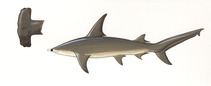
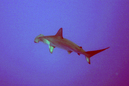
The Great Hammerhead’s most notable feature is its wide, scalloped head, also known as its cephalofoil. It has a streamlined, fusiform body allowing for speed, and wide-set eyes for visual acuity. Its teeth are triangular and serrated, aiding in the successful capture and consumption of its prey. There are over 30 rows of teeth in the upper jaw alone, not including the midline. Body coloration is variable and ranges from brown to green, with many other hues such as gray or tan. Ventral coloration is white, as is typical in animals that display countershading. The dorsal fin is hooked, high, and long. These sharks can grow up to approximately 6 meters in length and over 227 kg. Claspers on the anal fin indicate the shark is male. Females are typically slightly larger than males. ("Great Hammerhead Shark (Sphyrna Mokarran) - Office of Protected Resources - NOAA Fisheries", 2015; "Great Hammerhead Sharks, Sphyrna mokarran", 2013; "Sphyrna mokarran; Great Hammerhead Shark", 2000; Denham, et al., 2007)
- Other Physical Features
- ectothermic
- bilateral symmetry
- Sexual Dimorphism
- female larger
-
- Range mass
- 350 to 500 kg
- 770.93 to 1101.32 lb
-
- Average mass
- 400 kg
- 881.06 lb
-
- Range length
- 3 to 6 m
- 9.84 to 19.69 ft
-
- Average length
- 3 m
- 9.84 ft
-
- Average basal metabolic rate
- unknown cm3.O2/g/hr
Development
Great Hammerhead sharks engage in internal fertilization. Seminal fluid is transferred from the clasper into the female's cloaca, and sperm fertilize the eggs in the uterus. Embryos are initially sustained with yolk, then a connection between the uterine wall and yolk sac develops, and functions in a similar way as a placenta does. The young are born live and have flexible, soft heads. Upon being birthed, the young must immediately fend for themselves with instinctual predatory behaviors. (Allen, 1999)
Reproduction
Mating occurs both near the sea bottom and close to the surface. Fertilization occurs internally, wherein the male shark’s claspers fertilize the female’s eggs through the cloaca. The species is viviparous, with embryos sustained on the yolk sack and about 20-40 eggs hatching inside the female and being subsequently sustained with nutrients via the placenta. The female sharks give live birth after a gestation period of about 11 months. (van Dyck, 1993)
- Mating System
- polygynandrous (promiscuous)
The Great Hammerhead shark is unique in that it is reported to mate near the surface. Most other species of sharks mate on or near the ocean floor every 2 years, often during spring and summer. Sphyrna mokarran has a gestation period of 7 to 12 months, with 11 months being the average. While there is not sufficient research to substantiate a specific birth mass of the species, pup length at birth is between 50 and 70 centimeters. Females reach sexual maturity at 15 years of age, while males reach it sooner, at 6 years. ("Great Hammerhead Shark (Sphyrna Mokarran) - Office of Protected Resources - NOAA Fisheries", 2015; Denham, et al., 2007)
- Key Reproductive Features
- iteroparous
- seasonal breeding
- gonochoric/gonochoristic/dioecious (sexes separate)
- sexual
- fertilization
- viviparous
-
- Breeding interval
- The Great Hammerhead breeds every 2 years.
-
- Breeding season
- Spring and Summer
-
- Range number of offspring
- 6 to 50
-
- Average number of offspring
- 20-40
-
- Range gestation period
- 7 to 12 months
-
- Average gestation period
- 11 months
-
- Range time to independence
- 0 to 5 minutes
-
- Average time to independence
- 0 minutes
-
- Average age at sexual or reproductive maturity (female)
- 15 years
-
- Average age at sexual or reproductive maturity (male)
- 6 years
Within the first few minutes after birth, the shark pups will quickly swim away in search of food, becoming an independent predator almost immediately. ("Great Hammerhead Shark (Sphyrna Mokarran) - Office of Protected Resources - NOAA Fisheries", 2015; "Sphyrna mokarran; Great Hammerhead Shark", 2000)
- Parental Investment
- no parental involvement
Lifespan/Longevity
The Great Hammerhead shark lives approximately 20 to 40 years of age. The oldest age ever recorded for an individual is 44 years. Age can be determined by carefully counting vertebral rings, while radiocarbon dating and marginal-increment analysis are used to validate the data. Because the of the species' extraordinarily elusive nature, the longest known and expected lifespans in captivity and the longest known lifespan in the wild are unknown. Based on data from similar species, it might be hypothesized that the Great Hammerhead's lifespan would be shortened in captivity due to extremely high levels of stress and aggression created by an inability to migrate seasonally and engage in natural reproductive behaviors. (Piercy, et al., 2010)
-
- Range lifespan
Status: wild - 44 (high) years
- Range lifespan
-
- Typical lifespan
Status: wild - 40 (high) years
- Typical lifespan
-
- Average lifespan
Status: wild - 30 years
- Average lifespan
Behavior
This species is typically solitary but has been noted to migrate in groups during warmer periods, specifically summer. Great Hammerheads move around every day and are found all over the world. There is avid interspecific competition for food and mates, as with many shark species. (Snyderman, 1997)
- Key Behaviors
- natatorial
- motile
- nomadic
- migratory
- solitary
- territorial
Home Range
This highly migratory shark is known to travel long distances each day; as such, the home range and territory size is indeterminate.
Communication and Perception
The species has a highly developed electrosensory system as granted by its Ampullae of Lorenzini wherein it is able to detect the electric fields of other animals; this is typically heavily relied upon at dusk in order to detect prey and also to navigate extensive distances. Additionally, the olfactory sense of this shark is indubitably keen, supplying it with the ability to smell blood and track prey from long distances away. Contributing to the said sense of smell are its large nostrils and hammer-shaped head which serve to provide a "stereoscopic" detection of scent. It auditory-detection senses are advanced , especially when picking up lower frequencies. Its lateral line system detects changes in pressure and turbulence, allowing it to effectively navigate in areas of little to no light. Being able to sense these vibrations enables successful predation. (van Dyck, 1993)
- Other Communication Modes
- pheromones
- vibrations
Food Habits
The Great Hammerhead is a carnivore that feeds on invertebrates such as squid and octopus, bony fishes such as skates and rays, and other sharks, thereby engaging in cannibalism. Another well-known favorite of this shark is the stingray. Digested stingray remnants were discovered in the stomachs of over 80% of Great Hammerhead sharks caught off Natal, South Africa. There are few to no known instances of the shark consuming plant matter or detritus. (Bright, 2000)
- Primary Diet
-
carnivore
- eats non-insect arthropods
- molluscivore
- eats other marine invertebrates
- scavenger
- omnivore
- Animal Foods
- birds
- mammals
- fish
- mollusks
- aquatic crustaceans
- other marine invertebrates
Predation
The Great Hammerhead Shark has placoid scales; the texture is rough and comparable to sandpaper. They serve to deter any possible predators and to injure prey. Its cartilagenous vertebral column and skeleton allow for maximum flexibility and speed. Due to the combination of these adaptations alongside the Great Hammerhead's position at the top of the food chain, these sharks are very rarely preyed upon. One of the only known predators is the killer whale, whose massive size and penchant to hunt in groups is highly successful, even when tracking down large sharks. Young and wounded sharks are sometimes preyed upon by bigger sharks. (Bright, 2000; van Dyck, 1993)
- Anti-predator Adaptations
- cryptic
-
- Known Predators
Ecosystem Roles
Because sharks are apex/keystone predators, at the highest status in the food chain hierarchy, they serve to regulate populations of cephalopods, crustaceans, and more. Remoras are known to attach to these sharks, and the pilot fish Naucrates ductor is a noted mutualistic partner of Sphyrna mokarran. Naucrates ductor is protected by the shark and is able to eat the leftovers of the shark's meals. Furthermore, they eat parasites such as parasitic siphonostomatoid copepods Alebion elegans. The tapeworm Phoreiobothrium manirei is commonly found within the digestive tract of this shark. There are no known species used as hosts by Sphyrna mokarran. (Bray, 1996; Caira, et al., 1996; Oldewage and Smale, 1993)
- Ecosystem Impact
- keystone species
- Pilot fish Naucrates ductor
- Remora Remora remora
- Tapeworm Phoreiobothrium manirei
- Copepod Alebion elegans
Economic Importance for Humans: Positive
Humans benefit at the expense of Sphyrna mokarran in that the prized fins of the shark are made into shark fin soup, a Chinese luxury food of an extremely high price. The hides of the Great Hammerhead are used as leather, as is typical for many shark species. Shark fatty oils harvested from the liver, specifically squalene, are used in vitamins, medicine, and health supplements. Sharks prey upon many weak and diseased fish, thereby allowing the lines of slow, sick fish to die out, while faster, healthier fish are able to reproduce and be harvested by fishermen. Great Hammerheads are commonly the victim of bycatch fisheries. This is especially prevalent with long-line fishing. ("SHARKS' ROLE IN THE OCEANS", 2016)
- Positive Impacts
- food
- body parts are source of valuable material
- source of medicine or drug
- research and education
- controls pest population
Economic Importance for Humans: Negative
The Great Hammerhead shark is the most dangerous of the hammerheads and is more commonly in contact with humans than many other species of shark. This is because they prefer warm waters, a similarly desired environment for surfers, swimmers, and divers. This shark has been said to approach and rush toward divers, swimmers, and surfers when sudden movements are made. Even so, the majority of the demonstrated aggressive behavior of this shark is based on defense and competition. From 1580 to 2012, 37 hammerhead shark attacks have been reported; 17 of these attacks were unprovoked and none fatal. As this data refers only to the genus Sphyrna, it is interesting to note that only 1 attack has been reported as being orchestrated by Sphyrna mokarran. The reported attack was provoked, demonstrating that although Great Hammerheads are dangerous, they do not attack often and are typically provoked first. (Burgess, 2012; Stafford-Deitsch, 2000)
- Negative Impacts
-
injures humans
- bites or stings
Conservation Status
The IUCN Red List lists Sphyrna mokarran as an endangered species due to fishing pressure and fin trade. Because the species breeds only once every 2 years, it is very vulnerable to overfishing. Even though the USA and Australia have embraced many bans to prevent shark finning, excessive illegal fishing and lack of implementation for other countries have resulted in a decreasing population trend of the Great Hammerhead shark. (Denham, et al., 2007)
-
- IUCN Red List
-
Endangered
More information
-
- IUCN Red List
-
Endangered
More information
-
- US Federal List
- No special status
-
- CITES
- Appendix II
-
- State of Michigan List
- No special status
Other Comments
An interesting facet of Sphyrna mokarran is its fondness for stingray consumption. The Great Hammerhead will search the sandy floor for stingrays, whose physical adaptations and cryptic appearance allow it to effectively camouflage. After sensing the vibrations of the creature, the shark will bite the pectoral fin or "wing" of the ray, immobilizing its prey before taking leisurely bites from its body. A Great Hammerhead found off the Florida coast had 96 stingray barbs lodged in its mouth.
An open source photo that could be used for this species account is found at
 ("Great Hammerhead Sharks, Sphyrna mokarran", 2013; Martin, 2003)
Contributors
Clarissa Saunders (author), San Diego Mesa College, Paul Detwiler (editor), San Diego Mesa College, Tanya Dewey (editor), University of Michigan-Ann Arbor.
Glossary
- Atlantic Ocean
-
the body of water between Africa, Europe, the southern ocean (above 60 degrees south latitude), and the western hemisphere. It is the second largest ocean in the world after the Pacific Ocean.

- Australian
-
Living in Australia, New Zealand, Tasmania, New Guinea and associated islands.
- Neotropical
-
living in the southern part of the New World. In other words, Central and South America.
- Pacific Ocean
-
body of water between the southern ocean (above 60 degrees south latitude), Australia, Asia, and the western hemisphere. This is the world's largest ocean, covering about 28% of the world's surface.
- acoustic
-
uses sound to communicate
- bilateral symmetry
-
having body symmetry such that the animal can be divided in one plane into two mirror-image halves. Animals with bilateral symmetry have dorsal and ventral sides, as well as anterior and posterior ends. Synapomorphy of the Bilateria.
- brackish water
-
areas with salty water, usually in coastal marshes and estuaries.
- carnivore
-
an animal that mainly eats meat
- chemical
-
uses smells or other chemicals to communicate
- coastal
-
the nearshore aquatic habitats near a coast, or shoreline.
- cosmopolitan
-
having a worldwide distribution. Found on all continents (except maybe Antarctica) and in all biogeographic provinces; or in all the major oceans (Atlantic, Indian, and Pacific.
- cryptic
-
having markings, coloration, shapes, or other features that cause an animal to be camouflaged in its natural environment; being difficult to see or otherwise detect.
- drug
-
a substance used for the diagnosis, cure, mitigation, treatment, or prevention of disease
- ectothermic
-
animals which must use heat acquired from the environment and behavioral adaptations to regulate body temperature
- electric
-
uses electric signals to communicate
- fertilization
-
union of egg and spermatozoan
- food
-
A substance that provides both nutrients and energy to a living thing.
- internal fertilization
-
fertilization takes place within the female's body
- iteroparous
-
offspring are produced in more than one group (litters, clutches, etc.) and across multiple seasons (or other periods hospitable to reproduction). Iteroparous animals must, by definition, survive over multiple seasons (or periodic condition changes).
- keystone species
-
a species whose presence or absence strongly affects populations of other species in that area such that the extirpation of the keystone species in an area will result in the ultimate extirpation of many more species in that area (Example: sea otter).
- magnetic
-
(as perception channel keyword). This animal has a special ability to detect the Earth's magnetic fields.
- migratory
-
makes seasonal movements between breeding and wintering grounds
- molluscivore
-
eats mollusks, members of Phylum Mollusca
- motile
-
having the capacity to move from one place to another.
- natatorial
-
specialized for swimming
- native range
-
the area in which the animal is naturally found, the region in which it is endemic.
- nomadic
-
generally wanders from place to place, usually within a well-defined range.
- oceanic islands
-
islands that are not part of continental shelf areas, they are not, and have never been, connected to a continental land mass, most typically these are volcanic islands.
- omnivore
-
an animal that mainly eats all kinds of things, including plants and animals
- pelagic
-
An aquatic biome consisting of the open ocean, far from land, does not include sea bottom (benthic zone).
- pheromones
-
chemicals released into air or water that are detected by and responded to by other animals of the same species
- polygynandrous
-
the kind of polygamy in which a female pairs with several males, each of which also pairs with several different females.
- reef
-
structure produced by the calcium carbonate skeletons of coral polyps (Class Anthozoa). Coral reefs are found in warm, shallow oceans with low nutrient availability. They form the basis for rich communities of other invertebrates, plants, fish, and protists. The polyps live only on the reef surface. Because they depend on symbiotic photosynthetic algae, zooxanthellae, they cannot live where light does not penetrate.
- saltwater or marine
-
mainly lives in oceans, seas, or other bodies of salt water.
- scavenger
-
an animal that mainly eats dead animals
- seasonal breeding
-
breeding is confined to a particular season
- sexual
-
reproduction that includes combining the genetic contribution of two individuals, a male and a female
- solitary
-
lives alone
- temperate
-
that region of the Earth between 23.5 degrees North and 60 degrees North (between the Tropic of Cancer and the Arctic Circle) and between 23.5 degrees South and 60 degrees South (between the Tropic of Capricorn and the Antarctic Circle).
- territorial
-
defends an area within the home range, occupied by a single animals or group of animals of the same species and held through overt defense, display, or advertisement
- tropical
-
the region of the earth that surrounds the equator, from 23.5 degrees north to 23.5 degrees south.
- vibrations
-
movements of a hard surface that are produced by animals as signals to others
- visual
-
uses sight to communicate
- viviparous
-
reproduction in which fertilization and development take place within the female body and the developing embryo derives nourishment from the female.
References
2015. "Great Hammerhead Shark (Sphyrna Mokarran) - Office of Protected Resources - NOAA Fisheries" (On-line).
NOAA Fisheries: Office of Protected Resources. Accessed February 03, 2016 at http://www.fisheries.noaa.gov/pr/species/fish/great-hammerhead-shark.html.
2013. "Great Hammerhead Sharks, Sphyrna mokarran" (On-line). MarineBio Conservation Society. Accessed February 04, 2016 at http://marinebio.org/species.asp?id=87.
2016. "SHARKS' ROLE IN THE OCEANS" (On-line). SharkSavers WildAid. Accessed May 01, 2016 at http://www.sharksavers.org/en/education/the-value-of-sharks/sharks-role-in-the-ocean/.
2000. "Sphyrna mokarran; Great Hammerhead Shark" (On-line). Encyclopedia of Life. Accessed April 27, 2016 at http://eol.org/pages/224168/details.
Allen, T. 1999. The Shark Almanac. New York, New York: The Lyons Press.
Bray, R. 1996. "Phoreiobothrium manirei Caira, Healy & Swanson, 1996" (On-line). WoRMS World Register of Marine Species. Accessed February 04, 2016 at http://www.marinespecies.org/aphia.php?p=taxdetails&id=419263.
Bright, M. 2000. The Private Life of Sharks. Mechanicsburg, PA: Stackpole Books.
Burgess, G. 2012. "
ISAF Statistics on Attacking Species of Shark" (On-line).
International Shark Attack File, Florida Museum of Natural History, University of Florida. Accessed May 01, 2016 at https://www.flmnh.ufl.edu/fish/isaf/worldwide-summary/.
Caira, J., C. Healy, J. Swanson. 1996.
A New Species of Phoreiobothrium (Cestoidea: Tetraphyllidea) from the Great Hammerhead Shark Sphyrna mokarran and Its Implications for the Evolution of the Onchobothriid Scolex. The Journal of Parasitology, 82/3: 458-462.
Denham, J., J. Stevens, C. Simpendorfer, M. Heupel, G. Cliff, A. Morgan, R. Graham, M. Ducrocq, N. Dulvy, M. Seisay, S. Valenti, F. Litvinov, P. Martins. 2007. "Sphyrna mokarran" (On-line).
The IUCN Red List of Threatened Species. Accessed February 04, 2016 at http://www.iucnredlist.org/details/39386/0.
Froese, E., D. Pauly. 2016. "Sphyrna mokarran (Rüppell, 1837) Great hammerhead" (On-line). FishBase. Accessed February 03, 2016 at http://www.fishbase.org/summary/SpeciesSummary.php?id=914.
Hammerschlag, N., A. Gallagher, D. Lazarre, C. Slonim. 2011. Range extension of the Endangered great hammerhead sharak Sphyrna mokarran in the Northwest Atlantic: Preliminary data and significance for conservation. Endangered Species Research Endang. Species Res., 13/2: 111-116.
Martin, A. 2003. "Biology of Sharks and Rays" (On-line). ReefQuest Centre for Shark Research. Accessed May 01, 2016 at http://www.elasmo-research.org/education/ecology/sandy-gt_hammerhead.htm.
Oldewage, W., M. Smale. 1993. Occurrence of piscine parasitic copepods (Crustacea) on sharks taken mainly off Cape Recife, South Africa. South African Journal of Marine Science, 13/1: 309-312.
Piercy, A., J. Carlson, M. Passerotti. 2010. Age and growth of the great hammerhead shark, Sphyrna mokarran, in the north-western Atlantic Ocean and Gulf of Mexico.
Marine and Freshwater Research
, 61: 992-998.
Snyderman, M. 1997. Shark: Endangered Predator of the Sea. San Diego, CA: Laurel Glen Publishing.
Stafford-Deitsch, J. 2000. Sharks of Florida, the Bahamas, the Caribbean and the Gulf of Mexico. Piccadilly, London: Trident Press Ltd.
van Dyck, C. 1993. Fish: An Enthusiast's Guide. Oxford, England: University of California Press.