Spermophilus armatusUinta ground squirrel



Geographic Range
Spermophilus armatus are found only in a small area of the United States. Their range includes southwestern Montana, western Wyoming, southeastern Idaho and northern central Utah.
(Whitaker 1996)
Habitat
Spermophilus armatus are found in the sagegrass mountain meadows of the western United States. Here they burrow in the soft soils. They can be found near timberline, in valley pastures, cultivated fields or along irrigation ditches. They are also sometimes found in lawns. They prefer moist habitats with lush vegetation and/or aquatic plants.
(Whitaker 1996, MacClintock 1970)
- Terrestrial Biomes
- savanna or grassland
Physical Description
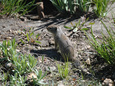
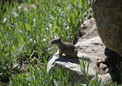
Spermophilus armatus are fairly large ground squirrels with a body length of 280-303 mm and tail length 63 to 81 mm. Skull length is 46 to 48 mm. The Uinta ground squirrels, as they are commonly named, have mixed, brown-buff colored coats. Their sides are slightly paler and their underbellies are pale buff to white. Their tails are black mixed with buff on top and bottom, with paler buff colored edges. The noses, ears and faces are more cinnamon colored. The ears are small and rounded with short fur.
(Whitaker 1996, Hall 1981)
- Other Physical Features
- endothermic
- bilateral symmetry
-
- Range mass
- 284 to 425 g
- 10.01 to 14.98 oz
Reproduction
The breeding season begins immediately after the end of hibernation in March or April. During this season males attract females with calls and scent markings. Scents are laid down by wiping their faces, which have aprocrine scent glands, against the ground. Breeding is also in part dependent on the social rank of individuals within the colony.
Females give birth to one litter per year usually sometime in May. Gestation length is 28 days. Young first emerge from burrow, 24 days after birth. After this female parental investment is minimal. First-year females bear, on average, 4 to 5 yong per litter, whereas older mothers bear 7 to 8 on average.
(Whitaker 1996, Balph 1984)
- Key Reproductive Features
- gonochoric/gonochoristic/dioecious (sexes separate)
- sexual
Behavior
Spermophilus armatus are burrowers. In the winter these squirrels hibernate, and in the summer they aestivate (that is become dormant for the summer). Adults begin aestivation in July whereas juveniles do not go into aestivation until later. By September the Uinta ground squirrels can no longer be seen above ground. From aestivation they go directly into the long period of hibernation, where they will remain until March or April. This means that individuals only remain active above ground about three to three and a half months out of the year.
Population density is high for ground squirrels, around 23-28 individuals per square hectare. S. armatus live in matrilineal colonies. Males disperse as juveniles to other colonies. Individuals are territorial though home ranges do overlap. Females especially become territorial and aggressive during pregnancy. Males are quite aggressive during the breeding season. Aggression is indicated by fights and warning "chirps." "Chirps" are also used as mating calls and as warnings to the colony of avian predators. (Balph, 1984; Nowak, 1999; Whitaker, 1996)
- Key Behaviors
- fossorial
- diurnal
- motile
- sedentary
- hibernation
- aestivation
- social
- colonial
- dominance hierarchies
Communication and Perception
Food Habits
Spermophilus armatus eat seeds, green vegetation, invertebrates and some vertebrates. They are often found near water, as they prefer succulent plants. They are strong swimmers and swim to retrieve species of aquatic plants. Uinta ground squirrels collect food for their periods of hibernation, during which they rely mostly on fat stores and some seeds stockpiled in their burrows. (Nowak, et al., 1987; Whitaker, 1996)
- Animal Foods
- insects
- terrestrial non-insect arthropods
- Plant Foods
- seeds, grains, and nuts
Economic Importance for Humans: Negative
Like other ground squirrels, Spermophilus armatus can be destructive to crops, eating vegetables and harvesting seeds. Their winter stores of food consist almost entirely of seeds, including a significant amount dug up from farmers' plantings. (Nowak, et al., 1987)
Conservation Status
-
- IUCN Red List
-
Least Concern
More information
-
- IUCN Red List
-
Least Concern
More information
-
- US Federal List
- No special status
-
- CITES
- No special status
Contributors
Alicia LaValle (author), University of Michigan-Ann Arbor, Phil Myers (editor), Museum of Zoology, University of Michigan-Ann Arbor.
Glossary
- Nearctic
-
living in the Nearctic biogeographic province, the northern part of the New World. This includes Greenland, the Canadian Arctic islands, and all of the North American as far south as the highlands of central Mexico.

- bilateral symmetry
-
having body symmetry such that the animal can be divided in one plane into two mirror-image halves. Animals with bilateral symmetry have dorsal and ventral sides, as well as anterior and posterior ends. Synapomorphy of the Bilateria.
- chemical
-
uses smells or other chemicals to communicate
- colonial
-
used loosely to describe any group of organisms living together or in close proximity to each other - for example nesting shorebirds that live in large colonies. More specifically refers to a group of organisms in which members act as specialized subunits (a continuous, modular society) - as in clonal organisms.
- diurnal
-
- active during the day, 2. lasting for one day.
- dominance hierarchies
-
ranking system or pecking order among members of a long-term social group, where dominance status affects access to resources or mates
- endothermic
-
animals that use metabolically generated heat to regulate body temperature independently of ambient temperature. Endothermy is a synapomorphy of the Mammalia, although it may have arisen in a (now extinct) synapsid ancestor; the fossil record does not distinguish these possibilities. Convergent in birds.
- folivore
-
an animal that mainly eats leaves.
- fossorial
-
Referring to a burrowing life-style or behavior, specialized for digging or burrowing.
- herbivore
-
An animal that eats mainly plants or parts of plants.
- hibernation
-
the state that some animals enter during winter in which normal physiological processes are significantly reduced, thus lowering the animal's energy requirements. The act or condition of passing winter in a torpid or resting state, typically involving the abandonment of homoiothermy in mammals.
- motile
-
having the capacity to move from one place to another.
- native range
-
the area in which the animal is naturally found, the region in which it is endemic.
- sedentary
-
remains in the same area
- sexual
-
reproduction that includes combining the genetic contribution of two individuals, a male and a female
- social
-
associates with others of its species; forms social groups.
- tactile
-
uses touch to communicate
- tropical savanna and grassland
-
A terrestrial biome. Savannas are grasslands with scattered individual trees that do not form a closed canopy. Extensive savannas are found in parts of subtropical and tropical Africa and South America, and in Australia.
- savanna
-
A grassland with scattered trees or scattered clumps of trees, a type of community intermediate between grassland and forest. See also Tropical savanna and grassland biome.
- temperate grassland
-
A terrestrial biome found in temperate latitudes (>23.5° N or S latitude). Vegetation is made up mostly of grasses, the height and species diversity of which depend largely on the amount of moisture available. Fire and grazing are important in the long-term maintenance of grasslands.
References
Balph, D. 1984. Spatial and Social Behavior in a Population of Uinta Ground Squirrels: Interrelation with Climate and Annual Cycle. Pp. 336-349 in J Murie, G Michener, eds. The Biology of Ground-Dwelling Squirrels. United States of America: University of Nebraska Press.
CITES Secretariat, October 12, 1999. "CITES" (On-line). Accessed December 12, 1999 at http://www.wcmc.org.uk/CITES/eng/index.shtml.
Hall, R. 1981. The Mammals of North America. New York: John Wiley and Sons.
MacClintock, D. Squirrels of North America. New York: Van Nostrand Reinhold Co..
Nowak, R., H. Campbell, J. Chapmann, A. Gardner, V. Geist. 1987. Wild Animals of North America. Washington D.C: The National Geographic Society.
Nowak, R. 1999. Walker's Mammals of the World. Baltimore and London: Johns Hopkins University Press.
Whitaker, J. 1996. National Audubon Society Field Guide to North American Mammals. New York: Alfred A. Knopt Inc..