Speoplatyrhinus poulsoniAlabama Cavefish
Geographic Range
Speoplatyrhinus poulsoni is a cavefish whose range is limited solely to Key Cave, Lauderdale County, Alabama, north of the Tennessee River. (Kuhajda and Mayden, 2001)
Habitat
Key cave, the single locale of S. poulsoni, is a large underground multi-level structure that has thousands of meters of mapped area. The pools of water in the cave in which the fish dwell are typically 5 to 10 feet deep. Seasonal flooding within the cave fluctuates this depth. Far within the cave are very deep pools of unknown depth. However no evidence exists that S. poulsoni can be found in these deep pools. Above the pools are bat roosts which, via guano droppings, supply the pools with nutrients and have established small, flourishing ecosystems. The water in the pools is groundwater with a constant temperature of about 16 C and dissolved oxygen concentrations between 7 and 9.8 ppm. The pools receive no natural light. (Kuhajda and Mayden, 2001; Romero, 1998)
- Habitat Regions
- temperate
- freshwater
- Other Habitat Features
- caves
-
- Range depth
- 3.5 to 0 m
- 11.48 to 0.00 ft
Physical Description
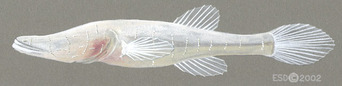
Speoplatyrhinus poulsoni is a troglobitic fish of the family Amblyopsidae. They have no eyes and almost no pigment, making them nearly transparent. On average members of this species have a length close to 50 mm, ranging from 30-58 mm. They have an elongated, flattened head with a laterally constricted snout and a terminal mouth. Speoplatyrhinus poulsoni has no pelvic fins, a relatively high dorsal fin that mirrors the anal fin in size and shape, and a rounded paddle-shaped homocercal tail. Embedded cycloid scales cover the body and bifurcate fin rays are absent in all fins. Alabama cavefish have an elaborate system of sensory papillae on the sides and head and a hypertrophied lateral-line. The major distinguishing feature between it, and the only other cavefish in Alabama, Typhlichthys subterraneus, are the three nonpapilliferous fin rays between the medial-most rows of caudal sensory papillae (whereas T. subterraneus has 5). (Romero, 1998)
- Other Physical Features
- ectothermic
- homoiothermic
- bilateral symmetry
- Sexual Dimorphism
- sexes alike
-
- Range length
- 31 to 58 mm
- 1.22 to 2.28 in
-
- Average length
- 50 mm
- 1.97 in
Reproduction
Nothing is known about mating systems in this species of cavefish.
Little is known about the mate selection, life cycle, or breeding cycle of S. poulsoni. However, repeated visits to the cave have to established a summer spawning. This is interesting because it is differs from the typical pattern of late winter and spring spawnings for other species of Amblyopsidae. Some studies have suggested that S. poulsoni practices branchial incubation, based on the location of the vent and the size of the branchial chamber. The females in the population do not all reproduce annually and each fertile female only releases a few eggs per mating season. Seasonal cave flooding is responsible for hormonal changes that initiate the reproductive cycle. (Kuhajda and Mayden, 2001; Romero, 1998)
- Key Reproductive Features
- iteroparous
- seasonal breeding
- gonochoric/gonochoristic/dioecious (sexes separate)
- sexual
- fertilization
- oviparous
-
- Breeding interval
- Alabama cavefish females breed once every several years.
-
- Breeding season
- Alabama cavefish spawn during the summer.
Though not yet witnessed in this species of Amblyopsidae, S. poulsoni are likely gill cavity brooders, like their kin. The male of the species is the most likely candidate to harbor the eggs untill their hatching, as is the case with the other North American cavefish. (Moe, 2002)
- Parental Investment
-
pre-fertilization
- provisioning
-
pre-hatching/birth
-
protecting
- male
-
protecting
Lifespan/Longevity
The lifespan of Speoplatyrhinus poulsoni is estimated at 5 to 10 years if they survive to adult size. (Kuhajda and Mayden, 2001; Romero, 1998)
-
- Typical lifespan
Status: wild - 5 to 10 years
- Typical lifespan
Behavior
There is little to nothing known about behavior in Alabama cavefish. They are likely to be active at any time of the day or night since there is no difference between day and night in these environments.
- Key Behaviors
- natatorial
- diurnal
- nocturnal
- motile
- sedentary
Communication and Perception
Speoplatyrhinus poulsoni is blind and therefore must rely on other senses to navigate its environment. The lateral line-system is hypertrophied, sensory papillae on the caudal fin are greatly developed, and visible ridges of neuromasts (tactile sensory organs) are present on the head and body. These are all adaptations to using primarily tactile cues in a pitch-black environment. Tactile and electroperceptile senses have replaced the sense of sight. (Romero, 1998)
Food Habits
No invasive studies have been done due to the species extremely endangered status and the fragility of their cave habitat. It is thought that the diet consists of copepods, isopods, amphipods, and small cavefish. In any case S. poulsoni sits at the top of a food chain that begins with incident grey bat (Myotis grisescens) droppings, or guano. ("Species accounts- Alabama Cavefish", 1991)
- Animal Foods
- fish
- aquatic crustaceans
Predation
These fish have few or no predators because they live in caves with an impoverished fauna. They are top predators in this enclosed ecosystem.
Ecosystem Roles
Speoplatyrhinus poulsoni is the top predator in the aquatic environment of Key Cave. (Kuhajda and Mayden, 2001)
Economic Importance for Humans: Positive
Alabama cavefish are a fascinating example of isolated cave evolution.
Economic Importance for Humans: Negative
There are no negative effects of Alabama cavefish on humans.
Conservation Status
Speoplatyrhinus poulsoni is the rarest of all American cavefish and is likely one of the rarest of all freshwater fish. There are only an estimated 100 of these fish that live in Key Cave and their population is threatened by groundwater pollution due to the agriculture industry above the cave. Also, local bat populations around the cave have recently been threatened which puts strain on the lowest link in the food chain for S. poulsoni. Low population size and low reproductive potential make S. poulsoni extremely vulnerable. ("Species accounts- Alabama Cavefish", 1991; Kuhajda and Mayden, 2001)
-
- IUCN Red List
-
Critically Endangered
More information
-
- IUCN Red List
-
Critically Endangered
More information
-
- US Federal List
- Endangered
Contributors
Tanya Dewey (editor), Animal Diversity Web.
David Moore (author), University of Michigan-Ann Arbor, Kevin Wehrly (editor, instructor), University of Michigan-Ann Arbor.
Glossary
- Nearctic
-
living in the Nearctic biogeographic province, the northern part of the New World. This includes Greenland, the Canadian Arctic islands, and all of the North American as far south as the highlands of central Mexico.

- bilateral symmetry
-
having body symmetry such that the animal can be divided in one plane into two mirror-image halves. Animals with bilateral symmetry have dorsal and ventral sides, as well as anterior and posterior ends. Synapomorphy of the Bilateria.
- carnivore
-
an animal that mainly eats meat
- chemical
-
uses smells or other chemicals to communicate
- diurnal
-
- active during the day, 2. lasting for one day.
- ectothermic
-
animals which must use heat acquired from the environment and behavioral adaptations to regulate body temperature
- electric
-
uses electric signals to communicate
- external fertilization
-
fertilization takes place outside the female's body
- fertilization
-
union of egg and spermatozoan
- freshwater
-
mainly lives in water that is not salty.
- iteroparous
-
offspring are produced in more than one group (litters, clutches, etc.) and across multiple seasons (or other periods hospitable to reproduction). Iteroparous animals must, by definition, survive over multiple seasons (or periodic condition changes).
- motile
-
having the capacity to move from one place to another.
- natatorial
-
specialized for swimming
- native range
-
the area in which the animal is naturally found, the region in which it is endemic.
- nocturnal
-
active during the night
- oviparous
-
reproduction in which eggs are released by the female; development of offspring occurs outside the mother's body.
- piscivore
-
an animal that mainly eats fish
- seasonal breeding
-
breeding is confined to a particular season
- sedentary
-
remains in the same area
- sexual
-
reproduction that includes combining the genetic contribution of two individuals, a male and a female
- tactile
-
uses touch to communicate
- temperate
-
that region of the Earth between 23.5 degrees North and 60 degrees North (between the Tropic of Cancer and the Arctic Circle) and between 23.5 degrees South and 60 degrees South (between the Tropic of Capricorn and the Antarctic Circle).
References
U.S. Fish and Wildlife Service, Division of Endangered Species. Species accounts- Alabama Cavefish. Washington, D.C.: U.S. Fish and Wildlife Service. 1991. Accessed October 17, 2005 at http://www.fws.gov/endangered/i/e/sae1c.html.
Kuhajda, B., R. Mayden. 2001. Status of the federally endangered Alabama cavefish, Speoplatyrhinus poulsoni (Amblyopsidae), in Key Cave and surrounding caves, Alabama. Environmental Biology of Fishes, 62: 215-222. Accessed October 17, 2005 at http://www.springerlink.com.proxy.lib.umich.edu/(havmk0qi5zrmh345pwstpiby)/app/home/contribution.asp?referrer=parent&backto=issue,20,34;journal,42,89;linkingpublicationresults,1:102877,1.
Moe, M. 2002. "Advanced Aquariast's Online Magazine" (On-line). Science, Biology, and Terminology of Fish reproduction. Accessed December 05, 2005 at http://advancedaquarist.com/issues/june2002/breeder.htm.
Romero, A. 1998. Threatened fishes of the world: Speoplatyrhinus poulsoni Cooper and Kuehne, 1974 (Amblyopsidae). Environmental Biology of Fishes, 53: 293-294. Accessed October 17, 2005 at http://www.springerlink.com.proxy.lib.umich.edu/(sf3ylwqvxptsmo45z5h3jy55)/app/home/contribution.asp?referrer=parent&backto=issue,6,11;journal,72,89;linkingpublicationresults,1:102877,1.