Spea intermontanaGreat Basin Spadefoot
Geographic Range
Great Basin spadefoot toads are found in the United States and Canada. The species occurs in northwest Arizona, in California east of the Sierra Nevada mountain range, northwestern Colorado, lower Idaho, southwestern Wyoming, throughout Nevada and Utah, and between the Cascade and Rocky Mountain ranges in Oregon, Washington, and British Columbia. (Whorley, 2001)
Habitat
Great Basin spadefoot toads are found in arid regions, semi-desert shrubland, or sagebrush flats, but can also be found in alkali flats, pinion-juniper woodland, ponderosa pine, and high elevation spruce-fir forests at about 2800 m (9200 ft). Great Basin spadefoot toads require temporary or permanent water sources for breeding, such as slow-flowing springs, seasonal pools, irrigation ditches, and ponds. They are able to survive in arid habitats by remaining buried underground, thus their survival requires soils that permit burrowing. ("Washington Department of Natural Resources", 2005; Morey, 2005; "NatureServe", 2009; Whorley, 2001; Zack and Johnson, 2008)
- Habitat Regions
- temperate
- terrestrial
- Terrestrial Biomes
- desert or dune
- chaparral
- forest
- scrub forest
- mountains
- Aquatic Biomes
- temporary pools
-
- Range elevation
- 2800 (high) m
- 9186.35 (high) ft
Physical Description
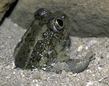
Great Basin spadefoot toads usually have a gray, olive, or brown colored dorsal coloration mottled with darker spots with light-colored centers. Gray streaks outline an hourglass shaped marking on the back. The coloration is similar to that of other species of the genera Spea and Scaphiopus. Ventral coloration is light gray, white, or creamy and without markings. The skin is relatively smooth compared to the rough, warty nature of true toads (genus Bufo), but still contains small bumps. Parotoid glands seem to be absent. There is a dark brown or orange spot present on each upper eyelid. Pupils are vertical, and the eyes are large, catlike, golden yellow, and located on the side of the head. The nose is slightly upturned and there is a raised callus between the eyes. The body is short and fat with stubby limbs. Spadefoot toads get their name from the presence of a black, keratinized spade, or tubercle, on the underside of each hind foot, which is used for burrowing behavior. Adult body lengths vary from 32 to 67 mm and females tend to be only slightly larger than males. Tadpoles have large globular bodies and can reach 70 mm in length. They are colored black, brown, and gaey with scattered golden specks. When threatened, adult Great Basin spadefoot toads can produce noxious skin secretions, which are probably poisonous or at least distasteful to predators. (Morey, 2005; "NatureServe", 2009; "Frogs and Toads of Nevada", 2003; Whorley, 2001)
- Other Physical Features
- ectothermic
- heterothermic
- bilateral symmetry
- poisonous
- Sexual Dimorphism
- sexes alike
- female larger
-
- Range length
- 32 to 67 mm
- 1.26 to 2.64 in
Development
Eggs usually hatch within 2 to 4 days. Tadpoles transform in about 30 to 40 days, but the rate of metamorphosis can increase if the temporary pools in which the larvae are developing begin to dry out. Growth and differentiation rates are also influenced by temperature, which affects thyroid hormone activity (thyroid hormone is involved in metamorphosis). It is critical that larvae develop rapidly in species that breed in temporary pools, such as Spea intermontana, because metamorphosis must occur before the water evaporates, as the tadpoles cannot survive outside of water. Transformed juveniles still have a tail which disappears soon after they leave the breeding pools, and they may remain at the breeding location for a period of several days to several weeks before they leave the site. Transformed juveniles develop into sexually mature adults in 1 to 2 years for males, and in about 2 years for females. ("California Reptiles & Amphibians", 2010; "Washington Department of Natural Resources", 2005; Buchholz and Hayes, 2002; Hall, et al., 1997; Morey, 2005; Stebbins, 1954)
- Development - Life Cycle
- metamorphosis
Reproduction
Great Basin spadefoot toads are explosive breeders, with all breeding completed in a few days. There is no specific or definite breeding season, but all breeding takes place from May through August, when temperature and water availability is favorable. There is much variation in the timing of mating each year due to the nature of mating locations. Adults are terrestrial, but breeding sites are located around water sources. As a result, adults of the species must migrate to the breeding sites. These journeys typically occur at night in order to limit exposure to dangers such as evaporative water loss and predation. The factors that stimulate mating are not very well understood. Rainfall may be one of them, but is not necessary for it as is the case with other spadefoot toad species. Adults migrate anywhere from 1 to 5 km to reach breeding sites. ("Washington Department of Natural Resources", 2005; Buseck, et al., 2005; Morey, 2005; Whorley, 2001)
The breeding pools may be permanent or temporary sources of water, such as rain-water pools, snowmelt, ponds, irrigation ditches, and streams. Breeding is more common in ephemeral water sources in areas where it rains enough to create temporary pools, and more common in permanent water sources in areas where it does not rain enough to create temporary pools. The water must be still or slow-moving to allow breeding. In order to support metamorphosis, breeding pools must remain filled for at least 40 days to allow enough time for eggs to hatch and for larval transformation. ("California Reptiles & Amphibians", 2010; "Washington Department of Natural Resources", 2005; Bragg, 1965; Buseck, et al., 2005; Mayhew, 1968; Morey, 2005; Stebbins, 1954; Whorley, 2001; Zack and Johnson, 2008)
Males migrate to breeding sites, partially submerge near the shore, and attempt to attract females using loud calls 1 to 3 notes in length. The calls, or choruses, are reported to be monotonous duck-like snoring sounds, and may be heard over great distances. The choruses attract females, and probably other males, to the breeding pools. As females arrive, males scramble and compete to find mates. Reproduction involves amplexus, where males embrace females from behind using their forelimbs. This position allows males to externally fertilize the female eggs as they emerge from the females' cloacae. When mating is completed, the adults quickly burrow underground to avoid evaporative water loss. ("Washington Department of Natural Resources", 2005; Buseck, et al., 2005; Morey, 2005; Whorley, 2001)
- Mating System
- polygynandrous (promiscuous)
After mating, females lay anywhere from 300 to 1000 eggs in small clusters of 10 to 40 eggs. They attach the egg clusters to floating sticks, submerged rocks, and underwater vegetation. Eggs usually hatch within 2 to 4 days, but may take longer if water temperatures are too cold. Their size at sexual maturity is unknown. Males mature sexually in the first 1 to 2 years after metamorphosis, while females do not sexually mature until at least the second year after metamorphosis. ("California Reptiles & Amphibians", 2010; "Washington Department of Natural Resources", 2005; Bragg, 1965; Buseck, et al., 2005; Mayhew, 1968; Morey, 2005; Stebbins, 1954; Whorley, 2001; Zack and Johnson, 2008)
- Key Reproductive Features
- iteroparous
- seasonal breeding
- gonochoric/gonochoristic/dioecious (sexes separate)
- sexual
- fertilization
- oviparous
-
- Breeding interval
- Great Basin spadefoot toads breed an average of once yearly if conditions are favorable.
-
- Breeding season
- Great Basin spadefoot toads will breed from May through August when conditions are favorable.
-
- Range number of offspring
- 300 to 1000
-
- Range time to hatching
- 2 to 4 days
-
- Average age at sexual or reproductive maturity (female)
- 2 years
-
- Range age at sexual or reproductive maturity (male)
- 1 to 2 years
There is no parental involvement in the care for young once the eggs are laid. Females lay and attach their eggs to vegetation in bodies of water, and subsequently migrate back to feeding habitats, along with males, to replenish their energy reserves. (Buseck, et al., 2005)
- Parental Investment
- no parental involvement
-
pre-fertilization
- provisioning
-
protecting
- female
Lifespan/Longevity
The lifespan of Great Basin spadefoot toads is unknown. It is assumed to be similar to other spadefoot toad species and is therefore estimated to be about 13 years for females and 11 years for males in the wild. (Morey, 2005)
-
- Typical lifespan
Status: wild - 11 to 13 years
- Typical lifespan
Behavior
Great Basin spadefoot toads are mostly nocturnal, but are also active in the early morning and the late afternoon. They tend to be more active after it rains and during periods of high humidity, probably because damp environments help prevent desiccation. The toads are able to survive in dry and arid climates by burrowing underground or by using the burrows of small mammals, such as rodents. Great Basin spadefoots are able to bury themselves in loose soils by using the spades on their hind legs to dig into the ground. They accomplish this by moving their hind legs in a circular fashion and backing up into the soil. When inactive during the day, the toads spend their time in shallow burrows just beneath the surface. The burrows are typically 35 to 45 cm deep, depending on conditions. In general, the drier it is, the deeper the toads tend to burrow. When the toads are hibernating, the burrows may be as deep as 1 m. ("California Reptiles & Amphibians", 2010; "Washington Department of Natural Resources", 2005; Bragg, 1965; Mayhew, 1968; Morey, 2005; Stebbins, 1954; Zack and Johnson, 2008)
Great Basin spadefoot toads are active from the months of April through October. They hibernate during the winter by burrowing deep underground to avoid the cold. Once buried, the toads can remain underground for months and can tolerate high levels of water loss by accumulating urea in their body fluids. This allows the toads to absorb water osmotically from their surroundings. The toads may also protect themselves from dessication by coating themselves in a gelatinous substance that helps prevent water loss. ("California Reptiles & Amphibians", 2010; "Washington Department of Natural Resources", 2005; Morey, 2005; Stebbins, 1954; Zack and Johnson, 2008)
Great Basin spadefoot toads are mostly terrestrial, and only return to water to breed. Males tend to maintain individual space when chorusing to attract females, but may sometimes attract other males. They are not territorial, and with the exception of breeding periods, tend to be solitary creatures. ("Washington Department of Natural Resources", 2005; Morey, 2005; Whorley, 2001)
- Key Behaviors
- terricolous
- fossorial
- saltatorial
- nocturnal
- crepuscular
- motile
- sedentary
- hibernation
- daily torpor
- solitary
Home Range
Home ranges for Spea intermontana are unknown, but given the species' fossorial and relatively sedentary lifestyle, it can be surmised that with appropriate living conditions (e.g. soil suitable for burrowing, availability of breeding sites), individuals would not need much space to survive. Individuals cannot venture too far from breeding sites; typically migrations tend to be under 0.8 km, but some reports have suggested that migrations could potentially be up to 5 km. (Buseck, et al., 2005; Morey, 2005; "NatureServe", 2009)
Communication and Perception
Males attract females to temporary breeding pools with loud calls while they are partially submerged in the water. These calls may also attract other males who will compete for the females. The calls are short, between 1 and 3 notes long, and duck-like. Because Spea intermontana is nocturnal, it has large eyes probably adapted to seeing at night. Great Basin spadefoot toads likely perceive their environment through a minimum of audio, visual, tactile and chemical stimuli. ("California Reptiles & Amphibians", 2010; Morey, 2005; Whorley, 2001)
Food Habits
Adult Great Basin spadefoot toads are insectivores and carnivores who feed primarily at night. They are generalists, feeding on easily captured terrestrial insects and other arthropods. One study found that adult toads consumed at least 56 different arthropod taxa from the orders Coleoptera, Diptera, Hemiptera, Hymenoptera, Lepidoptera, Neuroptera, Orthoptera, Trichoptera, Collembola, and Araneae. Due to their abundance in the native habitats of Great Basin spadefoot toads, ants and darkling beetles are the most common sources of prey. Great Basin spadefoots do not have any particular preference, however, for one prey type over another. Toads are limited to eating species small enough for them to swallow whole, and tend not to eat species that produce noxious secretions, such as certain types of ground beetles. While plant matter has been found in the stomach contents of the toads, vegetation is not a primary source of food for adults of the species. (Bragg, 1965; Morey, 2005; "NatureServe", 2009; Zack and Johnson, 2008)
Little information is available regarding the feeding habits of Great Basin spadefoot toad larva. Tadpoles of spadefoot toads are omnivorous; they feed on water-born plant material such as algae, organic detritus, and small plants, as well as insects and other amphibian larvae. Tadpoles also feed on carrion and may even become cannibalistic, especially in breeding pools. Carnivorous larvae are able to grow and metamorphose faster due to the higher level of protein in their diet. (Bragg, 1965; Buseck, et al., 2005; Morey, 2005; "NatureServe", 2009)
- Primary Diet
- carnivore
- Animal Foods
- amphibians
- carrion
- insects
- terrestrial non-insect arthropods
- Plant Foods
- algae
- phytoplankton
- Other Foods
- detritus
Predation
Adult Great Basin spadefoot toads are preyed upon by western rattlesnakes, coyotes, and burrowing owls. Tadpoles are mainly preyed upon by western terrestrial garter snakes and American crows. When water levels rise high enough to flood breeding pools, tadpoles are also preyed upon by rainbow trout and brown trout. ("California Reptiles & Amphibians", 2010; Buseck, et al., 2005; Morey, 2005)
When threatened, adult Great Basin spadefoot toads can produce noxious skin secretions, which are reported to smell like popcorn or roasted peanuts. The skin secretions are probably poisonous or at least distasteful to predators. They may even cause minor allergic reactions in humans, symptoms of which may include sneezing and a runny nose, and may also cause a burning sensation upon contact with the eyes and nose. Burrowing and camouflaged coloration may also help adult spadefoots escape predation. By contrast, tadpoles are comparatively helpless and have few defenses against predation other than cryptic coloration. ("California Reptiles & Amphibians", 2010; Buseck, et al., 2005; Morey, 2005)
- Anti-predator Adaptations
- cryptic
-
- Known Predators
-
- western rattlesnakes (Crotalus viridis)
- coyotes (Canis latrans)
- burrowing owls (Athene cunicularia)
- western terrestrial garter snakes (Thamnophis elegans)
- American crows (Corvus brachyrhynchos)
- rainbow trout (Oncorhynchus mykiss)
- brown trout (Salmo trutta)
Ecosystem Roles
Great Basin spadefoot toads affect populations of the arthropods they prey on. Due to the relative stability of their populations, the species also helps maintain the populations of its predators, as the toads are a relatively consistent source of food. They have no symbiotic or mutualistic interactions with any other species. Parasites that infect the species include Polystoma nearcticum in the lung and bladder, Distoichometra bufonis in the small intestine, Aplectana incerta in the small and large intestine, species of the genera Physaloptera (larvae) in the stomach, and Acuariidea (larvae) in cysts on the stomach wall. (Buseck, et al., 2005; Goldberg and Bursey, 2002)
- lung and bladder parasites Polystoma nearcticum
- intestinal parasites Distoichometra bufonis
- intestinal parasites Aplectana incerta
- stomach parasites Physaloptera (larvae)
- stomach parasites Acuariidea (larvae)
Economic Importance for Humans: Positive
There are no known positive impacts of Great Basin spadefoot toads on humans.
Economic Importance for Humans: Negative
When threatened, adult Great Basin spadefoot toads can produce noxious skin secretions which may cause minor allergic reactions in humans, symptoms of which may include sneezing and a runny nose, and may also cause a burning sensation upon contact with the eyes and nose.
Conservation Status
Total adult population size is not knows but exceeds 10,000. The species has no special conservation status and populations seem to be stable. Natural habitats have mostly not been subject to threat, though agriculture has reduced and threatened some populations. Irrigation, however, could be creating new habitats, as it creates standing water sources necessary for breeding in areas previously inhospitable to the toads. Man-made reservoirs also account for a sizable number of breeding sites. The fact that the toads are generalized in their feeding habits is also good news for the survival of the species; the elimination or reduction of a particular species of prey will not significantly impact the availability of food. In general, Great Basin spadefoot toads have a good chance of survival wherever standing water is available and wherever soil allows for burrowing. (Bradford, et al., 2005; "NatureServe", 2009; Zack and Johnson, 2008)
-
- IUCN Red List
-
Least Concern
More information
-
- IUCN Red List
-
Least Concern
More information
-
- US Federal List
- No special status
-
- CITES
- No special status
Other Comments
Spea intermontana may sometimes be referred to as Spea intermontana. ("NatureServe", 2009)
Some studies place Spea intermontana as a sister group to to Spea bombifrons and suggest that S. intermontana is in fact paraphyletic. (Wiens and Titus, 1991)
Contributors
Bassel Kadi (author), University of Michigan-Ann Arbor, Phil Myers (editor), University of Michigan-Ann Arbor, Rachelle Sterling (editor), Special Projects, Catherine Kent (editor), Special Projects.
Glossary
- Nearctic
-
living in the Nearctic biogeographic province, the northern part of the New World. This includes Greenland, the Canadian Arctic islands, and all of the North American as far south as the highlands of central Mexico.

- acoustic
-
uses sound to communicate
- bilateral symmetry
-
having body symmetry such that the animal can be divided in one plane into two mirror-image halves. Animals with bilateral symmetry have dorsal and ventral sides, as well as anterior and posterior ends. Synapomorphy of the Bilateria.
- carnivore
-
an animal that mainly eats meat
- carrion
-
flesh of dead animals.
- chaparral
-
Found in coastal areas between 30 and 40 degrees latitude, in areas with a Mediterranean climate. Vegetation is dominated by stands of dense, spiny shrubs with tough (hard or waxy) evergreen leaves. May be maintained by periodic fire. In South America it includes the scrub ecotone between forest and paramo.
- chemical
-
uses smells or other chemicals to communicate
- crepuscular
-
active at dawn and dusk
- cryptic
-
having markings, coloration, shapes, or other features that cause an animal to be camouflaged in its natural environment; being difficult to see or otherwise detect.
- desert or dunes
-
in deserts low (less than 30 cm per year) and unpredictable rainfall results in landscapes dominated by plants and animals adapted to aridity. Vegetation is typically sparse, though spectacular blooms may occur following rain. Deserts can be cold or warm and daily temperates typically fluctuate. In dune areas vegetation is also sparse and conditions are dry. This is because sand does not hold water well so little is available to plants. In dunes near seas and oceans this is compounded by the influence of salt in the air and soil. Salt limits the ability of plants to take up water through their roots.
- detritus
-
particles of organic material from dead and decomposing organisms. Detritus is the result of the activity of decomposers (organisms that decompose organic material).
- ectothermic
-
animals which must use heat acquired from the environment and behavioral adaptations to regulate body temperature
- external fertilization
-
fertilization takes place outside the female's body
- fertilization
-
union of egg and spermatozoan
- forest
-
forest biomes are dominated by trees, otherwise forest biomes can vary widely in amount of precipitation and seasonality.
- fossorial
-
Referring to a burrowing life-style or behavior, specialized for digging or burrowing.
- heterothermic
-
having a body temperature that fluctuates with that of the immediate environment; having no mechanism or a poorly developed mechanism for regulating internal body temperature.
- hibernation
-
the state that some animals enter during winter in which normal physiological processes are significantly reduced, thus lowering the animal's energy requirements. The act or condition of passing winter in a torpid or resting state, typically involving the abandonment of homoiothermy in mammals.
- insectivore
-
An animal that eats mainly insects or spiders.
- iteroparous
-
offspring are produced in more than one group (litters, clutches, etc.) and across multiple seasons (or other periods hospitable to reproduction). Iteroparous animals must, by definition, survive over multiple seasons (or periodic condition changes).
- metamorphosis
-
A large change in the shape or structure of an animal that happens as the animal grows. In insects, "incomplete metamorphosis" is when young animals are similar to adults and change gradually into the adult form, and "complete metamorphosis" is when there is a profound change between larval and adult forms. Butterflies have complete metamorphosis, grasshoppers have incomplete metamorphosis.
- motile
-
having the capacity to move from one place to another.
- mountains
-
This terrestrial biome includes summits of high mountains, either without vegetation or covered by low, tundra-like vegetation.
- native range
-
the area in which the animal is naturally found, the region in which it is endemic.
- nocturnal
-
active during the night
- oviparous
-
reproduction in which eggs are released by the female; development of offspring occurs outside the mother's body.
- phytoplankton
-
photosynthetic or plant constituent of plankton; mainly unicellular algae. (Compare to zooplankton.)
- poisonous
-
an animal which has a substance capable of killing, injuring, or impairing other animals through its chemical action (for example, the skin of poison dart frogs).
- polygynandrous
-
the kind of polygamy in which a female pairs with several males, each of which also pairs with several different females.
- saltatorial
-
specialized for leaping or bounding locomotion; jumps or hops.
- scrub forest
-
scrub forests develop in areas that experience dry seasons.
- seasonal breeding
-
breeding is confined to a particular season
- sedentary
-
remains in the same area
- sexual
-
reproduction that includes combining the genetic contribution of two individuals, a male and a female
- solitary
-
lives alone
- tactile
-
uses touch to communicate
- temperate
-
that region of the Earth between 23.5 degrees North and 60 degrees North (between the Tropic of Cancer and the Arctic Circle) and between 23.5 degrees South and 60 degrees South (between the Tropic of Capricorn and the Antarctic Circle).
- terrestrial
-
Living on the ground.
- visual
-
uses sight to communicate
References
2010. "California Reptiles & Amphibians" (On-line). Accessed February 21, 2010 at http://www.californiaherps.com/frogs/pages/s.intermontana.html.
Nevada Department of Wildlife. 2003. "Frogs and Toads of Nevada" (On-line pdf). Nevada Division of Wildlife. Accessed March 21, 2010 at http://www.fws.gov/nevada/nv_species/urban_wildlife/Frogs%20and%20Toads%20of%20NV%20Sheet.pdf.
NatureServe. 2009. "NatureServe" (On-line). Spea Intermontana. Accessed March 21, 2010 at http://www.natureserve.org/explorer/servlet/NatureServe?searchName=Spea+intermontana.
2005. "Washington Department of Natural Resources" (On-line). Accessed February 21, 2010 at http://www1.dnr.wa.gov/nhp/refdesk/herp/html/4spin.html.
Bradford, D., J. Jaeger, S. Shanahan. 2005. Distributional Changes and Population Status of Amphibians in the Eastern Mojave Desert. Western North American Naturalist, 65/4: 462-472.
Bragg, A. 1965. Gnomes of the Night. Philadelphia: Univ. Pennsylvania Press.
Buchholz, D., T. Hayes. 2002. Evolutionary Patterns of Diversity in Spadefoot Toad Metamorphosis. Copeia, 2002/1: 180-189.
Buseck, R., D. Keinath, M. Geraud. 2005. "SPECIES ASSESSMENT FOR GREAT BASIN SPADEFOOT TOAD (SPEA INTERMONTANA) IN WYOMING" (On-line pdf). Accessed April 18, 2010 at http://www.uwyo.edu/wynddsupport/docs/Reports/SpeciesAssessments/Great%20Basin%20Spadefoot%20Toad%20-%20Final%20%28Jan%202005%29.pdf.
Goldberg, S., C. Bursey. 2002. HELMINTHS OF THE PLAINS SPADEFOOT, SPEA BOMBIFRONS,THE WESTERN SPADEFOOT, SPEA HAMMONDII, AND THE GREAT BASIN SPADEFOOT, SPEA INTERMONTANA. Western North American Naturalist, 62/4: 491-495.
Hall, J., J. Larsen, R. Fitzner. 1997. POSTEMBRYONIC ONTOGENY OF THE SPADEFOOT TOAD, SCAPHIOPUS INTERMONTANUS (ANURA: PELOBATIDAE): EXTERNAL MORPHOLOGY. Herpetological Monographs, 11: 124-178.
Mayhew, W. 1968. The biology of desert amphibians and reptiles. New York: Academic Press.
Morey, S. 2005. "AmphibiaWeb" (On-line). Accessed February 21, 2010 at http://amphibiaweb.org/cgi/amphib_query?where-genus=Spea&where-species=intermontana&account=lannoo.
Stebbins, R. 1954. Amphibians and reptiles of western North America. New York: McGraw-Hill.
Whorley, J. 2001. "AmphibiaWeb" (On-line). Accessed February 21, 2010 at http://amphibiaweb.org/cgi/amphib_query?where-genus=Spea&where-species=intermontana&account=amphibiaweb.
Wiens, J., T. Titus. 1991. A Phylogenetic Analysis of Spea (Anura: Pelobatidae). Herpetologica, 47/1: 21-28.
Zack, R., D. Johnson. 2008. FEEDING BY THE GREAT BASIN SPADEFOOT TOAD (SPEA INTERMONTANA [COPE]) (ANURA: PELOBATIDAE). Western North American Naturalist, 68/2: 241-244.