Sorex disparlong-tailed shrew
Geographic Range
The range of Sorex dispar extends from Nova Scotia, Canada south through Eastern Tennessee and North Carolina (Nowak,1999). In the United States, they are found in greatest abundance throughout the Appalachian Mountain Range (PA Game Commission website, 2001).
Habitat
Sorex dispar has a wide tolerance for altitudinal variation, as well as different types of vegetation. They can be found in cool, damp forests, both deciduous and mixed (Nowak, 1999). However, their preferred habitats are the moist forested areas of high altitude regions. Living primarily in mountainous environments, these shrews can be found at high densities along mountain streams and amid the debris surrounding rock-slides (Whitaker and Hamilton, 1998). In these rock-slide areas, they can often be found amongst the subterranean tunnels found in the rocky crevices between boulders (DiscoverLife website, 2001).
- Habitat Regions
- temperate
- terrestrial
Physical Description
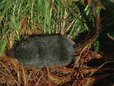
Sorex dispar is often confused with its close relative Sorex fumeus, the smoky shrew. Their appearance is quite similar and their ranges may overlap in some locations. However, Sorex dispar can be distinguished by several defining characteristics, including a more slender body and longer tail (Whitaker and Hamilton, 1998). They have a long snout and small eyes, with a long and thick tail. Their length ranges from 46-100 mm. and their weight ranges between 4-6 g., with a tail length that ranges between 25-82 mm (Nowak, 1999). They have a dark grey pelage with slightly paler under parts. Their teeth are sharp, pointed and often stained (PA Game Commission website, 2001).
- Other Physical Features
- endothermic
- bilateral symmetry
-
- Range mass
- 4 to 6 g
- 0.14 to 0.21 oz
-
- Range length
- 46 to 100 mm
- 1.81 to 3.94 in
Reproduction
The reproductive season for Sorex dispar is between April through August and they usually have several litters throughout each year. The average litter size is between four and seven, and the young are born helpless and unfurred (Nowak, 1999). They are placed quickly into a nest made of grasses and leaves, where they reumain until they are weaned. The nests are usually 10-20 cm in diameter (DiscoverLife website, 2001). Due to the rare opportunities for study of Sorex dispar, not much is known about their reproductive and behavioral development. The newborns are usually placed in a ball of vegetation directly after birth. After four or five weeks, the young are weaned and partially independent. Usually, the young spend the next several weeks foraging close to their mother before becoming completely independent (Nowak, 1999).
- Key Reproductive Features
- gonochoric/gonochoristic/dioecious (sexes separate)
- sexual
-
- Average weaning age
- 4-5 weeks
- Parental Investment
- altricial
- female parental care
Lifespan/Longevity
Like many other shrews, this species is short-lived. Lifespan estimates for wild individuals rarely exceed 2 years. Other than predation, some other common causes of death include starvation, rapid temperature changes, floods, and fights with other individuals. (PA Game Commission website, 2001)
-
- Average lifespan
Status: wild - 2 years
- Average lifespan
Behavior
These long-tailed shrews are active both day and night and do not become seasonally inactive. They are primarily solitary animals and can be quite aggressive with one another when put in close proximity. Almost all of their time is spent foraging (Nowak, 1999).
Their home ranges are estimated to be between .25-1 acre.
Communication and Perception
Food Habits
Due to their size, these shrews forage day and night, often consuming twice their body weight in food every day. This ravenous need for food is a response to their active lifestyle and small size, which produces a large surface-area-to-volume ratio compared to larger mammals. Due to their greater heat loss, these small animals must consume a proportionally larger amount of food than larger species (Vaughn, 2000). Their foraging focuses mainly on small invertebrates and plant materials. They eat almost continuously, feeding mostly above the ground and amongst the debris (PA Game Commission website, 2001). Some of their more common foods are centipedes, beetles, and spiders, as well as flies and crickets (Richmond, 1950).
- Primary Diet
-
carnivore
- insectivore
- eats non-insect arthropods
- Animal Foods
- insects
- terrestrial non-insect arthropods
Predation
To avoid predation while foraging, Sorex dispar often feed at night. Also, they tend to remain concealed under the debris of the forest floor. Also, since they are often mistaken by predators for mice, these shrews have a distinct musky odor that may serve as a deterant to predators (PA Game Commission website, 2001).
-
- Known Predators
-
- snakes (Serpentes)
- weasels (Mustela)
- other small mammals (Mammalia)
- birds of prey (Falconiformes and Strigiformes)
Ecosystem Roles
Due to their relative rarity, not much is known about specific ecosystem roles for this species. However, like many other terrestrial shrew species, Sorex dispar likely plays a large role in controlling insect populations through their foraging (DiscoverLife website, 2001).
Economic Importance for Humans: Positive
Since this species has such little direct human contact (due to their isolated habitats), they have little direct economic impact. However, due to their intense and constant consumption of insects, these shrews may have a positive effect on the farming industry by reducing the number of insect larvae and pupae that become pests (Banfield, 1974).
- Positive Impacts
- controls pest population
Conservation Status
This species is rare, but is not specifically recognized under any major conservation status.
-
- IUCN Red List
-
Least Concern
More information
-
- IUCN Red List
-
Least Concern
More information
-
- US Federal List
- No special status
-
- CITES
- No special status
Contributors
Jonathan Burian (author), University of Michigan-Ann Arbor, Ondrej Podlaha (editor), University of Michigan-Ann Arbor.
Glossary
- Nearctic
-
living in the Nearctic biogeographic province, the northern part of the New World. This includes Greenland, the Canadian Arctic islands, and all of the North American as far south as the highlands of central Mexico.

- altricial
-
young are born in a relatively underdeveloped state; they are unable to feed or care for themselves or locomote independently for a period of time after birth/hatching. In birds, naked and helpless after hatching.
- bilateral symmetry
-
having body symmetry such that the animal can be divided in one plane into two mirror-image halves. Animals with bilateral symmetry have dorsal and ventral sides, as well as anterior and posterior ends. Synapomorphy of the Bilateria.
- carnivore
-
an animal that mainly eats meat
- chemical
-
uses smells or other chemicals to communicate
- endothermic
-
animals that use metabolically generated heat to regulate body temperature independently of ambient temperature. Endothermy is a synapomorphy of the Mammalia, although it may have arisen in a (now extinct) synapsid ancestor; the fossil record does not distinguish these possibilities. Convergent in birds.
- female parental care
-
parental care is carried out by females
- forest
-
forest biomes are dominated by trees, otherwise forest biomes can vary widely in amount of precipitation and seasonality.
- insectivore
-
An animal that eats mainly insects or spiders.
- motile
-
having the capacity to move from one place to another.
- mountains
-
This terrestrial biome includes summits of high mountains, either without vegetation or covered by low, tundra-like vegetation.
- native range
-
the area in which the animal is naturally found, the region in which it is endemic.
- sexual
-
reproduction that includes combining the genetic contribution of two individuals, a male and a female
- solitary
-
lives alone
- tactile
-
uses touch to communicate
- temperate
-
that region of the Earth between 23.5 degrees North and 60 degrees North (between the Tropic of Cancer and the Arctic Circle) and between 23.5 degrees South and 60 degrees South (between the Tropic of Capricorn and the Antarctic Circle).
- terrestrial
-
Living on the ground.
References
"DiscoverLife website" (On-line). Accessed November 19, 2001 at discoverlife.org/nh/tx/vertebrata/mammalia/soricidae/sorex/dispar.
"PA Game Commission website" (On-line). Accessed November 19, 2001 at sites.pa.us/PA_Exec/PGC/pubs/w-notes/shres.html.
Banfield, A. 1974. Mammals of Canada. Toronto: University of Toronto Press.
Kirkland, G. 1981. *Sorex dispar* and *Sorex gaspensis*. Mammalian Species, 155: 1-4.
Nowak, R. 1999. Walker's Mammals of the World. Baltimore: Johns Hopkins University Press.
Richmond, N. 1950. Ecology and distribution of shrew *S. dispar* in Pennsylvania. Ecology, 31: 279-282.
Vaughn, T., J. Ryan, N. Czaplewski. 1999. Mammalogy. Fort Worth: Saunders College Publishing.
Whitaker, J., W. Hamilton. 1998. Mammals of Eastern United States. Cornell University: Cornell University Press.