Sorex araneusEurasian shrew

Geographic Range
Sorex araneus is found in Europe, including Great Britain and the Pyrenees. The extent of its range to the east is Lake Baikal, except in the dry steppes and desert zone. It is not found in Iberia, or most of France.(Mitchell-Jones 1999, Stone 1995)
- Biogeographic Regions
- palearctic
Habitat
Sorex araneus lives in variable habitats. These include woodlands, grassland, dunes, scree, heath, and hedgerows. It can live as far as the limits of the summer snow line.(Parker 1990)
- Habitat Regions
- temperate
Physical Description
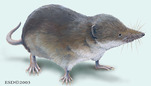
Sorex araneus has a tricolored coat. The ventral side is grayish, and the dorsal side varies in color from black to reddish brown. Its flanks are nut brown. Its tail is brown on the dorsal side, and gray ventrally. It has small eyes and it ears are hidden in fur. It has red-tipped teeth.(Mitchell-Jones 1990, Stone 1995)
- Other Physical Features
- endothermic
- bilateral symmetry
-
- Range mass
- 5 to 14 g
- 0.18 to 0.49 oz
-
- Range length
- 48 to 80 mm
- 1.89 to 3.15 in
-
- Average basal metabolic rate
- 0.348 W
- AnAge
Reproduction
Gestation takes place for 19-21 days. Young are born weighing between 0.5-0.6 grams. The young are weaned after 26-30 days, and reach sexual maturity at 9 or 10 months.(Parker 1990, Mitchell-Jones 1999)
- Key Reproductive Features
- gonochoric/gonochoristic/dioecious (sexes separate)
- sexual
- fertilization
- viviparous
-
- Average number of offspring
- 6
- AnAge
-
- Range gestation period
- 19 to 21 days
-
- Range weaning age
- 26 to 30 days
-
- Range age at sexual or reproductive maturity (female)
- 9 to 10 months
-
- Range age at sexual or reproductive maturity (male)
- 9 to 10 months
- Parental Investment
- altricial
Lifespan/Longevity
Sorex araneus can live for about 2 years. (Mitchell-Jones 1990)
-
- Average lifespan
Status: captivity - 2 years
- Average lifespan
-
- Average lifespan
Status: wild - 2.0 years
- Max Planck Institute for Demographic Research
- Average lifespan
Behavior
Juveniles disperse shortly after weaning, and are especially vulnerable to predation during dispersal. Both sexes establish home ranges as juveniles, and are territorial. The home ranges vary in size from 370-630 m^(2). Breeding is delayed until the second year. Individuals are solitary and aggressive, and population densities range from 42-69 individuals per hectare. They are active during night and day. (Stone 1995)
- Key Behaviors
- nocturnal
- motile
- solitary
- territorial
Communication and Perception
Food Habits
It is an opportunistic feeder that preys upon many insects, woodlice, spiders, and earthworms. (Cove et al. 2000)
- Primary Diet
-
carnivore
- insectivore
- eats non-insect arthropods
Predation
There are a number of predators of Sorex araneus, as listed below. (Kristofik 1999, Parker 1990)
-
- Known Predators
-
- tawny owls (Strix aluco)
- stoats (Mustela erminea)
- weasels (Mustela)
- red foxes (Vulpes vulpes)
- domestic cats (Felis silvestris)
- reptiles (Reptilia)
Ecosystem Roles
Sorex araneus makes burrows below ground, and also uses the burrows of mice, voles, and moles. (Stone 1995)
Economic Importance for Humans: Positive
There may be some pest invertebrates in the diet of Sorex araneus.
- Positive Impacts
- controls pest population
Economic Importance for Humans: Negative
Sorex araneus eats helpful invertebrates such as earthworms and spiders.
Conservation Status
The main threat to Sorex araneus is by habitat destruction through road construction and development in Europe(Stone 1995).
The common shrew in England is protected by the Wildlife and Countryside Act (1981) and cannot trapped without a license (The Mammal Society 2001).
-
- IUCN Red List
-
Least Concern
More information
-
- IUCN Red List
-
Least Concern
More information
-
- US Federal List
- No special status
-
- CITES
- No special status
Contributors
Meghan Taylor (author), University of Michigan-Ann Arbor, Bret Weinstein (editor), University of Michigan-Ann Arbor.
Glossary
- Palearctic
-
living in the northern part of the Old World. In otherwords, Europe and Asia and northern Africa.

- altricial
-
young are born in a relatively underdeveloped state; they are unable to feed or care for themselves or locomote independently for a period of time after birth/hatching. In birds, naked and helpless after hatching.
- bilateral symmetry
-
having body symmetry such that the animal can be divided in one plane into two mirror-image halves. Animals with bilateral symmetry have dorsal and ventral sides, as well as anterior and posterior ends. Synapomorphy of the Bilateria.
- carnivore
-
an animal that mainly eats meat
- chemical
-
uses smells or other chemicals to communicate
- endothermic
-
animals that use metabolically generated heat to regulate body temperature independently of ambient temperature. Endothermy is a synapomorphy of the Mammalia, although it may have arisen in a (now extinct) synapsid ancestor; the fossil record does not distinguish these possibilities. Convergent in birds.
- fertilization
-
union of egg and spermatozoan
- forest
-
forest biomes are dominated by trees, otherwise forest biomes can vary widely in amount of precipitation and seasonality.
- insectivore
-
An animal that eats mainly insects or spiders.
- internal fertilization
-
fertilization takes place within the female's body
- motile
-
having the capacity to move from one place to another.
- mountains
-
This terrestrial biome includes summits of high mountains, either without vegetation or covered by low, tundra-like vegetation.
- native range
-
the area in which the animal is naturally found, the region in which it is endemic.
- nocturnal
-
active during the night
- sexual
-
reproduction that includes combining the genetic contribution of two individuals, a male and a female
- solitary
-
lives alone
- tactile
-
uses touch to communicate
- temperate
-
that region of the Earth between 23.5 degrees North and 60 degrees North (between the Tropic of Cancer and the Arctic Circle) and between 23.5 degrees South and 60 degrees South (between the Tropic of Capricorn and the Antarctic Circle).
- territorial
-
defends an area within the home range, occupied by a single animals or group of animals of the same species and held through overt defense, display, or advertisement
- viviparous
-
reproduction in which fertilization and development take place within the female body and the developing embryo derives nourishment from the female.
References
January 1, 2001. "The Mammal Society" (On-line). Accessed November 25, 2001 at http://www.abdn.ac.uk/mammal/cshrew.htm.
Cove, R., D. Glue, S. Harris, C. Webbon. 2000. Changes in the food of British barn owls between 1974 and 1997. Mammal Review, 30(2): 107-129.
Kristofik, J. 1999. Small mammals in floodplain forests. Folia Zoologica, 48(3): 173-184.
Mitchell-Jones, A. 1999. The Atlas of European Mammals. San Diego, CA: Academic Press.
Parker, S. 1990. Grzimek's Encyclopedia of Mammals. New York, NY: McGraw Hill, Inc..