Sistrurus miliariusPigmy Rattlesnake
Geographic Range
Pygmy rattlesnakes, Sistrurus miliarius, are native to the United States and are most often found in the southeastern region of the country. Their range expands from the Florida Keys to as far north as Missouri, southern Kentucky, and southern North Carolina. These snakes' range also extends west, into eastern Texas and almost half of Oklahoma. This range can be found between 25-40 degrees north latitude and 75-100 degrees west longitude. However, pygmy rattlesnakes are not found near the Mississippi River, which runs directly through their natural range.
There are three subspecies of pygmy rattlesnakes. Carolina pygmy rattlesnakes, Sistrurus miliarius miliarius, are found primarily in South Carolina and eastern North Carolina. Their range also expands through central Alabama and Georgia and into the eastern parts of Mississippi. Dusky pygmy rattlesnakes, Sistrurus miliarius barbouri, are mostly found throughout Florida, southern Alabama, and southeastern Mississippi. Their range extends as far north as southern South Carolina. Western pygmy rattlesnakes, Sistrurus miliarius streckeri, are found primarily is Louisiana, Alabama, and Mississippi. Their ranges extends west into eastern Texas and southeastern Oklahoma. (Hammerson, 2007; Wooten and Gibbs, 2011; Wozniak, et al., 2006)
Habitat
Pygmy rattlesnakes can live in a variety of habitats, such as wet prairies, swamps, floodplains, forests, wet savannas and pastures, and moist lowlands. Carolina pygmy rattlesnakes, in particular, are a forest-dwellers. These snakes tend to inhabit areas that are in close proximity to water and have ample places of coverage (herbaceous and shrub layers), such as temperate forests and marshes. The close proximity to water allows them to be in the immediate area of their prey and vegetative coverage provides protection from predators. Pygmy rattlesnakes are very reclusive creatures and spend much of their time hiding in bushes or rotting logs. They also have been known to live in abandoned burrows made by small mammals. (Hammerson, 2007; Palmer and Williamson, 1971; Wozniak, et al., 2006)
- Habitat Regions
- temperate
- Terrestrial Biomes
- forest
Physical Description
Pygmy rattlesnakes vary from other closely related rattlesnakes in that they are remarkably smaller and have much smaller rattles. Adult pygmy rattlesnakes range in length from 38.1 cm to 63.5 cm, with an average length of 50.8 cm. Size is similar between the sexes, with the females and males both averaging around 50.8 cm in length. Maximum mass for these snakes has been reported as 623.69 g.
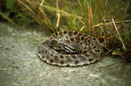
Their rattles have no free rattle segment, and only produce a slight buzzing sound when rattled. Pygmy rattlesnakes' patterns vary in color, such as black, tan, grey, brown, light red, and light pink. Pattern color typically is associated with geographic location and environment. All individuals have alternating red and black mid-dorsal spots and multiple black blotches on either side of the spots. The spots on either side of the mid-dorsum typically are mirror images. Their heads have a prominent black stripe running from their eyes to the corner of the mouths, giving these snakes a cat-like appearance. Pygmy rattlesnakes have solenoglyphous (front-fanged, hinged) fangs, which they use to both catch and inject venom into their prey. Tail color changes as the snakes mature, beginning bright yellow as juveniles and becoming darker brown as they reach adulthood. Juveniles do not have rattles, developing them as the snakes age. Juveniles begin to develop a rattle after the first time they shed their skin. These rattlesnakes' rattles are made of keratin and have interlocking segments that produce a faint sound when shaken. The rattles are small and brittle and are susceptible to breaking. Forty percent of all pygmy rattlesnakes lack rattles because the rattles have broken off. Pygmy rattlesnakes are heterothermic, meaning their body temperatures vary with the environment. They are also ectothermic and depend on direct sunlight to regulate their body temperatures.
Carolina pygmy rattlesnakes typically have a light red or even pink pattern that matches the red clay soil of their region. They are often light red or pinkish in pattern color. Western pygmy rattlesnakes are grey, light pink, or light red in pattern color. Their black dorsal spots appear more stretched than the spots on the other two subspecies, and are bar-like in appearance. Dusky pygmy rattlesnakes often are darker in color and sometimes lack the red mid-dorsal spots that are present in the other subspecies. (Cook, et al., 1994; Snellings, 2012; Wozniak, et al., 2006)
- Other Physical Features
- ectothermic
- heterothermic
- bilateral symmetry
- venomous
- Sexual Dimorphism
- sexes alike
-
- Range mass
- 623.69 (high) g
- 21.98 (high) oz
-
- Range length
- 38.1 to 63.5 cm
- 15.00 to 25.00 in
Development
After fertilization, young pygmy rattlesnakes develop as embryos for 3-5 months. Young are ovoviviparous and are born alive in an embryonic sac, which is broken immediately after birth. Young are 121-191 mm in length at birth and grow rapidly for the next two years of life. Pygmy rattlesnakes have indeterminate growth, growing rapidly for the first two years of life and then slowing down to a steady growth of about 1 mm per year for the rest of their lives. As the young grow into adulthood, the color of pygmy rattlesnakes' rattles changes from a bright yellow or orange color to a darker shade of grey or brown. The rattles increase in size as pygmy rattlesnakes age. A new rattle segment is added each time the snakes shed their skin, which occurs approximately 1-4 times per year. (Ernst and Ernst, 2011; Snellings, 2012)
- Development - Life Cycle
- indeterminate growth
Reproduction
Pygmy rattlesnakes' mating season occurs in early spring (March-April), with young typically born from July into September. Reproductively-active snakes release chemical signals to inform potential mates that they are receptive. The potential mates detect these chemical signals by flicking their tongues over the snakes' bodies. Epidermal lipids found on the snakes' bodies allow males to determine the sex, size, and mating condition of a potential mate. Pygmy rattlesnakes are monogamous, with only one male successfully fertilizing a female. Males are not aggressive towards each other during mating seasons and many males will pursue one female without conflict. Multiple males will compete to mate with one female and will continue their attempts to mate until one male successfully fertilizes the female. Once a male fertilizes a female, all other males cease their mating attempts with the female snake. This occurs because the male leaves a gelatinous plug in the female after she has been fertilized, closing up the cloaca (the opening for the reproductive tract) and preventing the female from mating with other snakes. The male will continue to remain in close proximity to the fertilized female for most of her pregnancy. The male will "mate guard" the female and they can sometimes be found coiled around one another. (Shrine and Mason, 2012; Snellings, 2012)
- Mating System
- monogamous
Pygmy rattlesnakes are iteroparous, meaning that females will reproduce multiple times throughout their lifetimes. Both male and female pygmy rattlesnakes reach sexual maturity at 2 years of age. They are also seasonal breeders, typically mating during the spring and giving birth to their young during the late summer. Female pygmy rattlesnakes will store sperm in instances of early-season mating. The females store the sperm until late March or April and then release it, allowing fertilization of the female eggs to occur. Males compete with each other to breed with one female. Males flick their tongues over other snakes bodies to determine sex, size, and mating condition of a potential mate. Breeding is on a first come, first serve basis, with the first male to successfully consummate with the female being the one who gets to fertilize her eggs. Once a male has successfully fertilized the female, the other males will no longer attempt to mate with her. Gestation period for pygmy rattlesnakes is approximately 3-5 months, with young being born between July and early September. Pygmy rattlesnakes are ovoviviparous. Young are born alive in an embryonic sac, which is broken immediately after birth. Litters vary from 2-12 young, with an average of 6 in each litter. Young are typically 1.8-5.0 grams at birth. Once born, young stay near their mother for 7-10 days for protection. (Aldrige and Sever, 2011; Glaudus, et al., 2005; Shrine and Mason, 2012; Snellings, 2012)
- Key Reproductive Features
- iteroparous
- seasonal breeding
- gonochoric/gonochoristic/dioecious (sexes separate)
- sexual
- fertilization
- ovoviviparous
- sperm-storing
-
- Breeding interval
- Pygmy rattlesnakes breed typically once yearly.
-
- Breeding season
- The breeding season for the pygmy rattlesnake lasts for about two months from March to April.
-
- Range number of offspring
- 2 to 12
-
- Average number of offspring
- 6
-
- Range gestation period
- 3 to 5 months
-
- Range time to independence
- 7 to 10 days
-
- Range age at sexual or reproductive maturity (female)
- 2 (low) years
-
- Range age at sexual or reproductive maturity (male)
- 2 (low) years
After fertilization, male pygmy rattlesnakes will often engage in "mate guarding," remaining close to the female in a protective manner. This guarding will continue for an extended period of time, sometimes for days, weeks, or even months at a time. The snakes often can be found coiled up together during this period of time. Males typically leave the females before the young are born. During gestation, female pygmy rattlesnakes bask in areas with more sun-exposure. This extra exposure causes the snakes' body temperature to rise above normal temperature levels, which in turn facilitates the growth of embryos. Once the young are born, they stay near their mother for 7-10 days for protection. The young tend to leave their mother after they shed their skin for the first time, ending parental involvement. Young are precocial, learning how to hunt and find territory on their own soon after birth. (Snellings, 2012)
- Parental Investment
- precocial
- male parental care
- female parental care
-
pre-hatching/birth
-
provisioning
- female
-
protecting
- male
-
provisioning
-
pre-independence
-
provisioning
- female
-
provisioning
Lifespan/Longevity
Pygmy rattlesnakes can live up to 16.1 years in captivity. Lifespans in the wild have not been reported. (Snider and Bowler, 1992)
-
- Range lifespan
Status: captivity - 16.1 (high) years
- Range lifespan
-
- Average lifespan
Status: captivity - 16.1 years
- AnAge
- Average lifespan
Behavior
Pygmy rattlesnakes are a solitary species, rarely interacting with other animals or their own species except during mating season. Once young leave their mothers, they typically spend the rest of their lives, outside of breeding, in solitary. Pygmy rattlesnakes are terricolous, living on the ground under logs and in abandoned mammal burrows. Their territory is small, primarily made up of the burrow or log that they inhabit. These snakes are sedentary, spending the majority of their lives in the immediate area surrounding their burrows. Pygmy rattlesnakes are motile creatures and typically will run away from a predator or invader, choosing to flee over fighting. However, if extremely threatened, they will become physically aggressive and may even strike the intruder. Defensive behavior is dependent upon multiple intrinsic factors, such as body temperature, sex, size, and recent feeding. If the snakes are physically depleted, they will often choose to flee over confronting their attackers.
Adult pygmy rattlesnakes are ambush predators, lying in wait before striking their prey. Their brightly-colored tails mimic an insect, the type of diet on which their prey thrives. Pygmy rattlesnakes are most active in warm weather. Unlike many other rattlesnakes, pygmy rattlesnakes do not go into hibernation during the winter. Instead, they only cover themselves in debris or take refuge in burrows when the weather is cooler (below freezing). They emerge from hiding when the weather is warmer and retreat back to their sanctuaries when the temperature begins to drop again. They do not need to go into a full hibernation like their northern relatives because the temperature in their habitat hardly ever drops too low for them to survive in. Pygmy rattlesnakes are diurnal, being active during the daytime. These rattlesnakes, like other snake species, are dependent on their environment to maintain their metabolic rate. Pygmy rattlesnakes use the warmth from sunlight to moderate their metabolic system. (Glaudus, et al., 2005; Shrine and Mason, 2012; Snellings, 2012)
-
- Range territory size
- 1 (low) m^2
Home Range
Pygmy rattlesnakes' territory is made up of the small burrows in which they live. These burrows are only about 1 m^2 in size. These rattlesnakes are solitary and live alone in these burrows. Pygmy rattlesnakes will defend their burrows if provoked. These snakes often have to venture out of their home range in order to obtain food, traveling typically 7-242 meters from their burrows to find prey. (Hammerson, 2007; Snellings, 2012)
Communication and Perception
Pygmy rattlesnakes are reclusive and rarely communicate with their own species, except during mating procedures. During the snakes' mating season, they release hormones in order to signal reproductive readiness. These hormones can be detected through direct contact with the forked tongues of other snakes. These hormones not only help the snake determine the sex of a potential partner, but also hormones allow pygmy rattlesnakes to know the senders' relative size and mating ability. These rattlesnakes flick their tongues over the bodies of potential mates in order to determine their mating ability.
The pygmy rattlesnake communicates with other animals by physical means. These snakes often shake their rattles, producing a warning sound that alerts predators. Pygmy rattlesnakes can be aggressive towards predators. When threatened, these rattlesnakes will coil, shake their rattle, and strike violently. This species uses caudal luring as a means of mimicking animals that its prey eats. Pygmy rattlesnakes have a heat-sensing pit that is located between their eyes and mouths. This pit allows the rattlesnakes to see prey in an infrared image, sensing their body heat. This sense can be used to locate prey and also defend itself from potential predators. Pygmy rattlesnakes use the color patterns on their bodies to blend in with their environment. These patterns allow them to be undetected by both predators and prey. (Shrine and Mason, 2012; Snellings, 2012)
- Other Communication Modes
- pheromones
- vibrations
- Perception Channels
- visual
- infrared/heat
- acoustic
- chemical
Food Habits
The pygmy rattlesnake carnivorous diet consists primarily of small frogs, lizards, small snakes, and small mammals, such as mice. Pygmy rattlesnakes often use caudal luring when trying to capture prey. Caudal luring is a method through which the snakes use their tails to mimic other animals that its prey might eat, such as insects or earthworms. As juveniles, their tails are more brightly colored. This gives the tails the appearance of insect larvae, which attracts insects and lizards. The tail color changes to dark brown as the snakes reach adulthood. As adults, pygmy rattlesnakes' primary diet consists of larger prey, such as small mammals and other snakes. Caudal luring is no longer as effective for catching this type of prey. In order to detect their prey, pygmy rattlesnakes have heat-sensitive areas between their eyes and nostrils, which allows them to detect the location of their prey. Pygmy rattlesnakes ambush their prey and inject venom into it with their hollow fangs. (Gibbs, et al., 2013; Rabatsky and Waterman, 2005)
- Primary Diet
-
carnivore
- eats terrestrial vertebrates
- insectivore
- Animal Foods
- mammals
- amphibians
- reptiles
- insects
Predation
Pygmy rattlesnakes are preyed on by larger snakes, owls, Virginia opossums, Didelphis virginianus, raccoons, Procyon lotor, and skunks. Fire ants Solenopsis invicta have been known to prey on infant pygmy rattlesnakes. Pygmy rattlesnakes have evolved anti-predator adaptations in order to survive. These snakes have evolved color patterns on their scales that act as camouflage and allows them to blend into the ground and fallen foliage of their environment, camouflaging the snakes from both predators and prey. When encountering a predator, pygmy rattlesnakes will often try to run away. If extremely threatened or provoked, pygmy rattlesnakes will become quite aggressive. Pygmy rattlesnakes will often shake their rattles as a warning sign and may strike their intimidator if they feel provoked. Although not a direct predator, humans, Homo sapiens, are responsible for a large number of pygmy rattlesnake mortalities each year. Humans often kill pygmy rattlesnakes when they come into direct contact. (Ernst and Ernst, 2011; Hammerson, 2007; Snellings, 2012)
- Anti-predator Adaptations
- cryptic
-
- Known Predators
-
- fire ants (Solenopsis invicta)
- humans (Homo sapiens)
- Virginia opossums (Didelphis virginiana)
- raccoons (Procyon lotor)
- skunks (Mephitis species)
- snakes (Serpentes)
- owls (Strigiformes)
Ecosystem Roles
Pygmy rattlesnakes serve an important role as both a predator and an animal of prey in their ecosystem. As a predator, pygmy rattlesnakes prey on small mammals, amphibians, insects, and other small snakes.
Pygmy rattlesnakes are host to a number of parasites such as: ticks (Amblyomma dissimile), fungi (Sporothrix schenckii, Pestalotia pezizoides, Geotrichum candidum, Paecilomyces), trematodes (Ochetosoma kansense, Ochetosoma elongatum), cestodes (Proteocephalus), and nematodes (Kalicephalus inermis coronellae, Kalicephalus appendiculatus, Kalicephalus rectiphilus). (Cheatwood, et al., 2003; Foster, et al., 2000; Snellings, 2012)
- ticks (Amblyomma dissimile)
- fungi (Sporothrix schenckii)
- fungi (Pestalotia pezizoides)
- fungi (Geotrichum candidum)
- fungi (Paecilomyces species)
- trematodes (Ochetosoma kansense)
- trematodes (Ochetosoma elongatum)
- cestodes (Proteocephalus)
- nematodes (Kalicephalus inermis coronellae)
- nematodes (Kalicephalus appendiculatus)
- nematodes (Kalicephalus rectiphilus)
Economic Importance for Humans: Positive
Pygmy rattlesnakes are often captured, bred, and sold on classified websites and at reptiles shows. (Boldizar, 2016)
- Positive Impacts
- pet trade
Economic Importance for Humans: Negative
Pygmy rattlesnakes have been known to bite humans when threatened. The venom injected during pygmy rattlesnakes' bite is fairly toxic, but because it is delivered in such small amounts, bites are not known to be fatal. No human deaths due to pygmy rattlesnakes' bite have been reported. However, a bite is a very serious issue and requires immediate medical attention. Bite victims often exhibit symptoms of pain, swelling, discoloration, blisters, and sometimes vomiting. Symptoms are dependent on the amount of envenomation, venom that has been injected into their circulatory system. Envenomation can cause blood cell loss and a decrease in blood circulation. If left untreated, bites can become infected and lead to serious medical issues, such as gangrene and permanent tissue damage. (Shupe, 2013; Sprenger and Bailey, 1986; Wozniak, et al., 2006)
- Negative Impacts
-
injures humans
- bites or stings
- venomous
Conservation Status
Pygmy rattlesnakes are currently listed as a species of "Least Concern" on the IUCN Red List and are listed as "No special status" on the US Federal List, State of Michigan List, or on CITES appendices. The IUCN Red List reports that this species appears to be stable, but habitat loss and habitat degradation may negatively impact some populations. Hammerson (2007) reported that a fungal pathogen affected Sistrurus miliarius barbouri in Florida in 1997-1998, but long-term impacts haven't seemed to have affected this species. (Hammerson, 2007)
-
- IUCN Red List
-
Least Concern
More information
-
- IUCN Red List
-
Least Concern
More information
-
- US Federal List
- No special status
-
- CITES
- No special status
-
- State of Michigan List
- No special status
Contributors
Rebecca Stamm (author), Radford University, Alex Atwood (editor), Radford University, Marisa Dameron (editor), Radford University, Karen Powers (editor), Radford University, Tanya Dewey (editor), University of Michigan-Ann Arbor.
Glossary
- Nearctic
-
living in the Nearctic biogeographic province, the northern part of the New World. This includes Greenland, the Canadian Arctic islands, and all of the North American as far south as the highlands of central Mexico.

- acoustic
-
uses sound to communicate
- bilateral symmetry
-
having body symmetry such that the animal can be divided in one plane into two mirror-image halves. Animals with bilateral symmetry have dorsal and ventral sides, as well as anterior and posterior ends. Synapomorphy of the Bilateria.
- carnivore
-
an animal that mainly eats meat
- chemical
-
uses smells or other chemicals to communicate
- cryptic
-
having markings, coloration, shapes, or other features that cause an animal to be camouflaged in its natural environment; being difficult to see or otherwise detect.
- diurnal
-
- active during the day, 2. lasting for one day.
- ectothermic
-
animals which must use heat acquired from the environment and behavioral adaptations to regulate body temperature
- female parental care
-
parental care is carried out by females
- fertilization
-
union of egg and spermatozoan
- forest
-
forest biomes are dominated by trees, otherwise forest biomes can vary widely in amount of precipitation and seasonality.
- heterothermic
-
having a body temperature that fluctuates with that of the immediate environment; having no mechanism or a poorly developed mechanism for regulating internal body temperature.
- indeterminate growth
-
Animals with indeterminate growth continue to grow throughout their lives.
- infrared/heat
-
(as keyword in perception channel section) This animal has a special ability to detect heat from other organisms in its environment.
- insectivore
-
An animal that eats mainly insects or spiders.
- iteroparous
-
offspring are produced in more than one group (litters, clutches, etc.) and across multiple seasons (or other periods hospitable to reproduction). Iteroparous animals must, by definition, survive over multiple seasons (or periodic condition changes).
- male parental care
-
parental care is carried out by males
- marsh
-
marshes are wetland areas often dominated by grasses and reeds.
- monogamous
-
Having one mate at a time.
- motile
-
having the capacity to move from one place to another.
- native range
-
the area in which the animal is naturally found, the region in which it is endemic.
- ovoviviparous
-
reproduction in which eggs develop within the maternal body without additional nourishment from the parent and hatch within the parent or immediately after laying.
- pet trade
-
the business of buying and selling animals for people to keep in their homes as pets.
- pheromones
-
chemicals released into air or water that are detected by and responded to by other animals of the same species
- seasonal breeding
-
breeding is confined to a particular season
- sedentary
-
remains in the same area
- sexual
-
reproduction that includes combining the genetic contribution of two individuals, a male and a female
- solitary
-
lives alone
- sperm-storing
-
mature spermatozoa are stored by females following copulation. Male sperm storage also occurs, as sperm are retained in the male epididymes (in mammals) for a period that can, in some cases, extend over several weeks or more, but here we use the term to refer only to sperm storage by females.
- swamp
-
a wetland area that may be permanently or intermittently covered in water, often dominated by woody vegetation.
- tactile
-
uses touch to communicate
- temperate
-
that region of the Earth between 23.5 degrees North and 60 degrees North (between the Tropic of Cancer and the Arctic Circle) and between 23.5 degrees South and 60 degrees South (between the Tropic of Capricorn and the Antarctic Circle).
- venomous
-
an animal which has an organ capable of injecting a poisonous substance into a wound (for example, scorpions, jellyfish, and rattlesnakes).
- vibrations
-
movements of a hard surface that are produced by animals as signals to others
- visual
-
uses sight to communicate
- young precocial
-
young are relatively well-developed when born
References
Aldrige, R., D. Sever. 2011. Reproductive Biology and Phylogeny of Snakes. Boca Raton, Florida: Taylor & Francis Group.
Boldizar, K. 2016. "Pigmy Rattlesnake Care Sheet" (On-line). Accessed November 13, 2016 at http://www.reptilesmagazine.com/Care-Sheets/Pigmy-Rattlesnake/.
Cheatwood, J., E. Jacobson, P. May, T. Farrell, B. Homer, D. Samuelson, J. Kimbrough. 2003. An outbreak of fungal dermatitis and stomatitis in a free-ranging population of pigmy rattlesnakes (Sistrurus miliarius barbouri) in Florida. Journal of Wildlife Diseases, 39/2: 329-337.
Cook, P., M. Rowe, R. Van Devender. 1994. Allometric scaling and interspecific differences in the rattling sounds of rattlesnakes. Herpetologica, 50/3: 358-368.
Ernst, C., E. Ernst. 2011. Venomous Reptiles of the United States, Canada, and Northern Mexico. Baltimore, Maryland: The Johns Hopkins University Press.
Foster, G., P. Moler, J. Kinsella, S. Terrell, D. Forrester. 2000. Parasites of eastern indigo snakes (Drymarchon corais couperi) from Florida, U.S.A. Comparative Parasitology, 67/1: 124-128.
Gibbs, H., M. Sanz, J. Calvete. 2013. Phylogeny-based comparative analysis of venom proteome variation in a clade of rattlesnakes. PLoS One, 8/6: e67220. Accessed September 11, 2016 at http://dx.doi.org/10.1371/journal.pone.0067220.
Glaudus, X., T. Farrell, P. May. 2005. Defensive behavior of free-ranging pygmy rattlesnakes. Copeia, 2005/1: 196-200.
Hammerson, G. 2007. "Sistrurus miliarius" (On-line). The IUCN Red List of Threatened Species 2007: e.T64347A12772862. Accessed September 11, 2016 at http://www.iucnredlist.org/details/64347/0.
Palmer, W., G. Williamson. 1971. Observations on the natural history of the Carolina pygmy rattlesnake, Sistrurus miliarius. The Journal of the Elisha Mitchell Scientific Society, 87/1: 20-25.
Rabatsky, A., J. Waterman. 2005. Ontogenetic shifts and sex differences in caudal luring in the dusky pygmy rattlesnake, Sistrurus miliarius barbouri. Herpetolgica, 61/2: 87-91.
Shrine, R., R. Mason. 2012. An airbourne sex pheromone in snakes. Biology Letters, 8/2: 183-185.
Shupe, S. 2013. U.S. Guide to Venomous Snakes and Their Mimics. New York, New York: Skyhorse Publishing, Inc.
Snellings, E. 2012. The Diminutive Giant Dusky Pygmy Rattlesnake. Rodeo, New Mexico: ECO Herpetological Publishing & Distribution.
Snider, A., J. Bowler. 1992. Longevity of Reptiles and Amphibians in North American Collections. Oxford, Ohio: Society for the Study of Amphibians and Reptiles.
Sprenger, T., W. Bailey. 1986. Snakebite treatment in the United States. International Journal of Dermatology, 25/8: 479-484.
Telford, S., J. Butler, R. Telford. 2002. Hepatozoon species (Apicomplexa: Hepatozoidae) of the corn snake, Elaphe guttata (Serpentes: Colubridae) and the pigmy rattlesnake, Sistrurus miliarius barbouri (Serpentes: Viperidae) in south Florida. The Journal of Parasitology, 88/4: 778-782.
Wooten, J., H. Gibbs. 2011. Niche divergence and lineage diversification among closely related Sistrurus rattlesnakes. Journal of Evolutionary Biology, 25/2: 317-328.
Wozniak, E., J. Wisser, M. Schwartz. 2006. Venomous adversaries: A reference to snake identification, field safety, and bite-victim first aid for disaster-response personnel deploying into hurricane-prone regions of North America. Wilderness & Environmental Medicine Journal, 17/4: 246-266.