Sigmodon hispidushispid cotton rat


Geographic Range
Hispid cotton rats have an extensive range. The southern range reaches northern South America in Peru, Ecuador, Columbia, Venezuela, Guyana, French Guiana, and Brazil. The range extends northward through central America and Mexico. In the United States, they are found as far north as Nebraska in the west and coastal and central Virginia to the east. There is also an isolated population in southeastern California in the Imperial Valley along the Colorado River. However, since Sigmodon hispidus was separated genetically from Sigmodon arizonae in recent years, it's unclear whether this California population is indeed Sigmodon hispidus.
In the past 50 to 100 years hispid cotton rats have been extending their range northward and to higher elevations. Genoways and Schlitter (1966) observed that hispid cotton rats moved northward in Nebraska. In 2002, Dunnum et al. observed that they were extending their range into higher elevations in New Mexico. As recently as 2008 (Francl and Meikle, 2009), they were captured in central Virginia - the first record of this species in the Ridge and Valley province. They may also be moving westward in Virginia. (Cameron and Spencer, 1981; Cameron, 1999; Choate, et al., 1994; Dunnum, et al., 2002; Francl and Meikle, 2009; Genoways and Schlitter, 1966)
- Biogeographic Regions
- nearctic
- neotropical
Habitat
Hispid cotton rats prefer dense, grassy areas. They are most commonly captured in grassy fields, brushy pastures, canal banks, roadsides, and edges of cultivated fields overgrown with weeds and other brushy vegetation such as broomsedge and honeysuckle. They occasionally have been observed in areas of dense cacti, salt marshes, and in grasslands bordering brackish waters. In Kansas, grasslands are the most common habitat in which they are trapped, but they also have been found in open wetland habitats, in agricultural fields, and in "planted plum-cedar woodlands" (Rehmeier et al. 2005). In Mexico, hispid cotton rats range from sea level to 1130 m in elevation. In radiotelemetry studies, Cameron and Spencer (2008) found that reproductively active females spent more time in habitats that were a mix of monocots and dicots, and actually avoided all-dicot patches. Males show no preference. (Cameron and Spencer, 2008; Espinoza and Rowe, 1979; Linzey, 1998; Rehmeier, et al., 2005; Schwartz and Schwartz, 1981; Webster, et al., 1985)
- Habitat Regions
- temperate
- tropical
- terrestrial
- Terrestrial Biomes
- savanna or grassland
- Other Habitat Features
- agricultural
-
- Range elevation
- 0 to 1130 m
- 0.00 to 3707.35 ft
Physical Description
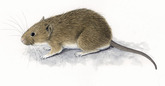
Hispid cotton rats are small to medium sized rodents, with adults weighing 100 to 225 g (average 159 g). Total length ranges from 80 to 320 mm, with males slightly longer than females. Regional size variation exists; hispid cotton rats in Virginia are smaller than those found in North and South Carolina. The color of both sexes consists of a mixture of tan, brown, and black fur on their dorsal parts, giving them a coarse, or "hispid," appearance. The underparts are white to greyish, the tail is sparsely haired and considerably shorter than the combined length of the head and body. Regional variation in color is common, hispid cotton rats from the Coastal Plain of North and South Carolina are darker than those from Maryland and Virginia. An additional characteristic feature of Sigmodon hispidus is the s-shaped crown pattern on the second and third molars. The dental formula is I 1/1, C 0/0, O 0/0, M 3/3 = 16. (Choate, et al., 1994; Linzey, 1998; Mengak and Laerm, 2007; Schwartz and Schwartz, 1981; Webster, et al., 1985)
- Other Physical Features
- endothermic
- homoiothermic
- bilateral symmetry
- Sexual Dimorphism
- male larger
-
- Range mass
- 100 to 225 g
- 3.52 to 7.93 oz
-
- Average mass
- 159 g
- 5.60 oz
-
- Range length
- 224 to 365 mm
- 8.82 to 14.37 in
-
- Average length
- 295 mm
- 11.61 in
-
- Range basal metabolic rate
- 0.96/g to 2.89/g cm3.O2/g/hr
-
- Average basal metabolic rate
- 1.33/g cm3.O2/g/hr
Reproduction
Little has been published about the mating systems of hispid cotton rats. Most assumptions about their habits are indirect. For example, hispid cotton rats appear to polygamous because of gender differences in home range sizes. In species where males have a much larger home range than females, polygyny is common. (Sulok, et al., 2004)
- Mating System
- polygynous
Hispid cotton rats have the potential to breed year-round and do so in tropical and semi-tropical portions of their range. In temperate regions breeding seems to be determined by temperature. In Virginia no pregnant females have been reported from November through February. In non-pregnant females heat occurs about every 7 to 9 days. The gestation period is about 27 days. A single adult female typically produces 3 to 4 litters per year, averaging 5 to 7 young per litter. Newborns average 76 mm in total length and 6.5 g. They are usually weaned at about 3 weeks and can be reproductively active in 35 to 40 days. However, most do not reproduce until 2 months and they are fully grown at 5 months. (Espinoza and Rowe, 1979; Linzey, 1998; Schwartz and Schwartz, 1981; Webster, et al., 1985)
- Key Reproductive Features
- iteroparous
- seasonal breeding
- year-round breeding
- gonochoric/gonochoristic/dioecious (sexes separate)
- sexual
- viviparous
-
- Breeding interval
- Breeding occurs year-round or 3 to 4 times per year, varying by region.
-
- Breeding season
- Breeding occurs in summer months in temperate portions of their range and year-round in tropical portions.
-
- Range number of offspring
- 1 to 15
-
- Average number of offspring
- 5-7
-
- Average number of offspring
- 5
- AnAge
-
- Average gestation period
- 27 days
-
- Average gestation period
- 27 days
- AnAge
-
- Range weaning age
- 5 to 25 days
-
- Average time to independence
- 21 days
-
- Range age at sexual or reproductive maturity (female)
- 2 (low) months
-
- Average age at sexual or reproductive maturity (female)
- 5 months
-
- Range age at sexual or reproductive maturity (male)
- 2 (low) months
-
- Average age at sexual or reproductive maturity (male)
- 5 months
Female hispid cotton rats produce more than one litter per year. The young stay in the nest until they are about 3 weeks old when they are weaned and begin to care for themselves. (Linzey, 1998)
- Parental Investment
- altricial
- female parental care
-
pre-fertilization
- provisioning
-
protecting
- female
-
pre-hatching/birth
-
provisioning
- female
-
protecting
- female
-
provisioning
-
pre-weaning/fledging
-
provisioning
- female
-
provisioning
Lifespan/Longevity
Hispid cotton rats, like many rodents, are not long lived in the wild. Few cotton rats (13.2%) live beyond six months. The oldest recorded Sigmodon species individual lived 12 months in the wild. In captivity, the oldest hispid cotton rat recorded is five years, two months old. (Linzey, 1998)
-
- Range lifespan
Status: wild - 12 (high) months
- Range lifespan
-
- Range lifespan
Status: captivity - 62 (high) months
- Range lifespan
-
- Average lifespan
Status: wild - 6 months
- Average lifespan
-
- Average lifespan
Status: captivity - 5.2 years
- Max Planck Institute for Demographic Research
- Average lifespan
Behavior
Hispid cotton rats are active year-round and during all hours of the day. Maximum activity is concentrated from late afternoon to about midnight. Although heavy rains and extreme cold decreases activity in this species, light or moderate rains have little or no effect. Interactions are limited to the breeding season, when older males have some dominance over the younger males. They also show cooperative behavior in cooler months, huddling together for warmth. They tend to be aggressive towards other rodent species occupying the same habitat. Hispid cotton rats construct nests using dry grass, fibers stripped from larger plants, and other materials. Nests are built under logs and rocks for protection. Sometimes they use abandoned dens of larger mammals such as skunks or squirrels. They also construct a maze of runways, about 7.5 to 10 cm wide, and tunnels from 2.5 to 5 cm wide and from 2.5 to 10 cm below the surface. New growth of grasses and sedges is trimmed from main runways and trimmings are piled up in an irregular manner.
Homing studies found that cotton rats were more successful in returning to their territories if they were released less than 300 m away. This suggests familiarity with the habitat at this distance. In radiotelemetry studies, Cameron and Spencer (2008) found that reproductively active females spent more time in habitats that were a mix of monocots and dicots, and avoided all-dicot patches. Males showed no preference. The authors speculate that this difference in preference is related to nutritional needs. Females, with larger caloric demands, consume a mix of monocots and dicots. (Cameron and Spencer, 1981; Cameron and Spencer, 2008; Linzey, 1998; Schwartz and Schwartz, 1981)
Home Range
Hispid cotton rats have a home ranges from 0.10 to 0.50 ha. Males usually have larger home ranges (0.40 to 0.50 ha) than females (0.10 to 0.30 ha). Adult home ranges are larger than those of young adults or juveniles. Movements are typically less than 100 m per day, but can be upwards of 300 m in rare cases. They typically do not defend territories, but there have been reports that females may occasionally do so. (Cameron and Spencer, 1981; Espinoza and Rowe, 1979; Linzey, 1998; Schwartz and Schwartz, 1981)
Communication and Perception
Little information regarding communication of hispid cotton rats has been reported. One article mentions communication when young were being handled by researchers. The young made a squeaking sound alerting an adult to come close to researchers. However, like most mammals, hispid cotton rats have a keen sense of smell and hearing. (Cameron and Spencer, 1981)
Food Habits
Hispid cotton rats are folivorous, granivorous, and lignivorous. In addition they feed on the eggs and young of ground-nesting birds, insects, crayfish, fiddler crabs, and carrion where possible. They do not cache food. When feeding on tall plants they cut down the plant near its base then cut the whole plant into smaller sections. They drink water but do not require a permanent water source in their habitat. (Linzey, 1998; Schwartz and Schwartz, 1981)
- Animal Foods
- eggs
- carrion
- insects
- aquatic crustaceans
- Plant Foods
- leaves
- roots and tubers
- wood, bark, or stems
- seeds, grains, and nuts
- fruit
Predation
Hispid cotton rats avoid predation by staying in their runways, being alert, and taking advantage of their cryptic coloration. Their rate of reproduction is high, suggesting that this effort may quickly replace those individuals lost to predation. Hispid cotton rats are preyed on by a wide variety of predators including owls, hawks, red foxes, bobcats, raccoons, coyotes, domestic cats, weasels, mink, and snakes.
Hispid cotton rats presumably fall victim to invasive red fire ants, Solenopsis invicta. Pederson et al., 2003 demonstrated that cotton rat densities in habitats containing fire ants in the summer may be half of that in plots where fire ant suppression techniques have been implemented. This may be a result of habitat switching by cotton rats or direct predation on cotton rat young. In a laboratory study by Ferris (1994) high densities of fire ants caused females to abandon their nests, carrying young in tow one by one for as long as they were able. (Cameron and Spencer, 1981; Ferris, 1994; Pedersen, et al., 2003)
- Anti-predator Adaptations
- cryptic
-
- Known Predators
-
- fire ants Solenopsis invicta
- owls (Strigiformes)
- hawks (Accipitridae)
- red foxes (Vulpes vulpes)
- bobcats (Lynx rufus)
- raccoons (Procyon lotor)
- weasels (Mustela species)
- minks (Neovison vison)
- snakes (Serpentes)
- coyotes (Canis latrans)
- house cats (Felis catus)
Ecosystem Roles
Hispid cotton rats are prey for many larger animals such as foxes, dogs, coyotes, weasels, raccoons, minks, domestic cats, bobcats,, hawks, and snakes. This makes them an important food source. Some researchers suggest that their abundance and availability as prey means they are a buffer between predators and game animals. In the piedmont and coastal plains of North Carolina cotton rats appear to be an important food source to bobcats, ranking first or second in frequency of occurrence in their stomachs. Hispid cotton rats have an important relationship with bobwhite quail (Colinus virginianus) because they compete with quail for food resources and feed on the quail eggs. Hispid cotton rats do not feed on all quail nests at one time, suggesting an adaptive reason for staggered quail breeding. This staggering may actually benefit quail for reasons other than predation by Sigmodon hispidus; all nests may not be not subjected to the same adverse weather and environmental conditions as others. In addition, hispid cotton rats are host to many internal and external parasites. External parasites are hosts to mites, ticks, lice, and fleas. They are also hosts to cestode species (Choanotaenia nebraskensis, Hymenolepis diminuta, Raillietina bakeri, Taenia taeniaeformis), bacteria (Rickettsia rickettsii), nematodes (Longistriata adunca, Physaloptera hispida, Mastophorus muris), and ascarid worms. (Linzey, 1998; Mengak and Laerm, 2007; Schwartz and Schwartz, 1981)
- cestodes (Choanotaenia nebraskensis)
- cestodes (Hymenolepis diminuta)
- cestodes (Raillietina bakeri)
- cestodes (Taenia taeniaeformis)
- bacteria (Rickettsia rickettsii)
- nematodes (Longistriata adunca)
- nematodes (Physaloptera hispida)
- nematodes (Mastophorus muris)
- ascarid worms (Ascarididae)
Economic Importance for Humans: Positive
There is no evidence hispid cotton rats are economically beneficial.
Economic Importance for Humans: Negative
Hispid cotton rats can greatly reduce crop production. They cause damage to a variety of crops, including cotton, rice, alfalfa, grains, vegetables, fruits, squash, sugarcane, corn, sweet potatoes, and melons. Crop damage is directly related to population densities, which vary by year and by season. Dense populations of hispid cotton rats also cause damage to canal banks. (Espinoza and Rowe, 1979)
- Negative Impacts
- crop pest
Conservation Status
Over much of their range hispid cottons rats are common and populations are stable. In Kentucky hispid cotton rats are listed as vulnerable because they occur in only a portion of the state, in portions of just 8 counties in the southwestern and southeastern corners. (Mengak and Laerm, 2007)
-
- IUCN Red List
-
Least Concern
More information
-
- IUCN Red List
-
Least Concern
More information
-
- US Federal List
- No special status
-
- CITES
- No special status
-
- State of Michigan List
- No special status
Contributors
Dwight Meikle (author), Radford University, Karen Powers (author, editor), Radford University, Gail McCormick (editor), Animal Diversity Web Staff, Tanya Dewey (editor), University of Michigan-Ann Arbor.
Glossary
- Nearctic
-
living in the Nearctic biogeographic province, the northern part of the New World. This includes Greenland, the Canadian Arctic islands, and all of the North American as far south as the highlands of central Mexico.

- Neotropical
-
living in the southern part of the New World. In other words, Central and South America.
- acoustic
-
uses sound to communicate
- agricultural
-
living in landscapes dominated by human agriculture.
- altricial
-
young are born in a relatively underdeveloped state; they are unable to feed or care for themselves or locomote independently for a period of time after birth/hatching. In birds, naked and helpless after hatching.
- bilateral symmetry
-
having body symmetry such that the animal can be divided in one plane into two mirror-image halves. Animals with bilateral symmetry have dorsal and ventral sides, as well as anterior and posterior ends. Synapomorphy of the Bilateria.
- carrion
-
flesh of dead animals.
- chemical
-
uses smells or other chemicals to communicate
- cryptic
-
having markings, coloration, shapes, or other features that cause an animal to be camouflaged in its natural environment; being difficult to see or otherwise detect.
- endothermic
-
animals that use metabolically generated heat to regulate body temperature independently of ambient temperature. Endothermy is a synapomorphy of the Mammalia, although it may have arisen in a (now extinct) synapsid ancestor; the fossil record does not distinguish these possibilities. Convergent in birds.
- female parental care
-
parental care is carried out by females
- folivore
-
an animal that mainly eats leaves.
- granivore
-
an animal that mainly eats seeds
- herbivore
-
An animal that eats mainly plants or parts of plants.
- iteroparous
-
offspring are produced in more than one group (litters, clutches, etc.) and across multiple seasons (or other periods hospitable to reproduction). Iteroparous animals must, by definition, survive over multiple seasons (or periodic condition changes).
- motile
-
having the capacity to move from one place to another.
- native range
-
the area in which the animal is naturally found, the region in which it is endemic.
- nocturnal
-
active during the night
- polygynous
-
having more than one female as a mate at one time
- seasonal breeding
-
breeding is confined to a particular season
- sedentary
-
remains in the same area
- sexual
-
reproduction that includes combining the genetic contribution of two individuals, a male and a female
- solitary
-
lives alone
- tactile
-
uses touch to communicate
- temperate
-
that region of the Earth between 23.5 degrees North and 60 degrees North (between the Tropic of Cancer and the Arctic Circle) and between 23.5 degrees South and 60 degrees South (between the Tropic of Capricorn and the Antarctic Circle).
- terrestrial
-
Living on the ground.
- tropical
-
the region of the earth that surrounds the equator, from 23.5 degrees north to 23.5 degrees south.
- tropical savanna and grassland
-
A terrestrial biome. Savannas are grasslands with scattered individual trees that do not form a closed canopy. Extensive savannas are found in parts of subtropical and tropical Africa and South America, and in Australia.
- savanna
-
A grassland with scattered trees or scattered clumps of trees, a type of community intermediate between grassland and forest. See also Tropical savanna and grassland biome.
- temperate grassland
-
A terrestrial biome found in temperate latitudes (>23.5° N or S latitude). Vegetation is made up mostly of grasses, the height and species diversity of which depend largely on the amount of moisture available. Fire and grazing are important in the long-term maintenance of grasslands.
- visual
-
uses sight to communicate
- viviparous
-
reproduction in which fertilization and development take place within the female body and the developing embryo derives nourishment from the female.
- year-round breeding
-
breeding takes place throughout the year
References
Anderson, A., J. Mithchell, J. Pagels, H. Mansfield. 2001. Mammals of Fort A. P. Hill, Caroline County, Virginia and Vicinity. Virginia Journal of Science, 52: 163-226.
Cameron, G. 1999. The Smithsonian Book of North American Mammals. Washington: Smithsonian Institution Press.
Cameron, G., S. Spencer. 2008. Mechanisms of Habitat Selection by the Hispid Cotton Rat (Sigmodon hispidus). Journal of Mammalogy, 89/1: 126-131.
Cameron, G., S. Spencer. 1981. Sigmodon hispidus. Mammalian Species, 158: 1-9.
Choate, J., J. Jones, Jr., C. Jones. 1994. Handbook of Mammals of the South-Central States. Baton Rouge: Louisiana State University Press.
Dunnum, J., J. Frey, D. Tinnin, J. Salazar-Bravo, T. Yates. 2002. Elevational Range Extension for the Hispid Cotton Rat, Sigmodon hispidus, (Rodentia: Muridae). Southwester Naturalist, 47: 637-639.
Espinoza, H., F. Rowe. 1979. Biology and Control of the Cotton Rat, Sigmodon hispidus. International Journal of Pest Management, 25/3: 251-256.
Ferris, K. 1994. Parental responses of hispid cotton rats (Sigmodon hispidus) to intrusion by red imported fire ants (Solenopsis invicta) into simulated nests - M.S. Thesis. College Station, TX: Texas A & M University.
Francl, K., D. Meikle. 2009. A Range Extension of the Hispid Cotton Rat, Sigmodon hispidus, in Virginia. Banisteria, 33: 54-55.
Genoways, H., D. Schlitter. 1966. Northward dispersal of the Hispid Cotton Rat in Nebraska and Missouri. Transactions of the Kansas Academy of Science, 69: 356-357.
Linzey, D. 1998. The Mammals of Virgina. Blacksburg, Va: The McDonald and Woodward Publishing Company.
Mengak, M., J. Laerm. 2007. Hispid Cotton Rat. Pp. 374-380 in M Trani, W Ford, B Chapman, eds. The Land Managers Guide to Mammals of the South. Atlanta: USDA Forest Service and The Nature Conservancy.
Pagels, J. 1977. Distribution and habitat of cotton rat (Sigmodon hispidus) in Central Virginia. Virginia Journal of Science, 28: 133-153.
Pedersen, E., T. Bedford, W. Grant, S. Vinson, J. Martin, M. Longnecker, C. Barr, B. Drees. 2003. Effect of Red Imported Fire Ants on Habitat Use by Hispid Cotton Rats (Sigmodon hispidus) and Northern Pygmy Mice (Baiomys taylori) Effect of Red Imported Fire Ants on Habitat Use by Hispid Cotton Rats (Sigmodon hispidus) and Northern Pygmy Mice (Baiomys taylori). Southwestern Naturalist, 48/3: 419-426.
Rehmeier, R., G. Kaufman, D. Kaufman, B. McMillan. 2005. Long-Term Study of Abundance of the Hispid Cotton Rat in Native Tallgrass Prairie. Journal of Mammalogy, 86/4: 670-676.
Schwartz, C., E. Schwartz. 1981. The Wild Mammals of Missouri. Columbia: University of Missouri Press.
Sulok, M., N. Slade, T. Doonan. 2004. Effects of Supplemental Food on Movements of Cotton Rats (Sigmodon hispidus) in Northeastern Kansas. Journal of Mammalogy, 85/6: 1102-1105.
Webster, W., J. Parnell, W. Biggs, Jr.. 1985. Mammals of the Carolinas, Virginia, and Maryland. Chapel Hill: The University of North Carolina Press.