Sericulus chrysocephalusRegent bowerbird
Geographic Range
Regent bowerbirds are found in rainforests on the east coast of Australia, east of the Great Dividing Range, in southeast Queensland and northeast New South Wales. They mostly stay in the same area year-round, but in the winter they may move from higher altitudes to coastal areas. Their total range covers an area of about 20,000 to 50,000 kilometers squared. ("Birds in Backyards", 2006; BirdLife International, 2008; Lenz, 1994; Zwiers, et al., 2008)
- Biogeographic Regions
- australian
Habitat
Regent bowerbirds prefer dense trees and gullies. Bowers are often built in dense liana thickets, with only a few built on open forest floor. ("Birds in Backyards", 2006; Lenz, 1994)
- Habitat Regions
- temperate
- tropical
- terrestrial
- Terrestrial Biomes
- rainforest
-
- Range elevation
- 0 to 900 m
- 0.00 to 2952.76 ft
Physical Description
Bowerbirds (Ptilonorhynchidae) are passerine songbirds that have several exceptional traits. Most songbirds have 9 to 10 secondary feathers, bowerbirds have more, ranging from 11 to 14. They also have larger lacrimal bones, a trait shared by lyrebirds (Menuridae). Their legs and feet are short, strong, and covered in scales. Regent bowerbirds have a notably long and slim bill compared to the other species of bowerbirds. ("Bowerbirds (Ptilonorhynchidae)", 2003)
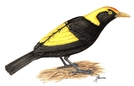
Regent bowerbirds exhibit sexual dimorphism. Males are mostly shiny black with glossy gold patches on their crowns, the backs of their necks, and the distal ends of their wings. They have yellow bills and eyes. Females are mottled brown with a scalloped pattern of dark and light brown. The eyes and bill are brown, with a little yellow in the eyes, in females. Immature males share features of both sexes, with their lower parts similar to females in coloration and their heads, necks, and wings darker and more similar to males. Males have brownish eyes, which change to yellow in their second year. It usually takes between two and five years for a male to attain mature plumage. ("Birds in Backyards", 2006)
- Other Physical Features
- endothermic
- homoiothermic
- bilateral symmetry
- Sexual Dimorphism
- sexes colored or patterned differently
- male more colorful
-
- Average mass
- 100 g
- 3.52 oz
-
- Range length
- 25 to 30 cm
- 9.84 to 11.81 in
-
- Average length
- 28 cm
- 11.02 in
Reproduction
Regent bowerbirds mate seasonally. During breeding season, males build avenue-type bowers: unroofed corridors made out of sticks and decorations. Bowers are usually constructed by mature males, though occasionally immature males build them as well. It only takes a few hours to construct a bower, which is much less time than the days or weeks required by other bowerbird species. Each male usually has one bower at a time, though some have two. Color is very important to the bowerbirds, and even unnatural objects like plastic will be used if they are the right color. Generally only the builder of the bower maintains it, though maintenance behavior has been exhibited by visiting males. (Lenz, 1994)
Adult bower owners spend an average of 3% of the day working on their bowers, usually building or maintaining them. Only about 1% of their daylight hours are spent vocalizing, whether they are courting a female or displaying to a male. Immature bower owners spent far more time in each activity, up to 4 times more effort. However, regent bowerbirds spend far less time on bowers than other bowerbird species. This lack of time at the bower is explained by their habit of beginning courtship in the canopy. Bower owners often raid other bowers nearby in order to damage them or steal decorations. Favorite decorations include fruit, snail shells, and blue plastic, all of which are vulnerable to thieving. Green leaves are often present but not stolen as much as other objects. Morrell and Kokko (2004) studied raiding behavior in six species of bowerbird. Of the six, they found regent bowerbirds raided the most at 0.264 raids per day. Raiders also cause destruction of the bower. Slight damage is often repaired, but if the bower is badly damaged, the owner will relocate and build a new one. Often, before relocating, the owner will completely destroy the bower. Only one bower in a study by Lenz (1994) was rebuilt after being severely damaged, and it was owned by an immature male. Due to all this destruction, bowers don't last long. In Lenz's study, bowers only lasted ten days before abandonment or destruction. (Lenz, 1994; Morrell and Kokko, 2004)
Courtship is initiated in the canopy. The arboreal part of the courtship resembles the bower display, but is simpler. After courtship, the female is escorted to the bower, where the male continues to display. Sometimes the female arrives at the bower on her own, but females who arrived on their own did not mate with the bower owner (Lenz, 1994). The male display includes showing her the back of his neck, flicking his wings, and offering her decorations from his bower. If the female is interested, she sits in the avenue or its entrance and watches the male display for over 20 minutes before allowing copulation. Disinterested females leave the bower. A display time of over twenty minutes (averaging 24.5 minutes) is much longer than display times of other bowerbird species, which suggests the male's display is more important in courtship and may be why their bowers are less complex and less well tended than in other species. Females often visit more than one bower, but it is unclear whether this results in multiple copulations. (Lenz, 1994)
- Mating System
- polygynous
Females build shallow nests of twigs and leaves. They choose locations in foliage, often on patches of mistletoe or in a small crook of a tree. Eggs are elliptical and covered in wavy lines. If two eggs are laid, they are laid 2 days apart. Hatching occurs after about 25 days and young are ready to leave the nest 22 days later. Growth of nestlings has not been well researched in regent bowerbirds. ("Bowerbirds (Ptilonorhynchidae)", 2003; "Birds in Backyards", 2006)
- Key Reproductive Features
- iteroparous
- seasonal breeding
- gonochoric/gonochoristic/dioecious (sexes separate)
- sexual
- oviparous
-
- Breeding interval
- Regent bowerbirds breed once yearly.
-
- Breeding season
- Regent bowerbirds breed from September to March.
-
- Range eggs per season
- 1 to 2
-
- Average time to hatching
- 25 days
-
- Average time to independence
- 22 days
Females incubate eggs and raise the young without help from males. ("Bowerbirds (Ptilonorhynchidae)", 2003; "Birds in Backyards", 2006)
- Parental Investment
- altricial
-
pre-fertilization
- provisioning
-
protecting
- female
-
pre-hatching/birth
-
provisioning
- female
-
protecting
- female
-
provisioning
-
pre-weaning/fledging
-
provisioning
- female
-
protecting
- female
-
provisioning
Lifespan/Longevity
Bowerbirds have high average lifespans compared to other bird families, living up to 20 to 30 years. Specific information on lifespan in regent bowerbirds was not found. ("Bowerbirds (Ptilonorhynchidae)", 2003)
Behavior
Regent bowerbirds are active during the day and are solitary during the breeding season. Females and immature males may form groups in the winter. ("Birds in Backyards", 2006; Lenz, 1994)
- Key Behaviors
- flies
- diurnal
- motile
- sedentary
- solitary
- territorial
Home Range
There was no information on home range sizes in regent bowerbirds.
Communication and Perception
Regent bowerbirds communicate through visual displays and vocalizations. Color is very important, as seen in their bower decorations. (Lenz, 1994)
Food Habits
Regent bowerbirds are primarily frugivorous. They forage mostly in the canopy and upper parts of the foliage. They also take insects opportunistically. ("Bowerbirds (Ptilonorhynchidae)", 2003; "Birds in Backyards", 2006)
Interestingly, a female's drive to forage for fruits of a certain color seems to be exploited by males decorating their bowers. In a study by Madden and Tanner (2003), grapes of different colors were used to determine preferences. Male preference for blue decorations was found to be correlated with female preference for eating blue grapes. This correlation seems to be common among bowerbird species, with different species favoring different colors. The fruits used as decorations aren't eaten by the male, but sometimes the female takes them away or eats them. The amounts and colors of fruit present help determine a male's mating success. (Madden and Tanner, 2003)
- Animal Foods
- insects
- Plant Foods
- fruit
Predation
There are no reports of predation on regent bowerbirds. Nests and fledglings may be taken by snakes and fledglings and adults may be taken by birds of prey.
Ecosystem Roles
Beadell and his colleagues (2004) studied the prevalence of malaria (Plasmodium) and blood parasites (Haemoproteus) in a range of bird families found in Australia and Papua New Guinea. While they did not study regent bowerbirds specifically, they note that both parasites are common in species in the family Ptilonorhynichidae. (Beadell, et al., 2004)
Regent bowerbirds disperse seeds through their consumption of fruit. ("Bowerbirds (Ptilonorhynchidae)", 2003)
- Ecosystem Impact
- disperses seeds
Economic Importance for Humans: Positive
Regent bowerbirds are important members of native ecosystems. They sometimes visit picnic areas, providing entertainment for birdwatchers. Bowerbirds in general are important in studies of mating behavior. ("Birds in Backyards", 2006)
- Positive Impacts
- research and education
Economic Importance for Humans: Negative
Regent bowerbirds take decorations from a myriad of places, occasionally stealing interesting objects from areas of human habitation. They have been known to take items from human middens, confusing archaeologists. ("Bowerbirds (Ptilonorhynchidae)", 2003)
Conservation Status
Within their range, regent bowerbirds have relatively high population sizes and are commonly observed. While population trends have not been measured precisely, it is believed they are not declining. The IUCN Red List classifies them as Least Concern. (BirdLife International, 2008)
-
- IUCN Red List
-
Least Concern
More information
-
- IUCN Red List
-
Least Concern
More information
-
- US Migratory Bird Act
- No special status
-
- US Federal List
- No special status
-
- CITES
- No special status
-
- State of Michigan List
- No special status
Other Comments
There is evidence that Sericulus chrysocephalus is the most basal of the three Sericulus species found in New Guinea. New Guinean Sericulus left Australia about 3.7 to 4.3 MYA. After arrival, their populations were separated by mountains, resulting in 3 species: S. ardens, S. aureus, and S. bakeri. (Zwiers, et al., 2008)
Contributors
Tanya Dewey (editor), Animal Diversity Web.
Aqua Nara Dakota (author), Special Projects.
Glossary
- Australian
-
Living in Australia, New Zealand, Tasmania, New Guinea and associated islands.

- acoustic
-
uses sound to communicate
- altricial
-
young are born in a relatively underdeveloped state; they are unable to feed or care for themselves or locomote independently for a period of time after birth/hatching. In birds, naked and helpless after hatching.
- bilateral symmetry
-
having body symmetry such that the animal can be divided in one plane into two mirror-image halves. Animals with bilateral symmetry have dorsal and ventral sides, as well as anterior and posterior ends. Synapomorphy of the Bilateria.
- chemical
-
uses smells or other chemicals to communicate
- diurnal
-
- active during the day, 2. lasting for one day.
- endothermic
-
animals that use metabolically generated heat to regulate body temperature independently of ambient temperature. Endothermy is a synapomorphy of the Mammalia, although it may have arisen in a (now extinct) synapsid ancestor; the fossil record does not distinguish these possibilities. Convergent in birds.
- frugivore
-
an animal that mainly eats fruit
- herbivore
-
An animal that eats mainly plants or parts of plants.
- iteroparous
-
offspring are produced in more than one group (litters, clutches, etc.) and across multiple seasons (or other periods hospitable to reproduction). Iteroparous animals must, by definition, survive over multiple seasons (or periodic condition changes).
- motile
-
having the capacity to move from one place to another.
- native range
-
the area in which the animal is naturally found, the region in which it is endemic.
- oviparous
-
reproduction in which eggs are released by the female; development of offspring occurs outside the mother's body.
- polygynous
-
having more than one female as a mate at one time
- rainforest
-
rainforests, both temperate and tropical, are dominated by trees often forming a closed canopy with little light reaching the ground. Epiphytes and climbing plants are also abundant. Precipitation is typically not limiting, but may be somewhat seasonal.
- seasonal breeding
-
breeding is confined to a particular season
- sedentary
-
remains in the same area
- sexual
-
reproduction that includes combining the genetic contribution of two individuals, a male and a female
- solitary
-
lives alone
- tactile
-
uses touch to communicate
- temperate
-
that region of the Earth between 23.5 degrees North and 60 degrees North (between the Tropic of Cancer and the Arctic Circle) and between 23.5 degrees South and 60 degrees South (between the Tropic of Capricorn and the Antarctic Circle).
- terrestrial
-
Living on the ground.
- territorial
-
defends an area within the home range, occupied by a single animals or group of animals of the same species and held through overt defense, display, or advertisement
- tropical
-
the region of the earth that surrounds the equator, from 23.5 degrees north to 23.5 degrees south.
- visual
-
uses sight to communicate
References
Australian Museum. 2006. "Birds in Backyards" (On-line). Regent Bowerbird (Sericulus chrysocephalus). Accessed December 20, 2008 at http://www.birdsinbackyards.net/finder/display.cfm?id=313.
2003. Bowerbirds (Ptilonorhynchidae). Pp. 477-481 in M Hutchins, J Jackson, W Bock, D Olendorf, eds. Grzimek's Animal Life Encyclopedia, Vol. 11: Birds IV, 2nd Edition. Farmington Hills, MI: The Gale Group Inc..
Beadell, J., E. Gering, J. Austin, J. Dumbacher, M. Peirce, T. Pratt, C. Atkinson, R. Fleischer. 2004. Prevalence and differential host-specificity of two avian blood parasite genera in the Australo-Papuan region. Molecular Ecology, 13: 3829-3844.
BirdLife International, 2008. "2008 IUCN Red List of Threatened Species" (On-line). Sericulus chrysocephalus. Accessed December 20, 2008 at http://www.iucnredlist.org/details/146081.
Lenz, N. 1994. Mating Behavior and Sexual Competition in the Regent Bowerbird Sericulus chrysocephalus . EMU, 94: 263-272.
Madden, J., K. Tanner. 2003. Preferences for coloured bower decorations can be explained in a nonsexual context. Animal Behavior, 65: 1077-1083.
Morrell, L., H. Kokko. 2004. Can too strong female choice deteriorate male ornamentation?. Proc. R. Soc. Lond., 271: 1597-1604.
Zwiers, P., G. Borgia, R. Fleischer. 2008. Plumage based classification of the bowerbird genus Sericulus evaluated using a multi-gene, multi-genome analysis. Molecular Phylogenetics and Evolution, 46: 923-931.