Scolopax minorAmerican woodcock


Geographic Range
American woodcocks occurs only in North America. They are distributed widely in the eastern United States and southeast Canada. Some individuals may winter in the Caribbean (Keppie and Whiting 1994).
Habitat
American woodcocks are found in forests with open areas. A mosaic of young forests and abandoned farm fields is ideal for woodcocks. The specific habitat varies with activity and season. Woodcocks prefer areas with woody vegetation for singing grounds, and forest edges or areas with cover for feeding. They nest in a variety of habitats such as open fields, mixed forests, brush fields, and coniferous forests. Wintering grounds are a wide variety of forest types, including bottomland hardwoods, mature longleaf pine forests, and upland mixed pine-hardwood forests.
- Habitat Regions
- temperate
- Terrestrial Biomes
- forest
- Other Habitat Features
- agricultural
Physical Description
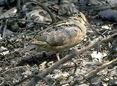
American woodcocks are short, plump, compact birds with very long (5.9 to 7.8 cm) bills that are specialized for feeding on earthworms. Woodcocks are mottled brown, rich buff and gray in a way that camouflages them well in woodland habitat. Their heads are large, with three dark bands across the back. Woodcocks have large brown eyes that are set far back in the skull, providing rearview binocular vision. Their wings are broad and rounded.
Male and female American woodcocks are similar in appearance, though females are generally larger than males. Female American woodcocks range from 27 to 31 cm long and can weigh 151 to 279 g. Their wingspans range from 44.6 to 50.8 cm. Males range from 25 to 28 cm long and weigh 116 to 219 g. Their wingspans range from 40.4 to 45.5 cm (Keppie and Whiting, 1994; Terres, 1980).
- Other Physical Features
- endothermic
- bilateral symmetry
- Sexual Dimorphism
- female larger
-
- Range mass
- 116 to 279 g
- 4.09 to 9.83 oz
-
- Range length
- 25 to 31 cm
- 9.84 to 12.20 in
-
- Range wingspan
- 40 to 51 cm
- 15.75 to 20.08 in
-
- Average basal metabolic rate
- 1.066 W
- AnAge
Reproduction
American woodcocks are polygynous. Courtship and nesting span a six-month period, usually beginning in late February or early May. The male may even begin his courtship flights on the wintering grounds, and continue them on the breeding grounds. Males attract a mate by performing a courtship flight, called a “sky dance,” at dusk and dawn. They spiral up high, flittering their wings and chirping, and then circle sharply back to the ground, where they make a peenting call. The areas where males perform this display are called 'singing sites' or 'breeding fields', and each male is loyal to a few sites. Females then chose between available males. There is no pair-bond, and males give no parental care. There is also no mate guarding.
- Mating System
- polygynous
The female builds a simple nest on the ground. Sometimes she builds no nest at all, and the eggs are simply laid upon dry litter. She lays 1 to 5 (usually 4) eggs shortly after mating. The eggs are grayish-orange, and are incubated for 20 to 22 (usually 21) days. All of the eggs in a nest hatch within 4 to 5 hours, and the female broods the chicks until they are dry. The chicks then all leave the nest together within a few hours of hatching. The female continues to brood the chicks for some part of the time until they are 15 to 20 days old. She feeds them for the first week, but they are able to search for food at 3 to 4 days old. The chicks are nearly fully grown at 28 days after hatching and become independent at 31 to 38 days. They are sexually mature in 10 to 12 months. (Keppie and Whiting, 1994; Terres, 1980)
- Key Reproductive Features
- iteroparous
- seasonal breeding
- gonochoric/gonochoristic/dioecious (sexes separate)
- sexual
- oviparous
-
- Breeding interval
- American woodcocks breed once yearly.
-
- Breeding season
- American woodcocks begin breeding activities as early as January, though most activity takes place in April and May.
-
- Range eggs per season
- 1 to 5
-
- Average eggs per season
- 4
-
- Average eggs per season
- 4
- AnAge
-
- Range time to hatching
- 20 to 22 days
-
- Range fledging age
- 1 (high) days
-
- Range time to independence
- 31 to 38 days
-
- Range age at sexual or reproductive maturity (female)
- 10 to 12 months
-
- Range age at sexual or reproductive maturity (male)
- 10 to 12 months
Male woodcocks do not provide any parental care. Female woodcocks build the nest and incubate the eggs for approximately 21 days. They brood and protect the precocial chicks until they reach independence, and feed the chicks for the first week after hatching.
- Parental Investment
- precocial
-
pre-fertilization
- provisioning
-
protecting
- female
-
pre-hatching/birth
-
protecting
- female
-
protecting
-
pre-weaning/fledging
-
provisioning
- female
-
protecting
- female
-
provisioning
-
pre-independence
-
provisioning
- female
-
protecting
- female
-
provisioning
Lifespan/Longevity
The maximum known lifespan of American woodcocks is 8 years.
-
- Range lifespan
Status: wild - 8 (high) years
- Range lifespan
-
- Average lifespan
Status: wild - 251 months
- Bird Banding Laboratory
- Average lifespan
Behavior
American woodcocks are solitary birds seldom seen by day. They are most active from dusk to dark, around dawn, on moonlit nights, and sometimes on cloudy days. They also migrate at night, singly or in small, loose flocks. During migration, flocks may turn up in city parks, yards, orchards, and on lawns. There is no evidence of social dominance hierarchy in this species, nor minimum individual distances.
- Key Behaviors
- terricolous
- flies
- crepuscular
- motile
- migratory
- solitary
Home Range
Studies of American woodcocks have estimated home range sizes between 150,000 and 740,000 square meters.
Communication and Perception
American woodcocks use vocalizations and physical displays to communicate. They make at least four recognized calls, including the Peent, Tuko, Chirping and Cackle. Males perform a spectacular display called a “song flight” or “sky dance”, presumably to attract potential mates. In this display, males fly silently into the air, rising in continually widening circles up to about 100 m. Their wings 'twitter' with increasing melody as they rise. They hover momentarily and begin singing and chirping vigorously, continuing to sing while fluttering down like a falling leaf. In the breeding season, the song flight follows a bout of Peenting. It is not known if song flights are used solely to attract females; they are also performed in the presence of other males or when the male is alone (Keppie and Whiting, 1994; Terres, 1980)
Food Habits
American woodcocks primarily eat invertebrates. Earthworms account for 50-90% of the diet, which also includes beetles, flies, centipedes, and various insect larvae. Woodcocks occasionally eat seeds, but plant materials account for a very small fraction of their total diet.
American woodcocks feed mostly during the day in spring and summer. In winter, they feed at night. They are generally solitary foragers, though they don’t defend a feeding territory, and loose concentrations may develop if few suitable sites are available. Woodcocks locate surface food visually. There is some evidence that they use foot-stomping and shifts in weight to locate subsurface prey. If one of those movements causes an earthworm to move underground, a woodcock locates the worm either by hearing it or by feeling its vibrations through the bill, which it keeps in contact with the ground. (Keppie and Whiting, 1994; US Forest Service)
Woodcocks probably do not drink water. They obtain sufficient water in the foods that they eat.
- Primary Diet
-
carnivore
- vermivore
- Animal Foods
- insects
- terrestrial worms
- Plant Foods
- seeds, grains, and nuts
Predation
Though specific predators of American woodcocks have not been well documented, predation is the primary cause of woodcock mortality in many areas. Woodcock adults, chicks and eggs are vulnerable to predation by a number of avian and mammalian predators, including domestic cats. Eggs are also vulnerable to predation by snakes.
Woodcocks are cryptically colored in brown, buff and gray. This coloration allows them to blend in with their habitat, making them less visible to predators. In response to predators, females may feign injury in order to draw a predator away from her nest or chicks.
- Anti-predator Adaptations
- cryptic
-
- Known Predators
-
- domestic cats (Felis silvestris)
Ecosystem Roles
American woodcocks affect the local populations of the earthworms and insect species that they eat. They may aerate the soil while probing for insects and earthworms. They also host at least 49 different types of parasites.
- Ecosystem Impact
- soil aeration
Economic Importance for Humans: Positive
American woodcocks are a popular gamebird. An average of 2 million American woodcocks are shot each year by hunters.
- Positive Impacts
- food
- ecotourism
Economic Importance for Humans: Negative
There are no known adverse affects of American woodcocks on humans.
Conservation Status
Populations of American woodcocks appear to have declined over the past several decades. However, there is not sufficient data to accurately track woodcock populations. Sources of mortality for American woodcocks include hunting and collisions with cars, utility wires, lighthouses, TV towers, and other structures during migration. They are also sometimes killed in long periods of cold or freezing weather when food is unavailable. Scientists are concerned that American woodcocks are threatened on their breeding and wintering grounds by hydrocarbon pesticides sprayed for insect control. However, this has not been sufficiently studied. (Keppie and Whiting, 1994; Terres, 1980)
American woodcocks are protected under the U.S. Migratory Bird Act. They are not protected under CITES or the U.S. Endangered Species Act.
-
- IUCN Red List
-
Least Concern
More information
-
- IUCN Red List
-
Least Concern
More information
-
- US Migratory Bird Act
- Protected
-
- US Federal List
- No special status
-
- CITES
- No special status
-
- State of Michigan List
- No special status
Other Comments
American woodcocks have several other interesting common names, including timberdoodle, Labrador twister, night partridge and bog sucker (Keppie and Whiting, Jr. 1994).
Contributors
Kari Kirschbaum (author, editor), Animal Diversity Web.
Alicia Ivory (author), University of Michigan-Ann Arbor.
Glossary
- Nearctic
-
living in the Nearctic biogeographic province, the northern part of the New World. This includes Greenland, the Canadian Arctic islands, and all of the North American as far south as the highlands of central Mexico.

- acoustic
-
uses sound to communicate
- agricultural
-
living in landscapes dominated by human agriculture.
- bilateral symmetry
-
having body symmetry such that the animal can be divided in one plane into two mirror-image halves. Animals with bilateral symmetry have dorsal and ventral sides, as well as anterior and posterior ends. Synapomorphy of the Bilateria.
- carnivore
-
an animal that mainly eats meat
- chemical
-
uses smells or other chemicals to communicate
- crepuscular
-
active at dawn and dusk
- cryptic
-
having markings, coloration, shapes, or other features that cause an animal to be camouflaged in its natural environment; being difficult to see or otherwise detect.
- ecotourism
-
humans benefit economically by promoting tourism that focuses on the appreciation of natural areas or animals. Ecotourism implies that there are existing programs that profit from the appreciation of natural areas or animals.
- endothermic
-
animals that use metabolically generated heat to regulate body temperature independently of ambient temperature. Endothermy is a synapomorphy of the Mammalia, although it may have arisen in a (now extinct) synapsid ancestor; the fossil record does not distinguish these possibilities. Convergent in birds.
- food
-
A substance that provides both nutrients and energy to a living thing.
- forest
-
forest biomes are dominated by trees, otherwise forest biomes can vary widely in amount of precipitation and seasonality.
- iteroparous
-
offspring are produced in more than one group (litters, clutches, etc.) and across multiple seasons (or other periods hospitable to reproduction). Iteroparous animals must, by definition, survive over multiple seasons (or periodic condition changes).
- migratory
-
makes seasonal movements between breeding and wintering grounds
- motile
-
having the capacity to move from one place to another.
- native range
-
the area in which the animal is naturally found, the region in which it is endemic.
- oviparous
-
reproduction in which eggs are released by the female; development of offspring occurs outside the mother's body.
- polygynous
-
having more than one female as a mate at one time
- seasonal breeding
-
breeding is confined to a particular season
- sexual
-
reproduction that includes combining the genetic contribution of two individuals, a male and a female
- soil aeration
-
digs and breaks up soil so air and water can get in
- solitary
-
lives alone
- tactile
-
uses touch to communicate
- temperate
-
that region of the Earth between 23.5 degrees North and 60 degrees North (between the Tropic of Cancer and the Arctic Circle) and between 23.5 degrees South and 60 degrees South (between the Tropic of Capricorn and the Antarctic Circle).
- visual
-
uses sight to communicate
- young precocial
-
young are relatively well-developed when born
References
Keppie, D.M. and R.M. Whiting, Jr. 1994. American Woodcock (Scolopax minor). In The Birds of North America, No. 100 (A. Poole and F. Gill, Eds.). Philadelphia: The Academy of Natural Sciences; Washington, D.C.: The American Ornithologists' Union.
Terres, J. The Audubon Society Encyclopedia of North American Birds. Alfred A Knopf, New York, 1980.
Patuxent Science Information Systems, "Effect of hunting on survival and habitat use by American Woodcock (Scolopax minor) on breeding and migration areas" (On-line). Accessed (Date Unknown) at http://www.pwrc.nbs.gov/mcaul2s.htm.
U.S. Forest Service, "Fire Effects Information Service" (On-line). Accessed 2002 at http://www.fs.fed.us/database/feis/wildlife/bird/scmi/index.html.