Sceloporus undulatusFence Lizard

Geographic Range
Eastern fence lizards range from mid New York south to mid Florida and northern part Texas and as far west as Colorado.
Subspecies include: southern fence lizards, S. u. undulatus, southern prairie lizards, S. u. consobrinus, White Sands prairie lizards, S. u. cowlesi, northern plateau lizards, S. u. elongatus, red-lipped prairie lizards, S. u. erythrocheilus, northern prairie lizards, S. u. garmani, northern fence lizards, S. u. hyacinthinus, and southern plateau lizards, S. u. tristichus. (Bishop, 1941)
Habitat
Eastern fence lizards are found in grasslands, shrublands, and the edges of pine or hardwood forests. Eastern fence lizards live under wood piles, logs, and rocks where they can be protected during the evening hours. During daylight hours eastern fence lizards can be found basking in the same areas in which they rest: on fences, logs, rock, and tree trunks. (Behler, 1979; Bishop, 1941; Kennedy, 1958)
- Habitat Regions
- temperate
- terrestrial
- Terrestrial Biomes
- savanna or grassland
- forest
Physical Description
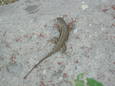
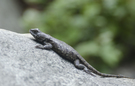
Eastern fence lizards vary in color geographically, but are usually gray, brown or a rusty color. Males and females are similar in size. Individuals in northern populations (northern New York south to Maryland) are generally smaller than individuals in southern populations (northern Virginia south to northern Florida). This may be because southern populations have a longer warm season in which to eat and grow.
Males have a blue patch on the belly and throat. Average adult mass is 15 g, while adult total lengths range from 9 to 19 cm. (Angilletta, 2001; Behler, 1979; Johnson, 1966; "Hormones, Brain, and Behavior", 1992)
- Other Physical Features
- heterothermic
- Sexual Dimorphism
- sexes colored or patterned differently
- male more colorful
-
- Average mass
- 15 g
- 0.53 oz
-
- Range length
- 9 to 19 cm
- 3.54 to 7.48 in
Development
After being laid, eggs double in size during embryonic development. Eggs hatch from June to September. Upon hatching, individuals are about half the size of adults. They tend to grow quickly in the first two months of life and are fully mature at 1 year. (Bishop, 1941; Ferguson, et al., 1980; Smith, 1946)
Reproduction
During the mating season, beginning in April, males flash their blue patches to attract females. Males also have anal glands that secrete a pheromone during and after breeding season to attract females. After mating males and females no longer associate. Males may seek other mating opportunities. (Behler, 1979; Ferguson, et al., 1980; "Lizard Ecology", 1983; "Hormones, Brain, and Behavior", 1992)
- Mating System
- polygynous
Mating occurs from April to August. Young females lay one clutch of 3 to 13 eggs. Older females lay 2 to 4 clutches per year. Eggs hatch from June to September. The eggs are laid below 3 to 7 cm of soil so that the moisture and temperature remain constant. It may take 10 weeks for the eggs to hatch after they have been deposited. The offspring reach maturity at 1 year of age. (Behler, 1979; "Lizard Ecology", 1983; Smith, 1946; "Hormones, Brain, and Behavior", 1992)
- Key Reproductive Features
- iteroparous
- seasonal breeding
- sexual
- fertilization
- oviparous
-
- Breeding interval
- Young eastern fence lizards lay one clutch per year while older females can lay 2 to 4 clutches per year.
-
- Breeding season
- Breeding occurs from April to August.
-
- Range number of offspring
- 3 to 13
-
- Average gestation period
- 8 weeks
-
- Range age at sexual or reproductive maturity (female)
- 1 to 2 years
-
- Range age at sexual or reproductive maturity (male)
- 1 to 2 years
Female eastern fence lizards increase body size if food is available, which is directly correlated to an increased clutch size. After laying her eggs females leave their young to fend for themselves. (Ferguson, et al., 1980)
- Parental Investment
- no parental involvement
-
pre-fertilization
- provisioning
-
protecting
- female
-
pre-hatching/birth
-
provisioning
- female
-
provisioning
Lifespan/Longevity
Lifespans of eastern fence lizards are not well understood, but researchers believe that they can live for more than 5 years, possibly averaging ages of 4 years. However, the majority of eastern fence lizards probably die soon after hatching. (Haenel and John-Alder, 2002; Smith, 1946)
-
- Range lifespan
Status: captivity - 5 (high) years
- Range lifespan
-
- Average lifespan
Status: wild - 4 years
- Average lifespan
Behavior
Fence lizards are active during the day, from 0600h - 2000h, basking in the sun on wood piles, fence posts and trees. During the summer months the use of rock perches decreased while the use of tree trunks and branches increased. This allows them to maintain their temperature as the season gets hotter. They tend to choose more closed surroundings than other lizards.
Their sleeping location is very close to, if not at, their basking locale. This site is usually selected based on temperature and relative protection from predators.
Males flash their blue patch, as well as exhibit head-bobs and push-ups, in order to let other males know that this is his territory. Territory seems to be correlated directly to the availability to food as well as the presence and varations of other lizard species in the area. (Angert, et al., 2002; Angilletta, 2001; Kennedy, 1958; Mitchell, 1994; "Lizard Ecology", 1983; "Hormones, Brain, and Behavior", 1992)
- Key Behaviors
- arboreal
- terricolous
- diurnal
- sedentary
- territorial
-
- Range territory size
- 47 to 61 m^2
Home Range
Fence lizards have a very defined home range, ranging from 47 - 61 square meters. During years when food is plentiful, their home range increases. (Kennedy, 1958; "Lizard Ecology", 1983)
Communication and Perception
To attract mates and warn off other individuals, male eastern fence lizards do head bob displays, push ups, and puff themselves up. Head-bobs and push-ups are done in 4 to 5 second durations. (Mitchell, 1994)
- Communication Channels
- visual
- Perception Channels
- visual
- tactile
- acoustic
- vibrations
- chemical
Food Habits
Eastern fence lizards eat primarily insects and other arthropods, including ants (Formicidae), beetles (Coleoptera), weevils (Curculionidae), lady bugs Coccinellidae), spiders (Araneae), and centipedes (Chilopoda). They also sometimes eat snails (Gastropoda). Some plant matter like cheatgrass (Bromus tectorum) and needlegrass (Caproni stipa) is sometimes consumed. Females tend to eat more insects during the spring months, in order to save energy for egg-laying. Lizards generally forage twice daily. (Behler, 1979; Johnson, 1966)
- Primary Diet
-
carnivore
- insectivore
- eats non-insect arthropods
- Animal Foods
- insects
- terrestrial non-insect arthropods
- mollusks
- Plant Foods
- leaves
Predation
Males with larger blue patches are more likely to be preyed on by birds. As a result, males have a high mortality rate during early spring when they are establishing mating territories. Females have a higher mortality rate during the period of egg-laying, because they are protecting their territory, making them more susceptible to predators. Larger lizard species, snakes, and domestic cats and dogs also eat eastern fence lizards. Eastern fence lizards are slower than other lizards, often giving predators. Eastern fence lizards are cryptically colored and can move quite rapidly when they are warm. (Angert, et al., 2002; Mitchell, 1994; "Lizard Ecology", 1983; "Hormones, Brain, and Behavior", 1992)
- Anti-predator Adaptations
- cryptic
-
- Known Predators
-
- predatory birds (Aves)
- blue racers (Coluber constrictor)
- rat snakes (Pantherophis obsoletus)
- prairie kingsnakes (Lampropeltis calligaster)
- cottonmouths (Agkistrodon contortrix)
- domestic dogs (Canis lupus familiaris)
- domestic cats (Felis domesticus)
- larger lizard species (Squamata)
Ecosystem Roles
Eastern fence lizards mainly feed on insects and are themselves prey for birds and other larger predators. They compete with other lizard species for their insect prey. Common parasites include chiggers and botflies. (Angert, et al., 2002)
- chiggers (Trombicula species)
- botflies (Oestridae)
Economic Importance for Humans: Positive
Eastern fence lizards are used to help educate people about conservation and reptiles. Eastern fence lizards decrease insect and arachnid populations, which can be pest species in some areas. (Mitchell, 1994)
- Positive Impacts
- research and education
- controls pest population
Economic Importance for Humans: Negative
Eastern fence lizards are not pests and do not have a negative effect on the human population. If individual lizards are harassed, they may bite. (Angilletta, 2001)
Conservation Status
Eastern fence lizards are thriving due to the availability edge habitats and secondary growth around pine forests, their preferred habitat. (Mitchell, 1994)
-
- IUCN Red List
-
Least Concern
More information
-
- IUCN Red List
-
Least Concern
More information
-
- US Federal List
- No special status
-
- CITES
- No special status
-
- State of Michigan List
- No special status
Other Comments
Flooding can have a disastrous effect on eastern fence lizard hatchling populations. (Behler, 1979; Pinch and Claussen, 2003)
Contributors
Tanya Dewey (editor), Animal Diversity Web.
Jennifer Largett (author), Radford University, Karen Powers (editor, instructor), Radford University.
Glossary
- Nearctic
-
living in the Nearctic biogeographic province, the northern part of the New World. This includes Greenland, the Canadian Arctic islands, and all of the North American as far south as the highlands of central Mexico.

- acoustic
-
uses sound to communicate
- arboreal
-
Referring to an animal that lives in trees; tree-climbing.
- carnivore
-
an animal that mainly eats meat
- chemical
-
uses smells or other chemicals to communicate
- cryptic
-
having markings, coloration, shapes, or other features that cause an animal to be camouflaged in its natural environment; being difficult to see or otherwise detect.
- diurnal
-
- active during the day, 2. lasting for one day.
- fertilization
-
union of egg and spermatozoan
- forest
-
forest biomes are dominated by trees, otherwise forest biomes can vary widely in amount of precipitation and seasonality.
- heterothermic
-
having a body temperature that fluctuates with that of the immediate environment; having no mechanism or a poorly developed mechanism for regulating internal body temperature.
- insectivore
-
An animal that eats mainly insects or spiders.
- iteroparous
-
offspring are produced in more than one group (litters, clutches, etc.) and across multiple seasons (or other periods hospitable to reproduction). Iteroparous animals must, by definition, survive over multiple seasons (or periodic condition changes).
- native range
-
the area in which the animal is naturally found, the region in which it is endemic.
- oviparous
-
reproduction in which eggs are released by the female; development of offspring occurs outside the mother's body.
- polygynous
-
having more than one female as a mate at one time
- seasonal breeding
-
breeding is confined to a particular season
- sedentary
-
remains in the same area
- sexual
-
reproduction that includes combining the genetic contribution of two individuals, a male and a female
- tactile
-
uses touch to communicate
- temperate
-
that region of the Earth between 23.5 degrees North and 60 degrees North (between the Tropic of Cancer and the Arctic Circle) and between 23.5 degrees South and 60 degrees South (between the Tropic of Capricorn and the Antarctic Circle).
- terrestrial
-
Living on the ground.
- territorial
-
defends an area within the home range, occupied by a single animals or group of animals of the same species and held through overt defense, display, or advertisement
- tropical savanna and grassland
-
A terrestrial biome. Savannas are grasslands with scattered individual trees that do not form a closed canopy. Extensive savannas are found in parts of subtropical and tropical Africa and South America, and in Australia.
- savanna
-
A grassland with scattered trees or scattered clumps of trees, a type of community intermediate between grassland and forest. See also Tropical savanna and grassland biome.
- temperate grassland
-
A terrestrial biome found in temperate latitudes (>23.5° N or S latitude). Vegetation is made up mostly of grasses, the height and species diversity of which depend largely on the amount of moisture available. Fire and grazing are important in the long-term maintenance of grasslands.
- vibrations
-
movements of a hard surface that are produced by animals as signals to others
- visual
-
uses sight to communicate
References
The University of Chicago. 1992. Hormones, Brain, and Behavior. Chicago: The University of Chicago Press.
Presidents and Fellows of Harvard College. 1983. Lizard Ecology. Cambridge, Massachusetts: Harvard University Press.
Adolph, S., W. Porter. 1996. Growth, Seasonality, and Lizard Life Histories: Age and Size at Maturity. Oikos, 77: 267-278. Accessed September 05, 2007 at http://links.jstor.org/sici?sici=0030-1299%28199611%2977%3A2%3C267%3AGSALLH%3E2.0.CO%3B2-V.
Angert, A., D. Hutchison, D. Glossip, J. Losos. 2002. Microhabitat Use and Thermal Biology of the Collared Lizard (Crotaphytus collaris collaris) and the Fence Lizard (Sceloporus undulatus hyacinthinus) in Missouri Glades. Journal of Herpetology, 36: 23-29. Accessed September 18, 2007 at http://www.bioone.org/perlserv/?request=get-document&doi=10.1670%2F0022-1511%282002%29036%5B0023%3AMUATBO%5D2.0.CO%3B2.
Angilletta, M. 2001. Thermal and Physiological Constraints on Energy Assimilation in a Widespread Lizard. Ecology, 82: 3044-3056. Accessed September 05, 2007 at http://links.jstor.org/sici?sici=0012-9658%28200111%2982%3A11%3C3044%3ATAPCOE%3E2.0.CO%3B2-A.
Behler, J. 1979. The Audubon Society Feild Guide to North American Reptiles and Amphibians. New York: Alfred A. Knopf, Inc.
Bishop, M. 1941. New Locality for Sceloporus undulatus undulatus. Copeia, 1941: 54. Accessed September 05, 2007 at http://links.jstor.org/sici?sici=0045-8511%2819410325%293%3A1941%3A1%3C54%3ANLFSUU%3E2.0.CO%3B2-Q.
Ferguson, G., C. Bohlen, P. Woolley. 1980. Sceloporus Undulatus: Comparative Life History and Regulation of a Kansas Population. Ecology, 61: 313-322. Accessed October 01, 2007 at http://links.jstor.org/sici?sici=0012-9658%28198004%2961%3A2%3C313%3ASUCLHA%3E2.0.CO%3B2-I.
Haenel, G., H. John-Alder. 2002. Experimental and demographic analyses of growth rate and sexual size dimorphism in a lizard, Sceloporus undulatus. OIKOS, 96: 70-81.
Johnson, D. 1966. Diet and Estimated Energy Assimilation of Three Colorado Lizards. American Midland Naturalist, 76: 504-509. Accessed September 05, 2007 at http://links.jstor.org/sici?sici=0003-0031%28196610%2976%3A2%3C504%3ADAEEAO%3E2.0.CO%3B2-Y.
Kennedy, J. 1958. Sleeping Habits of the Eastern Fence Lizard, Sceloporus Undulatus Hyacinthinus. The Southwestern Naturalist, 3: 90-93. Accessed September 05, 2007 at http://links.jstor.org/sici?sici=0038-4909%281958%293%3A1%2F4%3C90%3ASHOTEF%3E2.0.CO%3B2-J.
Mitchell, J. 1994. The Reptiles of Virginia. Washington: Smithsonian Institution Press.
Pinch, F., D. Claussen. 2003. Effects of Temperature and Slope on the Sprint Speed and Stamina of the Eastern Fence Lizard, Sceloporus undulatus. Journal of Herpetology, 37: 671–679. Accessed September 13, 2007 at http://www.bioone.org/perlserv/?request=get-document&doi=10.1670%2F183-02.
Smith, H. 1946. Handbook to Lizards. Binghamtom., NY: Comstock Publishing Company, Inc..