SalmonidaeSalmonids

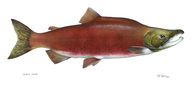
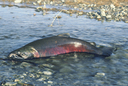
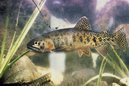
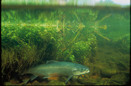
There are 66 species of salmon, trout, whitefish, and their relatives. Species in this family are found throughout the northern hemisphere and are some of the most important commercial and sport fishes in the world. Because they are so popular with fishermen they have been widely introduced to other parts of the world. Some species are endangered or have become extinct as a result of overfishing and the destruction of spawning streams. Fish in this family are almost all anadromous. Some species die immediately after spawning. Salmon, trout, whitefish, and their relatives generally need cold, clean waters to survive and breed. They are large, predatory fish, growing up to 1.5 meters and mainly eating other fish.
Contributors
Tanya Dewey (author), Animal Diversity Web.
Glossary
- bilateral symmetry
-
having body symmetry such that the animal can be divided in one plane into two mirror-image halves. Animals with bilateral symmetry have dorsal and ventral sides, as well as anterior and posterior ends. Synapomorphy of the Bilateria.
- chemical
-
uses smells or other chemicals to communicate
- motile
-
having the capacity to move from one place to another.
- natatorial
-
specialized for swimming
- tactile
-
uses touch to communicate