Saiga tataricasaiga

Geographic Range
Saiga tatarica populations are concentrated in three main areas within central Asia: Mongolia, Kazakhstan, and Kalmykia. (Milner-Gulland 1994)
- Biogeographic Regions
- palearctic
Habitat
Saiga tatarica inhabit dry steppes and semi deserts. Herds are found in grassy plains void of rugged terrain and hills. (Heptner, et. al. 1988)
- Terrestrial Biomes
- savanna or grassland
Physical Description
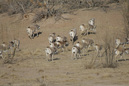
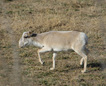
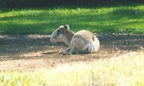
The most striking feature of a saiga is its large head with a huge mobile nose that hangs over its mouth. Males have a pair of long, waxy colored horns with ring-like ridges along their length. Except for the unusual snout and horns, S. tatarica look similar to small sheep. Saiga antelopes are approximately .6 m to .8 m tall at shoulder height and are approximately 1 m to 1.5 m long. They have long, thin legs and a slightly robust body. During the summer, S. tatarica have a short coat that is yellowish red on the back and neck with a paler underside. In the winter, the coat becomes thicker and longer. The winter pelage is dull gray on the back and neck and a very light, brown-gray shade on the belly. Saiga antelopes also have a short tail.
(Heptner, et. al. 1988; Sokolov 1974)
- Other Physical Features
- endothermic
- bilateral symmetry
-
- Range mass
- 30 to 45 kg
- 66.08 to 99.12 lb
Reproduction
Female saigas reach sexual maturity at 7 to 8 months while the males which reach sexual maturity at 2 years. The breeding period lasts from late November to late December. A female is pregnant for 5 months and usually gives birth to two young. Young begin to graze at 4-8 days old. Lactation lasts for about four months. In captivity, young saigas occasionally nurse from unrelated adults; however, this has never been observed in the wild. (Rubin, et. al 1994; Sokolov 1974)
- Key Reproductive Features
- gonochoric/gonochoristic/dioecious (sexes separate)
- sexual
-
- Range number of offspring
- 1 to 3
-
- Average number of offspring
- 1.3
-
- Average number of offspring
- 1.7
- AnAge
-
- Range gestation period
- 4.63 to 5.07 months
-
- Range weaning age
- 2.5 to 4 months
-
- Average age at sexual or reproductive maturity (female)
Sex: female - 331 days
- AnAge
- Average age at sexual or reproductive maturity (female)
-
- Average age at sexual or reproductive maturity (male)
Sex: male - 669 days
- AnAge
- Average age at sexual or reproductive maturity (male)
- Parental Investment
- extended period of juvenile learning
Lifespan/Longevity
-
- Average lifespan
Status: wild - 12.0 years
- Max Planck Institute for Demographic Research
- Average lifespan
-
- Average lifespan
Status: wild - 10.0 years
- Max Planck Institute for Demographic Research
- Average lifespan
Behavior
Saiga tatarica are a polygamous species. During the breeding season, saigas congregate into groups consisting of 5 to 10 females and one male. Males are very protective of their harem. Violent fights often break out between two males. It is not uncommon for a male saiga to kill another during these battles. Male saigas grow very weak toward the end of the breeding season. They do not graze at all during the breeding season and spend most of their stored energy defending their harem. As a result, male mortality often reaches 80 to 90%. When the breeding season is over, S. tatarica form herds consisting of 30-40 individuals. They occasionally migrate as a group to escape snowstorms and droughts. During the day, saigas graze and visit watering holes. Before resting at night, they dig small circular depressions in the soil to serve as beds.
(Heptner, et. al. 1988)
Communication and Perception
Food Habits
Saiga antelopes are herbivores. They graze on over one hundred different plant species; the most important being grasses, prostrate summer cypress, saltworts, fobs, sagebrush, and steppe lichens. (Heptner, et. al. 1988)
Economic Importance for Humans: Positive
Saiga antelopes are valued for their fur, meat, and horns. Their horns are considered their most valuable feature. The horns are ground up and commonly used in Chinese medicine to reduce fevers. (But, et. al. 1990)
- Positive Impacts
- food
- body parts are source of valuable material
Economic Importance for Humans: Negative
Saiga tatarica occasionally trample agricultural plants and feed on crops. (Sokolov, 1974)
Conservation Status
Up until 1990, Saiga tatarica were successfully managed by the Soviet Union. However, the break-up of the Soviet state led to the end of the intense management of the saiga antelope. Currently, the population is rapidly declining due to severe poaching. (Milner-Gullan 1994)
-
- IUCN Red List
-
Critically Endangered
More information
-
- IUCN Red List
-
Critically Endangered
More information
-
- US Federal List
- No special status
-
- CITES
- Appendix II
Other Comments
Wolves are the principle natural predator of adult and new born saiga. Foxes and stray dogs prey on newborn saigas. (Sokolov, 1974)
Contributors
Lauren Pascoe (author), University of Michigan-Ann Arbor.
Glossary
- Palearctic
-
living in the northern part of the Old World. In otherwords, Europe and Asia and northern Africa.

- bilateral symmetry
-
having body symmetry such that the animal can be divided in one plane into two mirror-image halves. Animals with bilateral symmetry have dorsal and ventral sides, as well as anterior and posterior ends. Synapomorphy of the Bilateria.
- chemical
-
uses smells or other chemicals to communicate
- endothermic
-
animals that use metabolically generated heat to regulate body temperature independently of ambient temperature. Endothermy is a synapomorphy of the Mammalia, although it may have arisen in a (now extinct) synapsid ancestor; the fossil record does not distinguish these possibilities. Convergent in birds.
- food
-
A substance that provides both nutrients and energy to a living thing.
- migratory
-
makes seasonal movements between breeding and wintering grounds
- motile
-
having the capacity to move from one place to another.
- native range
-
the area in which the animal is naturally found, the region in which it is endemic.
- sexual
-
reproduction that includes combining the genetic contribution of two individuals, a male and a female
- social
-
associates with others of its species; forms social groups.
- tactile
-
uses touch to communicate
- tropical savanna and grassland
-
A terrestrial biome. Savannas are grasslands with scattered individual trees that do not form a closed canopy. Extensive savannas are found in parts of subtropical and tropical Africa and South America, and in Australia.
- savanna
-
A grassland with scattered trees or scattered clumps of trees, a type of community intermediate between grassland and forest. See also Tropical savanna and grassland biome.
- temperate grassland
-
A terrestrial biome found in temperate latitudes (>23.5° N or S latitude). Vegetation is made up mostly of grasses, the height and species diversity of which depend largely on the amount of moisture available. Fire and grazing are important in the long-term maintenance of grasslands.
References
But, P., L. Lung, and Y. Tam. 1990. Ethnopharmacology of Rhinoceros Horns. I: Antipyretic effects of Rhinoceros horn and other animal horns. Journal of Ethnopharmacology, vol. 30. Elsevier Scientific Publishers, Limerick.
Heptner, V., A. Nasimovish, and A. Bannikov. 1988. Mammals of the Soviet Union, vol. 1. Amerind Publishing Co., New Deli.
Milner-Gulland, E. 1994. A Population Model for the Management of the Saiga Antelope. Journal of Applied Ecology, vol. 31. Blackwell Scientific Publications, London.
Rubin, E., and K. Michelson. 1994. Nursing Behavior in Dam-Reared Russian Saiga. Zoo Biology, vol. 13. Wiley Liss, NY.
Sokolov, V. 1974. Saiga tatarica. Mammalian Species no. 38. The American Society of Mammalogists.