Saguinus labiatusred-chested mustached tamarin


Geographic Range
Red-chested mustached tamarins, Saguinus labiatus, are found in South America and are found in particularly high densities (up to 45 individuals per sq km) in northwestern Bolivia (Suarez 2007). Red-chested mustached tamarins also inhabit the middle Amazonian region of Brazil as well as southeastern Peru (Wolfheim 1983). (Suarez, 2007; Wolfheim, 1983)
- Biogeographic Regions
- neotropical
Habitat
Red-chested mustached tamarins inhabit Amazonian rainforests. They are arboreal and spend most of their time in primary and secondary forests (Porter 2004, Mittermeier and Wallace 2008). They are generally found at elevations between 90 and 289 m. (Mittermeier and Wallace, 2008; Porter, 2004; Suarez, 2007)
- Habitat Regions
- tropical
- terrestrial
- Terrestrial Biomes
- rainforest
-
- Range elevation
- 90 to 289 m
- 295.28 to 948.16 ft
Physical Description
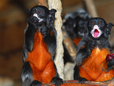
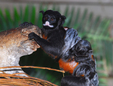
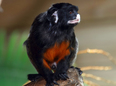
Red-chested mustached tamarins are also known as red-bellied tamarins and white-lipped tamarins because of their appearance. They are mostly dark brown or black in color, and have distinguishing red markings on their stomachs and chests (Hershkovitz 1977). They also have a patch of white fur surrounding their nose and mouth, giving the appearance of a mustache (Hershkovitz 1977). Red-chested mustached tamarins are relatively small, ranging from 23 to 29 cm in body length and 350 to 575 g in mass. Females are generally slightly larger than males (Suarez 2007). Members of this species have claw-like nails on all digits except the hallux, and their hind limbs are slightly longer than their forelimbs (Garber and Leigh 2001). The dental formula for this species is 2.1.3.2 (Suarez 2007). (Garber and Leigh, 2001; Herskovitz, 1977; Suarez, 2007)
- Other Physical Features
- endothermic
- bilateral symmetry
- Sexual Dimorphism
- sexes alike
- female larger
-
- Range mass
- 450 to 575 g
- 15.86 to 20.26 oz
-
- Range length
- 23 to 29 cm
- 9.06 to 11.42 in
Reproduction
Because breeding females may mate with more than one male, red-chested mustached tamarins are generally considered polyandrous. There is also evidence of male competition, as breeding males defend their mates by physically inserting themselves between a breeding female and non-breeding males within the group that approach (Suarez 2007).
Recent studies, however, propose a serially monogamous breeding system. Minimal aggression observed among males within a group has supported this idea (Suarez 2007). Additionally, genetic studies of wild groups indicate that one breeding male and one breeding female are responsible for all infants and/or juveniles in a group (Suarez 2007). (Suarez, 2007)
Other adults in a group of red-chested mustached tamarins are considered "helper" adults, and are typically related to one of the breeders (Suarez 2007). During intergroup encounters, helper group members assess the breeding situation of neighboring groups. If a helper, or a pair of helpers such as a set of twins, senses instability in a neighboring group, it may use an intergroup encounter as an opportunity to move to a different group, in which they can attempt to become a breeder (Suarez 2007).
Breeding males also defend breeding females during intergroup interactions. Females are generally chased away by their mates from sites where intergroup interactions occur. In fact, most aggression of breeding male red-chested mustached tamarins is targeted at a breeding female as he attempts to keep her away from these sites (Suarez 2007). (Suarez, 2007)
- Mating System
- monogamous
- polyandrous
In the wild, red-chested mustached tamarins generally mate in the spring (March to June), and breeding peeks in April. After a gestation period of about 160 days, most infants are born in the fall (late August to early December) (Suarez 2007). In captivity, however, members of this speices can mate during any season (Coates and Poole 1983). Red-chested mustached tamarins can breed as much as twice a year.
Each birth typically produces fraternal twins, each weighing approximately 40g, though occasionally only a single infant is born (Nakamichi and Yamada 2009, Coates and Poole 1983). Infants begin nursing immediately, and obtain all of their nutrients from their mother’s milk until they are 5 weeks old, when they may begin to eat solid food (Coates and Poole 1983). By 16 weeks of age, infants are usually completely weaned (Suarez 2007). Red-chested mustached tamarins become independent around 1 to 2 years of age and sexually mature around 2 to 4 years of age (Suarez 2007).
Breeding females chemically inhibit the first ovulation of their daughters, as females not related to the primary breeding female are rarely tolerated. These daughters may reach sexual maturity later than males of the same age (Smith and Gordon 2002). (Coates and Poole, 1983; Nakamichi and Yamada, 2009; Smith and Gordon, 2002; Suarez, 2007)
- Key Reproductive Features
- iteroparous
- gonochoric/gonochoristic/dioecious (sexes separate)
- sexual
- fertilization
- viviparous
-
- Breeding interval
- Breeding female red-chested mustached tamarins can breed up to twice yearly.
-
- Breeding season
- In the wild, red-chested mustached tamarins tend to mate during the spring (March to June), particularly in April. In captivity, however, they mate during any season.
-
- Range number of offspring
- 1 to 2
-
- Average number of offspring
- 2
-
- Range gestation period
- 150 to 170 days
-
- Average weaning age
- 16 weeks
-
- Range time to independence
- 1 to 2 years
-
- Range age at sexual or reproductive maturity (female)
- 2 to 4 years
-
- Range age at sexual or reproductive maturity (male)
- 2 to 4 years
Because red-chested mustached tamarins tend to live in groups, investment in offspring is shared. For 2 months after infants are born, a mother provides nourishment to her young in the form of milk (Coates and Poole 1983). Other group members protect infants by carrying them. This is generally performed by the breeding male and female as well as the helper male. Helper males are usually related to the degree of sibling or half-sibling to one of the breeding individuals and thus gain inclusive fitness by participating in infant care (Suarez 2007).
Degree of investment from each individual varies from group to group. In some cases, the breeding male is responsible for most of the carrying (Pryce 1988), while in others, the breeding male and helper male equally contribute but carry much less often than the breeding female (Suarez 2007). Other group members large enough to provide infant care often do so, but not to the extent of breeding adults or the most closely-related helper male (Suarez 2007).
Once weaning occurs, infants begin to eat solid food. Because infants are too small to forage for their own food, they rely on older members of the group to share. In the wild, adult males appear to be responsible for most food sharing, though the father does not necessarily share most (Suarez 2007). Infants reach independence around 1 to 2 years of age (Suarez 2007). (Coates and Poole, 1983; Pryce, 1988; Suarez, 2007)
- Parental Investment
- altricial
- male parental care
- female parental care
-
pre-hatching/birth
-
provisioning
- female
-
protecting
- female
-
provisioning
-
pre-weaning/fledging
-
provisioning
- female
-
protecting
- male
- female
-
provisioning
-
pre-independence
-
provisioning
- male
-
protecting
- male
- female
-
provisioning
Lifespan/Longevity
The lifespan of red-chested mustached tamarins is generally unknown. Other members of the genus Saguinus live into their early teens (Johnson 2008). In the wild, red-chested mustached tamarins estimated to be over the age of 8 based on tooth-wear are considered “old” (Suarez 2007). (Johnson, 2008; Suarez, 2007)
Behavior
Red-chested mustached tamarins are diurnal, social creatures that live in groups. Groups range in size from 2 to 13 individuals, though groups typically consist of 4 to 6 members (Suarez 2007, Buchanan-Smith 1991). Each group contains 1 breeding male and 1 breeding female. The rest of the group is composed of offspring and helper males, which are usually related to one of the breeding individuals (Suarez 2007).
Often, groups of red-chested mustached tamarins associate with groups of other callitrichines that share their home range. They have been observed associating with groups of saddle-backed tamarins as well as groups of Goeldi's marmosets (Garber and Leigh 2001). These associations allow for increased vigilance and home-range defense without increased competition for mates or food (Garber and Leigh 2001; Hardie and Buchanan-Smith 1997). (Buchanan-Smith, 1991; Garber and Leigh, 2001; Hardie and Buchanan-Smith, 1997; Suarez, 2007)
- Key Behaviors
- arboreal
- diurnal
- motile
- territorial
- social
-
- Range territory size
- 0.15 to 0.23 km^2
Home Range
Territories of a group of red-chested mustached tamarins range from 0.15 to 0.23 sq km in size, but this may vary with season and group size (Buchanan-Smith 1991; Suarez 2007). Red-chested mustached tamarins utilize 25 to 30% of their home range each day (Buchanan-Smith 1991). Some portions of the home range are visited more frequently than others, particularly favored feeding sites, sleeping sites, sites of intergroup encounters, and areas that provide shelter from rain during the rainy season. Red-chested mustached tamarins travel approximately 1.3 to 1.7 km each day (Buchanan-Smith 1991). In densly populated areas, home ranges of different groups may overlap by 20 to 30% (Suarez 2007). (Buchanan-Smith, 1991; Suarez, 2007)
Communication and Perception
Red-chested mustached tamarins primarily communicate through scent marking and vocal calls. They have scent glands in both the circumgenital and gularsternal regions of their bodies (Suarez 2007). The size and use of these glands as well as the frequency of scent marking vary with sex. Female red-chested mustached tamarins tend to have larger angiogenital and suprapubic scent glands, and males scentvmark using sternal glands more often than females (Suarez 2007). Females scent mark more frequently than males in almost any circumstance (Smith and Gordon 2002).
Females use scent marking more often when fertile. This scent marking is thought to attract breeding males or communicate receptiveness to breeding (Suarez 2007), because males, particularly breeding males, are much more interested in checking female scent markings than females are in checking male scent markings (Gordon and Smith 2002). Additionally, breeding males are more likely to witness (due to proximity), sniff, and over-mark a female scent mark than other males (Suarez 2007).
Breeding males use scent marking more often than other males in the group. Scent marking by males occurs most often during intergroup encounters and thus may be a communication of territoriality (Suarez 2007). This ritual of male scent marking requires two males (usually the breeding male and the second-ranking male in the group), and begins with the males facing one another. One male (usually the breeding male) climbs over the other male and scent marks the bottom male’s head and back using angiogenital scent glands. As this occurs, the bottom male scent marks the branch beneath him with his sternal and then his suprapubic scent glands (Suarez 2007). Once the top male has passed over the bottom male, he scent marks the branch behind the bottom male. Both conclude the ritual with an angiogenital scent mark (Suarez 2007). Because this ritual generally occurs during intergroup encounters, it may be a display of male solidarity to extragroup individuals (Suarez 2007). (Smith and Gordon, 2002; Suarez, 2007)
Because they are small, red-chested mustached tamarins are constantly alert and perform visual scans of their environment quite often to ensure they are safe from potential predators. Length of these visual scans varies with group size (Hardie and Buchanan-Smith 2002). If a potential predator is seen, a tamarin issues a loud alarm call, which differs based on the type of predator (Suarez 2007).
Red-chested mustached tamarins have also been observed producing “long calls,” which seem to be calls to neighboring groups of tamarins. These calls are often produced when red-chested mustached tamarins emerge from their sleeping sites in the morning and often result in intergroup encounters (Suarez 2007). (Hardie and Buchanan-Smith, 1997; Suarez, 2007)
- Other Communication Modes
- scent marks
Food Habits
Although red-chested mustached tamarins are omnivorous, the majority of their diet (about 60%) consists of fruit (Porter 2001). They eat a variety of fruits including Cecropia sciadophylla, Pseudolmedia rigida, and amazon grapes, Pourouma cecropiaefolia. However, they primarily eat fruits of the family Moraceae (Buchanan-Smith 1991).
During the dry season (June to August), when fruit is scarce, red-chested mustached tamarins often consume nectar, particularly from Symphonia globuliferae and Ochroma pyrmidale (Porter 2001). Members of this species also eat insects, primarily from the family Orthoptera (crickets, grasshoppers), as well as plant exudates (Porter 2001). Red-chested mustached tamarins do not have large, procumbent incisors, so their consumption of most exudates is likely opportunistic. Exudates of Parkia pendula, however, exude resin from a bean-shaped fruit, and predators do not require teeth that can damage the tough plant to obtain its nutrients (Buchanan-Smith 1991). (Buchanan-Smith, 1991; Porter, 2001)
- Animal Foods
- insects
- Plant Foods
- fruit
- nectar
- sap or other plant fluids
Predation
Predation of red-chested mustached tamarins is rarely observed in the wild. Crested eagles have been observed consuming infants of other speices of tamarins (Vasquez and Heymann 2001). Potential predators are identified based on the alarm calls they elicit. Animals known to elicit alarm calls from red-chested mustached tamarins include: spectacled owls, great horned owls, tayras, ocelots, margays, jaguarundi, jaguars, snakes of the families Boidae, Colubridae, and Viperidae, as well as Capuchin monkeys (Suarez 2007). (Suarez, 2007; Vasquez and Heymann, 2001)
Red-chested mustached tamarins decrease their susceptibility to predation by forming groups, occasionally with members of different species. Multi-species groups usually include a group of another species of tamarin. Group formation increases overall vigilance while decreasing the amount of time each individual must spend watching for predators (Hardie and Buchanan-Smith 1997). If a predator is spotted, red-chested mustached tamarins produce an alarm call to warn the others in their group (Suarez 2007).
The sleeping behavior of red-chested mustached tamarins also likely reduces susceptibility to predation. Red-chested mustached tamarins choose sleeping sites high off the ground (12 to 20 m) where there are triple or quadruple forks in trees, abandoned termite mounds, or holes in trees so that they are not easily visible (Buchanan-Smith 1991). In addition, these tamarins adopt a sleeping position in which their head is tucked into their chest and their tail is wrapped around their body. This position hides the white markings on their face, making them more difficult to spot (Buchanan-Smith 1991). (Buchanan-Smith, 1991; Hardie and Buchanan-Smith, 1997; Suarez, 2007)
-
- Known Predators
-
- crested eagles Morphnus guianensis
- spectacled owls Pulsatrix perspicillata
- great horned owls Bubo virginianus
- tayras Eira barbara
- ocelots Leopardus pardalis
- margays Leopardus wiedii
- jaguarundi Herpailurus yaguarondi
- jaguars Panthera onca
- some boas and pythons (snakes) Boidae
- some colubrids (snakes) Colubridae
- some vipers (snakes) Viperidae
- Capuchin monkeys Cebus
Ecosystem Roles
As frugivores, red-chested mustached tamarins likely disperse seeds of fruit trees from which they eat. Seeds are swallowed (Ferarri 1993) and may be excreted later to disperse seeds, as has been seen in other species of Saguinus (Oliviera and Ferrari 2000). Red-chested mustached tamarins also act as prey for a variety of Amazonian predators.
In Peru, red-chested mustached tamarins act as hosts to the parasties Athesmia heterolecithoides, Filaroides barretoi, Primasubulura jacchi, and Prosthenorchis elegans (Michaud 2003). (Ferrari, et al., 1993; Michaud, et al., 2003; Oliviera and Ferrari, 2000)
- Ecosystem Impact
- disperses seeds
- Athesmia heterolecithoides
- Filaroides barretoi
- Primasubulura jacchi
- Prosthenorchis elegans
Economic Importance for Humans: Positive
Red-chested mustached tamarins do not often interact with humans in the wild, though they are occasionally hunted or taken as pets (Wolfheim 1983). In captivity, they have proven quite useful in scientific study. Monkeys of the genus Saguinus, including red-chested mustached tamarins, are susceptible to the strain of Hepatitis A that affects humans. A portion of what we have learned regarding the pathology of Hepatitis A has stemmed from the study of the disease in these animals (Karayiannis 1986). (Karayiannis, et al., 1986; Wolfheim, 1983)
Economic Importance for Humans: Negative
Red-chested mustached tamarins do not often interact with humans, though it is possible that, when in captivity, these animals could transmit parasites to humans (Michaud 2003). (Michaud, et al., 2003)
- Negative Impacts
-
injures humans
- carries human disease
Conservation Status
Populations of red-chested mustached tamarins are stable, and they are not considered threatened. However, it is possible that deforestation in Bolivia could reduce habitat (Mittermeier and Wallace 2008). This species is not often hunted, though red-chested mustached tamarins are occasionally be taken as pets (Mittermeier and Wallace 2008). (Mittermeier and Wallace, 2008)
-
- IUCN Red List
-
Least Concern
More information
-
- IUCN Red List
-
Least Concern
More information
-
- CITES
- Appendix II
Other Comments
A very recent study based on mitochondrial ribosomal RNA has revealed that red-chested mustached tamarins, Saguinus labiatus, and mustached tamarins, S. mystax, are sister taxa and only diverged from one another approximately 1.15 million years ago (Matauschek, Roos, and Heymann 2011). (Matauschek, et al., 2011)
Contributors
Nina Kristofik (author), Yale University, Eric Sargis (editor), Yale University, Gail McCormick (editor), Animal Diversity Web Staff.
Glossary
- Neotropical
-
living in the southern part of the New World. In other words, Central and South America.

- acoustic
-
uses sound to communicate
- altricial
-
young are born in a relatively underdeveloped state; they are unable to feed or care for themselves or locomote independently for a period of time after birth/hatching. In birds, naked and helpless after hatching.
- arboreal
-
Referring to an animal that lives in trees; tree-climbing.
- bilateral symmetry
-
having body symmetry such that the animal can be divided in one plane into two mirror-image halves. Animals with bilateral symmetry have dorsal and ventral sides, as well as anterior and posterior ends. Synapomorphy of the Bilateria.
- chemical
-
uses smells or other chemicals to communicate
- diurnal
-
- active during the day, 2. lasting for one day.
- endothermic
-
animals that use metabolically generated heat to regulate body temperature independently of ambient temperature. Endothermy is a synapomorphy of the Mammalia, although it may have arisen in a (now extinct) synapsid ancestor; the fossil record does not distinguish these possibilities. Convergent in birds.
- female parental care
-
parental care is carried out by females
- fertilization
-
union of egg and spermatozoan
- food
-
A substance that provides both nutrients and energy to a living thing.
- frugivore
-
an animal that mainly eats fruit
- herbivore
-
An animal that eats mainly plants or parts of plants.
- iteroparous
-
offspring are produced in more than one group (litters, clutches, etc.) and across multiple seasons (or other periods hospitable to reproduction). Iteroparous animals must, by definition, survive over multiple seasons (or periodic condition changes).
- male parental care
-
parental care is carried out by males
- monogamous
-
Having one mate at a time.
- motile
-
having the capacity to move from one place to another.
- native range
-
the area in which the animal is naturally found, the region in which it is endemic.
- pet trade
-
the business of buying and selling animals for people to keep in their homes as pets.
- polyandrous
-
Referring to a mating system in which a female mates with several males during one breeding season (compare polygynous).
- rainforest
-
rainforests, both temperate and tropical, are dominated by trees often forming a closed canopy with little light reaching the ground. Epiphytes and climbing plants are also abundant. Precipitation is typically not limiting, but may be somewhat seasonal.
- scent marks
-
communicates by producing scents from special gland(s) and placing them on a surface whether others can smell or taste them
- sexual
-
reproduction that includes combining the genetic contribution of two individuals, a male and a female
- social
-
associates with others of its species; forms social groups.
- tactile
-
uses touch to communicate
- terrestrial
-
Living on the ground.
- territorial
-
defends an area within the home range, occupied by a single animals or group of animals of the same species and held through overt defense, display, or advertisement
- tropical
-
the region of the earth that surrounds the equator, from 23.5 degrees north to 23.5 degrees south.
- visual
-
uses sight to communicate
- viviparous
-
reproduction in which fertilization and development take place within the female body and the developing embryo derives nourishment from the female.
References
Buchanan-Smith, H. 1991. A Field Study on the Red-Bellied Tamarin, Saguinus labiatus labiatus, in Bolivia. International Journal of Primatology, 12/3: 259-276.
Coates, A., T. Poole. 1983. The Behavior of the Callitrichid Monkey, Saguinus labiatus labiatus, in the Laboratory. International Journal of Primatology, 4/4: 339-371.
Ferrari, S., M. Lopes, E. Krause. 1993. Gut morphology of Callithrix nigriceps and Saguinus labiatus from western Brazilian Amazonia. Journal of American Physical Anthropology, 90/4: 487-493.
Garber, P., S. Leigh. 2001. Patterns of Positional Behavior in Mixed-Species Troops of Callimico goeldii, Saguinus labiatus, and Saguinus fuscicollis in Northwestern Brazil. American Journal of Primatology, 54: 17-31.
Hardie, S., H. Buchanan-Smith. 1997. Vigilance in Single- and Mixed-Species Groups of Tamarins (Saguinus labiatus and Saguinus fuscicollis). International Journal of Primatology, 18/2: 217-234.
Herskovitz, P. 1977. Living New World monkeys (Platyrrhini): with an Introduction to Primates. Chicago, Il: University of Chicago Press.
Johnson, D. 2008. "The Life Spans of Nonhuman Primates" (On-line). Primate Info Net. Accessed March 16, 2011 at http://pin.primate.wisc.edu/aboutp/phys/lifespan.html.
Karayiannis, P., T. Jowett, M. Enticott, D. Moore, M. Pignatelli, F. Brenes, P. Scheuer, H. Thomas. 1986. Hepatitis A Virus Replication in Tamarins and Host Immune Response in Relation to Pathogenesis of Liver Cell Damage. Journal of Medical Virology, 18/3: 261-276.
Matauschek, C., C. Roos, E. Heymann. 2011. Mitochondrial Phylogeny of Tamarins (Saguinus, Hoffmannsegg 1807) with Taxonomic and Biogeographic Implications for the S. nigricollis Species Group. American Journal of Physical Anthropology, 144: 564–574.
Michaud, C., M. Tantalean, C. Ique, E. Montoya, A. Gonzalo. 2003. A survey for helminth parasites in feral New World non-human primate populations and its comparison with parasitological data from man in the region. Journal of Medical Primatology, 32: 341-345.
Mittermeier, R., R. Wallace. 2008. "Saguinus labiatus" (On-line). IUCN Red List of Threatened Species. Version 2010.4. Accessed April 17, 2011 at http://www.iucnredlist.org/apps/redlist/details/41524/0.
Nakamichi, M., K. Yamada. 2009. Distribution of dorsal carriage among simians. Primates, 50: 153-168.
Oliviera, A., S. Ferrari. 2000. Seed dispersal by black-handed tamarins, Saguinus midas niger (Callitrichinae, Primates): implications for the regeneration of degraded forest habitats in eastern Amazonia. Journal of Tropical Ecology, 16: 709-716.
Porter, L. 2001. Dietary Differences Among Sympatric Callitrichinae in Northern Bolivia: Callimico goeldii, Saguinus fuscicollis and S. labiatus. International Journal of Primatology, 22/6: 961-992.
Porter, L. 2004. Forest Use and Activity Patterns of Callimico goeldii in Comparison to Two Sympatric Tamarins, Saguinus fuscicollis and Saguinus labiatus. American Journal of Physical Anthropology, 124: 139-153.
Pryce, C. 1988. Individual and group effects on early caregiver-infant relationships in red-bellied tamarin monkeys. Animal Behavior, 36: 1455-1464.
Smith, T., S. Gordon. 2002. Sex Differences in Olfactory Communication in Saguinus labiatus. International Journal of Primatology, 23/2: 429-441.
Suarez, S. 2007. Paternity, Relatedness, and Socio-Reproductive Behavior in a Population of Wild Red-Bellied Tamarins (Saguinus labiatus). Ann Arbor, Michigan: ProQuest Information and Learning Company.
Vasquez, M., E. Heymann. 2001. Crested Eagle (Morphnus guianensis) Predation on Infant Tamarins (Saguinus mystax and Saguinus fuscicollis, Callitrichinae). Folia Primatologica, 72: 301-303.
Wolfheim, J. 1983. Primates of the World: Distribution, Abundance and Conservation. Seattle: University of Washington Press.