Rissa tridactylablack-legged kittiwake



Geographic Range
In North America, the Black-legged Kittiwake spans both coasts, as far north as the ice-free waters of Alaska in the west and the Great Banks of Newfoundland in the east. It lives as far south as Baja, California in the west and the tip of Florida in the east. Outside of America it can be found in nearly every coastal area of the world, given the proper habitat is available. This includes the coast of Norway, Britian, France, and the former Soviet Union, along with China, Japan, Korea, Central Europe, and nw. Africa.
- Biogeographic Regions
- nearctic
- palearctic
- oriental
- ethiopian
- neotropical
- australian
Habitat
The Black-legged Kittiwake nests on ledges of offshore islands, sea stacks, or inaccessible areas of coastal mainland. It also nests on steep earthen slopes, large boulders, glaciers, and cliff-like man-made structures, such as shipwrecks and skyscrapers. A true shoreline species, it rarely comes very far inland, even in the winter.
- Aquatic Biomes
- coastal
Physical Description
The Black-legged Kittiwake is a small gull, with a pearl gray back and wings and a stark white head and underside. The tips of the tail feathers are black. The adult bill is uniformly greenish-yellow. In spite of its name, its legs can be orange or red, although they are most commonly black.
- Other Physical Features
- endothermic
- bilateral symmetry
-
- Average mass
- 317 g
- 11.17 oz
- AnAge
Reproduction
Pairs are generally monogamous, although males attempt to mate with other partners. In a study done in Britian, 64% of pairs remained together from one breeding season to the next. Due to their global distribution, it is difficult to give precise copulation, incubation, and hatching dates for kittiwakes. Black-legged Kittiwakes nest on cliffs, and the male retains the same nest site from year to year. After the nest is ready, 1 to 3 eggs are laid. The male and female incubate the eggs for about 25 days. At this time the chicks hatch. The parents seem to share the responsibilities for the chicks evenly, with both sexes feeding and brooding the young.
- Key Reproductive Features
- iteroparous
- gonochoric/gonochoristic/dioecious (sexes separate)
- sexual
- oviparous
Lifespan/Longevity
-
- Average lifespan
Status: wild - 307 months
- Bird Banding Laboratory
- Average lifespan
Behavior
With a tern-like wingbeat the Black-legged Kittiwake is highly manueverable. It is able to land on narrow ledges in strong winds. It nests in interspecific colonies, with 51 to 57 cm between nests.
- Key Behaviors
- flies
- motile
Communication and Perception
Food Habits
Unlike many gulls, the Black-legged Kittiwake does not feed at dumps. Rather, it feeds on the water surface. An opportunistic feeder, it feeds on small surface fish and invertebrates. It prefer fishs, and the species consumed most often are capelin, sandlance, arctic cod, pollock, saffron cod, small trout, and young salmon.
Conservation Status
Although there is no special status for the Black-legged Kittiwake, fishing poses a possible threat to population size. As fish stocks decline along coastal areas, species that are kittiwake prey are being harvested. This may lead to disasterous effects on the population of kittiwakes, which often depending largely on one major source for food.
-
- IUCN Red List
-
Least Concern
More information
-
- IUCN Red List
-
Least Concern
More information
-
- US Migratory Bird Act
- Protected
-
- US Federal List
- No special status
-
- CITES
- No special status
-
- State of Michigan List
- No special status
Other Comments
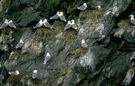
The Black-legged Kittiwake has many adaptations to nesting on vertical sea cliffs, including facing towards the cliff, so that their tails project over the edge and their feet are on solid ground.
Contributors
Jennifer Roof (author), University of Michigan-Ann Arbor.
Glossary
- Australian
-
Living in Australia, New Zealand, Tasmania, New Guinea and associated islands.

- Ethiopian
-
living in sub-Saharan Africa (south of 30 degrees north) and Madagascar.
- Nearctic
-
living in the Nearctic biogeographic province, the northern part of the New World. This includes Greenland, the Canadian Arctic islands, and all of the North American as far south as the highlands of central Mexico.
- Neotropical
-
living in the southern part of the New World. In other words, Central and South America.
- Palearctic
-
living in the northern part of the Old World. In otherwords, Europe and Asia and northern Africa.
- acoustic
-
uses sound to communicate
- bilateral symmetry
-
having body symmetry such that the animal can be divided in one plane into two mirror-image halves. Animals with bilateral symmetry have dorsal and ventral sides, as well as anterior and posterior ends. Synapomorphy of the Bilateria.
- chemical
-
uses smells or other chemicals to communicate
- coastal
-
the nearshore aquatic habitats near a coast, or shoreline.
- endothermic
-
animals that use metabolically generated heat to regulate body temperature independently of ambient temperature. Endothermy is a synapomorphy of the Mammalia, although it may have arisen in a (now extinct) synapsid ancestor; the fossil record does not distinguish these possibilities. Convergent in birds.
- iteroparous
-
offspring are produced in more than one group (litters, clutches, etc.) and across multiple seasons (or other periods hospitable to reproduction). Iteroparous animals must, by definition, survive over multiple seasons (or periodic condition changes).
- motile
-
having the capacity to move from one place to another.
- native range
-
the area in which the animal is naturally found, the region in which it is endemic.
- oriental
-
found in the oriental region of the world. In other words, India and southeast Asia.
- oviparous
-
reproduction in which eggs are released by the female; development of offspring occurs outside the mother's body.
- sexual
-
reproduction that includes combining the genetic contribution of two individuals, a male and a female
- tactile
-
uses touch to communicate
- visual
-
uses sight to communicate
References
Baird, Pat Herron. The Birds of North America. No. 92, 1994. The American Ornithologists' Union.