Rhyncholestes raphanurusChilean shrew opossum
Geographic Range
Chilean shrew opossums (Rhyncholestes raphanurus) have only been found in a small geographic range that covers southern Chile, Chiloe Island and a small part of southern Argentina (approximately 40 degrees south latitude and 70 degrees west longitude). These animals have been captured at elevations from sea level to 1,135 m. Only two specimens have been captured in Argentina. This species was once thought to be rare; however, it is possible that they are abundant in limited habitat types. (Meserve, et al., 1982; Patterson and Gallardo, 1987)
- Biogeographic Regions
- neotropical
Habitat
Chilean shrew opossums reside in temperate forest habitats. Favorable microclimates include wet areas of southern beech (Nothofagus species) forests with plenty of coarse, woody debris and a thick understory of shrub cover. These marsupials are more frequently caught at elevations lower than 600 meters. (Kelt and Martinez, 1989)
- Habitat Regions
- temperate
- terrestrial
- Terrestrial Biomes
- forest
- rainforest
-
- Range elevation
- 0 to 1135 m
- 0.00 to 3723.75 ft
Physical Description
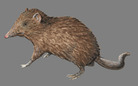
Chilean shrew opossums are small mammals. Their body size can range from 10 to 13 cm. Their ventral and dorsal portions are dark brown or gray. Their tail is shorter than their head to body length and is solid in color, with short, sparse hairs. Their body shape is shrew-like in appearance and their ears are small and rounded. Dental patterns are used to determine gender in this species, males have conical, single rooted upper canines and females have double-rooted canines, resembling premolars. (Patterson and Gallardo, 1987; Redford and Eisenberg, 1992)
- Other Physical Features
- endothermic
- homoiothermic
- bilateral symmetry
- Sexual Dimorphism
- sexes alike
-
- Range length
- 10 to 13 cm
- 3.94 to 5.12 in
Reproduction
Little is known about caenolestid mating systems. The seemingly solitary behavior of Chilean shrew opossums, as well as the random distribution of resources in their environment suggests a polygynandrous (promiscuous) mating system. Another hypothesis suggests that these animals live in family groups and have a monogamous mating system. However, neither hypothesis has been tested. (Kelt and Martinez, 1989)
Few studies have been conducted on the reproductive cycle of Chilean shrew opossums. Females do not have a pouch and possess five to seven teats. Patterns of teat development suggest litters of 5 to 7 or greater. There is evidence that females are capable of reproducing any time of the year, as lactating females have been captured in February, March, May, October, November and December. Males are thought to be reproductively active all year as well. They possess a cleft penis and paired sperm. (Nowak, 1999; Patterson and Gallardo, 1987)
- Key Reproductive Features
- iteroparous
- year-round breeding
- gonochoric/gonochoristic/dioecious (sexes separate)
- sexual
- viviparous
-
- Breeding interval
- Breeding intervals are unknown in Chilean shrew opossums.
-
- Breeding season
- Chilean shrew opossums may breed throughout the year.
-
- Range number of offspring
- 5 to 7
Little is known about parental care of Chilean shrew opossums. Researchers have never captured a female with young; this may suggest that these animals use a nest to raise their young. In close succession, an adult male, an adult female and two juveniles were captured in one trap, leading to the hypothesis that Chilean shrew opossums live in family groups. If this is accurate, both male and female parents may participate in the care of their young. However, this hypothesis has not yet been tested. (Patterson and Gallardo, 1987)
- Parental Investment
- altricial
-
pre-fertilization
- provisioning
-
protecting
- female
-
pre-hatching/birth
-
provisioning
- female
-
protecting
- female
-
provisioning
-
pre-weaning/fledging
-
provisioning
- female
-
provisioning
Lifespan/Longevity
No data has been gathered on the life span of Chilean shrew opossums. Few trapped individuals have been recaptured, making it difficult to judge their life span. Because of their small body size, it is likely that they do not live more than a few years. (Meserve, et al., 1982)
Behavior
Chilean shrew opossums are usually caught at night, indicating that they are nocturnal. They are often caught near burrows and under logs and appear to be semi-fossorial, foraging under leaf litter for insects. Lack of recapture may indicate trap shyness, high post-capture mortality or a large home range. (Kelt and Martinez, 1989)
Home Range
Due to lack of recapture data or radio tracking, home range size is not known for Chilean shrew opossums.
Communication and Perception
Little is known about the communication of Chilean shrew opossums or how they perceive their environment. They likely have poor eyesight due to their nocturnal activity and small eyes. Vibrissae are used to sense insects and objects in the environment. Examination of their brains shows large olfactory bulbs, indicating an acute sense of smell. (Patterson and Gallardo, 1987)
Food Habits
Chilean shrew opossums are semi-fossorial, foraging in the litter layer for soil invertebrates (54% of diet) and earthworms (7%). Another principle component of their diet is plant material and fungi (39%). When capturing these animals, successful traps are commonly baited with rolled oats. (Meserve, et al., 1988)
- Animal Foods
- insects
- terrestrial non-insect arthropods
- mollusks
- terrestrial worms
- Plant Foods
- seeds, grains, and nuts
- Other Foods
- fungus
Predation
Little data has been gathered on predation of Chilean shrew opossums. Like most small mammals, they are likely a food base for nocturnal carnivores. Possible vertebrate predators include variable hawks, white-tailed kites, American kestrels, black-chested buzzard eagles, Harris's hawks, burrowing owls, great horned owls, barn owls, culpeos, long-tailed snakes and Peru slender snakes. Chilean shrew opossums are small, cryptic, nocturnal animals and likely avoid most predation by being difficult to find. (Jaksic, et al., 1980; Nowak, 1999)
- Anti-predator Adaptations
- cryptic
Ecosystem Roles
Other than their consumption of insects, earthworms, plant material and fungi, little is known about the ecosystem roles of Chilean shrew opossums. (Meserve, et al., 1988)
Economic Importance for Humans: Positive
Due to few studies, economic importance of Chilean shrew opossums is not known.
Economic Importance for Humans: Negative
Due to few studies, economic importance of Chilean shrew opossums is not known.
Conservation Status
As of 2012, Chilean shrew opossums were listed as a near threatened species by the IUCN (International Union for Conservation of Nature and Natural Resources). These animals are vulnerable due to habitat loss and degradation. (Diaz and Teta, 2008)
-
- IUCN Red List
-
Near Threatened
More information
-
- IUCN Red List
-
Near Threatened
More information
-
- US Federal List
- No special status
-
- CITES
- No special status
-
- State of Michigan List
- No special status
Contributors
Tanya Dewey (editor), University of Michigan-Ann Arbor, Leila Siciliano Martina (editor), Animal Diversity Web Staff.
Andrew Moore (author), University of Wisconsin-Stevens Point, Chris Yahnke (editor, instructor), University of Wisconsin-Stevens Point.
Glossary
- Neotropical
-
living in the southern part of the New World. In other words, Central and South America.

- acoustic
-
uses sound to communicate
- altricial
-
young are born in a relatively underdeveloped state; they are unable to feed or care for themselves or locomote independently for a period of time after birth/hatching. In birds, naked and helpless after hatching.
- bilateral symmetry
-
having body symmetry such that the animal can be divided in one plane into two mirror-image halves. Animals with bilateral symmetry have dorsal and ventral sides, as well as anterior and posterior ends. Synapomorphy of the Bilateria.
- carnivore
-
an animal that mainly eats meat
- chemical
-
uses smells or other chemicals to communicate
- cryptic
-
having markings, coloration, shapes, or other features that cause an animal to be camouflaged in its natural environment; being difficult to see or otherwise detect.
- endothermic
-
animals that use metabolically generated heat to regulate body temperature independently of ambient temperature. Endothermy is a synapomorphy of the Mammalia, although it may have arisen in a (now extinct) synapsid ancestor; the fossil record does not distinguish these possibilities. Convergent in birds.
- forest
-
forest biomes are dominated by trees, otherwise forest biomes can vary widely in amount of precipitation and seasonality.
- insectivore
-
An animal that eats mainly insects or spiders.
- iteroparous
-
offspring are produced in more than one group (litters, clutches, etc.) and across multiple seasons (or other periods hospitable to reproduction). Iteroparous animals must, by definition, survive over multiple seasons (or periodic condition changes).
- motile
-
having the capacity to move from one place to another.
- mycophage
-
an animal that mainly eats fungus
- native range
-
the area in which the animal is naturally found, the region in which it is endemic.
- nocturnal
-
active during the night
- rainforest
-
rainforests, both temperate and tropical, are dominated by trees often forming a closed canopy with little light reaching the ground. Epiphytes and climbing plants are also abundant. Precipitation is typically not limiting, but may be somewhat seasonal.
- sedentary
-
remains in the same area
- sexual
-
reproduction that includes combining the genetic contribution of two individuals, a male and a female
- tactile
-
uses touch to communicate
- temperate
-
that region of the Earth between 23.5 degrees North and 60 degrees North (between the Tropic of Cancer and the Arctic Circle) and between 23.5 degrees South and 60 degrees South (between the Tropic of Capricorn and the Antarctic Circle).
- terrestrial
-
Living on the ground.
- visual
-
uses sight to communicate
- viviparous
-
reproduction in which fertilization and development take place within the female body and the developing embryo derives nourishment from the female.
- year-round breeding
-
breeding takes place throughout the year
References
Diaz, M., P. Teta. 2008. "Rhyncholestes raphanurus" (On-line). IUCN Red List of Threatened Species. Accessed June 04, 2013 at www.iucnredlist.org.
Jaksic, F., H. Greene, J. Yanez. 1980. The guild structure of a community of predatory vertebrates in central Chile. Oecologia, 49: 21-28.
Kelt, D., D. Martinez. 1989. Notes on distribution and ecology of two marsupials endemic to the Valvidian forests of southern South America. Journal of Mammalogy, 70: 220-224.
Meserve, P., B. Lang, B. Patterson. 1988. Trophic relations of small mammals in a Chilean Temperate Forest. Journal of Mammalogy, 69: 721-730.
Meserve, P., R. Murua, O. Lopetegui, J. Rau. 1982. Observations on the Small Mammal Fauna of a Primary Temperate Rain Forest in Southern Chile. Journal of Mammalogy, 63: 315-317.
Nowak, R. 1999. Mammals of the World. Baltimore, Maryland: John Hopkins University Press.
Patterson, B., M. Gallardo. 1987. Mammalian Species- Rhyncholestes raphanurus. American Society of Mammalogists, 286: 1-5.
Redford, K., J. Eisenberg. 1992. Mammals of the Neotropics- The Southern Cone. Chicago, Illinois: University of Chicago Press.