Rhinocerotidaerhinoceroses
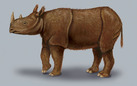

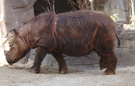
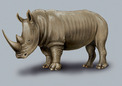
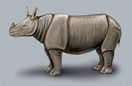
The family Rhinoceroteridae contains living rhinoceroses. They are represented by 5 species placed in 4 genera. Three of these species are found in south-central Asia and the other two live in Africa south of the Sahara. Rhinoceroses generally inhabit savannahs, shrubby regions and dense forests, and the African species usually live in more open areas than do the Asiatic species. All rhinos are generally restricted to areas where a daily trip to water is possible.
Rhinos have massive bodies and a large head with 1-2 horns. The horns are dermal in origin; they are very solid and are composed of compressed, fibrous keratin. Rhinos have a broad chest and short, stumpy legs. The radius/ulna and tibia/fibula are only slightly moveable, but they are well-developed and separate. Both hind and forefeet are mesaxonic with 3 digits each; each digit with a small hoof. Rhinos have small eyes and fairly short but prominent and erect ears. Their thick skin is scantily-haired and wrinkled, furrowed or pleated, producing the appearance of riveted armor plates in some species. The tail bears stiff bristles.

Rhinos have an elongate skull, which is elevated posteriorly. They have a small braincase, and the nasal bones project forward freely and may extend beyond and above the premaxillae. The surface of the nasals where the horns sit is roughened. There is a strongly developed occipital crest. Rhinos have 24-34 teeth, mostly premolars and molars for grinding (dental formula 1-2/0-1, 0/1-1, 3-4/3-4, 3/3). The canines and incisors are vestigial except for the lower incisors in Asian rhinos, which are developed into powerful slashing tusks. In grazing rhinos ( Ceratotherium), the cheek teeth are hypsodont, but they are brachydont in the other genera. Cheek teeth of all species have prominent transverse lophs of enamel.

Female rhinos give birth every 2 years to a single calf, which is active soon after birth and remains with the mother until the next offspring is born. Gestation is 420-570 days. Sexual maturity is reached at 7-10 years for bulls and 4-6 years for cows. The potential lifespan is approximately 50 years.
In general, African rhinos are more aggressive than Asian species. Asian forms fight with their bottom teeth (slashing) whereas African species fight with their horns, using them to toss and gore their adversaries. African rhinos tend to feed low to the ground whereas Asian rhinos usually browse on leaves. Both Asian and African rhinos are more active in the evening, through the night and in early morning, spending their days resting in heavy cover. Members of both groups are herbivores, but they may feed primarily on grasses or on branches, depending on the species. Rhinos sleep in both standing and laying positions and are fond of wallowing in muddy pools and sandy riverbeds. They penetrate dense thickets by shear force, often leaving behind a trail that other animals later use. Rhinos run with a cumbersome motion, reaching top speed at a canter. They can, however, attain speeds of up to 45 km per hour for short distances.
Rhinoceroses are basically solitary and territorial except for the mother-child unit. Groups of adult cows or bachelor bulls are sometimes formed, however, and during the mating season pairs of rhinos may stay together for up to 4 months. Rhinos mark their territories with urine and by dropping their dung in well-defined piles that can reach up to 1 m in height. They often furrow the areas around these piles with their horns, making the piles even more conspicuous.
Fossil rhinos are known from the late Eocene. A closely related family, Hyracodontidae, produced the largest land mammal to have ever lived, Indricotherium. This rhinoceros is believed to have stood 5.4 m tall at the shoulder and to have been capable of reaching vegetation over 8 m above the ground. It probably weighed around 30,000 kg -- over 4 times the weight of a modern elephant. Rhinocerotids were abundant in North America, Europe, and Africa from Miocene through Pleistocene times. Rhino species grazed temperate grasslands and tundra, and many were covered with a thick coat of hair. One of these species, the woolly rhino ( Coelodonta), is clearly shown in the cave paintings of early humans.
All species of rhinos are extremely endangered due to overhunting and destruction of their habitat. Humans have hunted rhinos extensively because nearly all parts of the animal have been used in folk medicine. The most prized part of the rhino is its horn, which has been used as an aphrodisiac, fever-reducing drug, dagger handle, and as a potion for detecting poison.
References and literature cited:
Carter, D.C. 1984. Perissodactyls. Pp. 549-562 in Anderson, S. and J. K. Jones, Jr. (eds). Orders and Families of Recent Mammals of the World. John Wiley and Sons, N.Y. xii+686 pp.
Nowak, R.M. and J.L. Paradiso. 1983. Walker's Mammals of the World, 4th edition . John Hopkins University Press, Baltimore, MD.
Parker, S.P., ed. 1990. Grzimek's Encyclopedia of Mammals, Vol. III . McGraw-Hill Publishing Company, New York.
Savage, R. J. G. and M. R. Long. 1986. Mammal Evolution: An Illustrated Guide. Facts on File Publications, UK. 251 pp.
Wilson, D. E., and D. M. Reeder. 1993. Mammal Species of the World, A Taxonomic and Geographic Reference. 2nd edition. Smithsonian Institution Press, Washington. xviii+1206 pp.
Contributors
Liz Ballenger (author), University of Michigan-Ann Arbor, Phil Myers (author), Museum of Zoology, University of Michigan-Ann Arbor.
Glossary
- bilateral symmetry
-
having body symmetry such that the animal can be divided in one plane into two mirror-image halves. Animals with bilateral symmetry have dorsal and ventral sides, as well as anterior and posterior ends. Synapomorphy of the Bilateria.
- chemical
-
uses smells or other chemicals to communicate
- endothermic
-
animals that use metabolically generated heat to regulate body temperature independently of ambient temperature. Endothermy is a synapomorphy of the Mammalia, although it may have arisen in a (now extinct) synapsid ancestor; the fossil record does not distinguish these possibilities. Convergent in birds.
- motile
-
having the capacity to move from one place to another.
- sexual
-
reproduction that includes combining the genetic contribution of two individuals, a male and a female
- tactile
-
uses touch to communicate