Rhinella marinaCane Toad


Geographic Range
The natural range of Rhinella marina is from the Rio Grande Valley of Texas south to the Central Amazon and southeastern Peru. This toad has been introduced into the Caribbean Islands, South Florida (Key West and Stock islands, Tampa Bay, Hillsborough, Dade and Broward counties), the Hawaiian islands, and Australia's east coast (East Queensland and Coastal New South Wales). Rhinella marina has been called one of the 100 worst invasive species worldwide by the Invasive Species Specialist Group. (Aguirre and Poss, 1999; Cameron, 2002; Invasive Species Specialist Group, 2005)
- Biogeographic Regions
- nearctic
- neotropical
- australian
- oceanic islands
Habitat
Rhinella marina is a tropical species that prefers forested areas with semi-permanent water nearby (Cogger 1983). (Cogger, 1983)
- Habitat Regions
- tropical
- terrestrial
- Terrestrial Biomes
- forest
- rainforest
Physical Description
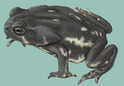
Rhinella marina has a grey olive brown dorsal skin with many warts ending in dark brown caps. The ventral skin tends to be a whitish yellow with dark brown speckles or mottles and is granular. Rhinella marina possesses huge paratoid glands stretching from the anterior side of the tympanum to halfway down the back. A high bony ridge meets at the snout between the nostrils. Rhinella marina, like other nocturnal species, has horizontal pupils. Rhinella marina can reach a maximum length of 238 millimeters, although generally is approximately 150 to 175 millimeters. (Cogger, 1983)
- Other Physical Features
- ectothermic
- heterothermic
- bilateral symmetry
- poisonous
- Sexual Dimorphism
- sexes alike
Development
The eggs hatch between forty-eight hours and one week. The tadpoles tend to be small and black and aggregate in dense numbers. Tadpoles metamorphose into small toadlets identical to the adults in forty-five to fifty-five days (Bureau of Rural Sciences 1998).
- Development - Life Cycle
- metamorphosis
Reproduction
Males congregate in temporary or permanent still or slow moving water and call for mates. More than one male may fertilize the eggs of a single female, and a particularly successful males may fertilize the eggs of multiple females in a breeding season. (Bureau of Rural Sciences, 1998)
- Mating System
- polygynandrous (promiscuous)
Rhinella marina is able to reproduce nearly year round. The females are able to lay eggs after their second year. Eggs are laid in long jelly-like strings on rocks, debris, or emergent vegetation; in excess of 30,000 eggs at a time. The eggs hatch in 2 to 7 days. (Bureau of Rural Sciences, 1998)
- Key Reproductive Features
- iteroparous
- seasonal breeding
- gonochoric/gonochoristic/dioecious (sexes separate)
- sexual
- fertilization
- oviparous
-
- Breeding interval
- These toads breed once yearly.
-
- Range number of offspring
- 30,000 (high)
-
- Range time to hatching
- 2 to 7 days
Once the eggs are fertilized and arrayed in the water, there is no further parental care.
- Parental Investment
-
pre-fertilization
- provisioning
Lifespan/Longevity
Rhinella marina is a relatively long-lived toad, reaching ages up to ten years (Cogger 1983). (Cogger, 1983)
-
- Range lifespan
Status: wild - 10 (high) years
- Range lifespan
-
- Average lifespan
Sex: female
Status: captivity - 8.0 years
- Max Planck Institute for Demographic Research
- Average lifespan
Behavior
The cane toad sits in an upright position when it moves, it hops in short fast hops. During cold or dry seasons it will remain inactive in shallow excavations beneath ground cover. When confronted by a predator, it is able to secrete bufotoxin from the paratoid and other glands on the back in the form of white viscous fluid. This toxic fluid is largely comprised of cardioactive substances. If a predator ingests these toxins, or they contact mucous membranes, they may cause profuse salivation, twitching, vomiting; shallow breathing and collapse of the hind limbs. This toxin can cause temporary paralysis or even death in some predators, including dogs. (Bureau of Rural Sciences, 1998)
- Key Behaviors
- terricolous
- saltatorial
- nocturnal
- motile
- sedentary
- aestivation
- solitary
Communication and Perception
- Other Communication Modes
- choruses
Food Habits
Rhinella marina forages primarily nocturnally in mature forests and roadways. It feeds on ants, beetles, and earwigs in southern Florida, but has been found with dragonflies, grasshoppers, truebugs, crustaceans, gastropods, plant matter and even dog and cat food in their stomachs (Krakauer 1968). (Krakauer, 1968)
- Primary Diet
-
carnivore
- insectivore
- eats non-insect arthropods
- Animal Foods
- insects
- terrestrial non-insect arthropods
Economic Importance for Humans: Negative
This toad is considered the most widely-introduced amphibian species in the world. People have tried to use it to control insects such as the greybacked cane beetle, Lepidoderma albohirtum which threatened sugar cane production. However, there is no evidence that it has controlled any pest in Australia and it is now considered a pest species itself in its introduced range of Australia and on Pacific and Caribbean Islands. It preys on and outcompetes native amphibians and also causes predator declines, since these predators have no natural immunity to the bufotoxin it secretes. (Bureau of Rural Sciences 1998, Aguirre and Poss 1999). (Aguirre and Poss, 1999; Bureau of Rural Sciences, 1998)
- Negative Impacts
- injures humans
- household pest
Conservation Status
In their native range cane toads are common, and not considered in need of special conservation efforts. Cane toads are considered one of the world's top 100 most widely-introduced species. Where they have been introduced they are considered pests, and targets of extermination efforts. (Invasive Species Specialist Group, 2005)
-
- IUCN Red List
-
Least Concern
More information
-
- IUCN Red List
-
Least Concern
More information
-
- US Federal List
- No special status
-
- CITES
- No special status
Contributors
Tanya Dewey (editor), Animal Diversity Web.
Ryan Hilgris (author), Michigan State University, James Harding (editor), Michigan State University.
Glossary
- Australian
-
Living in Australia, New Zealand, Tasmania, New Guinea and associated islands.

- Nearctic
-
living in the Nearctic biogeographic province, the northern part of the New World. This includes Greenland, the Canadian Arctic islands, and all of the North American as far south as the highlands of central Mexico.
- Neotropical
-
living in the southern part of the New World. In other words, Central and South America.
- acoustic
-
uses sound to communicate
- bilateral symmetry
-
having body symmetry such that the animal can be divided in one plane into two mirror-image halves. Animals with bilateral symmetry have dorsal and ventral sides, as well as anterior and posterior ends. Synapomorphy of the Bilateria.
- carnivore
-
an animal that mainly eats meat
- chemical
-
uses smells or other chemicals to communicate
- choruses
-
to jointly display, usually with sounds, at the same time as two or more other individuals of the same or different species
- ectothermic
-
animals which must use heat acquired from the environment and behavioral adaptations to regulate body temperature
- external fertilization
-
fertilization takes place outside the female's body
- fertilization
-
union of egg and spermatozoan
- forest
-
forest biomes are dominated by trees, otherwise forest biomes can vary widely in amount of precipitation and seasonality.
- heterothermic
-
having a body temperature that fluctuates with that of the immediate environment; having no mechanism or a poorly developed mechanism for regulating internal body temperature.
- insectivore
-
An animal that eats mainly insects or spiders.
- introduced
-
referring to animal species that have been transported to and established populations in regions outside of their natural range, usually through human action.
- iteroparous
-
offspring are produced in more than one group (litters, clutches, etc.) and across multiple seasons (or other periods hospitable to reproduction). Iteroparous animals must, by definition, survive over multiple seasons (or periodic condition changes).
- metamorphosis
-
A large change in the shape or structure of an animal that happens as the animal grows. In insects, "incomplete metamorphosis" is when young animals are similar to adults and change gradually into the adult form, and "complete metamorphosis" is when there is a profound change between larval and adult forms. Butterflies have complete metamorphosis, grasshoppers have incomplete metamorphosis.
- motile
-
having the capacity to move from one place to another.
- native range
-
the area in which the animal is naturally found, the region in which it is endemic.
- nocturnal
-
active during the night
- oceanic islands
-
islands that are not part of continental shelf areas, they are not, and have never been, connected to a continental land mass, most typically these are volcanic islands.
- oviparous
-
reproduction in which eggs are released by the female; development of offspring occurs outside the mother's body.
- poisonous
-
an animal which has a substance capable of killing, injuring, or impairing other animals through its chemical action (for example, the skin of poison dart frogs).
- polygynandrous
-
the kind of polygamy in which a female pairs with several males, each of which also pairs with several different females.
- rainforest
-
rainforests, both temperate and tropical, are dominated by trees often forming a closed canopy with little light reaching the ground. Epiphytes and climbing plants are also abundant. Precipitation is typically not limiting, but may be somewhat seasonal.
- saltatorial
-
specialized for leaping or bounding locomotion; jumps or hops.
- seasonal breeding
-
breeding is confined to a particular season
- sedentary
-
remains in the same area
- sexual
-
reproduction that includes combining the genetic contribution of two individuals, a male and a female
- solitary
-
lives alone
- tactile
-
uses touch to communicate
- terrestrial
-
Living on the ground.
- tropical
-
the region of the earth that surrounds the equator, from 23.5 degrees north to 23.5 degrees south.
References
Aguirre, W., S. Poss. 1999. "Indigenous Species in the Gulf of Mexico Ecosystem : Bufo marinus" (On-line). Accessed December 10, 1999 at http://museum.ims.usm.edu/~musweb/nis/Bufo_marinus.html.
Bureau of Rural Sciences, C. 1998. "Commercial Use of Wild Animals: Cane Toad" (On-line). Accessed 19 June 2000 at http://www.altgreen.com.au/wildlife/cuowa/cuwa19.html.
Cameron, E. 2002. "Cane Toads, Giant Toads or Marine Toads" (On-line). Australian Museum Online. Accessed July 28, 2005 at http://www.amonline.net.au/factsheets/canetoad.htm.
Cogger, H. 1983. Reptiles and Amphibians of Australia. Sanibel, Florida: Ralph Curtis Press.
Invasive Species Specialist Group, 2005. "Bufo marinus" (On-line). Global Invasive Species Database. Accessed July 28, 2005 at http://www.issg.org/database/species/ecology.asp?si=113&fr=1&sts=.
Krakauer, T. 1968. The Ecology of the Neotropical Toad, Bufo marinus in southern Florida. Herpetologica, 24(3): 214-221.