RhacophoridaeOld World Tree Frogs
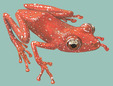


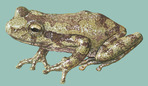

This diverse group of tree frogs is in a constant state of redefinition, and it is unlikely that the groups included here represent the family's final configuration. As defined here, there are three subfamilies, containing roughly 12 genera, and more than 300 species. Rhacophorids are found throughout much of the old world tropics. Several genera occur in the Asian tropics, from India and Sri Lanka to Japan, including the islands of SE Asia. One genus is restricted to tropical Africa, and four genera, including the subfamily Mantellinae, are endemic to Madagascar.
Rhacophorids are small to large frogs (15 - 120 mm snout-vent length) bearing several arboreal adaptations, including cartilaginous intercalary elements between the terminal and penultimate phalanges, and toe discs. They have flattened bodies, with broad, flat skulls. Synapomorphies of the group include only one slip of the extensor digitorum communis longus muscle, inserting on the distal portion of fourth metatarsal; and the outermost slip of the palmaris longus muscle inserting on the proximolateral rim of the aponeurosis palmaris. If hyperoliids are not sister to rhacophorids, synapomorphies also include a frontoparietal trapezoidal, and bifurcate terminal phalanx. Like related groups, rhacophorids lack ribs, have eight holochordal-procoelous presacral vertebrae, have dentate upper jaws, have palatines but no parahyoid, and an astragalus and calcaneum that are fused only at their ends. Pupils are horizontal. Amplexus is axillary, and tadpoles, when present, are usually type IV. Diploid number is 24 or 26.
Along with the hyperoliids, rhacophorids are the treefrogs of the Old World, analogous to hylids in tropical America. Rhacophorids exhibit a diversity of forms and habits. In Madagascar, where frogs are speciose and diverse, the rhacophorids represent the largest anuran group. There, Boophis tends to be arboreal, but Aglyptodactylus and the mantellines inhabit terrestrial niches. One notable exception is Mantella laevigata, whose arboreal adaptations, skin toxins, bright color, and complex courtship and parental behaviors suggest convergence with the neotropical dendrobatids. In addition, several mantellines breed in treeholes. The African Chiromantis builds arboreal foam nests, which may be, in part, made of seminal fluid. Multiple males have been observed amplexing a single female, while all participants whip up the foam with their legs. Some Asian species lay eggs in treeholes, and have a shortened, nonfeeding larval stage. Other species (Philautus) lay arboreal eggs that undergo direct development. Rhacophorus nigromaculatus, the "flying frog," uses extensive webbing and a flattened body to parachute from tree to tree.
Rhacophorids are Neobatrachians, but relationships among the families of these "advanced" frogs are almost wholly unresolved. Within the Neobatrachia, rhacophorids are members of the superfamily Ranoidea. Family relationships among the ranoids are in a state of chaos, and should be considered unknown. The rhacophorids and hyperoliids were originally placed in a single family, Polypedatidae. Since then, each has been accorded family status, but genera are sometimes swapped between the two groups. The subfamily Mantellinae has been moved back and forth between Rhacophoridae and Ranidae multiple times (and the rhacophorids have been considered ranids by at least one author). One hypothesis suggests a sister relationship between the Mantellines and Hyperoliidae, which would render both traditional placements for the Mantellinae inaccurate. Some authors posit that hyperoliids and rhacophorids were both derived independently from separate groups of ranids. Recent work suggests that the Madagascan rhacophorids (including mantellines) are sister to the monophyletic clade of Asian and African rhacophorids (Richards, et al. 2000).
No fossil rhacophorids are known.
Cannatella, D., L. Ford, and L. Bockstanz. 1996. Rhacophoridae: Tree of Life. (Website.)http://tolweb.org/tree?group=Rhacophoridae
Cogger, H. G., and R. G. Zweifel, editors. 1998. Encyclopedia of Reptiles and Amphibians, 2nd edition. Academic Press, San Diego.
Duellman, W. E., and L. Trueb. 1986. Biology of Amphibians. Johns Hopkins University Press, Baltimore, MD.
Ford, L. S., and D. Cannatella. 1993. The major clades of frogs. Herpetological Monographs 7:94-117.
Pough, F. H., R. M. Andrews, J. E. Cadle, M. L. Crump, A. H. Savitzky, and K. D. Wells. 1998. Herpetology. Prentice-Hall, Inc., Upper Saddle River, NJ.
Richards, C. M., R. A. Nussbaum, and C. J. Raxworthy. 2000. Phylogenetic relationships within the Madagascan boophids and mantellids as elucidated by mitochondrial ribosomal genes. Africal Journal of Herpetology 49:23-32.
Stebbins, R. C., and N. W. Cohen. 1995. A natural history of amphibians. Princeton University Press, Princeton.
Zug, G. R. 1993. Herpetology: an introductory biology of amphibians and reptiles. Academic Press, San Diego.
Contributors
Heather Heying (author).
Glossary
- bilateral symmetry
-
having body symmetry such that the animal can be divided in one plane into two mirror-image halves. Animals with bilateral symmetry have dorsal and ventral sides, as well as anterior and posterior ends. Synapomorphy of the Bilateria.
- ectothermic
-
animals which must use heat acquired from the environment and behavioral adaptations to regulate body temperature
- metamorphosis
-
A large change in the shape or structure of an animal that happens as the animal grows. In insects, "incomplete metamorphosis" is when young animals are similar to adults and change gradually into the adult form, and "complete metamorphosis" is when there is a profound change between larval and adult forms. Butterflies have complete metamorphosis, grasshoppers have incomplete metamorphosis.
- motile
-
having the capacity to move from one place to another.