Raphicerus campestrissteenbok

Geographic Range
The steinbuck is found in the southern and eastern savanna of Africa. There are two main populations of steinbuck, separated from one another by the miombo woodlands (Kingdon, 1982).
Habitat
Steinbucks prefer open areas, but they require cover nearby (Stuart and Stuart, 1995). Steinbucks are never found in wooded or broken areas. They are beginning to be found in slightly wooded areas and areas where the environment is more open due to cultivation and road building (Kingdon, 1982).
- Terrestrial Biomes
- savanna or grassland
Physical Description
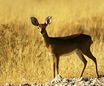
The steinbuck is a small antelope (Stuart and Stuart, 1995). The length of its head and body ranges from 70 - 95 cm. The shoulder height varies from 45 - 60 cm. The tail is very short, with total length ranging from 4 - 6 cm (Kingdon, 1982). The horns are only found on males; they range in height from 9- 19 cm (Kingdon, 1982) and are vertical in orientation (Stuart and Stuart, 1995). The coloration of the steinbuck is reddish-fawn, with a white throat and belly. They also have large, white lined ears. The hooves are sharp and serve a variety of functions (Kingdon, 1982).
- Other Physical Features
- endothermic
- bilateral symmetry
-
- Range mass
- 7 to 16 kg
- 15.42 to 35.24 lb
-
- Average basal metabolic rate
- 20.619 W
- AnAge
Reproduction
Steinbucks breed throughout the year (Kingdon, 1982), but calves are usually born in the summer (Stuart and Stuart, 1995). The interval between births ranges from five and a half to nine months. The gestation period ranges from 168 - 177 days. At birth, the young steinbucks weigh around one kilogram. Within five minutes of birth, steinbucks begin to feed from their mothers. Steinbucks begin to eat grass around two weeks after birth (Kingdon, 1982). For the first few weeks, young steinbucks remain hidden (Stuart and Stuart, 1995). Steinbucks are weaned in three months (Kingdon, 1982).
- Key Reproductive Features
- gonochoric/gonochoristic/dioecious (sexes separate)
- sexual
-
- Range number of offspring
- 1 to 2
-
- Average number of offspring
- 1
- AnAge
-
- Range gestation period
- 5.6 to 5.9 months
-
- Average weaning age
- 3 months
-
- Average age at sexual or reproductive maturity (female)
Sex: female - 238 days
- AnAge
- Average age at sexual or reproductive maturity (female)
-
- Average age at sexual or reproductive maturity (male)
Sex: male - 243 days
- AnAge
- Average age at sexual or reproductive maturity (male)
- Parental Investment
- altricial
Lifespan/Longevity
-
- Average lifespan
Status: captivity - 9.3 years
- AnAge
- Average lifespan
Behavior
Steinbucks are usually found singly or in pairs, and they are a territorial species (Stuart and Stuart, 1995). Sometimes, however, steinbucks occur in small grazing groups. The home range of a steinbuck is estimated to be around 4 - 5 hectacres. Males maintain the same territory for a long period of time. Territories are confirmed by the chasing away of other steinbucks. Territories are also marked by dung piles (Kingdon, 1982). Steinbucks eat in the early morning and in the late afternoon (Stuart and Stuart, 1995). When a predator approaches, the steinbuck freezes. If the predator comes too close, the steinbuck flees (Kingdon, 1982).
Communication and Perception
Food Habits
The diet of the steinbuck ranges from grasses to roots and tubers of some plants. Steinbucks prefer the shoots of buchland trees and shrubs. They prefer foods that are rich and easily digestible. Steinbuck tend to eat more grasses in the early rainy season or after burns (Kingdon, 1982).
Economic Importance for Humans: Positive
In Africa, steinbucks have been hunted for sport and meat. They are captured by snaring or by hunting with dogs (Kingdon, 1982).
- Positive Impacts
- food
- body parts are source of valuable material
Conservation Status
---
-
- IUCN Red List
-
Least Concern
More information
-
- IUCN Red List
-
Least Concern
More information
-
- US Federal List
- No special status
-
- CITES
- No special status
Other Comments
Steinbucks are mainly hunted by cheetahs, wild dogs, caracals, jackals, and hyaenas. Unlike some animals in Africa, steinbucks have probably benefited from human presence. (Kingdon, 1982).
Contributors
Toni Lynn Newell (author), University of Michigan-Ann Arbor.
Glossary
- Ethiopian
-
living in sub-Saharan Africa (south of 30 degrees north) and Madagascar.

- altricial
-
young are born in a relatively underdeveloped state; they are unable to feed or care for themselves or locomote independently for a period of time after birth/hatching. In birds, naked and helpless after hatching.
- bilateral symmetry
-
having body symmetry such that the animal can be divided in one plane into two mirror-image halves. Animals with bilateral symmetry have dorsal and ventral sides, as well as anterior and posterior ends. Synapomorphy of the Bilateria.
- chemical
-
uses smells or other chemicals to communicate
- endothermic
-
animals that use metabolically generated heat to regulate body temperature independently of ambient temperature. Endothermy is a synapomorphy of the Mammalia, although it may have arisen in a (now extinct) synapsid ancestor; the fossil record does not distinguish these possibilities. Convergent in birds.
- food
-
A substance that provides both nutrients and energy to a living thing.
- motile
-
having the capacity to move from one place to another.
- native range
-
the area in which the animal is naturally found, the region in which it is endemic.
- sexual
-
reproduction that includes combining the genetic contribution of two individuals, a male and a female
- social
-
associates with others of its species; forms social groups.
- tactile
-
uses touch to communicate
- tropical savanna and grassland
-
A terrestrial biome. Savannas are grasslands with scattered individual trees that do not form a closed canopy. Extensive savannas are found in parts of subtropical and tropical Africa and South America, and in Australia.
- savanna
-
A grassland with scattered trees or scattered clumps of trees, a type of community intermediate between grassland and forest. See also Tropical savanna and grassland biome.
- temperate grassland
-
A terrestrial biome found in temperate latitudes (>23.5° N or S latitude). Vegetation is made up mostly of grasses, the height and species diversity of which depend largely on the amount of moisture available. Fire and grazing are important in the long-term maintenance of grasslands.
References
Kingdon, J. 1982. East African Mammals: An Atlas of Evolution in Africa; Volume III Part C (Bovids). Academic Press. London, New York, and San Francisco.
Stuart, C.T. and M.D. Stuart. 1995. Field Guide to the Mammals of Southern Africa. Struck Publishers (Pty) Ltd. Cape Town.