Rangifer taranduscaribou(Also: reindeer)


Geographic Range
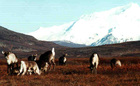
Caribou have a nearly circumpolar distribution. The woodland subspecies of caribou (Rangifer tarandus caribou) can be found as far south as 46o north latitude, while other subspecies (Peary caribou [R. t. pearyi] and Svalbard reindeer [R. t. platyrhynchus]) can be found as far north as 80o north latitude. Once found as far south as Germany, Great Britain, Poland, and Maine (USA), over-hunting and habitat destruction have diminished the historic range of caribou.
- Biogeographic Regions
- nearctic
- palearctic
- Other Geographic Terms
- holarctic
Habitat
Caribou inhabit arctic tundra and subarctic (boreal) forest regions.
- Habitat Regions
- temperate
- polar
- terrestrial
Physical Description
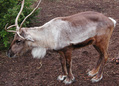
The various subspecies of caribou display a wide range of size. Generally speaking, the subspecies inhabiting the more southerly latitudes are larger than their northern cousins. Caribou can have shoulder heights of up to 120 cm and total length ranges from 150 to 230 cm. They have short tails. There is marked sexual dimorphism, with males of some subspecies being twice as large as females. The coat of the caribou is an excellent, lightweight insulation against the extreme cold temperatures they face. The hairs are hollow and taper sharply which helps trap heat close to the body and also makes them more buoyant. Color varies by subspecies, region, sex, and season from the very dark browns of woodland caribou bulls in summer to nearly white in Greenland (R. t. groenlandicus) and high Arctic caribou. White areas are often present on the belly, neck, and above the hooves. The hooves are large and concave, which support them in snow and soft tundra, conditions that they often face. The broad hooves are also useful when swimming. Caribou make an audible clicking noise while walking, which is produced from tendons rubbing across a bone in the foot. Rangifer tarandus is the only species of deer in which both sexes have antlers. Mature bulls can carry enormous and complex antlers, whereas cows and young animals generally have smaller and simpler ones. Mature bulls usually shed their antlers shortly after the rut whereas cows can keep theirs until spring.
- Other Physical Features
- endothermic
- homoiothermic
- bilateral symmetry
- Sexual Dimorphism
- male larger
- ornamentation
-
- Range mass
- 55 to 318 kg
- 121.15 to 700.44 lb
-
- Range length
- 150 to 230 cm
- 59.06 to 90.55 in
-
- Average basal metabolic rate
- 119.66 W
- AnAge
Reproduction
Males compete for access to females during the fall rut, which occurs in October and early November. During this time males may engage in battles that leave them injured and exhausted. Dominant males restrict access to small groups of 5 to 15 females. Males stop feeding during this time and lose much of their body reserves.
- Mating System
- polygynous
In late August and September, prime bulls shed the velvet that surrounds their antlers. Sparring begins shortly there after, with the rut typically occurring in October. Females can be sexually mature as early as 16 months of age but more commonly at 28 months. With good nutrition females give birth to calves each year, but may skip years in poor ranges. A single calf, weighing 3 to 12 kg, is born approximately 228 days after impregnation, in May or June. Twinning has been reported, but is very rare. The suckling period rarely last past the first week of July and grazing commences shortly after birth. Calves rely mainly on foraging for nutrition after 45 days old.
- Key Reproductive Features
- iteroparous
- seasonal breeding
- gonochoric/gonochoristic/dioecious (sexes separate)
- sexual
- viviparous
-
- Breeding interval
- Caribou breed once yearly.
-
- Breeding season
- Breeding typically occurs in October.
-
- Range number of offspring
- 2 (high)
-
- Average number of offspring
- 1
-
- Average number of offspring
- 1
- AnAge
-
- Average gestation period
- 7.6 months
-
- Average gestation period
- 228 days
- AnAge
-
- Average weaning age
- 1.5 months
-
- Range age at sexual or reproductive maturity (female)
- 16 (low) months
-
- Average age at sexual or reproductive maturity (female)
- 28 months
-
- Average age at sexual or reproductive maturity (male)
Sex: male - 680 days
- AnAge
- Average age at sexual or reproductive maturity (male)
Newborn calves are precocial, being able to suckle minutes after birth, follow their mother after an hour and are capable of outrunning a human at one day of age. Calves nurse exclusively for their first month, after which they begin to graze. They will continue to nurse occasionally through early fall, when they become independent.
- Parental Investment
- no parental involvement
- precocial
-
pre-fertilization
-
protecting
- female
-
protecting
-
pre-hatching/birth
-
provisioning
- female
-
protecting
- female
-
provisioning
-
pre-weaning/fledging
-
provisioning
- female
-
protecting
- female
-
provisioning
Lifespan/Longevity
Females generally have longer life spans than males, some over 15 years. Bulls are highly susceptible to predation after the rut, which can leave them injured and/or exhausted. Bulls typically live less than 10 years in the wild. Average life expectancy is 4.5 years.
-
- Average lifespan
Status: wild - 10 to 15 years
- Average lifespan
-
- Average lifespan
Status: wild - 4.5 years
- Average lifespan
-
- Average lifespan
Sex: male
Status: wild - 8.0 years
- Max Planck Institute for Demographic Research
- Average lifespan
-
- Average lifespan
Sex: female
Status: wild - 10.0 years
- Max Planck Institute for Demographic Research
- Average lifespan
-
- Average lifespan
Status: wild - 15.0 years
- Max Planck Institute for Demographic Research
- Average lifespan
-
- Average lifespan
Status: captivity - 20.2 years
- Max Planck Institute for Demographic Research
- Average lifespan
Behavior
Caribou are known to travel distances greater than any other terrestrial mammal. The can traverse more than 5,000 kilometers in a year, with extensive migrations in spring and fall. They can reach speeds of 80 km/hr. Spring migration leads the caribou off the winter range back to calving grounds. Use of traditional calving grounds is the basis by which caribou herds are defined. Caribou are gregarious and the largest groups, which can number in the tens of thousands, are found during the summer months. This behavior is thought to bring about some measure of relief from harassing mosquitoes, warble flies, and nose bot flies. As cooler weather arrives, groups become smaller but caribou may aggregate again during the rut and fall migration. Bulls spar with competitors to keep them from breeding with females in their area. Most encounters are brief, but serious battles do occur which can result in injury or death. Most caribou winter in forested areas, where snow conditions are more favorable. Caribou are able to locate forage under snow, apparently by their ability to smell it. To reach the forage they use their front paws to dig craters. Dominant caribou frequently usurp craters dug by subordinate animals.
Communication and Perception
Caribou communicate among themselves through vocal, visual, chemical, and tactile cues. They have a keen sense of smell, which allows them to find food buried deep under snow.
Food Habits
Caribou are primarily grazing herbivores. Their diet is most variable during the summer, when they consume the leaves of willows and birches, mushrooms, cotton grass, sedges and numerous other ground dwelling species of vegetation. Lichens are an important component of the diet, especially in winter, but are not eaten exclusively.
- Plant Foods
- leaves
- roots and tubers
- wood, bark, or stems
- bryophytes
- lichens
- Other Foods
- fungus
Predation
Calves are highly vulnerable to predation by bears, wolves, and other predators during their first week of life. Healthy adult caribou are less susceptible to predation until old age and illness weakens them. By traveling in herds, caribou increase the number of individuals that can watch for predators.
-
- Known Predators
-
- grizzly bears (Ursus arctos)
- gray wolves (Canis lupus)
- American black bears (Ursus americanus)
Ecosystem Roles
Through their foraging activities, caribou have a dramatic impact on communities of vegetation throughout their range. They are also important prey species for large predators, such as bears and wolves, especially during the calving season.
Economic Importance for Humans: Positive
Caribou have been used extensively for their meat, fur and antlers. Reindeer, the domesticated subspecies of caribou, have been herded throughout their range for thousands of years.
- Positive Impacts
- food
- body parts are source of valuable material
Economic Importance for Humans: Negative
There are no negative impacts of caribou.
Conservation Status
Although Alaska, with its more than 30 herds, has nearly double the number of caribou (1,000,000) than people, caribou in the contiguous US are considered endangered. Caribou in Alaska are of the barren-ground subspecies, whereas extant (WA, ID) and extinct (ME) herds are of the woodland subspecies. The Selkirk Herd, inhabiting WA, ID, and southern British Columbia numbers only around 30 members. They are listed as Endangered under the Endangered Species Act in these regions. Loss of habitat, overhunting, and other factors has contributed to the precarious position the woodland caribou now exists in the US. Worldwide, the caribou population is estimated to be around 5 million. The largest herds now occur in Alaska, Canada, and Russia. Humans have heavily hunted this species. They have been extinct in most parts of Europe since at least the 1600s. Exploration for oil and minerals in Canada may threaten woodland caribou habitat. High Arctic caribou populations are also thought to be vulnerable.
Despite their status in the wild, domestic herds of reindeer flourish in the Old World, in Canada, in Alaska, and in the lower 48 states including Michigan.
-
- IUCN Red List
-
Least Concern
More information
-
- IUCN Red List
-
Least Concern
More information
-
- US Federal List
- Endangered
-
- CITES
- No special status
Other Comments
Caribou, and their domestic counterparts - reindeer, have been very important in the cultures of native peoples througout the arctic. Several Siberian, Scandinavian, and American native cultures are built around herding caribou.
Contributors
Tanya Dewey (editor), Animal Diversity Web.
Kyle C. Joly (author), Alaska Science Center, U.S. Geological Survey.
Nancy Shefferly (author), Animal Diversity Web.
Glossary
- Nearctic
-
living in the Nearctic biogeographic province, the northern part of the New World. This includes Greenland, the Canadian Arctic islands, and all of the North American as far south as the highlands of central Mexico.

- Palearctic
-
living in the northern part of the Old World. In otherwords, Europe and Asia and northern Africa.
- acoustic
-
uses sound to communicate
- bilateral symmetry
-
having body symmetry such that the animal can be divided in one plane into two mirror-image halves. Animals with bilateral symmetry have dorsal and ventral sides, as well as anterior and posterior ends. Synapomorphy of the Bilateria.
- chemical
-
uses smells or other chemicals to communicate
- diurnal
-
- active during the day, 2. lasting for one day.
- endothermic
-
animals that use metabolically generated heat to regulate body temperature independently of ambient temperature. Endothermy is a synapomorphy of the Mammalia, although it may have arisen in a (now extinct) synapsid ancestor; the fossil record does not distinguish these possibilities. Convergent in birds.
- folivore
-
an animal that mainly eats leaves.
- food
-
A substance that provides both nutrients and energy to a living thing.
- forest
-
forest biomes are dominated by trees, otherwise forest biomes can vary widely in amount of precipitation and seasonality.
- herbivore
-
An animal that eats mainly plants or parts of plants.
- holarctic
-
a distribution that more or less circles the Arctic, so occurring in both the Nearctic and Palearctic biogeographic regions.
Found in northern North America and northern Europe or Asia.
- iteroparous
-
offspring are produced in more than one group (litters, clutches, etc.) and across multiple seasons (or other periods hospitable to reproduction). Iteroparous animals must, by definition, survive over multiple seasons (or periodic condition changes).
- migratory
-
makes seasonal movements between breeding and wintering grounds
- motile
-
having the capacity to move from one place to another.
- native range
-
the area in which the animal is naturally found, the region in which it is endemic.
- polar
-
the regions of the earth that surround the north and south poles, from the north pole to 60 degrees north and from the south pole to 60 degrees south.
- polygynous
-
having more than one female as a mate at one time
- seasonal breeding
-
breeding is confined to a particular season
- sexual
-
reproduction that includes combining the genetic contribution of two individuals, a male and a female
- sexual ornamentation
-
one of the sexes (usually males) has special physical structures used in courting the other sex or fighting the same sex. For example: antlers, elongated tails, special spurs.
- social
-
associates with others of its species; forms social groups.
- tactile
-
uses touch to communicate
- taiga
-
Coniferous or boreal forest, located in a band across northern North America, Europe, and Asia. This terrestrial biome also occurs at high elevations. Long, cold winters and short, wet summers. Few species of trees are present; these are primarily conifers that grow in dense stands with little undergrowth. Some deciduous trees also may be present.
- temperate
-
that region of the Earth between 23.5 degrees North and 60 degrees North (between the Tropic of Cancer and the Arctic Circle) and between 23.5 degrees South and 60 degrees South (between the Tropic of Capricorn and the Antarctic Circle).
- terrestrial
-
Living on the ground.
- tundra
-
A terrestrial biome with low, shrubby or mat-like vegetation found at extremely high latitudes or elevations, near the limit of plant growth. Soils usually subject to permafrost. Plant diversity is typically low and the growing season is short.
- visual
-
uses sight to communicate
- viviparous
-
reproduction in which fertilization and development take place within the female body and the developing embryo derives nourishment from the female.
- young precocial
-
young are relatively well-developed when born
References
Dalrymple, B.W. 1978. North american big-game animals. Outdoor Life Books, New York.
Nowak, R.M. and J.L. Paradiso. 1983. Walker's Mammals of the World, Fourth Edition. John Hopkins University Press. Baltimore and London.
Burt, W., R. Grossenheider. 1980. Peterson Field Guides: Mammals, 3rd edition. Boston, MA: Houghton Mifflin Company.
Geist, V. 1998. Deer of the world: their evolution, behavior, and ecology. Mechanicsburg, PA: Stackpole Books.
Kelsall, J. 1968. The migratory barren-ground caribou of Canada. Ottawa: Queen's Printer.
Reindeer Owners and Breeders Association, "Deer, Goats, Sheep, Etc: Reindeer" (On-line). Accessed 18 May 2000 at http://www.blarg.net/~critter/subindex/deer.html.
Valkenburg, P. 1999. "Caribou" (On-line). Alaska Department of Fish & Game's Notebook Series. Accessed September 19, 2003 at http://www.state.ak.us/adfg/notebook/biggame/caribou.htm.