Ramphastos tocoToco toucan


Geographic Range
Toco toucans (Ramphastos toco) thrive over a wide range of habitats and locations throughout much of the Neotropical region. They are native to the countries of Argentina, Peru, French Guiana, Bolivia, Paraguay, Suriname, and Brazil. Studies have shown a correlation between the wide range of R. toco and the availability of fleshy fruits, which make up the majority of the toucan's diet. (BirdLife International, 2009; Ragusa-Netto, 2006; Ragusa-Netto, 2008)
- Biogeographic Regions
- neotropical
Habitat
Toco toucans are most commonly found in dry semi-open areas, which include regions such as woodland, savanna, plantations, and other regions that consist of scattered trees. In Brazil, toco toucans have been found in abundance in the "cerrado." Brazil's cerrado consists of savanna, semidecidious, and gallery forests surrounding river corridors. They are canopy frugivores that rely heavily on the availability of seasonal fruiting plants. Toco toucans therefore move from one habitat and region to the next in order to satisfy their dietary needs. This species is typically found at lowland elevations. However they have been sighted in elevations up to 1750 m around the Andes mountain range of South America. (Absolute Astronomy Contributors, 2009; Ragusa-Netto, 2006)
- Habitat Regions
- tropical
- terrestrial
- Terrestrial Biomes
- savanna or grassland
- forest
- scrub forest
- Other Habitat Features
- riparian
-
- Range elevation
- 1750 (high) m
- 5741.47 (high) ft
Physical Description
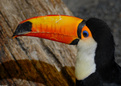
Toco toucans are recognized as the largest species in the toucan family and flaunt the biggest beak in regard to body size of all birds. This large yellow-orange colored beak with a distinct black marking at the tip of the bill is the most noticeable feature of R. toco. It accounts for one-twentieth of the total mass of the toucan, while also contributing to one-third of the bird's total length. Toco toucans weigh between 592 and 760 g, and average 61 cm in length. This species has what appears to be a blue iris, but is in fact a thin layer of skin that surrounds the eye. The blue circle is encompassed by an additional ring of orange skin that adds to the colorful physical appearance of toco toucans. Its basal metabolic rate is estimated at 8.72 cubed cm of oxygen per hour. Sexual dimorphism is present in this species of toucan. Measurements and observations reveal physical differences between males and females. Adult male toco toucans are typically larger than adult females. Juveniles are easily differentiated from the adults due to the young's duller colors and stubbier bill. (Absolute Astronomy Contributors, 2009; Castro, et al., 2003; McNab, 2009; Seki, et al., 2005; Tattersall, et al., 2009; Zoological Society of San Diego, 2010)
- Other Physical Features
- endothermic
- homoiothermic
- bilateral symmetry
- Sexual Dimorphism
- male larger
-
- Range mass
- 592 to 760 g
- 20.86 to 26.78 oz
-
- Average length
- 61 cm
- 24.02 in
-
- Average basal metabolic rate
- 8.72 cm3.O2/g/hr
Reproduction
The large colorful bills of toco toucans are often thought to be used in mate choice, but there are no specific studies that lead to this conclusion. However, it is known that this species uses its bill to gather fruit that is used in the bird's mating ritual. This courtship ritual consists of either the male or female initiating a fruit toss with its potential mate. After this ritual has been carried out, the male mates with the female. (National Geographic Contributors, 2010)
- Mating System
- monogamous
The breeding season for toco toucans occurs in the spring. Tree cavities are the typical nesting site where a single clutch of 2 to 4 eggs are laid by the female. Toco toucans breed yearly and have altricial young. The hatchlings are bare-skinned, close-eyed, and helpless until approximately 6 to 8 weeks later. At this time, the young begin to develop their characteristic beak and will soon fledge. Toco toucans become sexually mature in 3 to 4 years. (National Geographic Contributors, 2010; Zoological Society of San Diego, 2010)
- Key Reproductive Features
- iteroparous
- seasonal breeding
- gonochoric/gonochoristic/dioecious (sexes separate)
- sexual
- oviparous
-
- Breeding interval
- Toco toucans breed once yearly.
-
- Breeding season
- The breeding season occurs in the spring.
-
- Range eggs per season
- 2 to 4
-
- Range time to hatching
- 15 to 18 days
-
- Range fledging age
- 6 to 8 weeks
-
- Range age at sexual or reproductive maturity (female)
- 3 to 4 years
-
- Range age at sexual or reproductive maturity (male)
- 3 to 4 years
Both parents take turns incubating the eggs in the small cavity of a tree where the nest is situated. Nests of this species were found to be lined with regurgitated manduvi seeds from the manduvi tree (Sterculia apetala), suggesting that parents may provision nestlings with this fruit. The young remain in the nest for about 6 to 8 weeks. (National Geographic Contributors, 2010; Pizo, et al., 2008; Zoological Society of San Diego, 2010)
- Parental Investment
- altricial
- male parental care
- female parental care
-
pre-fertilization
- provisioning
-
protecting
- female
-
pre-hatching/birth
-
provisioning
- male
- female
-
protecting
- male
- female
-
provisioning
-
pre-weaning/fledging
-
provisioning
- male
- female
-
protecting
- male
- female
-
provisioning
-
pre-independence
-
provisioning
- male
- female
-
protecting
- male
- female
-
provisioning
Lifespan/Longevity
A lifespan of 20 years is typically seen in wild toco toucans with a maximum recorded lifespan of 26 years. In captivity, this species of toucan often has a shorter lifespan of approximately 18 years. Toco toucans that have been raised in captivity often experience iron-storage disease, which is sometimes referred to as hemochromatosis. This disease can lead to an uncomfortable life of the toucan involving emaciation, dyspnea, and feather picking and may eventually lead to the death of the bird. Since the diet of toco toucans is primarily fruits, which involves a low intake of iron, they have seemed to develop very iron-absorbent organs. When a toxic amount of iron builds-up within the liver of the bird due to the high-iron diet that many of these captive toucans are fed, the iron-storage disease occurs. (Absolute Astronomy Contributors, 2009; Drews, et al., 2004; National Geographic Contributors, 2010)
-
- Average lifespan
Status: wild - 26 years
- Average lifespan
-
- Average lifespan
Status: wild - 20 years
- Average lifespan
-
- Average lifespan
Status: captivity - 18 years
- Average lifespan
Behavior
Toco toucans are very social birds and live in flocks of approximately six members. This species is very mobile due to the constant change of available fruits in regions of their geographic range. Although the bright colors of their beak successfully camouflage this species in the forest's canopy, their noisy vocalizations seem to defeat the purpose of their camouflage. (National Geographic Contributors, 2010; Ragusa-Netto, 2006)
Home Range
Toco toucans have a very wide home range due to their frugivorous diet and the availability and abundance of seasonal fruits. Exact territory size is unknown. (Ragusa-Netto, 2006)
Communication and Perception
Toco toucans are very loud communicators with various means of sound production. Their repertoire consists of deep, course croaking that is repeated on a consistent basis. A rattling call is also a common form of conversation in this species. Besides vocal communication, they use bill-clacking as a form of auditory communication. Like all birds, toco toucans perceive their environment through visual, auditory, tactile, and chemical stimuli. (Absolute Astronomy Contributors, 2009)
Food Habits
Toco toucans are canopy frugivores whose diet is composed mainly of fruits, but they are considered to be an opportunistic feeder. They also occasionally feed on various types of insects and eggs of other birds, including those of endangered hyacinth macaws (Anodorhynchus hyacinthinus). Their broad geographical range of habitats is due in part to their foraging behavior and their diet of briefly-available fruits. The food sources include the fruits from trees such as genipapo (Genipa americana), agarrapolo (Ficus luschnathiana), ambay pumpwood (Cecropia pachystachya).
The large bills of toco toucans are the main foraging tool that allows the birds to reach into tree holes and to grasp fruits from surrounding branches. Toco toucans are unique in that they does not use their tongue in the process of swallowing food. Instead, they place a piece of fruit between the very end of their beak and lean their head back at an approximately 180 degree angle. This causes the food item to project directly into the pharynx. (Baussart, 2007; Pizo, et al., 2008; Ragusa-Netto, 2008; Seki, et al., 2005)
- Animal Foods
- amphibians
- reptiles
- eggs
- insects
- Plant Foods
- seeds, grains, and nuts
- fruit
Predation
Although the colorful characteristics of toco toucans provide adequate camouflage in the forest canopy, common predators include jaguars (Panthera onca), snakes (order Serpentes), coatis (Nasua and Nasuella species), and eagles (Accipitridae). (National Geographic Contributors, 2010; New World Encyclopedia Contributors, 2008; Pizo, et al., 2008)
- Anti-predator Adaptations
- cryptic
-
- Known Predators
-
- Jaguars (Panthera onca)
- Snakes (order Serpentes)
- Coatis (Nasua and Nasuella species)
- Eagles (Accipitridae)
Ecosystem Roles
Even though toco toucans prey on the eggs of endangered hyacinth macaws (Anodorhynchus hyacinthinus), these macaws are in fact indirectly dependent on the toucans. Since hyacinth macaws almost always nest in the hollows of the manduvi tree and the manduvi tree depends upon the seed dispersal services provided by toco toucans, hyacinth macaws are indirectly dependent on this species of toucan. (Pizo, et al., 2008)
- Ecosystem Impact
- disperses seeds
Economic Importance for Humans: Positive
Because of the natural attraction to the colorful and odd bills of toco toucans, tour guides in many South American countries provide trips to see them in their natural habitat. Also, many zoos attempt to preserve the natural beauty of this bird in a safe and people-friendly environment. Toco toucans are also found in the pet trade. (Absolute Astronomy Contributors, 2009; Tattersall, et al., 2009)
- Positive Impacts
- pet trade
- ecotourism
Economic Importance for Humans: Negative
There are no known adverse effects of toco toucans on humans.
Conservation Status
Toco toucans are considered by the IUCN Red List of Threatened Species to be of "least concern." This is due to the broad range and fairly common status of this species in its designated habitats and biogeographic range. They are listed under appendix II of CITES which regulates the trade of this species. (BirdLife International, 2009; UNEP-WCMC, 2009)
-
- IUCN Red List
-
Least Concern
More information
-
- IUCN Red List
-
Least Concern
More information
-
- CITES
- Appendix II
Contributors
Shannon Behmke (author), Florida State University, Emily DuVal (editor), Florida State University.
Glossary
- Neotropical
-
living in the southern part of the New World. In other words, Central and South America.

- acoustic
-
uses sound to communicate
- altricial
-
young are born in a relatively underdeveloped state; they are unable to feed or care for themselves or locomote independently for a period of time after birth/hatching. In birds, naked and helpless after hatching.
- arboreal
-
Referring to an animal that lives in trees; tree-climbing.
- bilateral symmetry
-
having body symmetry such that the animal can be divided in one plane into two mirror-image halves. Animals with bilateral symmetry have dorsal and ventral sides, as well as anterior and posterior ends. Synapomorphy of the Bilateria.
- chemical
-
uses smells or other chemicals to communicate
- cryptic
-
having markings, coloration, shapes, or other features that cause an animal to be camouflaged in its natural environment; being difficult to see or otherwise detect.
- diurnal
-
- active during the day, 2. lasting for one day.
- ecotourism
-
humans benefit economically by promoting tourism that focuses on the appreciation of natural areas or animals. Ecotourism implies that there are existing programs that profit from the appreciation of natural areas or animals.
- endothermic
-
animals that use metabolically generated heat to regulate body temperature independently of ambient temperature. Endothermy is a synapomorphy of the Mammalia, although it may have arisen in a (now extinct) synapsid ancestor; the fossil record does not distinguish these possibilities. Convergent in birds.
- female parental care
-
parental care is carried out by females
- forest
-
forest biomes are dominated by trees, otherwise forest biomes can vary widely in amount of precipitation and seasonality.
- frugivore
-
an animal that mainly eats fruit
- herbivore
-
An animal that eats mainly plants or parts of plants.
- iteroparous
-
offspring are produced in more than one group (litters, clutches, etc.) and across multiple seasons (or other periods hospitable to reproduction). Iteroparous animals must, by definition, survive over multiple seasons (or periodic condition changes).
- male parental care
-
parental care is carried out by males
- monogamous
-
Having one mate at a time.
- motile
-
having the capacity to move from one place to another.
- native range
-
the area in which the animal is naturally found, the region in which it is endemic.
- nomadic
-
generally wanders from place to place, usually within a well-defined range.
- oviparous
-
reproduction in which eggs are released by the female; development of offspring occurs outside the mother's body.
- pet trade
-
the business of buying and selling animals for people to keep in their homes as pets.
- riparian
-
Referring to something living or located adjacent to a waterbody (usually, but not always, a river or stream).
- scrub forest
-
scrub forests develop in areas that experience dry seasons.
- seasonal breeding
-
breeding is confined to a particular season
- sexual
-
reproduction that includes combining the genetic contribution of two individuals, a male and a female
- social
-
associates with others of its species; forms social groups.
- tactile
-
uses touch to communicate
- terrestrial
-
Living on the ground.
- tropical
-
the region of the earth that surrounds the equator, from 23.5 degrees north to 23.5 degrees south.
- tropical savanna and grassland
-
A terrestrial biome. Savannas are grasslands with scattered individual trees that do not form a closed canopy. Extensive savannas are found in parts of subtropical and tropical Africa and South America, and in Australia.
- savanna
-
A grassland with scattered trees or scattered clumps of trees, a type of community intermediate between grassland and forest. See also Tropical savanna and grassland biome.
- temperate grassland
-
A terrestrial biome found in temperate latitudes (>23.5° N or S latitude). Vegetation is made up mostly of grasses, the height and species diversity of which depend largely on the amount of moisture available. Fire and grazing are important in the long-term maintenance of grasslands.
- visual
-
uses sight to communicate
References
Absolute Astronomy Contributors, 2009. "Toco Toucan" (On-line). Accessed February 12, 2010 at http://www.absoluteastronomy.com/topics/Toco_Toucan.
Baussart, S. 2007. Feeding mechanism in fruit-eating bird toucan, Ramphastos toco. Comparative Biochemisty and Physiology, 146: S107.
Bird Paradise, World's Largest Birdstore, 2009. "Toucans/Toucanets" (On-line). Accessed February 11, 2010 at http://bird-paradise.biz/Toucan_ets.htm.
BirdLife International, 2009. "IUCN red list of threatened species" (On-line). Accessed February 11, 2010 at http://www.iucnredlist.org/apps/redlist/details/141926/0.
Castro, M., S. Recco-Pimentel, G. Rocha. 2003. Sexual dimorphism in Ramphastos toco and Ramphostos dicolorus (Piciformes, Aves). Revista de Biologia Tropical, 51: 241-245.
Drews, A., S. Redrobe, J. Patterson-Kane. 2004. Successful reduction of hepatocellular hemosiderin content by dietary modification in toco toucans (Ramphastos toco) with iron-storage disease. Journal of Avian Medicine and Surgery, 18: 101-105.
McNab, B. 2009. Ecological factors affect the level and scaling of avian BMR. Comparative Biochemisty and Physiology, 152: 22-45.
National Geographic Contributors, 2010. "Ramphastos toco" (On-line). Accessed February 11, 2010 at http://animals.nationalgeographic.com/animals/birds/toucan.html.
New World Encyclopedia Contributors, 2008. "Toucan" (On-line). Accessed February 12, 2010 at http://www.newworldencyclopedia.org/entry/Toucan.
Pizo, M., C. Donatti, N. Guedes, M. Galetti. 2008. Conservation puzzle: Endangered hyacinth macaw depeds on its nest predator for reproduction. Biological Coservation, 141: 792-796.
Ragusa-Netto, J. 2006. Abundance and frugivory of the toco toucan (Ramphastos toco) in a gallery forset in Brazil's Southern Pantanal. Brazilian Journal of Biology, 66: 133-142.
Ragusa-Netto, J. 2008. Toco toucan feeding ecology and local abundance in a habitat mosaic in the Brazilian cerrado. Ornithologia Neotropical, 19: 345-359.
Seki, Y., M. Schneider, M. Meyers. 2005. Structure and mechanical behavior of a toucan beak. Acta Materialia, 53: 5281-5296.
Tattersall, G., D. Andrade, A. Abe. 2009. Heat exchange from the toucan bill reveals a controllable cascular thermal radiator. Science, 325: 468-470.
UNEP-WCMC, 2009. "
UNEP-WCMC species database: CITES-listed species" (On-line). Accessed March 18, 2010 at http://www.cites.org/eng/resources/species.html.
Zoological Society of San Diego, 2010. "Toco Toucan" (On-line). Accessed February 12, 2010 at http://www.sandiegozoo.org/animalbytes/t-toucan.html.