Pyxicephalus adspersus


Geographic Range
The range of Pyxicephalus adspersus is mostly sub-Saharan. Its range extends north and east into Somalia, west to Nigeria, and south to the Cape Provence, South Africa.
A closely related, slightly smaller species, Pyxicephalus edulis, occupies a smaller range in southern Africa, from Zimbabwe and northern South Africa to (probably) Botswana, Mozambique, and Zambia (Passmore and Carruthers, 1995; Channing et al., 1994).
Habitat
One of the most adaptable amphibians on earth, Pyxicephalus can tolerate some of the harshest environments in Africa.
Certain areas of their range can be completely dry for years at a time, and can reach surface temperatures over 100 degrees F, and drop to below freezing during the winter. Protected in an underground estivation chamber, the frogs wait it out until more suitable conditions occur. When the rainy season begins, they occupy temporary floodplains and rapidly drying puddles scattered around the African countryside.
Pyxicephalus have been known to inhabit extremely hostile regions from the Kalihari desert, to the high veld domains between 4000 and 5000 feet above sea level (Switak 1997).
- Terrestrial Biomes
- desert or dune
- savanna or grassland
- Aquatic Biomes
- lakes and ponds
Physical Description
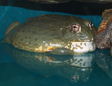
Male Pyxicephalus adspersus can reach lengths of more than 9 inches and weigh over 2 pounds. Females are much smaller. Males are olive in color, with yellow to orange on the throat region. Females are olive to light brown with cream to white throat areas. Both sexes have ridges running laterally on the dorsal surface. Juveniles are much more colorful than adults. Several white to yellow lines run down the animal's dorsal area on an overall mottled background. Both these dorsal lines, and mottling disappear with age. Adults have a spade like metatarsal tubercle on each hind foot to aid in digging. The front toes are thick and blunt with no webbing, the rear toes are slightly webbed. These frogs have massive skeletons with extremely large, heavy skulls. The bottom jaw has three odontodes which act as huge teeth, and are used in restraining struggling prey (Moore 1997, Switak 1997).
- Other Physical Features
- ectothermic
- bilateral symmetry
Development
- Development - Life Cycle
- metamorphosis
Reproduction
During the breeding season, males will congregate in large groups. Much aggression occurs in these groups with larger males pushing, pursuing, biting, even consuming smaller males. The large males will push their way to the center of the group, establish and defend a small area and begin calling. The call lasts about a second and can be described as a deep low-pitched whoop. The females will hear this call and swim underwater to the center of the group, to avoid the smaller males and surface in the defended area of a larger male. As they surface, they are persuaded until finally being seized by a male. Amplexus occurs in shallow water to allow the pair to stand on the bottom. Eggs are fertilized above the water's surface. As many as 4000 eggs may be released. The males exhibit parental care. Males will watch over and defend the eggs which hatch in two days. After hatching, the tadpoles will feed on each other, as well as on small fish and invertebrates. Defending males will continue to watch over the tadpoles which will metamorphose within three weeks. Moore states that during times when the pool nears dessication, the male will dig a channel between his offspring and the larger body of water. This parental care comes with a price, however, as the male will consume many of the tadpoles while he is defending them (Moore 1997; Channing et al., 1994).
- Key Reproductive Features
- gonochoric/gonochoristic/dioecious (sexes separate)
Lifespan/Longevity
-
- Average lifespan
Status: captivity - 16.2 years
- AnAge
- Average lifespan
Behavior
These frogs have a short active period depending on the rainy season. The majority of their lives are spent estivating underground. Adults will burrow underground using the metatarsal tubercle on their powerful hind legs. Juveniles lack this tubercle and must resort to utilizing an existing burrow made by some other animal. They slough off several layers of their skin's epidermal cells which form a tough cocoon. Most of their bodily functions slow or shut down all together. This period of dormancy may last a year or more. During the rainy season frogs will sit partially buried with the nose exposed, taking advantage of any smaller animal unfortunate enough to pass by (Switak 1997, Moore 1997).
- Key Behaviors
- motile
Food Habits
Pyxicephalus adspersus is carnivorous and will consume nearly any animal that can be overpowered and can fit in their huge mouths. Cannibalism is a common occurrence beginning the moment they metamorphose. Many of their first meals will be a member of the same egg mass. Other prey items may include invertebrates, other species of frogs, reptiles, small mammals, and even small birds. The tongue is folded over inside the mouth. To capture a potential meal, it will drop its lower jaw with considerable force, causing the tongue to flip over and out of the animal's mouth, siezing the prey (Moore 1997, Switak 1997).
Economic Importance for Humans: Positive
African bullfrogs are eaten by humans, and have been collected for the commercial pet trade.
Economic Importance for Humans: Negative
Because these frogs are such resilient animals, they might potentially have negative effects on the surrounding ecosystem if introduced by humans beyond their natural range.
Conservation Status
No special legal status has been given to Pyxicephalus species. Switak (1997) notes that advancing civilization has driven it near extinction in certain parts of its range.
-
- IUCN Red List
-
Least Concern
More information
-
- IUCN Red List
-
Least Concern
More information
-
- US Federal List
- No special status
-
- CITES
- No special status
Contributors
Benjamin Davidson (author), Michigan State University, James Harding (editor), Michigan State University.
Glossary
- Ethiopian
-
living in sub-Saharan Africa (south of 30 degrees north) and Madagascar.

- bilateral symmetry
-
having body symmetry such that the animal can be divided in one plane into two mirror-image halves. Animals with bilateral symmetry have dorsal and ventral sides, as well as anterior and posterior ends. Synapomorphy of the Bilateria.
- desert or dunes
-
in deserts low (less than 30 cm per year) and unpredictable rainfall results in landscapes dominated by plants and animals adapted to aridity. Vegetation is typically sparse, though spectacular blooms may occur following rain. Deserts can be cold or warm and daily temperates typically fluctuate. In dune areas vegetation is also sparse and conditions are dry. This is because sand does not hold water well so little is available to plants. In dunes near seas and oceans this is compounded by the influence of salt in the air and soil. Salt limits the ability of plants to take up water through their roots.
- ectothermic
-
animals which must use heat acquired from the environment and behavioral adaptations to regulate body temperature
- metamorphosis
-
A large change in the shape or structure of an animal that happens as the animal grows. In insects, "incomplete metamorphosis" is when young animals are similar to adults and change gradually into the adult form, and "complete metamorphosis" is when there is a profound change between larval and adult forms. Butterflies have complete metamorphosis, grasshoppers have incomplete metamorphosis.
- motile
-
having the capacity to move from one place to another.
- native range
-
the area in which the animal is naturally found, the region in which it is endemic.
- tropical savanna and grassland
-
A terrestrial biome. Savannas are grasslands with scattered individual trees that do not form a closed canopy. Extensive savannas are found in parts of subtropical and tropical Africa and South America, and in Australia.
- savanna
-
A grassland with scattered trees or scattered clumps of trees, a type of community intermediate between grassland and forest. See also Tropical savanna and grassland biome.
- temperate grassland
-
A terrestrial biome found in temperate latitudes (>23.5° N or S latitude). Vegetation is made up mostly of grasses, the height and species diversity of which depend largely on the amount of moisture available. Fire and grazing are important in the long-term maintenance of grasslands.
References
"African Bullfrog" (On-line). Accessed November 13, 1999 at http://www.zooregon.org/cards/Rainforest/bullfrog.african.htm.
"South African Burrowing Bullfrog" (On-line). Accessed November 13, 1999 at http://www.oaklandzoo.org/atoz/azsablfg.html.
Channing, A., L. duPreez, N. Passmore. 1994. Status, vocalization, and breeding biology of two species of African bullfrogs (Ranidae: Pyxicephalus). J. Zool. Soc. of London, 234: 141-148.
Moore, M. 1997. A Pyxie Perfecta. Reptiles Magazine, Sept. 1997: 62-67.
Passmore, A., V. Carruthers. 1995. South African Frogs: A Complete Guide. Halfway House, South Africa: Southern Book Publ..
Switak, K. 1997. Africa's Big Game Bullfrog. Reptiles Magazine, Sept. 1997: 48-61.